-
-
Built on Tiger Data
-
Persage tracks vitals in real-time
Inspiration
Afham is Maldivian. The Maldives is about 1,200 coral islands in 26 atolls; around 190 are inhabited, and most have a small health centre at best. Specialists, the cath lab and intensive care are concentrated in Malé. When someone on an outer island has a heart attack, a stroke or a bad fall, the slowest part is often not the medicine but the journey: a sea ambulance for an hour or more, a seaplane that can't fly after dark, and a chain of phone calls. The team waiting in Malé usually knows almost nothing until the doors open.
The theme was Time. We can't make the boat go faster, but every minute of the journey can be a minute of preparation instead of a cold start at the door.
What it does
AtollCare turns the phone everyone already has into the first monitor in the chain, and carries one patient story through three connected screens. What is captured once is never asked again.
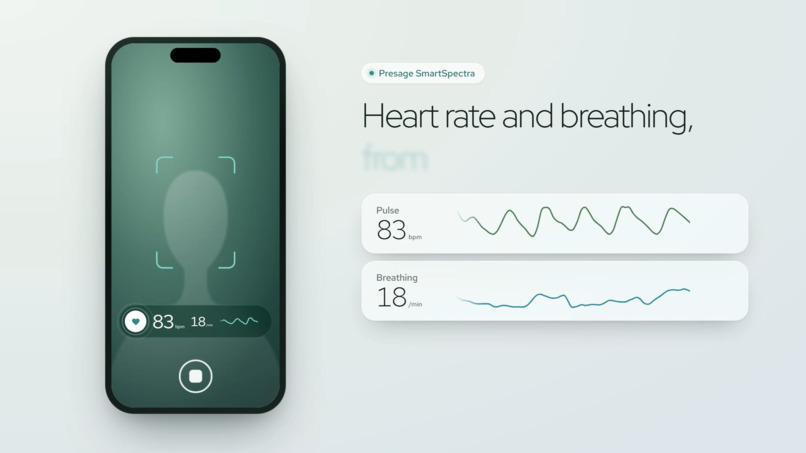
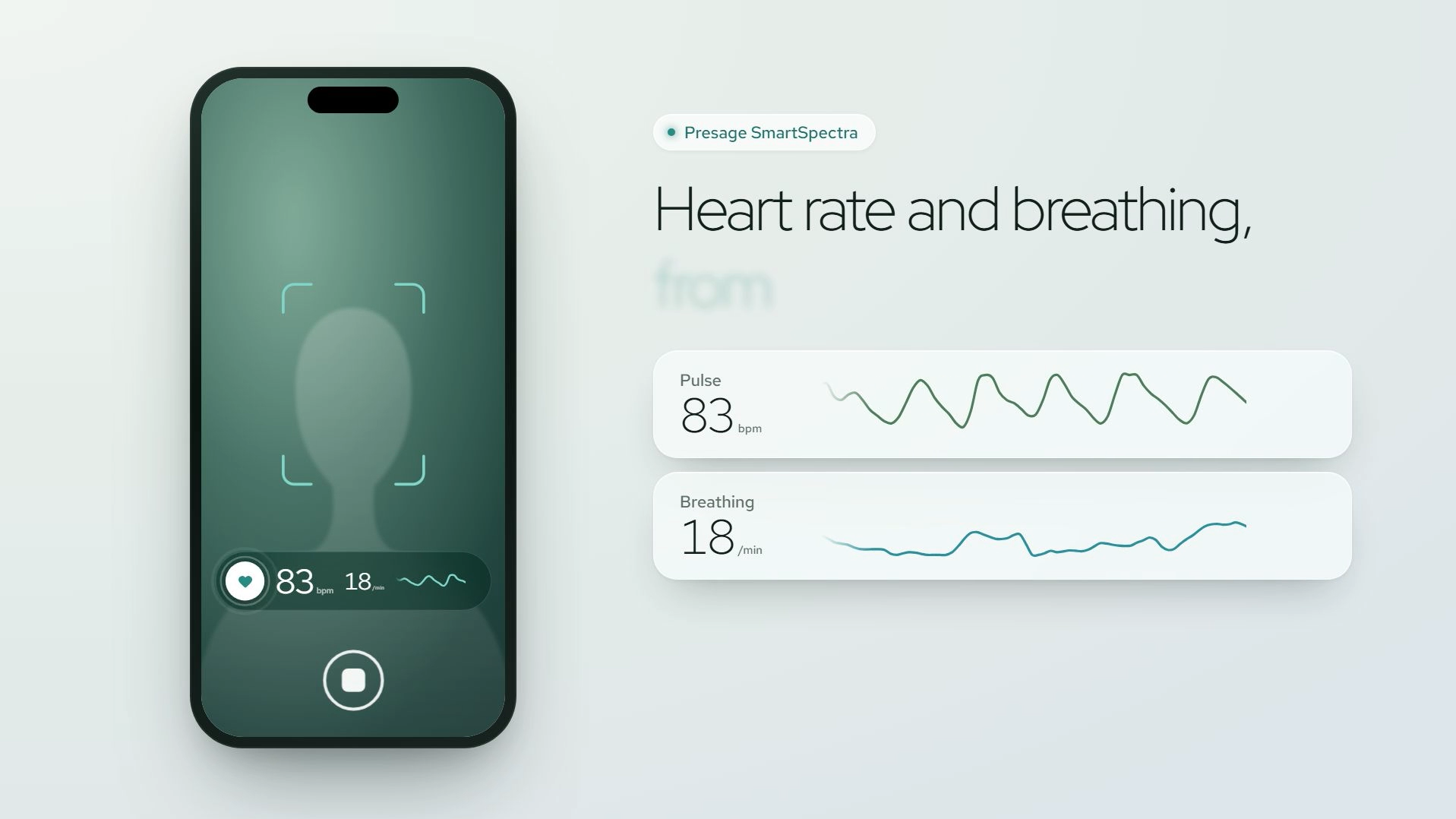
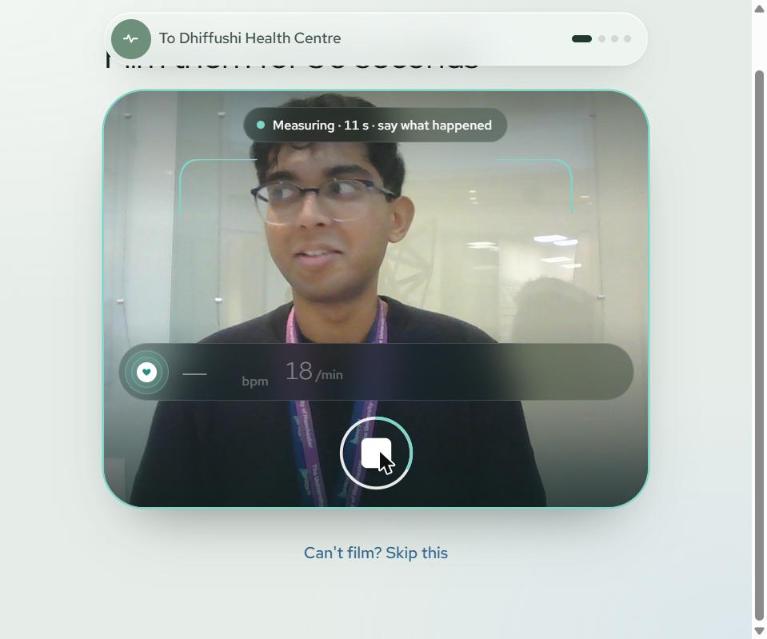
- Family's phone (/pre-arrival): scan the health centre's QR code, "Call 102 first", consent, then film the patient for 30 seconds while saying what happened. Presage measures heart and breathing rate live from the camera; ElevenLabs Scribe transcribes the account; Gemini checks still frames for visible signs and cites the frame. Nothing is sent until they press Send.
- Crew (/crew): the packet is waiting; one tap starts the transfer. A propped-up phone keeps measuring with Presage, the crew add SpO₂/BP/temperature/consciousness, and spoken notes ("aspirin 300, GTN spray") become a structured handoff. Hospital questions are read aloud by ElevenLabs.
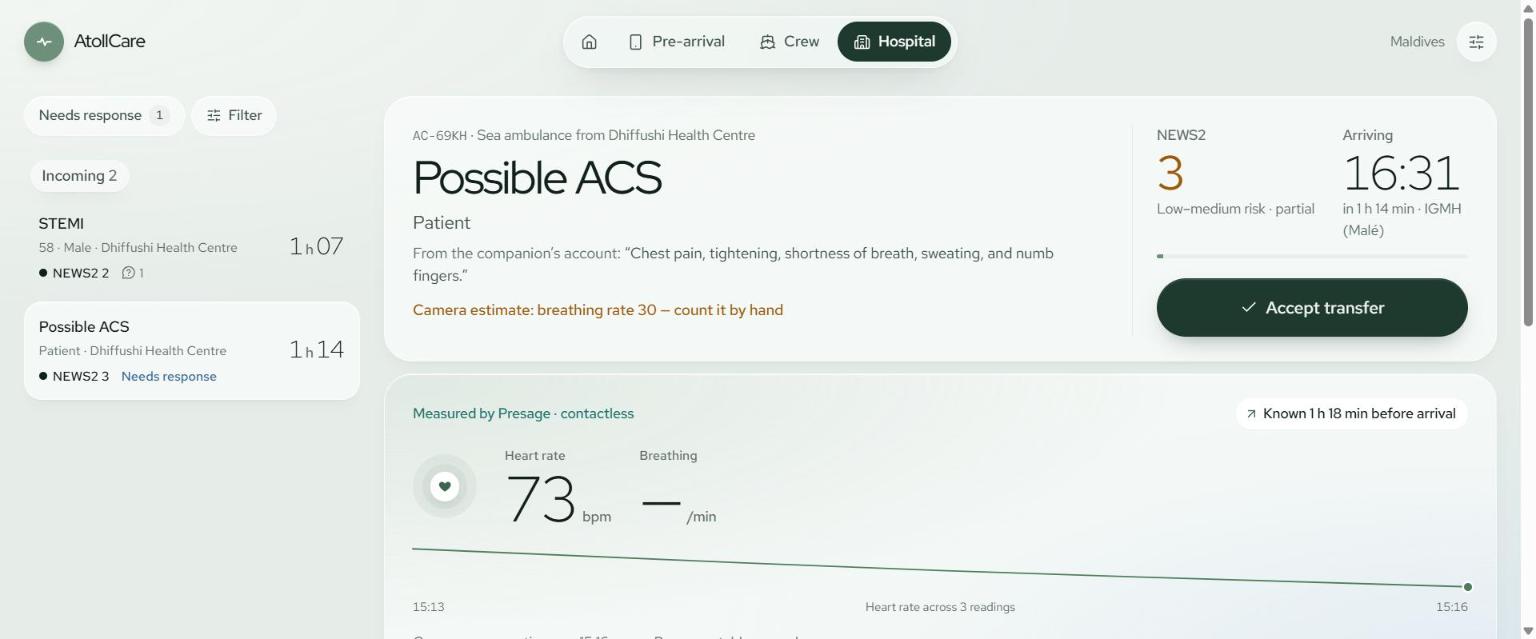
- Hospital (/hospital): a Presage tile (latest heart rate, trend, how long before arrival they knew), every measurement with its source and age, the family's words, a Gemini SBAR, and one decision: Accept, with what to prepare.
- Network insights (/insights): time to acceptance, journey times and alerts across the network, built on Tiger Data.
How we built it
- Presage SmartSpectra: the phone streams frames over HTTPS to a Node service running
@smartspectra/node-sdk; Presage returns framing hints, heart rate, breathing rate and waveforms. Presage's own stability verdict decides what is scored; readings outside its FDA-cleared ranges are shown as "count it by hand", and the family's video is a bystander estimate that is never scored. - Gemini: visible-sign check on video frames (a sign can only be "seen" if it cites real frames), ID reading, a live SBAR handoff from recorded facts with a JSON schema, and drug/dose extraction from spoken notes, with a fallback model and rule-based fallbacks.
- ElevenLabs: Scribe speech-to-text for the account and crew notes (it even tags [hyperventilating]); text-to-speech for hospital questions in the boat.
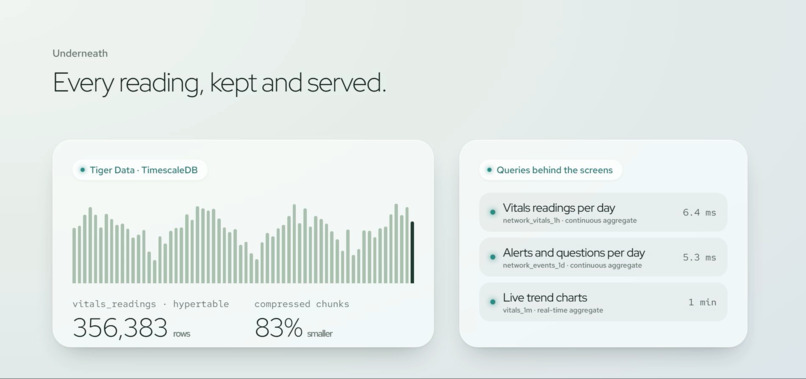
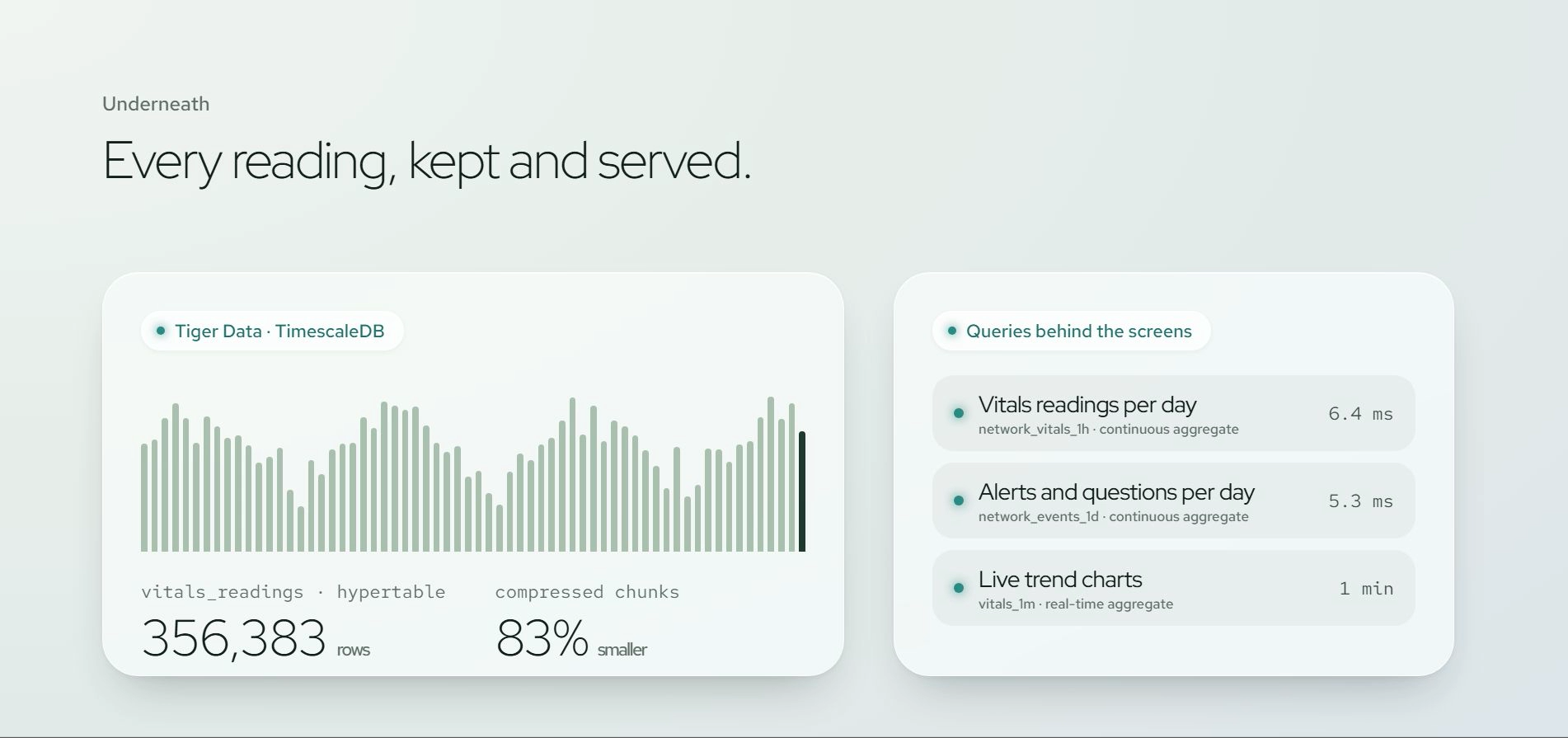
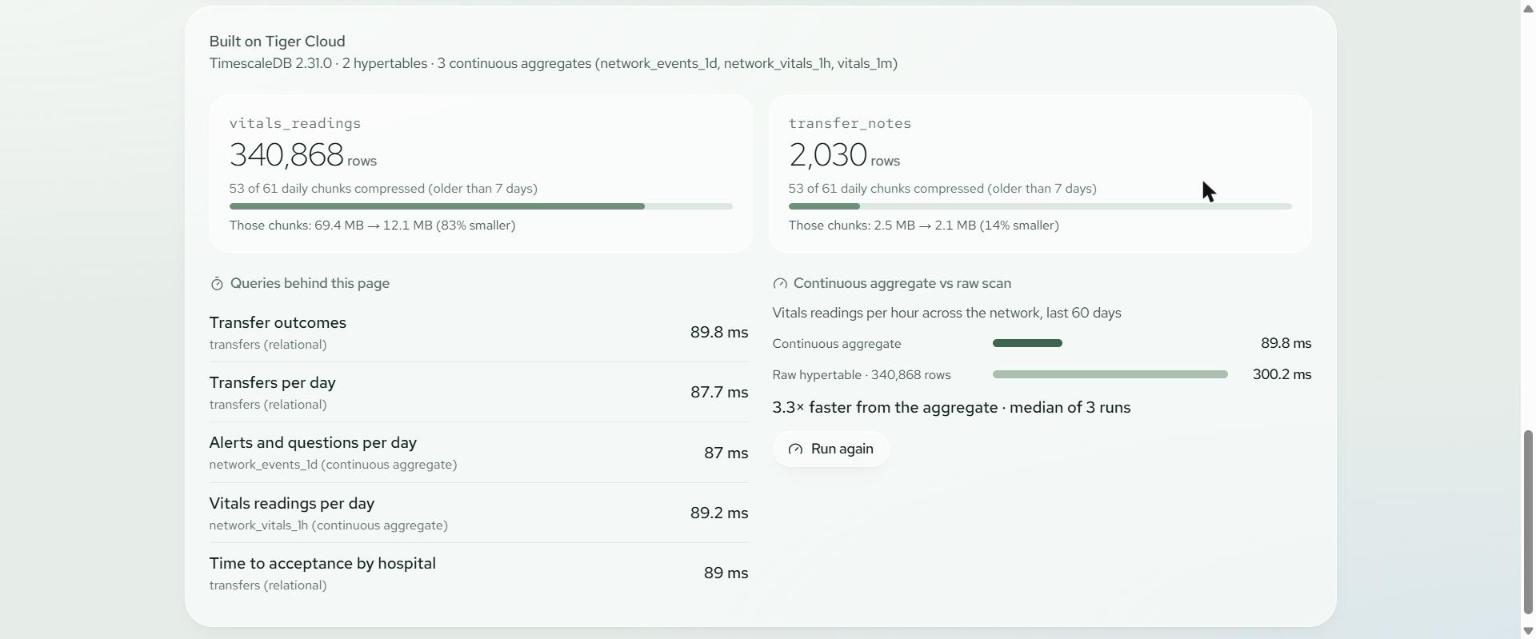
- Tiger Data (Tiger Cloud, TimescaleDB 2.31): vitals and notes are hypertables; three continuous aggregates; compression shrank 60 days of seeded history (about 340,000 readings) by 83%; a live benchmark answers from the aggregate in ~90 ms vs ~300 ms raw.
- Engine: FastAPI + Pydantic (NEWS2, deterioration forecast, alerts with hysteresis); web: Next.js 16 / React 19; types generated from the engine's OpenAPI spec.
Challenges we ran into
- Honest data provenance: every value carries its source (presage, manual, simulated); simulated values are muted and never scored.
- Designing for a moving boat: one primary action at a time, status in words as well as colour, everything spoken aloud once.
- Narrowing the idea: we started with a nine-screen referral system; testers told us it was too much, so we cut it to one story across three screens with Presage on the phone at the centre.
- Free-tier limits: Gemini's free tier allows about 20 requests a day per model, so the engine spreads work across models and falls back cleanly.
Accomplishments that we're proud of
Contactless vitals from an ordinary phone, end to end: a family member films for 30 seconds on an island, and the hospital sees a Presage-measured heart rate over an hour before the patient arrives.
What we learned
Trust is the product in health tech: label every number with where it came from, and let the sensor's own confidence decide what counts.
Not just the Maldives
Region packs are JSON; we ship the Maldives and Scotland's Western Isles. The same gap exists in the Philippines, Indonesia, Fiji, Vanuatu, the Solomon Islands, Kiribati, the Greek islands, Norway's coast, rural Australia, northern Canada and Alaska, rural India and sub-Saharan Africa, mountain rescue in Nepal and the Alps, and offshore platforms.
What's next for AtollCare
Presage's native mobile SDK so only numbers leave the phone, a Dhivehi interface and voice, per-hospital inboxes and authentication, SMS fallback for low connectivity, and validation against a monitor in a real sea ambulance.
Decision support only. No real patient data; clinical thresholds in the demo are illustrative.
Built With
- elevenlabs
- fastapi
- gemini
- next.js
- node.js
- postgresql
- presage
- python
- react
- tiger-data
- timescaledb
- typescript


Log in or sign up for Devpost to join the conversation.