-
-
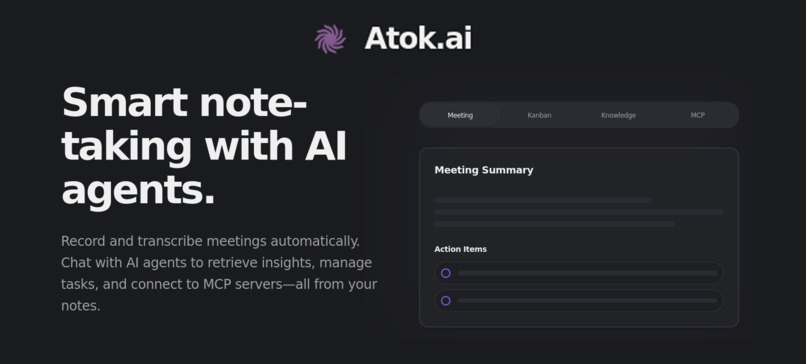
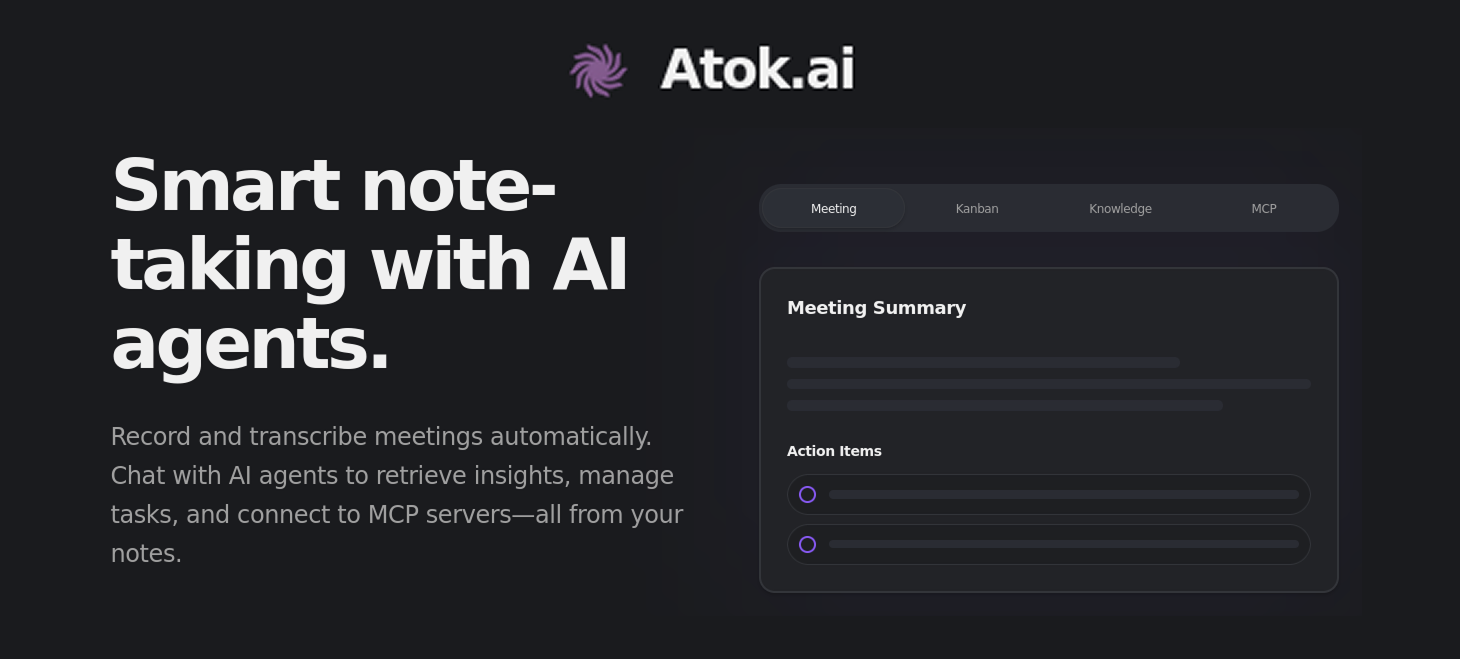
Atok.ai Banner
-
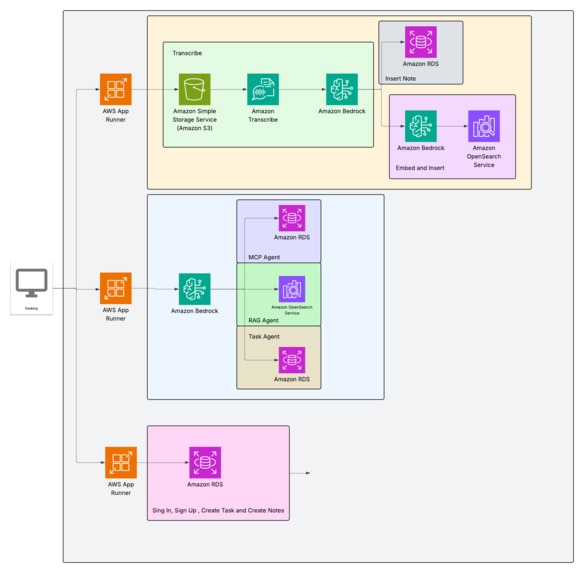
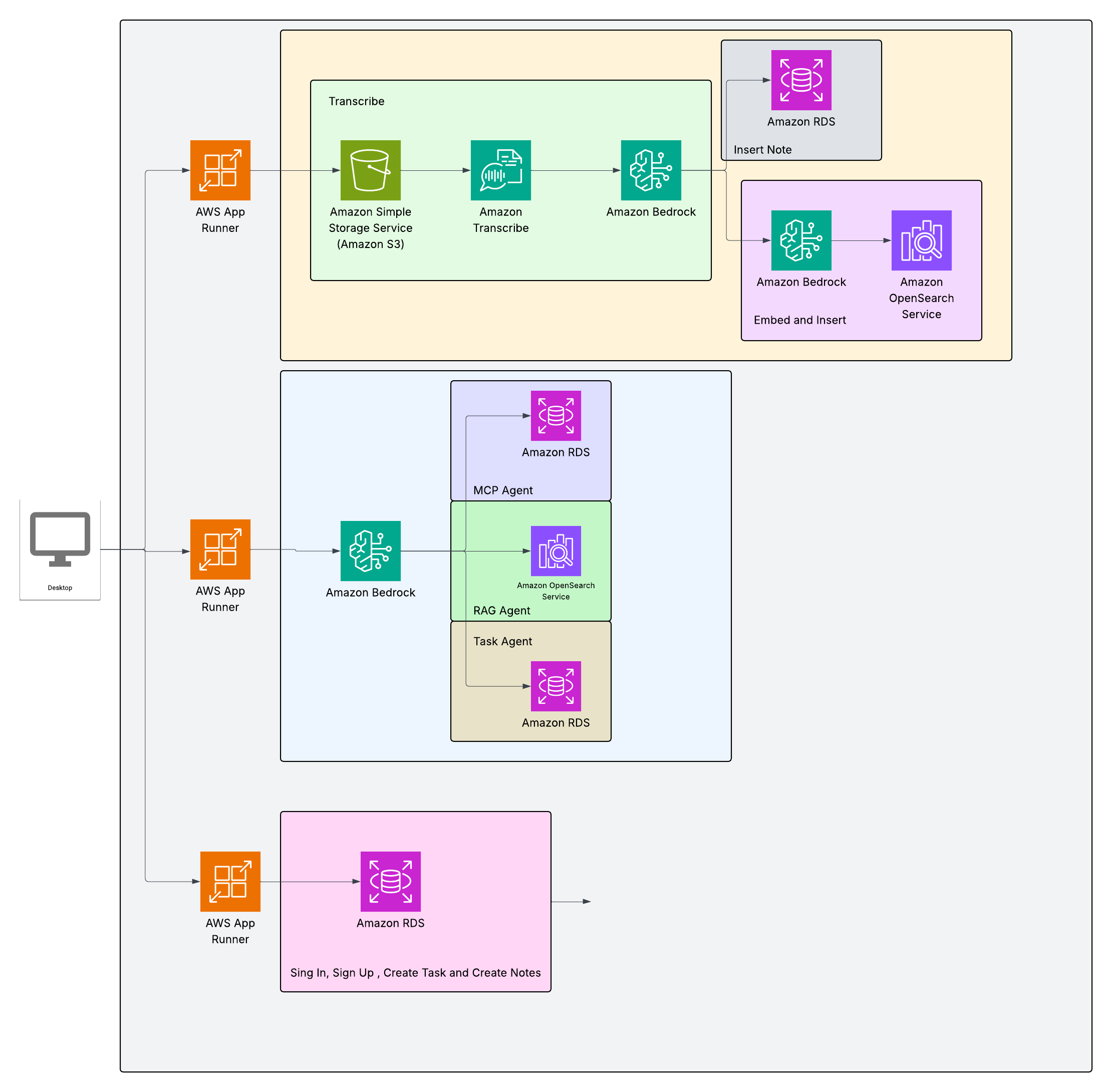
Architecture Diagram
Inspiration
We've all been in meetings that are full of brilliant ideas but end with a vague sense of "what's next?" The critical gap between discussion and action is where productivity is often lost. Action items get forgotten, key decisions are buried in long recordings, and the true value of a conversation fades over time.
Our inspiration for Atok.ai came from this universal challenge. We envisioned an AI that could be more than just a passive note-taker; we wanted to build a proactive, autonomous partner. This hackathon's theme, "Agents of change," resonated deeply with us. We were inspired to build a true agent of change for modern productivity—an AI that bridges the gap between conversation and execution.
What it does
Atok.ai is an autonomous desktop agent that transforms meeting conversations into actionable outcomes. It automates the entire meeting workflow:
- Captures and Transcribes: It records meetings and uses Amazon Transcribe to generate accurate, structured notes.
- Understands and Answers: Using a RAG pipeline powered by Amazon OpenSearch Service and Amazon Bedrock, the Atok Agent can answer specific questions about your past conversations.
- Identifies and Creates Tasks: The agent autonomously identifies action items from the dialogue and populates them into a built-in Kanban board.
- Executes Actions: It connects to external tools like GitHub to perform real-world tasks, such as creating a new code repository directly from a conversation's context.
How we built it
Atok.ai is a full-stack desktop application built on a robust AWS backend, designed to be modular and scalable.
- Data Ingestion and Processing: Audio from meetings is processed by Amazon Transcribe. The resulting transcript is stored in our primary database on Amazon RDS.
- Vectorization for RAG: The transcript is chunked, converted into vector embeddings, and indexed in Amazon OpenSearch Service, which serves as our high-performance vector database.
- The Autonomous Core: Our backend, deployed on Amazon App Runner, is the agent's brain. The Strands SDK acts as the orchestrator, analyzing user intent. For Q&A, it queries OpenSearch to provide context to a Large Language Model on Amazon Bedrock. For actions, it uses Bedrock's reasoning to select and execute tasks via external APIs.
- User Interface: We built an intuitive desktop application for a seamless user experience, allowing users to manage notes, interact with the agent, and track tasks.
Challenges we ran into
Our primary challenge was ensuring agent reliability and preventing "hallucinated" tasks. We overcame this by implementing a robust RAG pipeline with Amazon OpenSearch. By grounding every response and action in the factual context of the meeting notes, we significantly improved the agent's trustworthiness. Another challenge was orchestrating workflows across multiple services; the Strands SDK was crucial in simplifying this complexity into a manageable framework.
Accomplishments that we're proud of
We are incredibly proud of building a true, end-to-end agentic workflow. It's not just a demo of a single feature, but a complete, functional loop: from unstructured conversation to a structured note, intelligent Q&A, and finally, autonomous task execution in an external tool like GitHub. Implementing a production-ready RAG pipeline using a full suite of AWS services (Transcribe, RDS, OpenSearch, Bedrock) is a technical achievement we are particularly proud of.
What we learned
This project was a deep dive into building a full-stack AI solution. We learned the profound difference between a simple chatbot and an autonomous agent that can reason and act. We gained hands-on experience in architecting a scalable AWS backend, from data ingestion with Transcribe to container deployment with App Runner, and discovered the power of the Strands SDK for orchestrating complex agent logic.
What's next for Atok.ai
This is just the beginning for Atok.ai. Our roadmap includes:
- Expanding Integrations: Adding support for more essential workplace tools like Jira, Slack, and Google Calendar.
- Proactive Intelligence: Enhancing the agent to proactively suggest actions, such as scheduling follow-up meetings or identifying conflicting information across different notes.
- Team Collaboration Features: Introducing shared workspaces, collaborative note editing, and the ability to assign tasks to teammates to make Atok.ai a central hub for team productivity.
Built With
- amazon-amplify
- amazon-app-runner
- amazon-bedrock
- amazon-opensearch-service
- amazon-rds-relational-database-service
- amazon-s3-bucket
- amazon-strands-sdk
- amazon-transcribe
- amazon-web-services
- react
- tauri


Log in or sign up for Devpost to join the conversation.