-
-
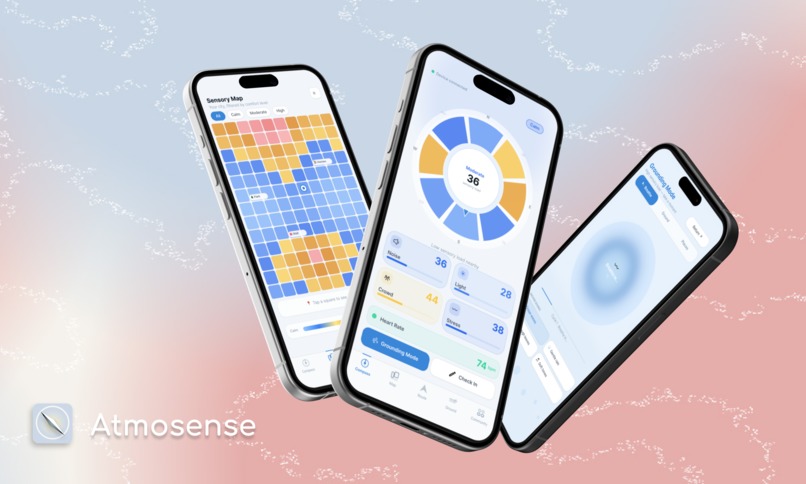
AtmoSense Thumbnail
Inspiration
Everyday environments like grocery stores, campuses, and transit stations can quickly become overwhelming for many autistic young adults. Harsh lighting, unpredictable noise, crowded walkways, and visual clutter can create sensory overload that is difficult to anticipate before entering a space. Right now, people often rely on stressful trial and error to figure out which environments feel safe or manageable.
This project was inspired by the idea of making invisible sensory experiences visible. Just as fitness trackers helped people understand steps, sleep, and heart rate, we wondered whether technology could help people understand the sensory conditions of the environments around them. Our goal was to design a tool that helps users anticipate sensory stress and navigate the world with greater confidence and control.
What it does
Atmosense is a sensory navigation system designed for autistic young adults who experience sensory overwhelm in everyday environments. Instead of focusing only on the fastest route, Atmosense helps users find the calmest route through a space.
Using a wearable sensor and mobile interface, the system measures signals such as noise levels, lighting harshness, visual clutter, and crowd density. It also considers the user’s own stress responses over time to understand how environments affect them personally.
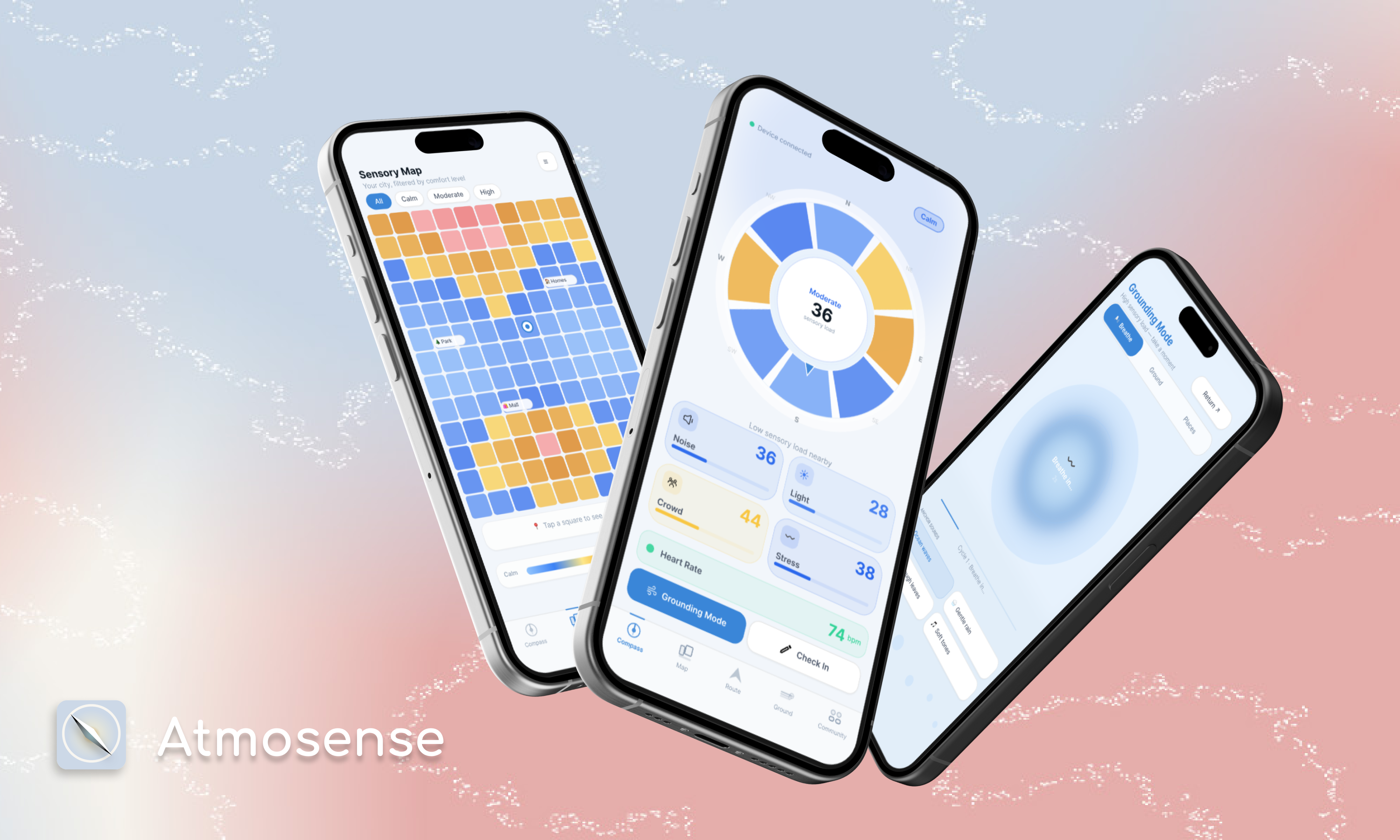
The interface works like a sensory compass, turning environmental signals into a visual map. Calm spaces appear in blue, while areas likely to cause sensory overload appear in red. Over time, the system builds a personalized comfort map that helps users navigate environments more safely and predictably.
How we built it
We began by researching sensory processing and understanding how different environmental factors can affect autistic individuals in public spaces. From there, we identified key signals that contribute to sensory overload, including sound intensity, lighting conditions, visual motion, and crowd proximity.
We then designed a speculative system that combines wearable sensing with a mobile navigation interface. The wearable device collects environmental and physiological signals, while the app processes and visualizes that information in a simplified compass-style interface.
The design prioritizes clarity and accessibility, using intuitive color cues and minimal visual complexity so users can quickly understand the sensory conditions of a space without adding additional cognitive load.
Challenges we ran into
One major challenge was determining how to represent complex sensory data without overwhelming users. Sensory environments involve multiple variables, and presenting too much information could create the same overload the tool is trying to prevent. To solve this, we simplified the data into a clear visual language using color zones and directional guidance.
Another challenge was addressing privacy concerns. Because the system collects location data and stress-related signals, we needed to design strong safeguards for consent, user control, and data security.
Finally, designing a speculative tool meant balancing imagination with believable user experiences, ensuring the concept felt both futuristic and grounded in real human needs.
Accomplishments that we're proud of
One accomplishment we are proud of is reframing navigation as a sensory experience rather than simply a spatial one. Instead of asking what route is fastest, our system asks what route is calmest and most comfortable for the user.
We are also proud of creating a clear and intuitive sensory visualization system that translates invisible environmental signals into something users can quickly understand.
Most importantly, we believe the project highlights how design can improve accessibility by making hidden aspects of human experience more visible and navigable.
What we learned
Through this project we learned how important predictability and control are in sensory environments. Even small pieces of information about noise, lighting, or crowd density can significantly affect how someone experiences a space.
We also learned that designing for accessibility often leads to better experiences for everyone. A system that helps users find calmer routes could benefit not only autistic individuals but anyone navigating stressful or overstimulating environments.
The project also expanded our understanding of human perception, reminding us that people experience far more than the traditional five senses.
What's next for Atmosense
Future versions of Atmosense could include community-generated sensory maps where users share insights about sensory-friendly locations such as quiet cafés, low-stimulus study areas, or calm walking routes.
We would also explore integrating adaptive environmental responses, where the system could automatically activate noise-canceling audio, calming playlists, or grounding interfaces when entering high-stimulation areas.
Ultimately, the next step is to continue exploring how technology can expand our awareness of sensory environments and help people navigate the world with greater confidence, independence, and wellbeing.


Log in or sign up for Devpost to join the conversation.