-
-
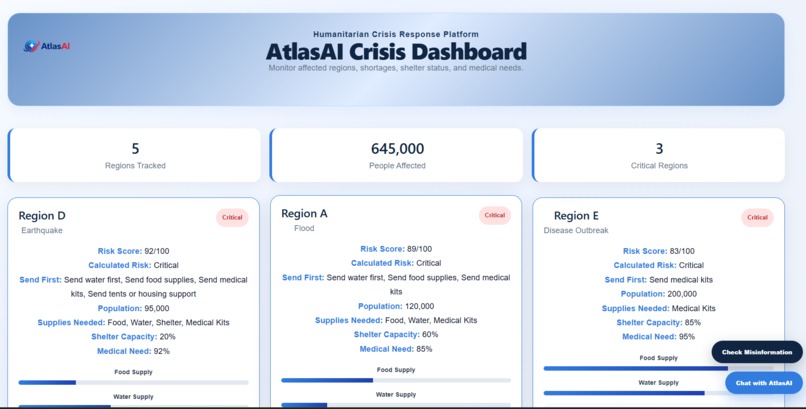
Main page
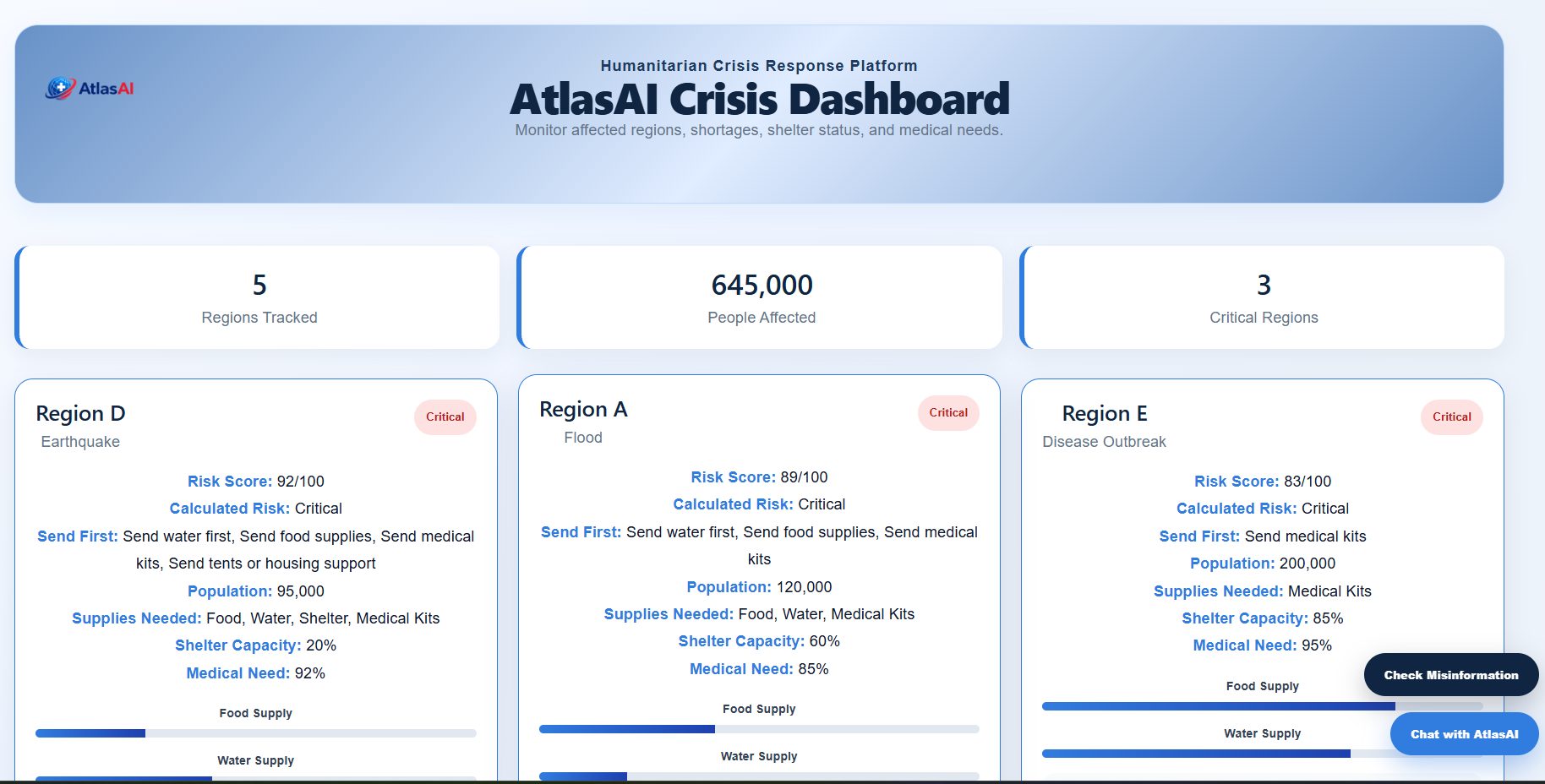
Inspiration
Natural disasters, disease outbreaks, and humanitarian emergencies continue to affect millions of people worldwide. During these crises, emergency response teams often struggle with fragmented information, delayed communication, supply shortages, and misinformation spreading online.
We wanted to build a platform that could help governments, NGOs, schools, hospitals, and local communities respond faster and more effectively during emergencies. Our goal was to create a centralized AI-powered dashboard capable of analyzing crisis data, prioritizing high-risk regions, recommending emergency actions, and helping users identify potentially misleading or dangerous information.
AtlasAI was inspired by real-world disaster response challenges and aligns closely with multiple United Nations Sustainable Development Goals, including:
- No Poverty
- Clean Water and Sanitation
- Sustainable Cities and Communities
- Climate Action
- Reduced Inequalities
- Peace, Justice and Strong Institutions
- Responsible Consumption and Production
- Partnerships for the Goals
What it does
AtlasAI is an AI-powered humanitarian crisis response platform designed to help organizations monitor and respond to emergencies more efficiently.
The dashboard allows users to:
- Monitor multiple crisis regions in real time
- View dynamically calculated risk scores
- Prioritize high-risk areas automatically
- Generate AI-powered crisis summaries
- Receive recommended emergency response actions
- Detect potential misinformation or scam emergency posts
- Ask an AI crisis assistant questions about current crisis conditions
The platform analyzes:
- disaster severity
- population affected
- supply shortages
- shelter availability
- medical demand
to produce a live crisis risk assessment.
We also implemented automated resource prioritization logic so the platform can recommend what supplies should be sent first based on conditions in each region.
How we built it
Frontend
- React
- Vite
- Custom CSS
The frontend dashboard was built using React and designed to resemble a modern emergency operations center interface. We focused heavily on usability, clarity, and visual prioritization.
Features include:
- dynamic crisis cards
- AI modal popups
- chatbot interface
- misinformation analyzer
- animated loading states
- live risk scoring
- automated region prioritization
Backend
- FastAPI
- Python
We built a FastAPI backend to manage AI requests and humanitarian risk processing logic.
The backend handles:
- crisis summarization
- emergency recommendations
- misinformation analysis
- chatbot interactions
- risk calculations
AI Integration
- IBM watsonx
- Llama 3 70B Instruct
We integrated IBM watsonx foundation models to power all AI-generated responses across the platform.
Careful prompt engineering was required to:
- reduce hallucinations
- keep responses concise
- avoid repetitive outputs
- improve emergency readability
- prevent overly long responses
Risk Scoring System
AtlasAI calculates a dynamic humanitarian risk score using multiple crisis indicators:
[ Risk\ Score = Disaster\ Severity + Population\ Impact + Supply\ Shortages + Medical\ Demand ]
Regions are then classified as:
- Low
- Medium
- High
- Critical
Regions are automatically sorted from highest to lowest risk to help prioritize emergency response efforts.
Challenges we ran into
One of the biggest challenges was balancing AI output quality with speed and readability.
Early AI responses were:
- too long
- repetitive
- inconsistent
- sometimes cut off mid-sentence
We solved this through extensive prompt engineering and token optimization.
Another major challenge was designing a clean user interface capable of presenting large amounts of crisis information without overwhelming users.
We also had to carefully structure frontend modal systems, chatbot interactions, loading states, and AI request handling to ensure the platform felt responsive and professional.
Accomplishments that we're proud of
We are proud that AtlasAI combines several different AI-powered humanitarian tools into one unified platform.
Some accomplishments include:
- building a fully functional AI-powered crisis dashboard
- integrating IBM watsonx foundation models successfully
- implementing live crisis risk scoring
- creating automated resource prioritization
- building a misinformation detection system
- designing a polished and responsive emergency operations interface
- implementing a working AI chatbot assistant
We are also proud that the platform addresses multiple United Nations Sustainable Development Goals simultaneously instead of focusing on only one isolated issue.
What we learned
Throughout this project we learned:
- prompt engineering techniques
- FastAPI backend architecture
- React state management
- AI integration workflows
- humanitarian risk modeling
- frontend UI/UX design for crisis systems
- how enterprise AI platforms like IBM watsonx can support real-world emergency response applications
We also learned how important clarity, usability, and fast communication are during emergency situations.
What's next for AtlasAI
Future versions of AtlasAI could include:
- live satellite and weather integrations
- real-time government emergency feeds
- interactive maps
- predictive AI forecasting
- multilingual emergency support
- NGO coordination systems
- SMS emergency alerts
- resource route optimization
- live crisis news feeds
We also hope to expand the platform into a real-time collaborative system that could assist humanitarian organizations during active disasters.
Built With
- cors-middleware
- css
- fastapi
- fetch-api
- html
- ibm-cloud
- ibm-watson
- javascript
- meta-llama
- prompt-engineering
- python
- react
- react-hooks
- rest-api
- vite

Log in or sign up for Devpost to join the conversation.