-
-
Sign in with Google. Your papers, sessions and graph stay private to your account."
-
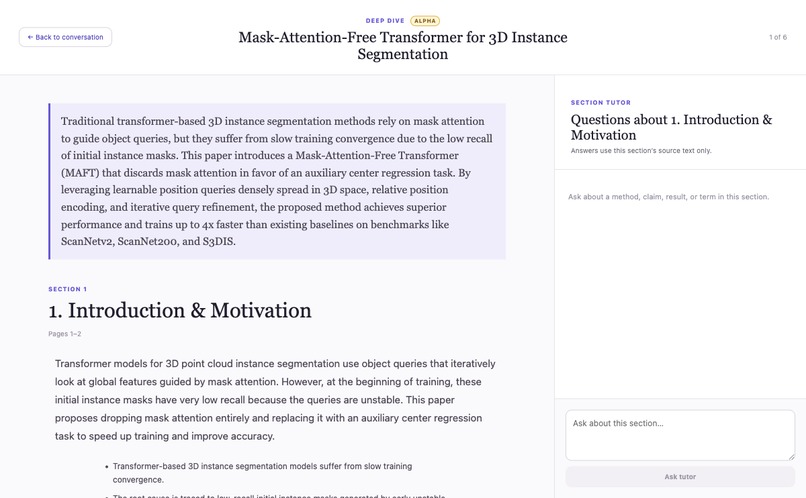
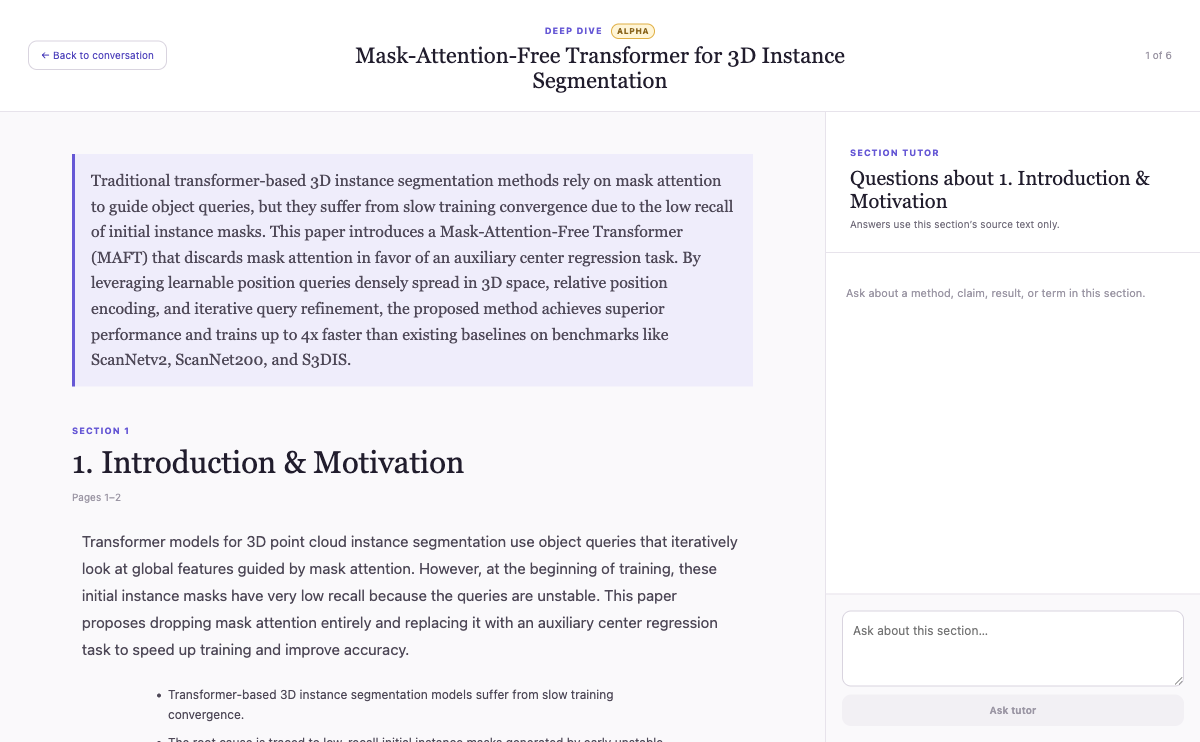
Deep dive: full paper text with a section-by-section tutor for follow-up questions."
-
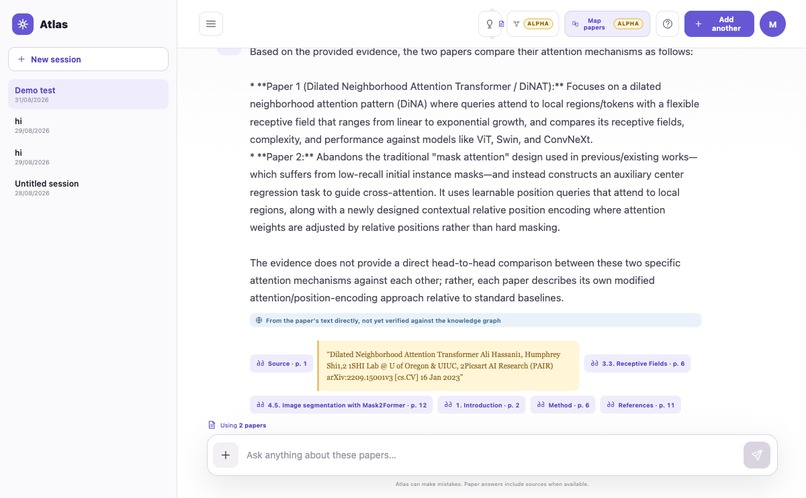
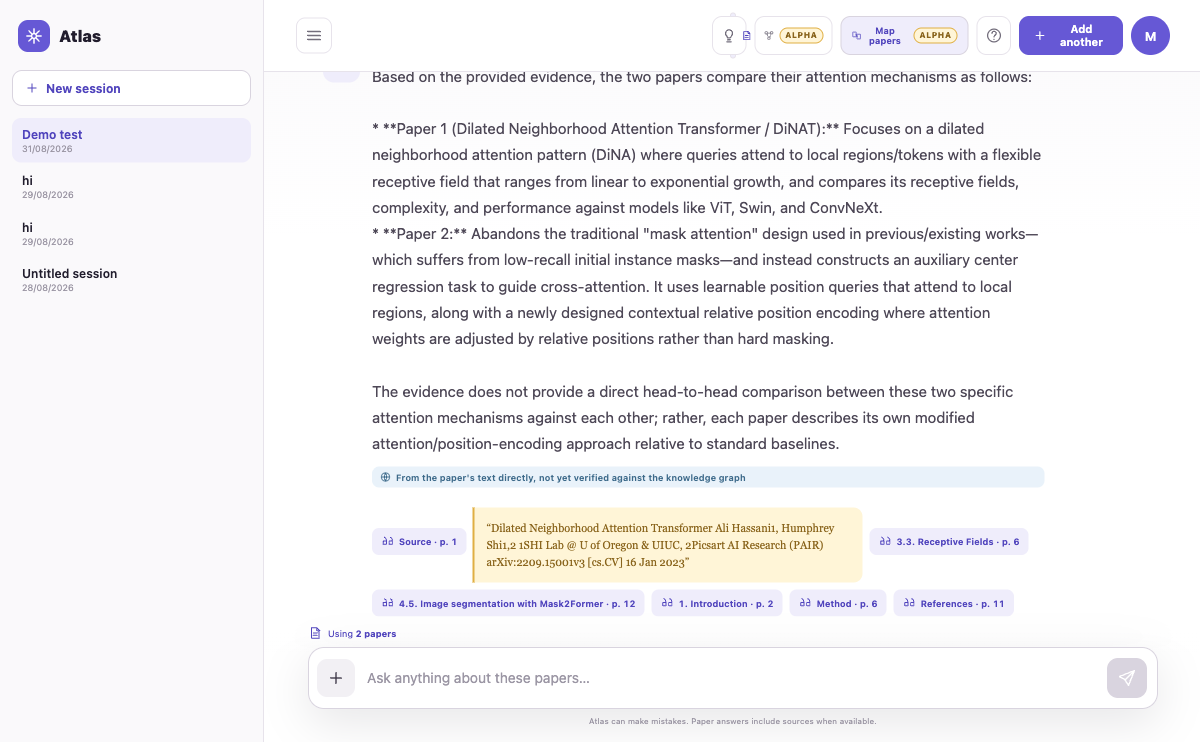
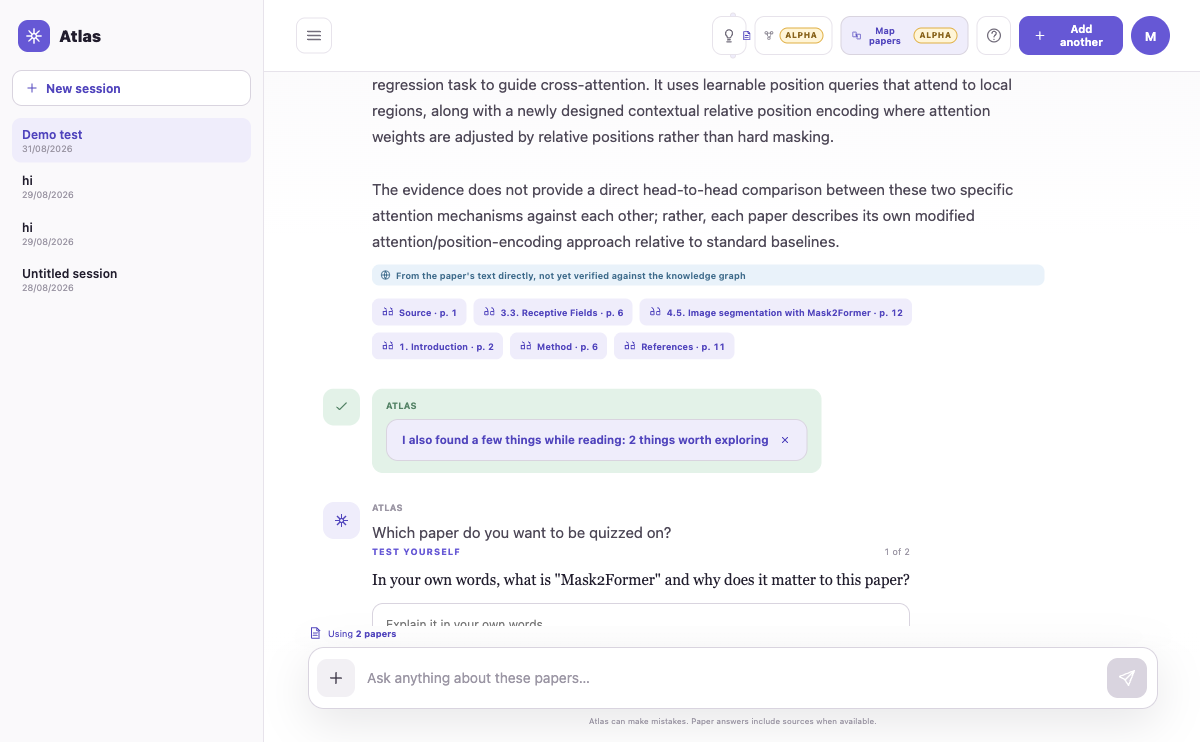
Every answer cites the exact paper and page it came from, not a guess.
-
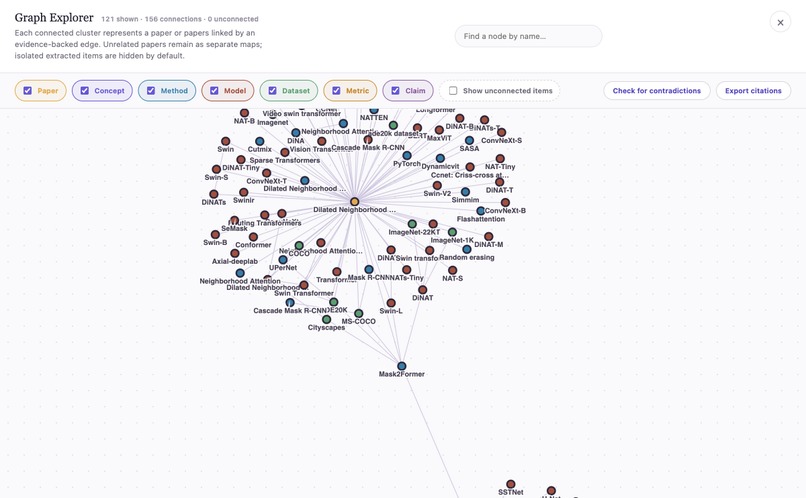
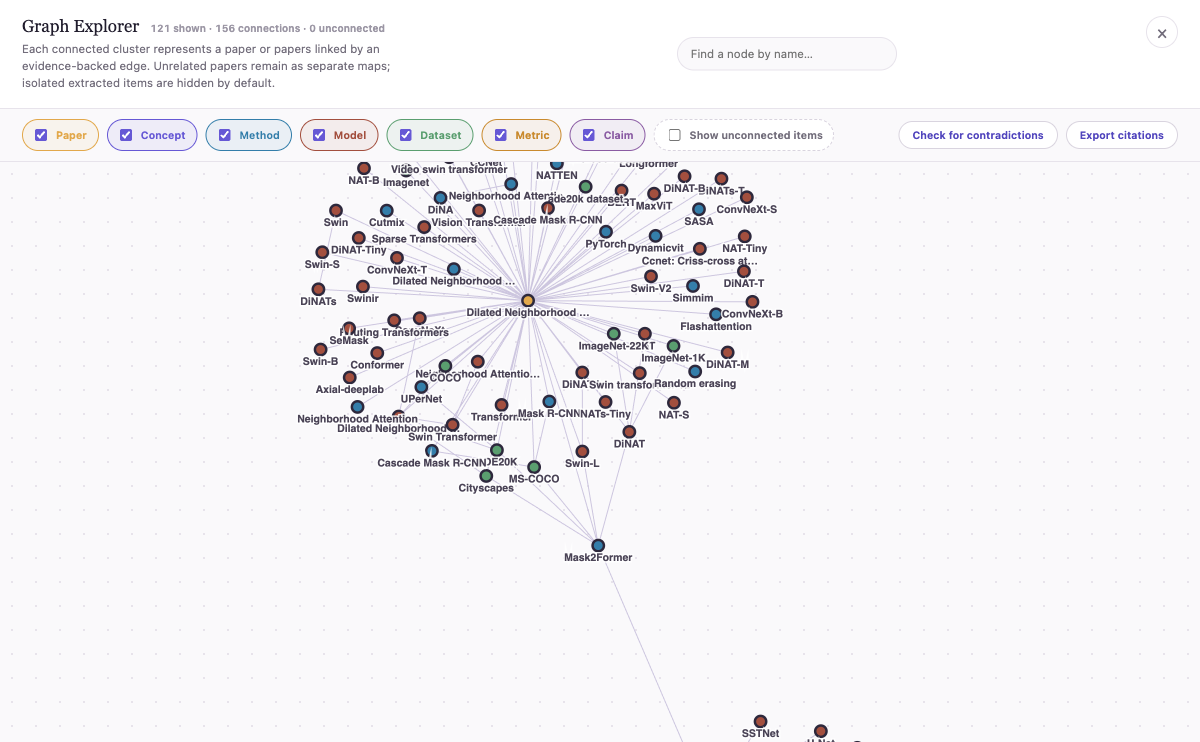
The knowledge graph Atlas builds live: real methods, models, datasets and claims, linked by evidence.
-
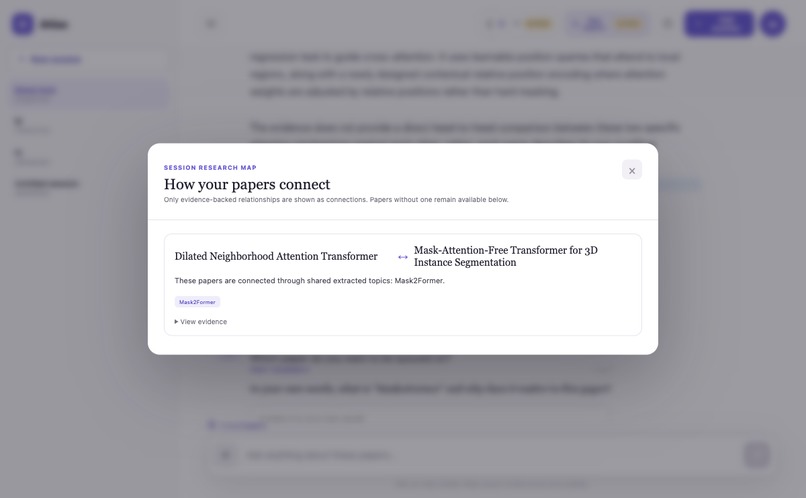
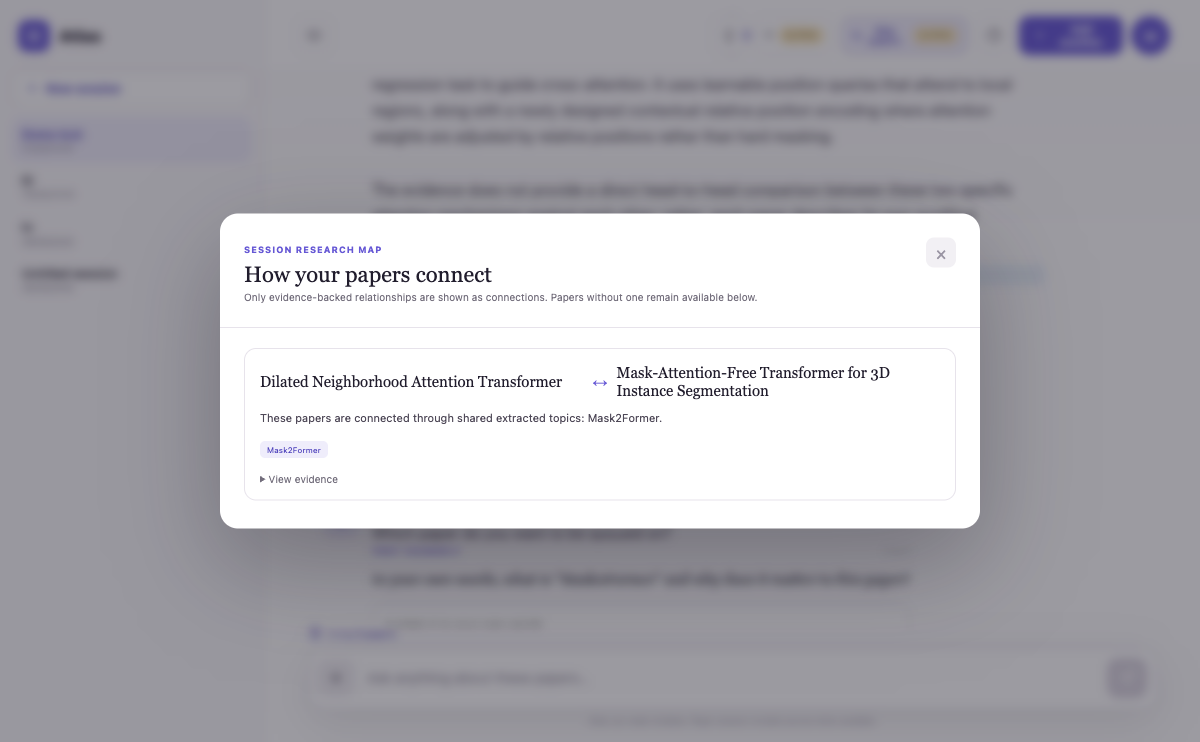
Atlas finds real connections between papers, backed by shared evidence, not guesses.
-
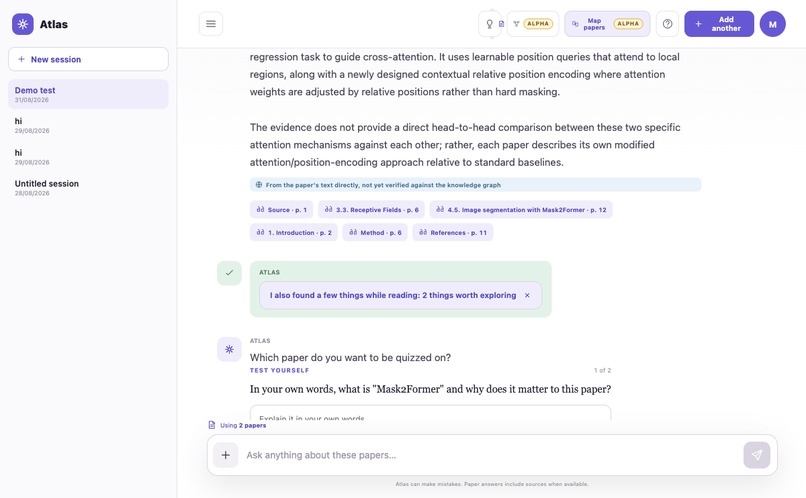
Test yourself: Atlas quizzes you on the paper and checks your answer against the evidence.
-
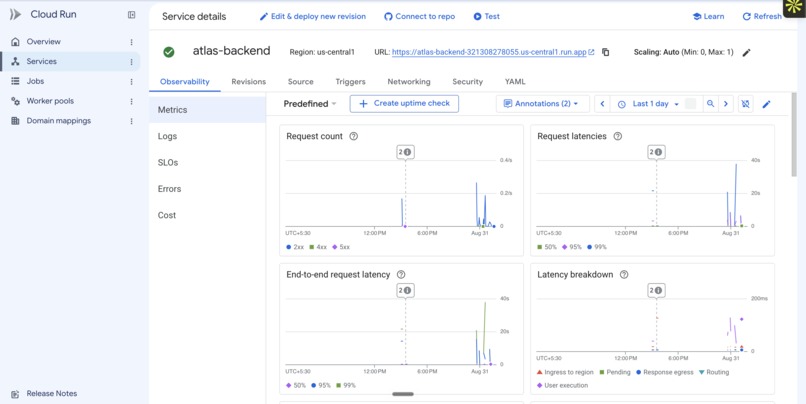
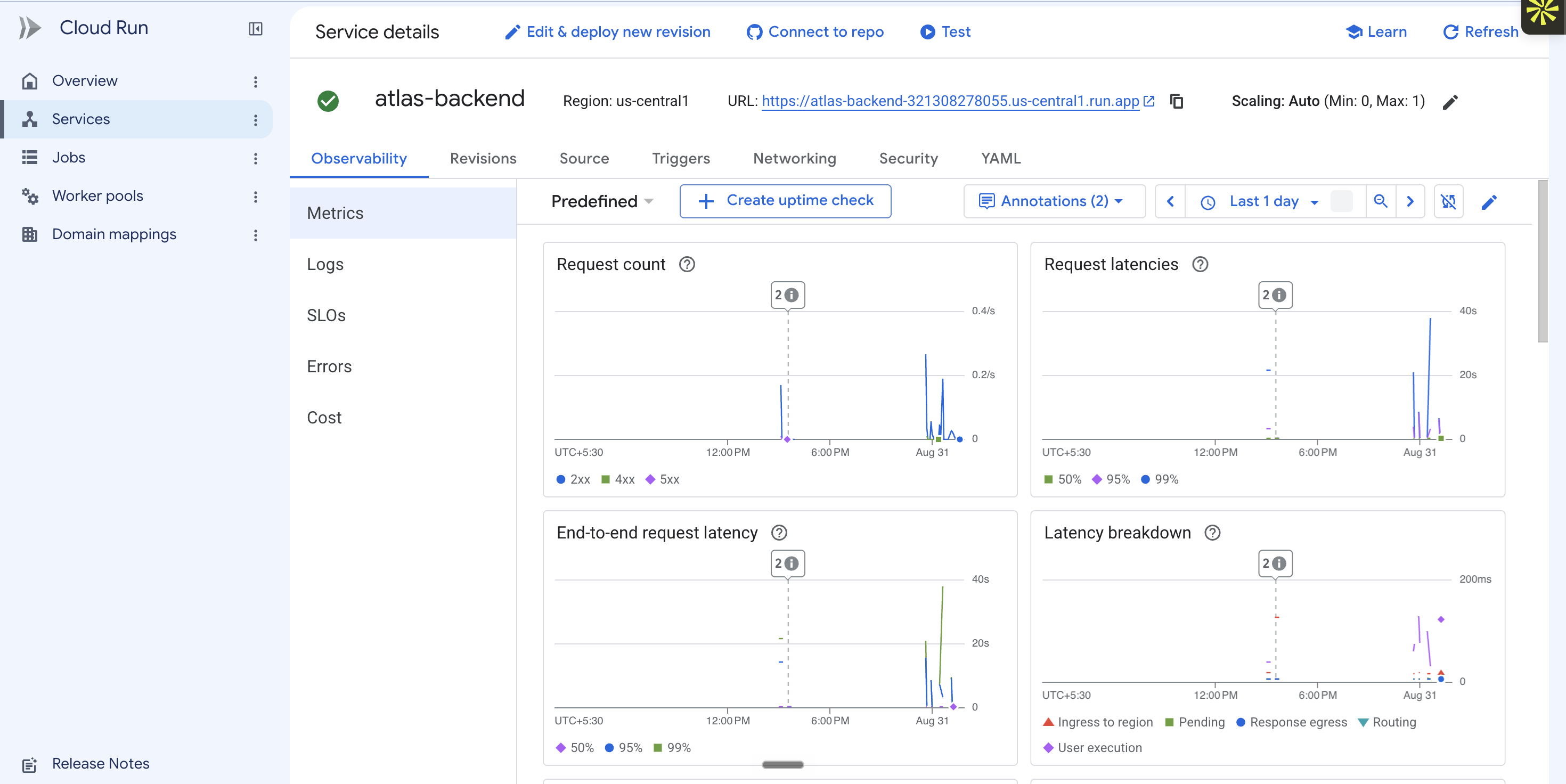
Atlas runs live on Google Cloud Run: real service, real metrics, not a local demo."
Inspiration
As a student who has published three papers and currently works in a research lab, I know how difficult it can be to read and understand academic literature efficiently. Even after spending hours on a paper, it can still be difficult to identify the main contribution, understand the methodology, or see how it connects to other work. When developing and testing hypotheses, we also repeatedly had to check whether our ideas contradicted existing research. This made us realize that a research assistant should do more than summarize papers. It should help researchers understand, verify, question, and connect ideas.
I bring a different angle to this. I interned at an AI startup where I got introduced to knowledge graphs and I have spent time in multiple research labs watching people try to use AI and hit the same wall every time: the answers weren't reproducible and research depends on being able to trust and cite an answer not get a different one each time you ask. That's the belief Atlas is built on that AI only becomes genuinely useful for research once its answers are grounded and consistent. Knowledge graphs are the structure that makes that possible: they let AI reason over a body of work with something deterministic underneath it, instead of just describing it. That's the whole idea behind Atlas.
What it does
Atlas is an AI research assistant for people who want to understand papers without spending hours searching through them manually.
It can:
- Explain complex papers in clear language.
- Guide users through papers section by section.
- Answer questions using evidence from the paper.
- Test users’ understanding with optional knowledge checks.
- Extract methods, models, concepts, benchmarks, datasets, metrics, and claims.
- Build an interactive knowledge graph of the extracted research.
- Identify relationships between multiple papers.
- Highlight contradictions and possible research gaps.
- Suggest related work for deeper exploration.
The goal is to help researchers move from reading papers one at a time to seeing the bigger picture around them.
How we built it
We built Atlas with a Next.js frontend and a FastAPI backend. A user can upload a paper or add one from arXiv. The backend extracts the text, keeps track of sections and pages, and uses Gemini to identify the important parts of the research and how they relate to each other.
The extracted information is stored in Firestore and shown as an interactive graph. The graph can connect a paper to its concepts, methods, models, datasets, metrics, and claims. We also keep the original paper text available so Atlas can answer broader questions using the paper’s motivation, methodology, results, and conclusions rather than relying only on extracted entities.
Gemini powers the explanations, questions, knowledge checks, contradiction checks, and research-gap exploration. We pass the relevant paper context and citations to the model so it can separate what the paper says directly from what can reasonably be inferred. The backend runs on Google Cloud Run, with Firestore for stored research data and Cloud Storage for uploaded papers. The frontend runs on Vercel.
Challenges we ran into
One of our first challenges was getting usable text out of different kinds of documents. Academic papers often use two columns, equations, tables, and unusual headings. Uploaded documents are not always formatted like papers at all. We needed to preserve page and section information so that users could trace an answer back to the source.
Retrieval was another problem. A question such as “Why is this paper important?” may not use the same words as the paper’s explanation. We changed Atlas to look across the paper’s context for broad questions. If the answer is an interpretation rather than a sentence stated directly in the paper, Gemini is asked to say so.
Since Atlas is intended to be free, we also had to think about abuse and cost. We added backend rate limits, per-user and global usage ceilings, production secrets, paper ownership checks, and a one-instance Cloud Run setup.
Accomplishments that we're proud of
- Built something that goes beyond summarizing a paper.
- Made answers traceable to paper sections and pages.
- Created a graph showing how papers and research ideas connect.
- Added contradiction checks, research-gap exploration, knowledge checks, and related work.
- Improved broad-question retrieval so the model sees the paper’s actual text.
- Added safeguards that stop expensive operations when usage limits are reached.
- Deployed the backend on Google Cloud Run with persistent storage and managed secrets. ## What we learned We learned that sending a document to a language model is not enough. The answer depends on how well the document is parsed, what context is retrieved, whether the source can be cited, and how clearly uncertainty is communicated.
We also learned that being helpful and being reliable are not always the same thing. If a paper does not answer a question directly, Atlas should either make a careful, clearly labeled inference based on the text or say that there is not enough evidence. Treating every possible connection as a fact may sound confident, but it makes the system less trustworthy.
Building Atlas also showed us that the infrastructure matters just as much as the model. Authentication, ownership rules, rate limits, secret management, storage, and deployment constraints all have to work together.
What's next for Atlas
- Improve document parsing for tables, equations, figures, and more file types.
- Make retrieval more accurate for detailed and specialized questions.
- Improve graph extraction and relationship confidence scores.
- Make the difference between direct evidence, inference, and an unresolved hypothesis clearer in the interface.
- Add better collaboration features for research teams.
- Expand paper comparison, literature review, and research planning features.
- Keep testing Atlas on real research tasks and improve its citations and answers.
Built With
- arxiv
- cloud-run
- cloud-storage
- docker
- document-processing
- fastapi
- firebase-authentication
- firestore
- gemini-3.5
- google-cloud-secrets-manager
- google-genai-sdk
- knowledge-graph
- next.js
- poppler
- pymupdf
- python
- rag
- research-assistant
- typescript
- vercel

Log in or sign up for Devpost to join the conversation.