-
Title Page
-
Demo
Inspiration
The Day 1 problem is real. Every developer has felt the overwhelming feeling of being dumped onto a massive repository and told to "get up to speed." We realized that while tools like Notion exist, they are islands of information, disconnected from the code they describe. We built Atlas: the “second brain” for codebases.
What it does
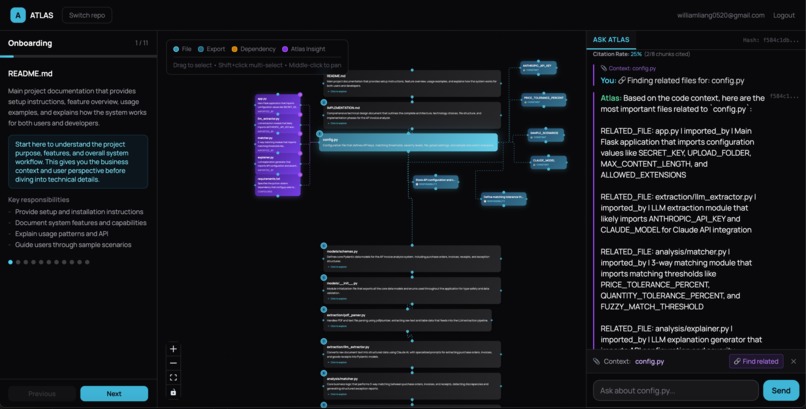
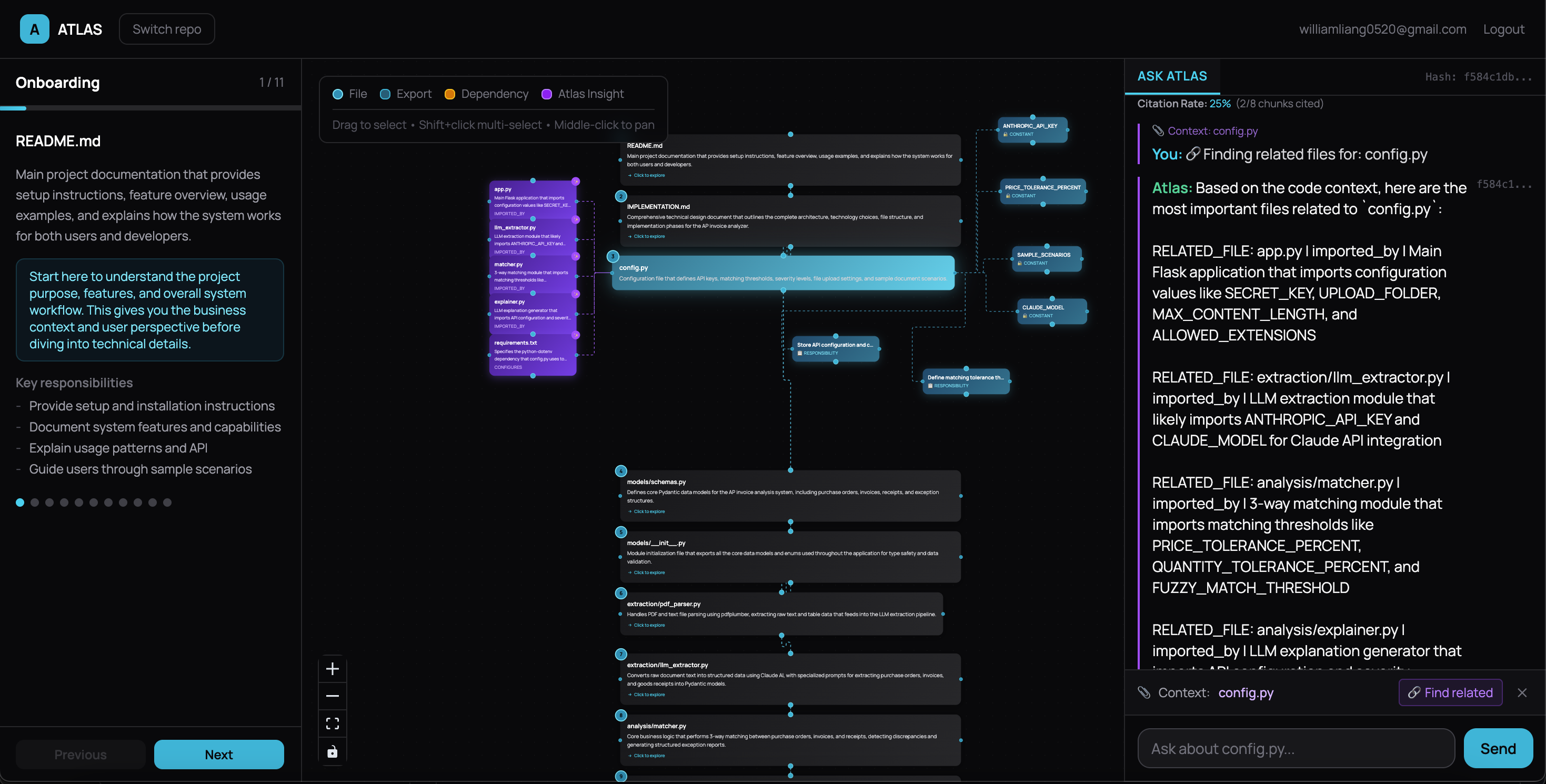
Atlas mimics the "second brain" philosophy, like Notion or Obsidian. Instead of context-switching between files and manually finding resources, there is a uniform interface that draws visual connections between onboarding resources into a graph. Through integrating their Github, the user can get a visual and interactive map of the codebase to guide their onboarding, which then uses Claude to rank files from 0–10 on score importance. This allows the user to only focus on the logic that actually matters. Atlas also generates logical onboarding paths for new devs, following the flow from entry points to utilities. If the user has any questions, ask Atlas: a chatbot window that can interact with the visuals, verified by line-by-line citations and accuracy checks.
How we built it
- FastAPI backend using Claude 3.5 Sonnet for deep analysis and OpenAI for semantic embeddings.
- ChromaDB handles the heavy lifting for our RAG pipeline, keeping code chunks organized and searchable.
- A React frontend with React Flow for the interactive graphs and Tailwind for a nice aesthetic.
- Used Server-Sent Events (SSE) so you can watch the app "think" as it processes your repo.
Challenges we ran into
We had to constantly test for consistency by normalizing embedding distances to 6 decimals so results didn't shift between runs. We had issues with GitHub OAuth and Vercel routing in production, as we had a lot of environment variables to configure. To keep things stable, we built a graceful fallback system where if one file fails to analyze, the whole ingest doesn't crash.
Accomplishments that we're proud of
- Creating a UI that feels more like a "Second Brain" and less like a standard, boring dashboard
- Our onboarding paths genuinely make sense as they follow real dependencies, not just file names.
- We built a test suite that implements fact-checking guardrails on our workflow to prove our AI gives the same answer every single time.
- Going from a raw repo URL to a full interactive walkthrough in under two minutes.
What we learned
- How to implement RAG pipelines with guardrails for 1) answering user queries with minimal hallucinations and 2) for mapping semantic relationships.
- The importance of basic, intuitive, UX for conveying information rather than 10 billion features.
- The importance of basic caching strategies for minimizing API call overhead.
What's next for Atlas
- Support 3rd party services for documentation; such as Jira, Slack, Loom, etc.
- Integrate as VS Code Plugin, bringing the Atlas "Second Brain" directly into the editor
- Detect query complexity; defaults to 8 lines currently, adapts to more or less depending on complexity
- Let teams curate and save onboarding paths, add annotations, and track which files new members have reviewed.
- Only re-analyze the files that change in a PR, not the entire repo.
- Support for mapping across multiple repos simultaneously.
Built With
- chromadb
- fastapi
- react
- tailwindcss


Log in or sign up for Devpost to join the conversation.