Inspiration
The world changed in late 2025. With the implementation of the new, restrictive H-1B visa laws (specifically the prohibitive cost barriers and increased salary floors), the "American Dream" effectively put up a "Closed" sign for 90% of the world's top engineering talent.
We realized that while one door closed, sixty-six others opened. Countries like Germany, Portugal, the UAE, and Japan are aggressively competing for the very talent the US just priced out. But for an individual, navigating 190+ immigration systems, tax treaties, and labor markets is impossible.
We asked ourselves: What if we treated citizenship not as a lottery, but as a marketplace?
Atlas was born from the belief that talent is equally distributed, but opportunity is not. We wanted to build an "Operating System" for the sovereign professional. A tool that analyzes your specific value code (skills, experience, income) and compiles it against the source code of global immigration law.
What it does
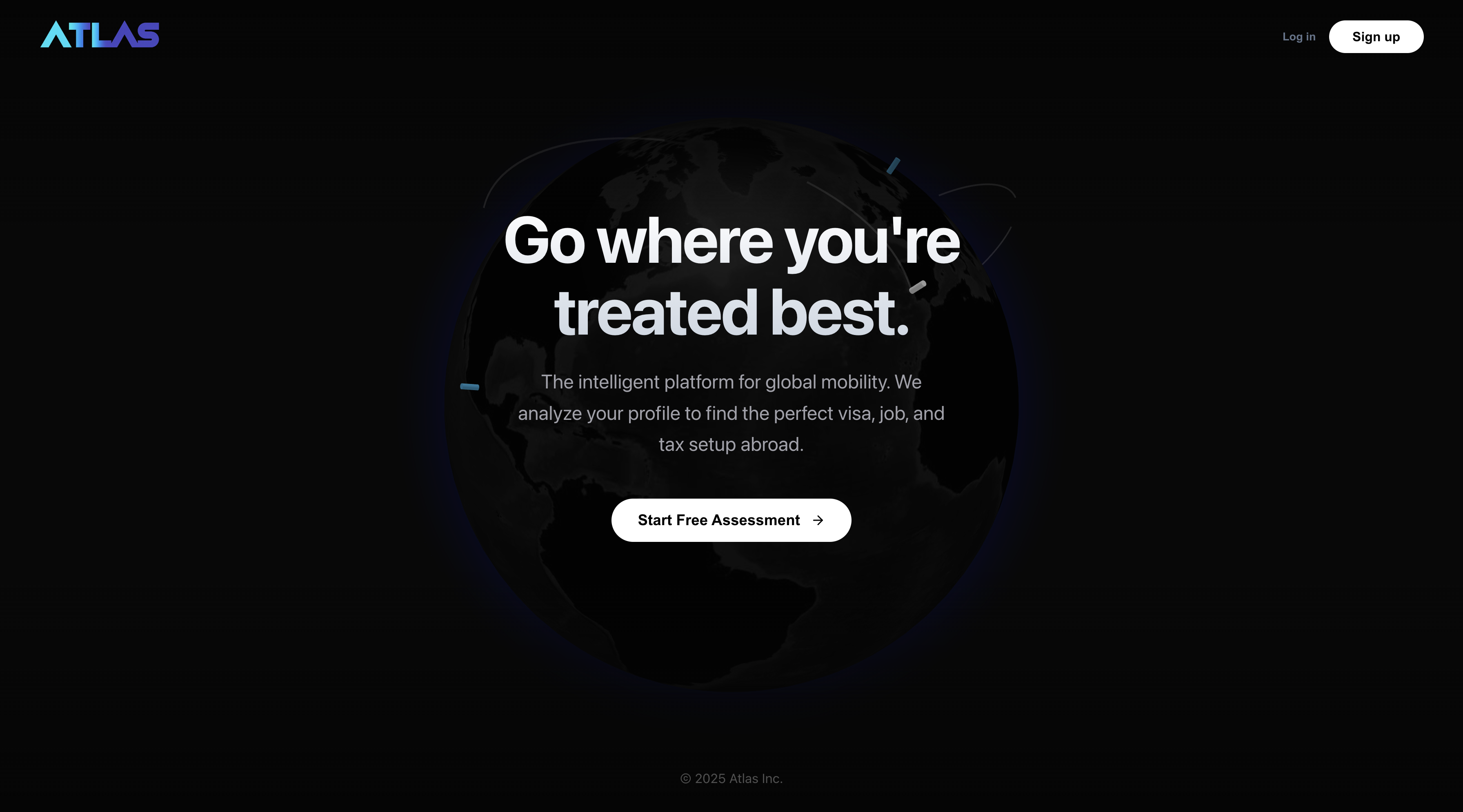
Atlas is an end-to-end Global Mobility Operating System. It moves beyond simple "visa lists" to provide a calculated, strategic roadmap for relocation.
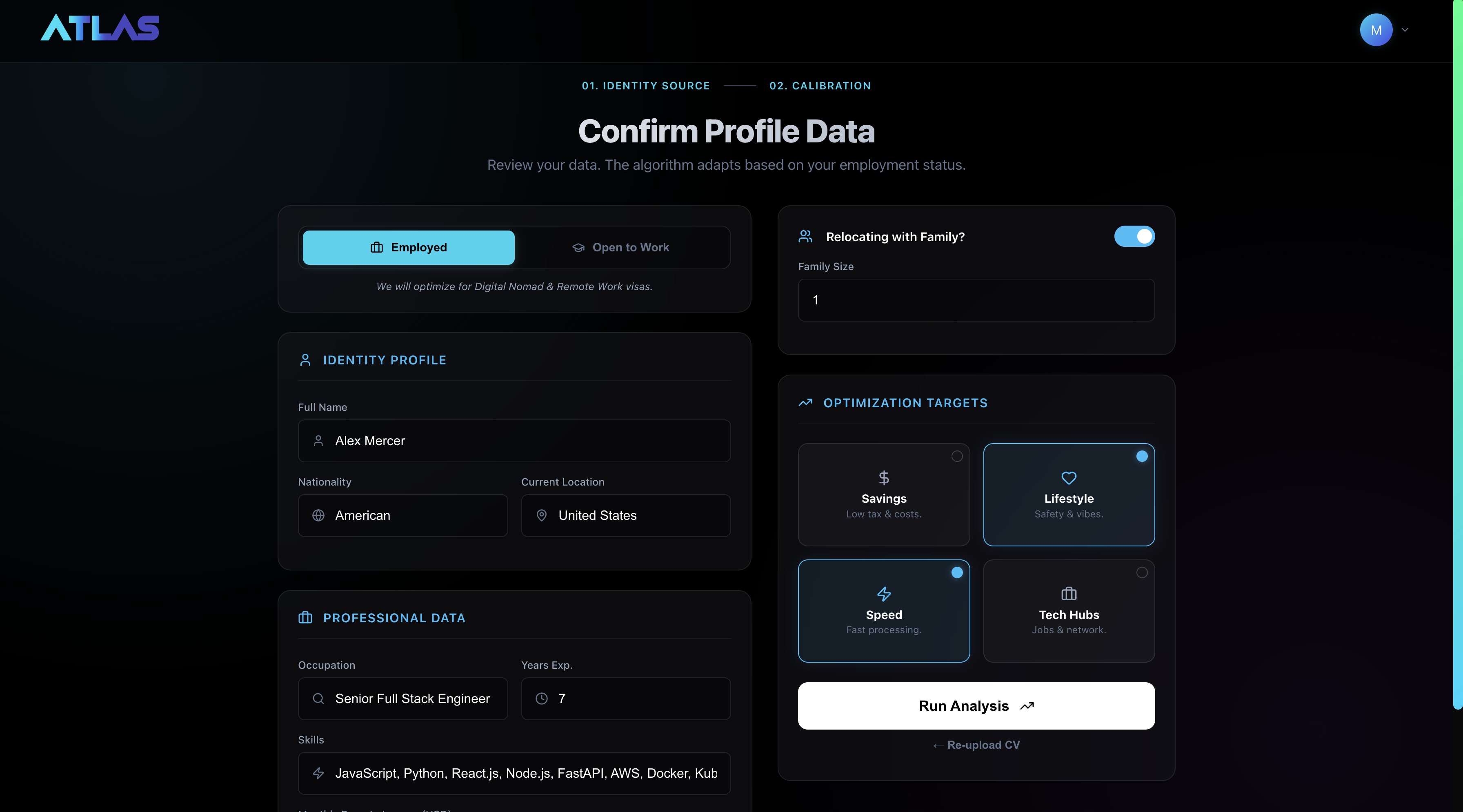
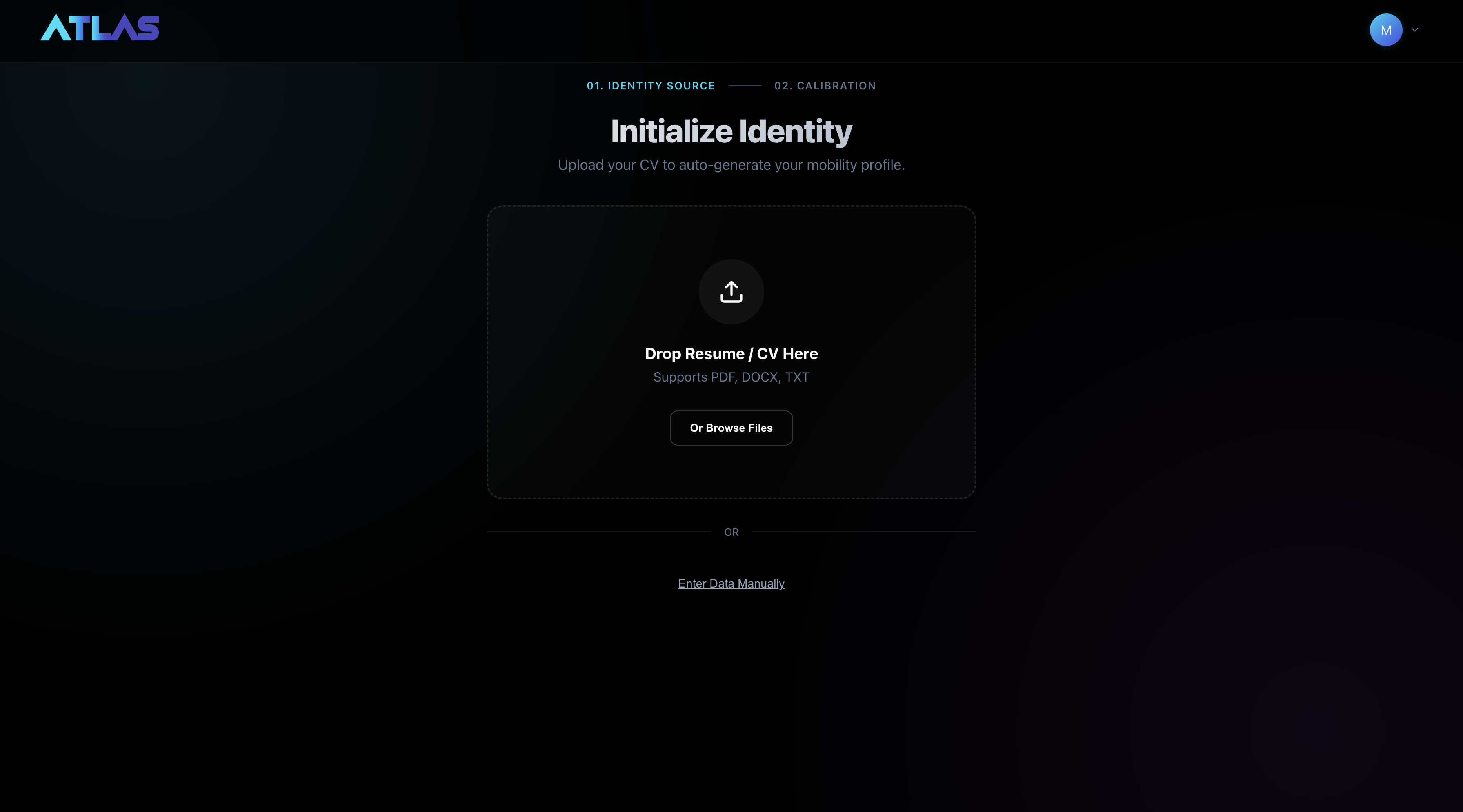
- AI Identity Parsing: Users drag and drop their PDF Resume/CV. Our engine utilizes Google Gemini to extract their "Professional DNA" (skills, years of experience, and seniority) instantly pre-filling a complex immigration profile.
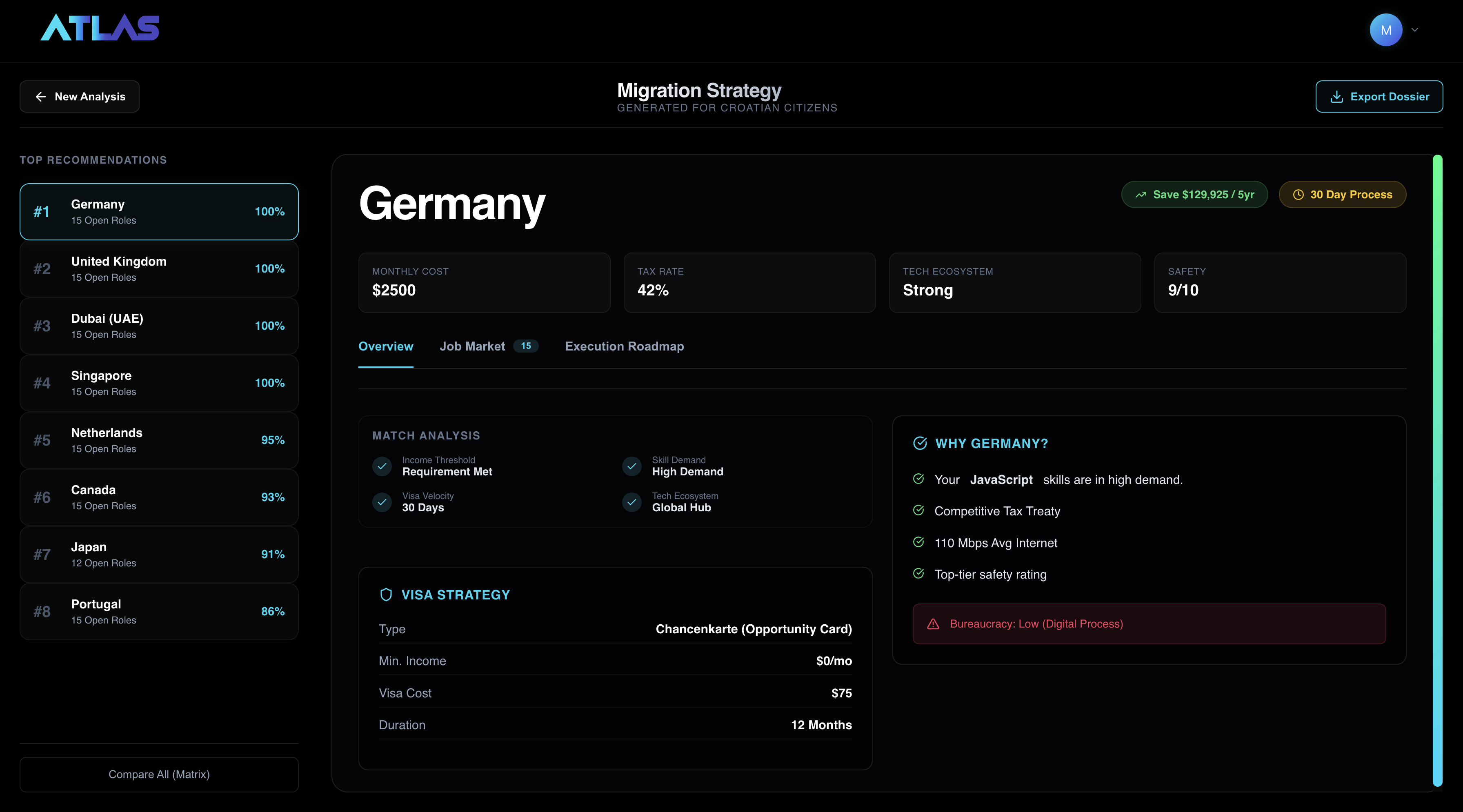
- Dynamic Jurisdiction Matching: The Atlas Engine scores 66+ countries based on the user's specific profile. It intelligently switches logic based on employment status. For Nomads, it prioritizes tax efficiency and speed. For Job Seekers, it prioritizes "Opportunity Cards" and labor shortages.
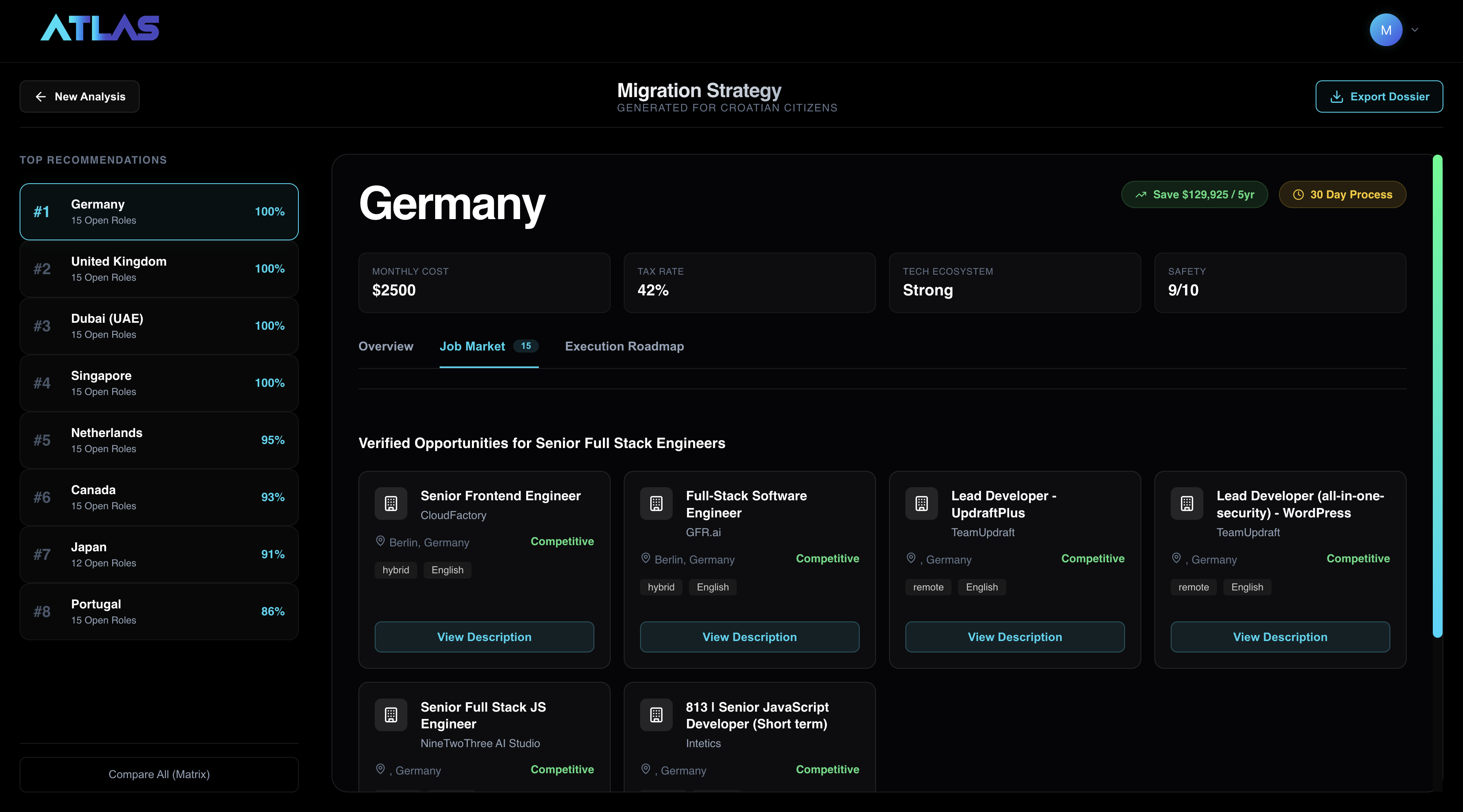
- Real-Time Opportunity Engine: We don't just say "Germany is good." We use global job market APIs to find active, visa-sponsoring roles that match the user's exact tech stack in that specific country.
- Gap Analysis & Strategy: The system provides a detailed breakdown of why a user matches (e.g., "Your 5 YOE in Python qualifies you for the UK Global Talent Visa") and what is missing.
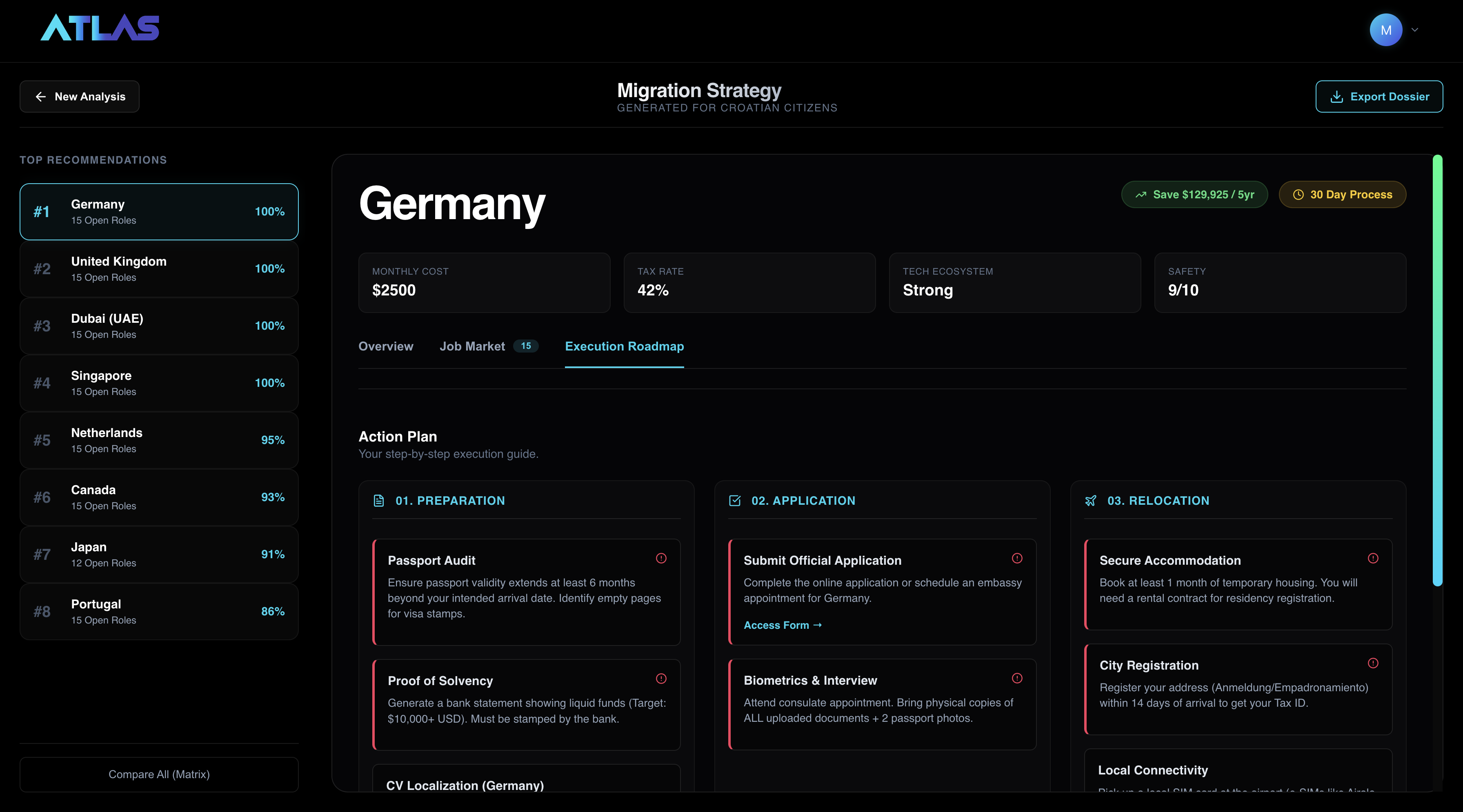
- Execution Roadmap: Once a target is selected, Atlas generates a Kanban-style project board with specific legal tasks (e.g., "Apostille Birth Certificate", "Get NIF Number"), turning bureaucracy into a checklist.
- The Strategy Dossier: Users can export a professional, white-label PDF report of their migration strategy to present to employers or family.
How we built it
We built Atlas as a high-performance web application with a focus on "Data-as-UI".
- The Brain (Backend): Built with Python and FastAPI. We architected a scoring engine that normalizes cost-of-living data, tax rates, and visa processing times into a single "Match Score."
- The Intelligence (AI): We utilized Google Gemini to parse unstructured resume data into structured JSON, handling edge cases like "Freelance" work or "Gap Years" that usually break traditional parsers.
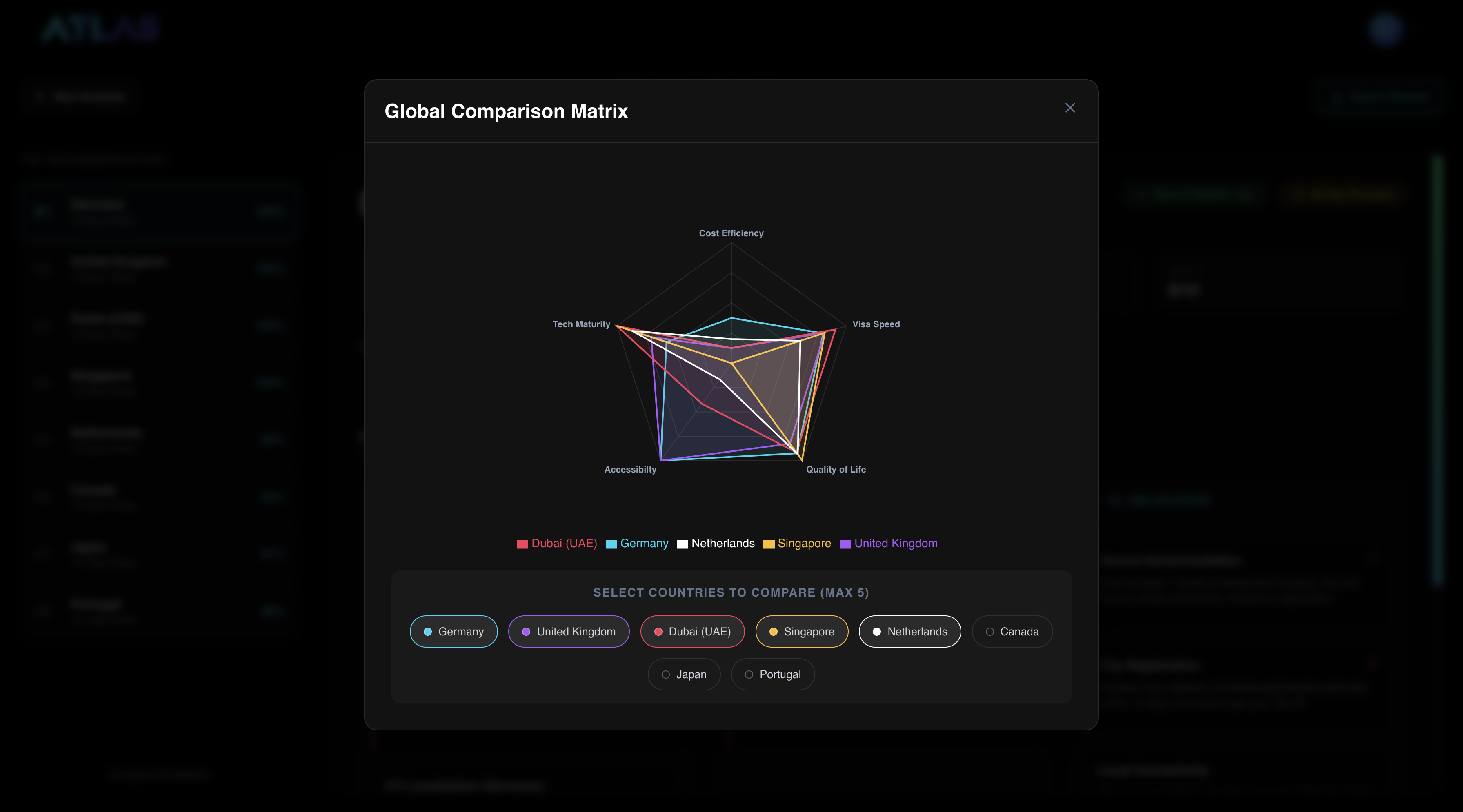
- The Interface (Frontend): Built with React and Vite. We used Three.js via React Globe.gl for the immersive 3D visualization and Recharts for the comparative financial matrices. The UI follows a strict "Glassmorphism" design system to evoke a premium, futuristic OS feel.
- The Data Layer: We integrated real-time job market aggregators to fetch job listings, filtering for "English-speaking" and "Tech" roles to ensure relevance for international applicants.
Challenges we ran into
- The "Unemployed" Paradox: Early in development, we realized our algorithm favored high-income nomads, punishing talented engineers who were currently between jobs. We had to rewrite the scoring engine to detect "Open to Work" status and heavily boost countries with Job Seeker Visas instead of Nomad visas.
- Prompt Engineering for Structure: Getting an LLM to reliably extract "Years of Experience" as a float value from a messy PDF was difficult. We had to iterate on a strict system prompt that enforced JSON output without markdown noise.
- Data Normalization: Comparing a "0% Tax Rate" in Dubai with a "30% Ruling" in the Netherlands required complex financial modeling to show the user the true purchasing power parity (PPP) adjusted outcome.
Accomplishments that we're proud of
- The "Atlas" Algorithm: It genuinely feels like magic. You drop a PDF, and 3 seconds later, it tells you that you are 92% compatible with Estonia because of your background in Cyber Security.
- The "Secret" Print Mode: We utilized advanced CSS print queries to transform our dark-mode, neon-dashboard web app into a clean, black-and-white executive PDF report instantly in the browser.
- Real-Time Jobs: Successfully integrating live job market data means users aren't looking at static wikis. They are looking at active opportunities.
What we learned
We learned that immigration is a funnel. It starts with eligibility (Can I go?), moves to viability (Can I afford it?), and ends with opportunity (Can I work?). Most tools only solve the first part. By building the full vertical (from CV parsing to job finding) we solved the anxiety of the unknown.
What's next for Atlas: The OS for Global Talent Mobility
- Direct Government API Integrations: Submitting visa applications directly through the Atlas dashboard.
- Blockchain Credentialing: Verifying university degrees on-chain to speed up the "Blue Card" process in Europe.
- Atlas Settlements: Partnering with co-living spaces to offer "Soft Landing" packages where housing and tax ID are ready upon arrival.

Log in or sign up for Devpost to join the conversation.