-

Logo
-
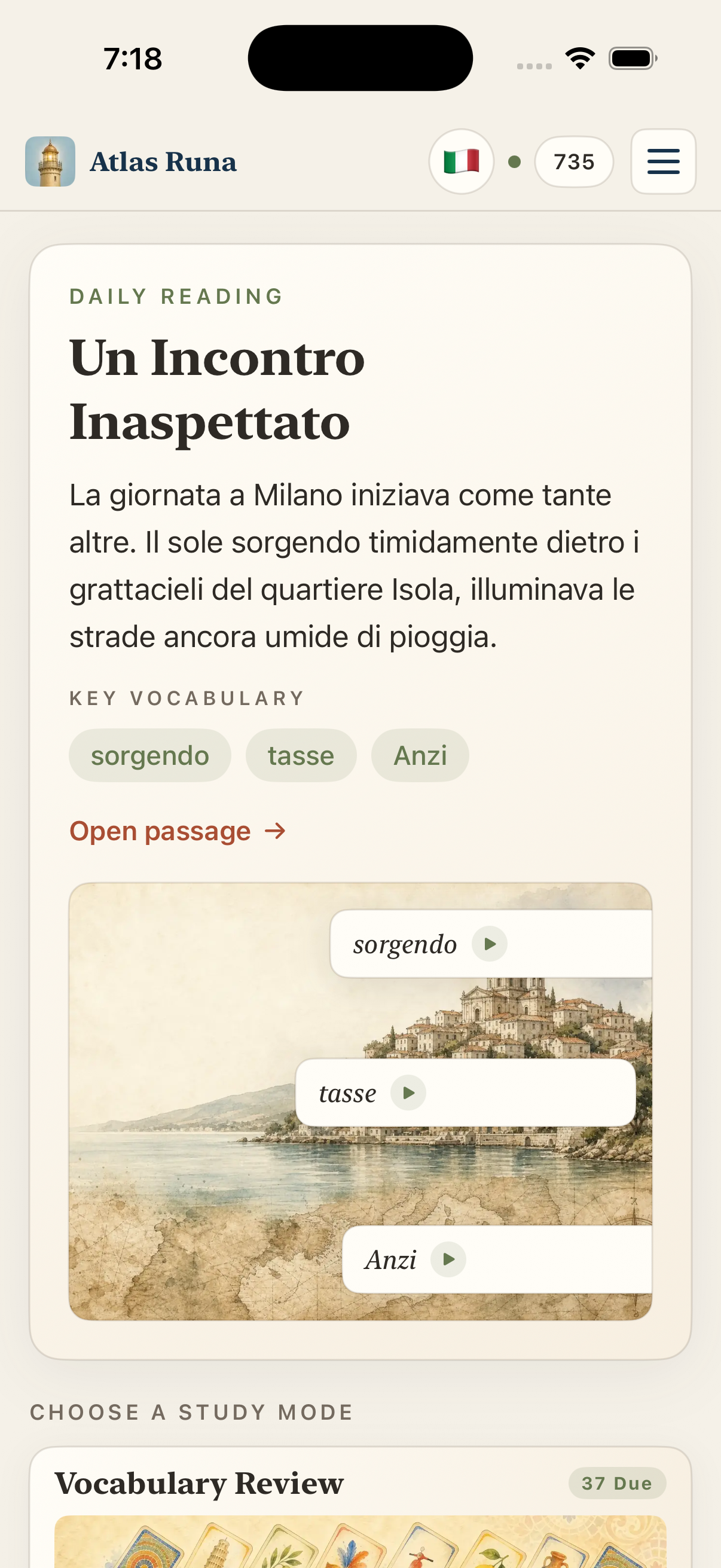
iOS screenshot

Inspiration
I knew language learning tools were leaving a lot on the table. Recent AI-based language learning tutors were OK, but they didn't really integrate full knowledge about the student or use the best research to teach. So I wanted a tool that teaches me as fast as possible, figures out my bad habits and fixes them and makes finding content easy.
What it does
Atlas Runa is an adaptive language-learning platform for Italian, Spanish, Chinese, and Japanese (with English on the way). Instead of chasing streaks or isolated flashcards, it tracks what you actually know—words you’ve looked up, missed, and mastered—and steers you toward reading, listening, writing, speaking, and drills at the right difficulty. The goal is frictionless immersion: level-matched stories and articles, integrated vocabulary review, conjugation and structural drills, and a browser extension so progress continues even when you’re on YouTube or the open web.
How I built it
The stack is a monorepo built for a real product, not a demo. The web app is SvelteKit + Svelte 5 + TypeScript; the API is Rust (Axum) + PostgreSQL (SQLx). There’s also a SwiftUI iOS app, a browser extension, curriculum skill graphs, and a large content pipeline for graded and catalog reading—all deployed on Railway with Docker.
Challenges I ran into
Keeping the learner model coherent across modes and languages. Comprehensible-input recommendation has to balance interest, difficulty, word-list goals, and real comprehension signals without dumping people into material that’s too hard. Supporting Italian, Spanish, Chinese, and Japanese means different orthographies, tokenizers, dictionaries, and conjugation systems under one product surface.
Accomplishments that I'm proud of
I’m proud that Atlas Runa is a connected learning system, not a pile of disconnected tools. Word knowledge from reading feeds recommendations and SRS; review outcomes feed back into what you see next; Study Hub makes the next useful action obvious. Shipping multi-modal practice (read / listen / write / speak / drill), multi-language NLP, a real recommendation stack with embeddings, and native + web clients that share one learner backend is a lot of surface area for a greenfield product.
What I learned
There's a lot of complexity that goes into this product. I learned a ton about LLMs, web, iOS, etc. Getting good output from LLMs has been challenging but fun.
What's next for Atlas Runa
Next is deepening the guided path: richer curriculum skills, sharper recommendations, more high-quality level-matched content, and smoother onboarding so beginners get a paved road while serious learners keep dense immersion. On the product side, tightening the extension/immersion loop, and shipping the iOS experience as a first-class way to study. Long term, the north star stays the same: the fastest path to fluency through input and practice that always sits at the edge of what you can understand.
Built With
- go
- postgresql
- railway
- rust
- svelte
- typescript


Log in or sign up for Devpost to join the conversation.