Inspiration
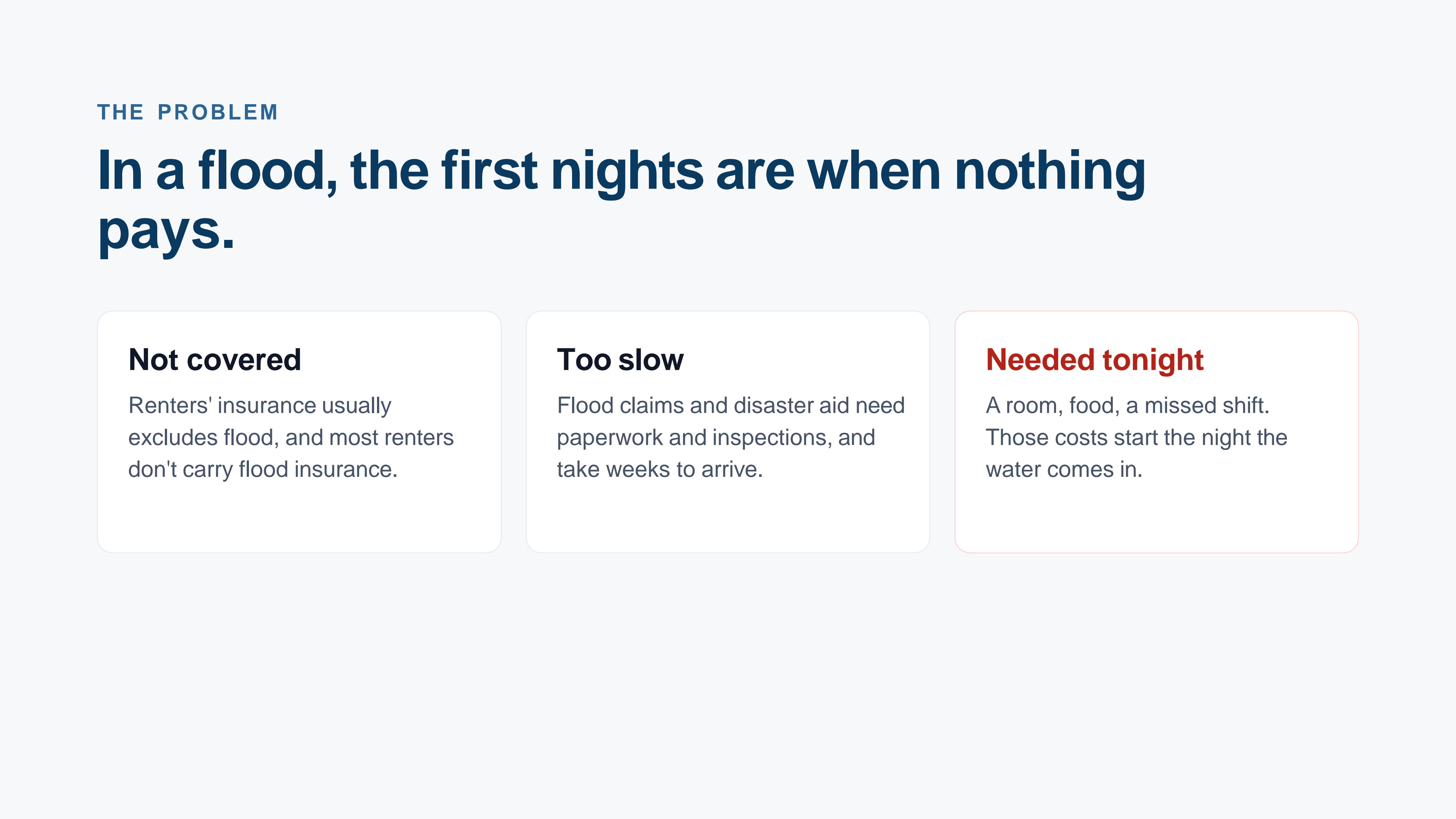
Maria rents in Meyerland, on Brays Bayou in Houston. When Harvey hit in 2017, the water came in a single night. Renters' policies rarely cover flood, and federal flood claims and disaster aid take weeks to arrive. The first 72 hours, when you need a hotel, food and a replacement for a missed shift, are when nothing pays.
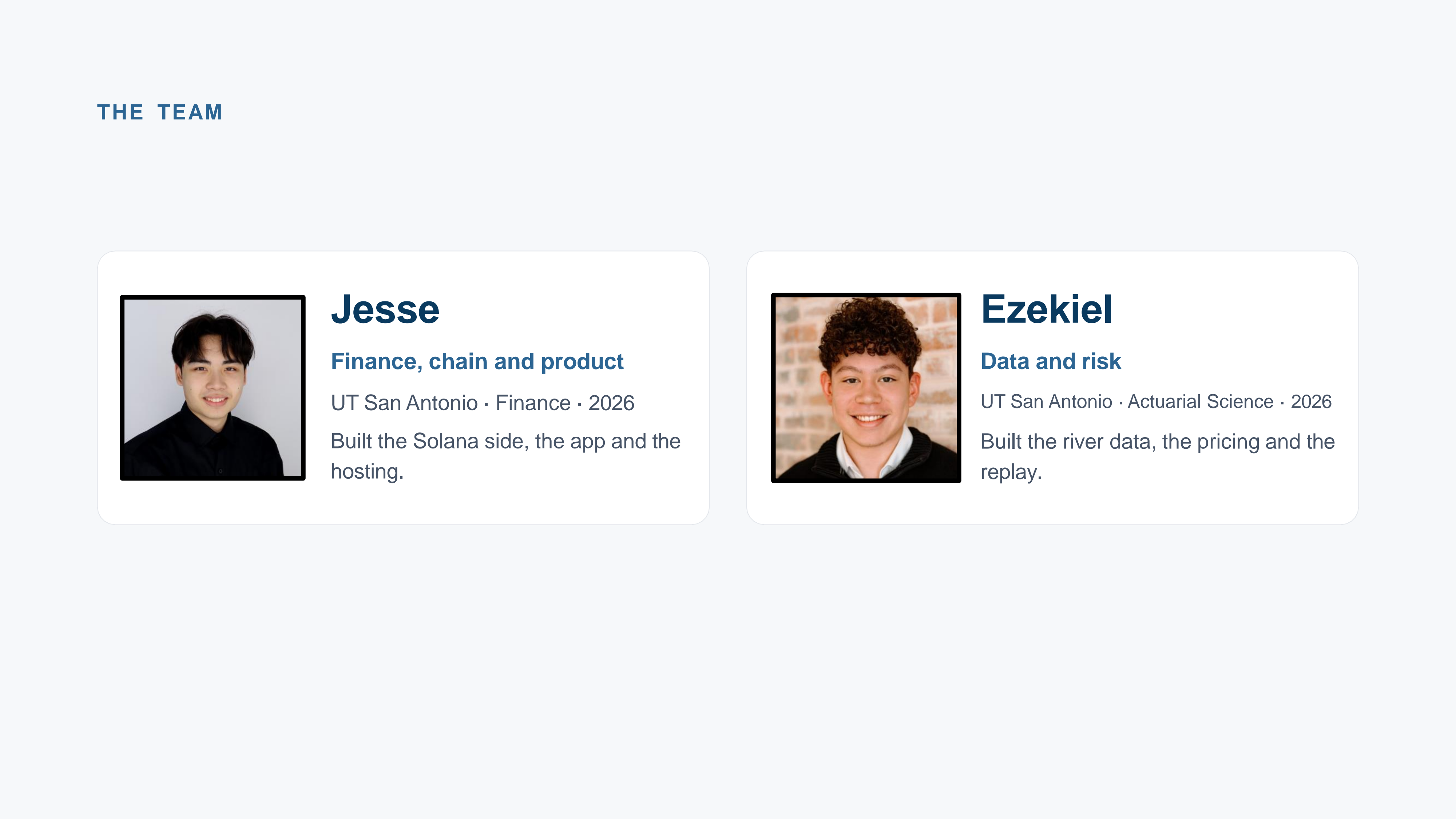
We are a finance major and a quant. We wanted to build the product an insurer, a city programme or a nonprofit could actually run: small, fixed, immediate cash that pays because a public measurement crossed a line, not because an adjuster visited.
What it does
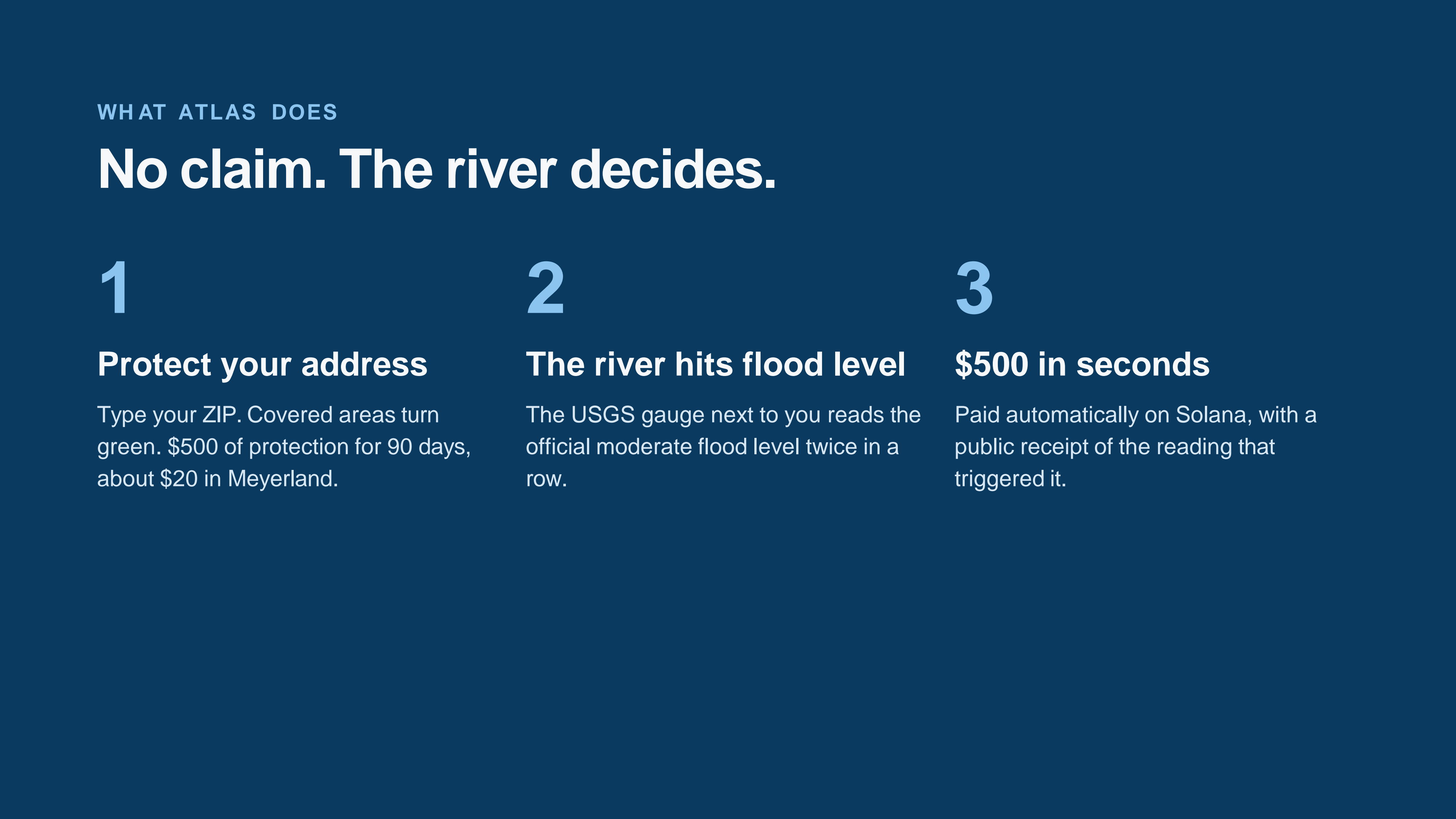
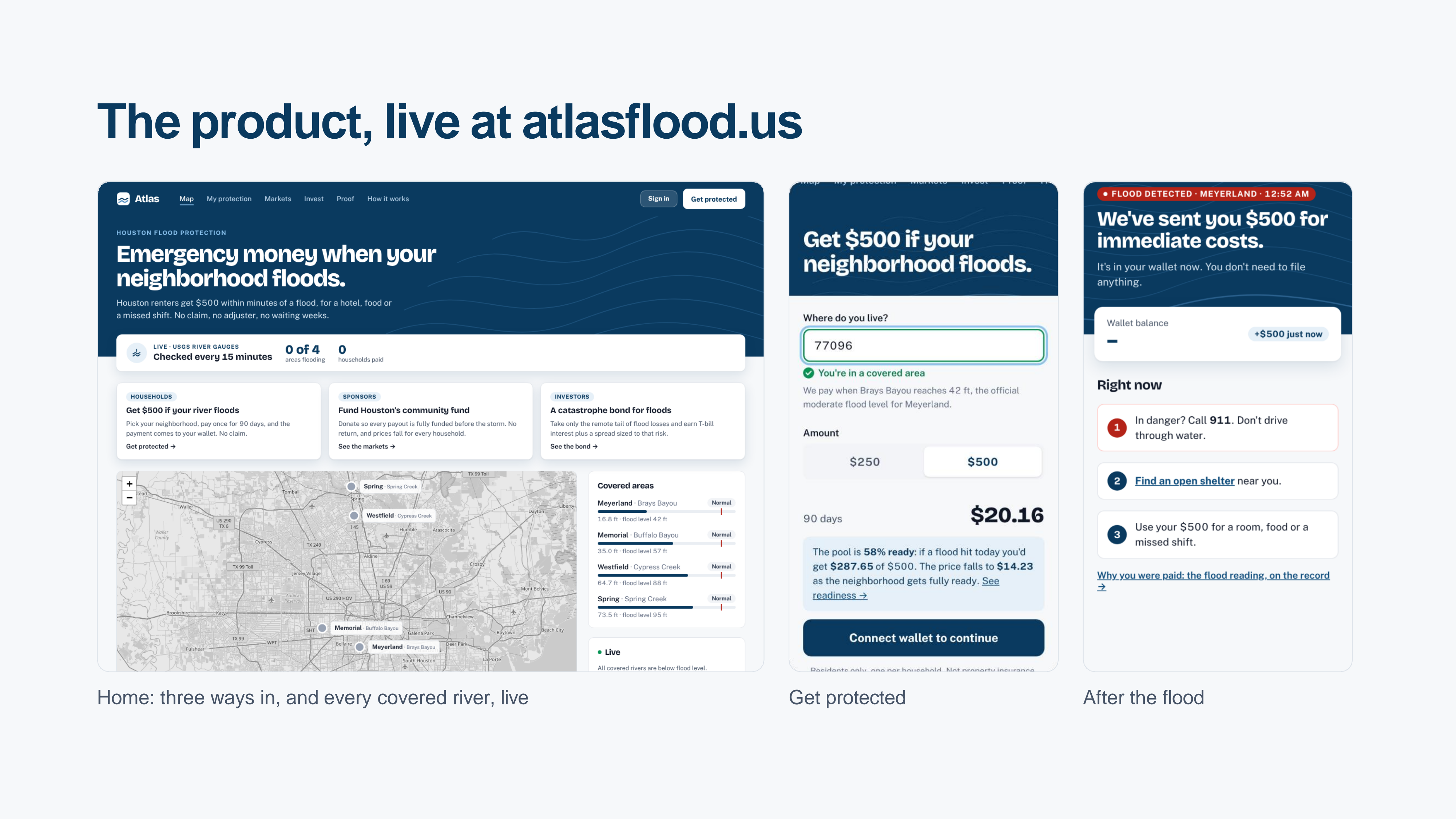
Atlas is emergency money for the first days of a flood. You protect your home's neighborhood for 90 days; if the river gauge that watches it reaches the official flood level, a fixed amount (for example \( B = 500 \) aUSD, a test dollar) lands in your wallet automatically, in seconds. It is a fixed emergency payment for residents (one per household), not property insurance and not a bet on the weather.
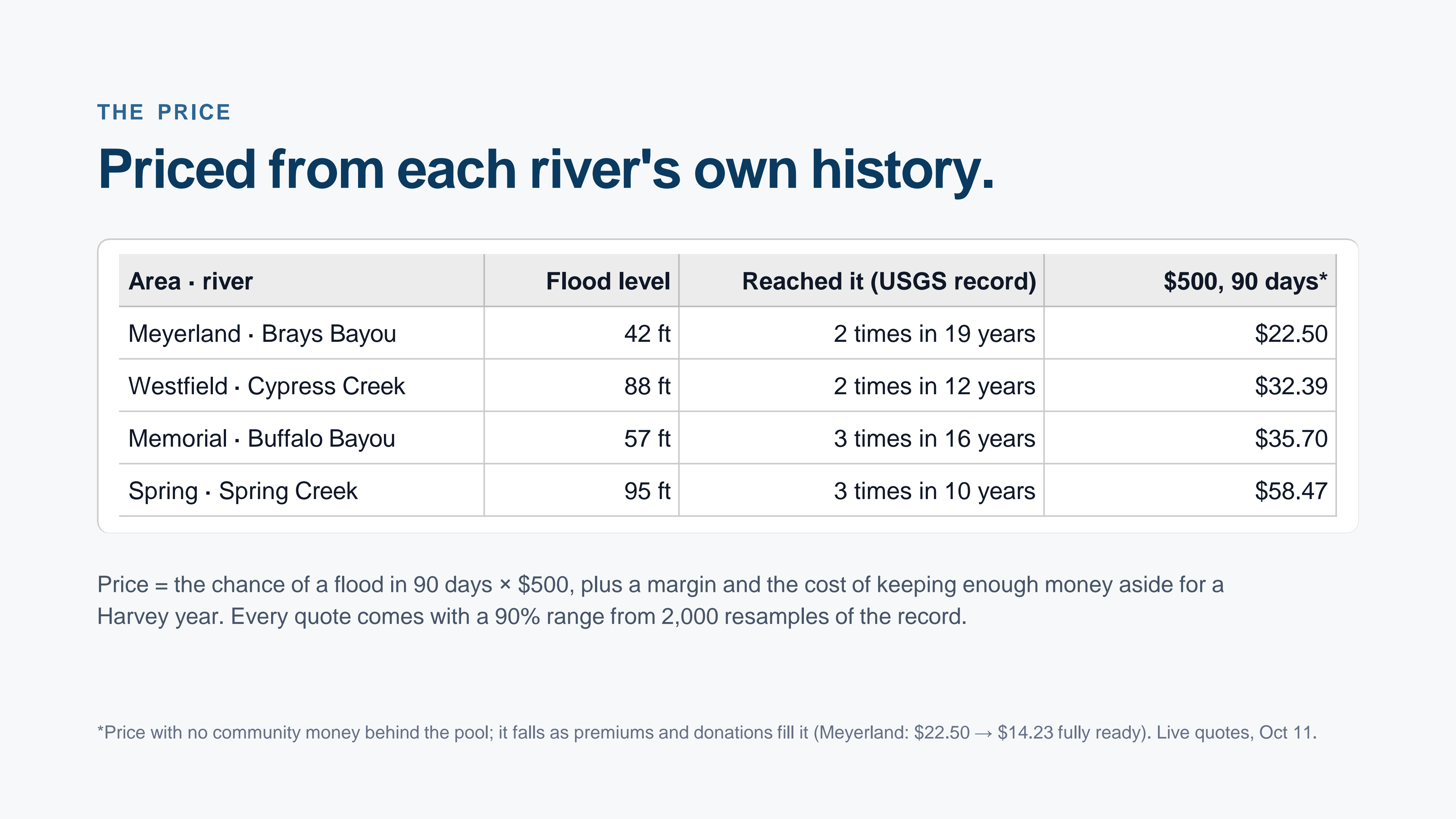
- Get protected: type your ZIP or neighborhood. A covered address turns green and shows the gauge and flood level that would pay you; an uncovered one turns red. Pick $250 or $500, see the price ($22.50 for $500 in Meyerland), and confirm one wallet transaction. "Why $22.50?" shows the basis: Brays Bayou reached flood level 2 times in 19 years of records. The policy is a non-transferable token in your wallet named Atlas Policy ACTV.
- You're protected: your page shows the river level against the flood line, days left and your balance.
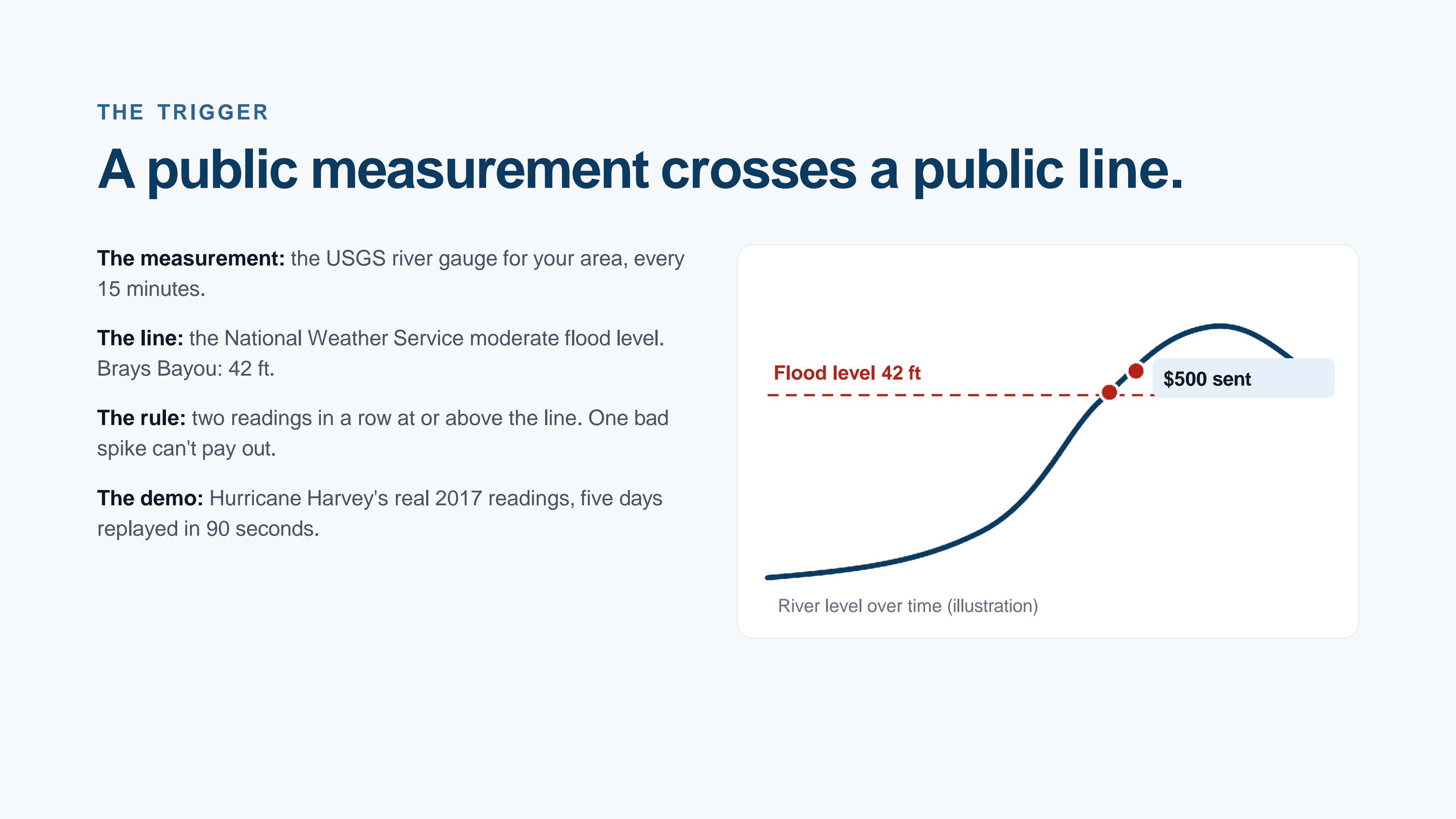
- Trigger: when a gauge records two consecutive accepted readings at or above its flood level, Atlas opens an event and records a hash of the exact reading.
- Pay: the payout bot sends the money with a Memo carrying that hash, and the policy turns PAID in the same transaction. The phone switches to "Flood detected · Meyerland. We've sent you $500 for immediate costs", with what to do right now: call 911 if in danger, find a shelter, use the money for a room or food.
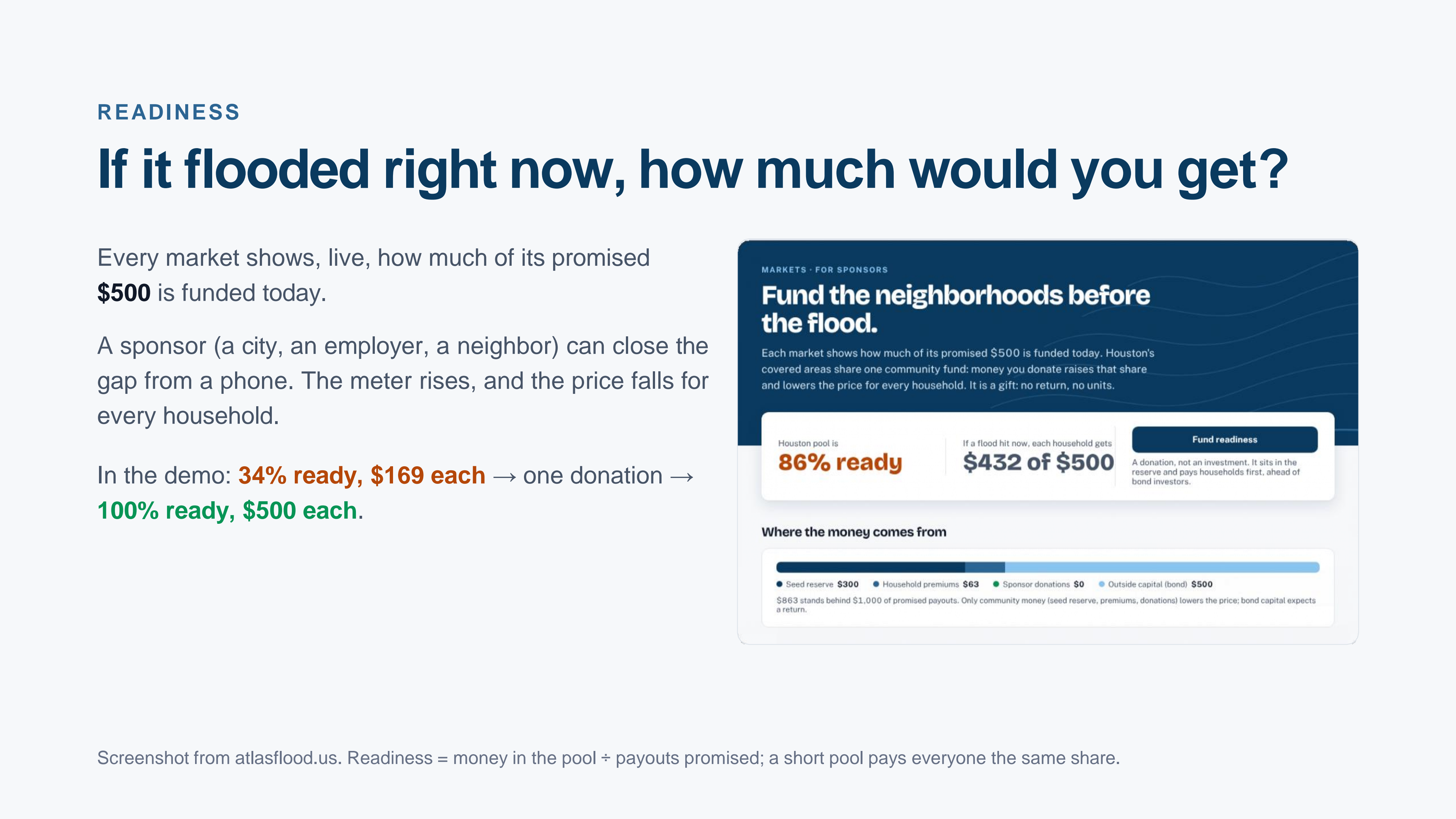
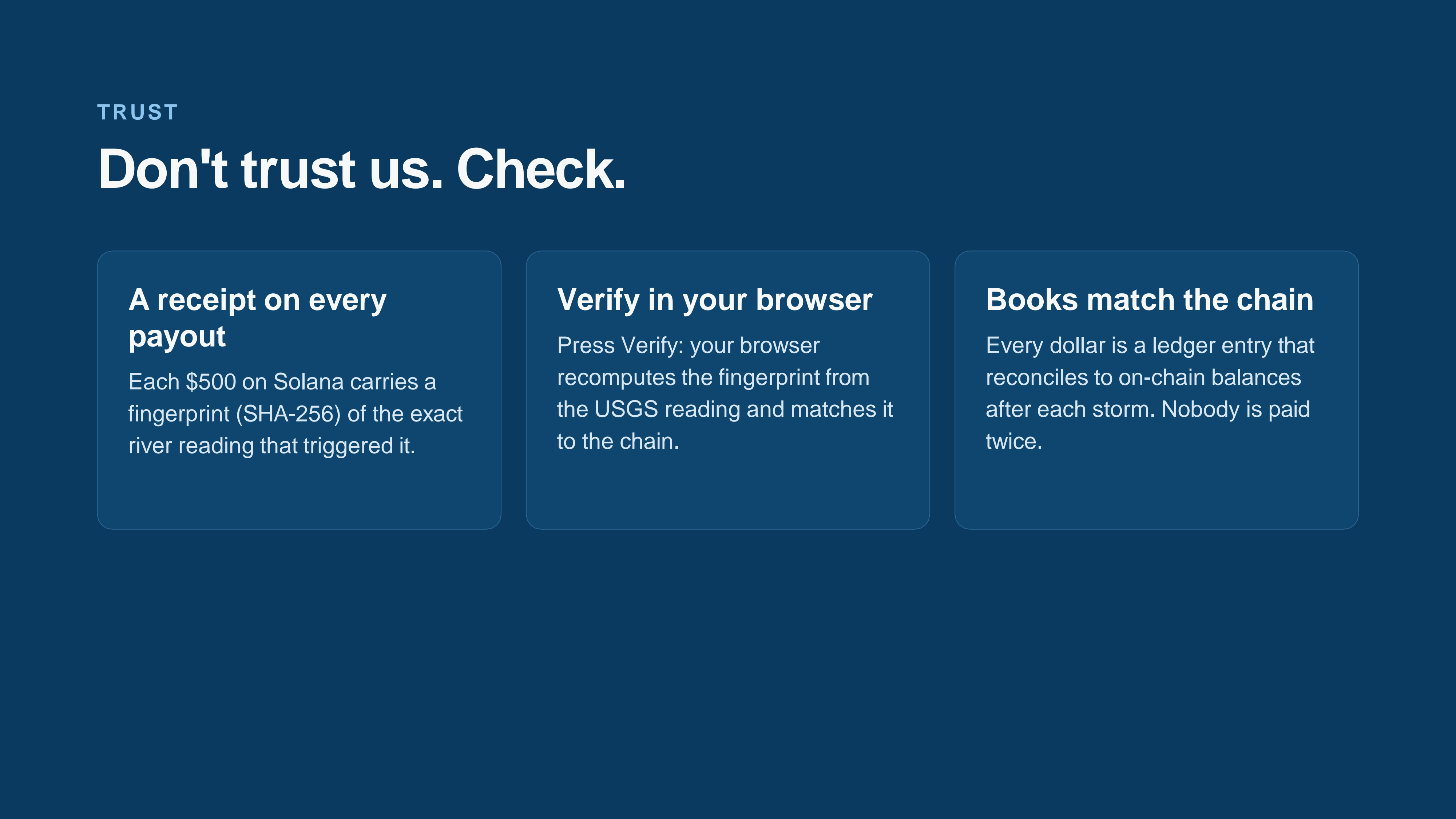
- Proof: one page shows the money set aside and a "matches the blockchain" check, lists every payout with a Verify button that recomputes the reading's fingerprint in your browser, and stress-tests the pool against another Harvey.
For the demo, we replay Hurricane Harvey from the real 2017 USGS record: about five days of 15-minute readings at our four covered gauges (Brays Bayou, Buffalo Bayou at Piney Point, Cypress Creek and Spring Creek), squeezed into about 90 seconds and time-shifted to now. The map turns red bayou by bayou, the live feed reports each flood in plain words, and payouts land on a real phone.
Cover runs for 90 days for one premium. Triggers sit at each gauge's National Weather Service moderate flood stage, which prices \( 500 \) aUSD of cover at about 22 to 58 aUSD per 90 days on the demo gauges.
How we built it
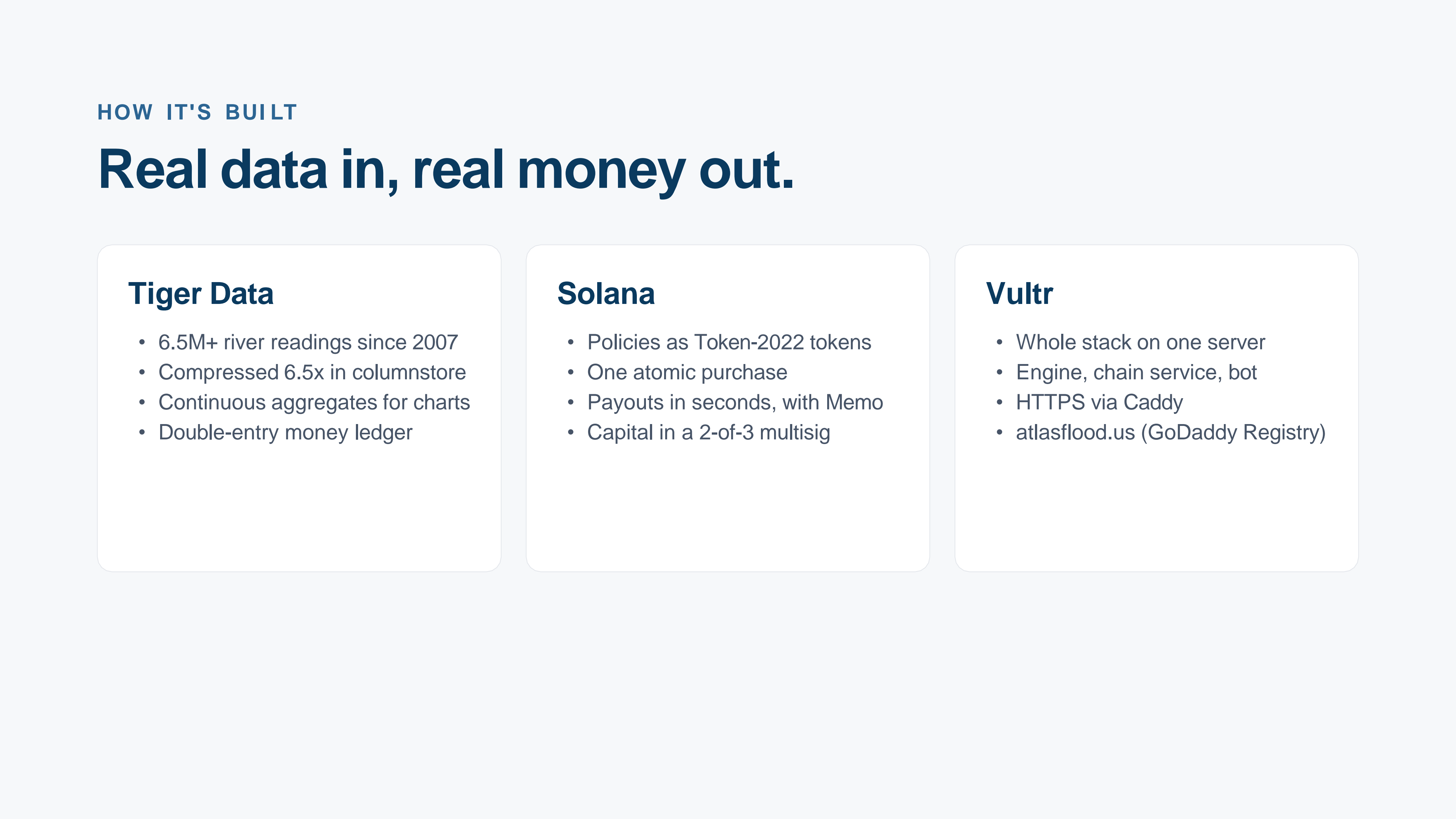
Tiger Data (TimescaleDB): the risk engine and the books
- Gauge readings and the money ledger are hypertables. The 2007 to 2026 instantaneous history (from 2011 for Spring Creek; more than 5.8 million readings) sits in columnstore, compressed from 1.05 GB to 162 MB (6.5x). The history charts read a continuous aggregate of hourly maxima, spot-checked against the raw readings.
- Annual peaks go back 60 to 92 years per gauge. USGS datum-change flags set where each gauge's comparable, priced record starts (2007 to 2015), so prices rest on 11 to 19 comparable years.
- Every money movement is a double-entry ledger row; every entry sums to zero.
- Events, storms, policies and payout intents live alongside, so one database answers "who gets paid, how much, and why".
- A FastAPI engine reads Tiger to price policies, stream the replay, open and close events, and reconcile.
Solana (devnet): the money
aUSD, a test stablecoin, so we never depend on a faucet.- Policies are Token-2022 mints with NonTransferable, MetadataPointer, TokenMetadata and PermanentDelegate. The status lives in the token name (
ACTV/PAID) so wallets show it. - Purchase is one atomic transaction: premium to the vault, mint the policy, lock supply at 1. You can't pay without getting the policy, or the reverse.
- The pool's capital sits in a Squads v4 2-of-3 multisig vault with a time lock. The payout bot only holds a capped float, refilled from the vault by a 2-of-3 proposal.
- Every payout is signed, recorded, then sent. After a crash, the bot settles every recorded signature before building anything new, so a policy is never paid twice.
Vultr + GoDaddy Registry: the whole stack (engine, chain service, payout bot and dashboard behind one gateway) runs on one Ubuntu Vultr instance behind Caddy (automatic HTTPS) and systemd at atlasflood.us, a domain registered through the GoDaddy Registry offer.
Dashboard: Vite + React with Leaflet: a map with the Harvey replay, a phone-first "Get protected" and "My protection" flow, and a Proof page that verifies payouts in the browser. The phone view can be mirrored on stage.
The math
Pricing. For gauge \( g \) we estimate the yearly event rate two ways, from annual peaks (\( \hat\lambda^{\text{peak}}_g = N_g / T_g \)) and from instantaneous readings with the contract's own open and close rule (\( \hat\lambda^{\text{iv}}_g \), since one year can hold several floods), and price with the higher. For a term \( t \) (90 days):
$$ \hat\lambda_g = \max\big(\hat\lambda^{\text{peak}}_g , \hat\lambda^{\text{iv}}_g\big) \qquad P(\text{payout}) = 1 - e^{-\hat\lambda_g t} \qquad \pi = B\left(1 - e^{-\hat\lambda_g t}\right)(1+\theta) + c k_i t $$
where \( \theta \) is the risk load and \( c k_i t \) the cost of the capital the policy ties up for its term. We bootstrap the years 2,000 times to show a 5th to 95th percentile band next to every quote.
Correlated capital. Floods hit every bayou at once, so each water year in which every gauge in the book has a comparable peak (WY2015 to WY2024, ten years) is one scenario across all gauges:
$$ S_y = \sum_i B_i \cdot \mathbf{1}\left[\text{peak}{g(i),y} \ge \text{trigger}{g(i)}\right] \qquad K = \max\Big(\max_y S_y , S_{\text{Harvey}}\Big) - \mathbb{E}[L] \qquad k_i = K \frac{B_i}{\sum_j B_j} $$
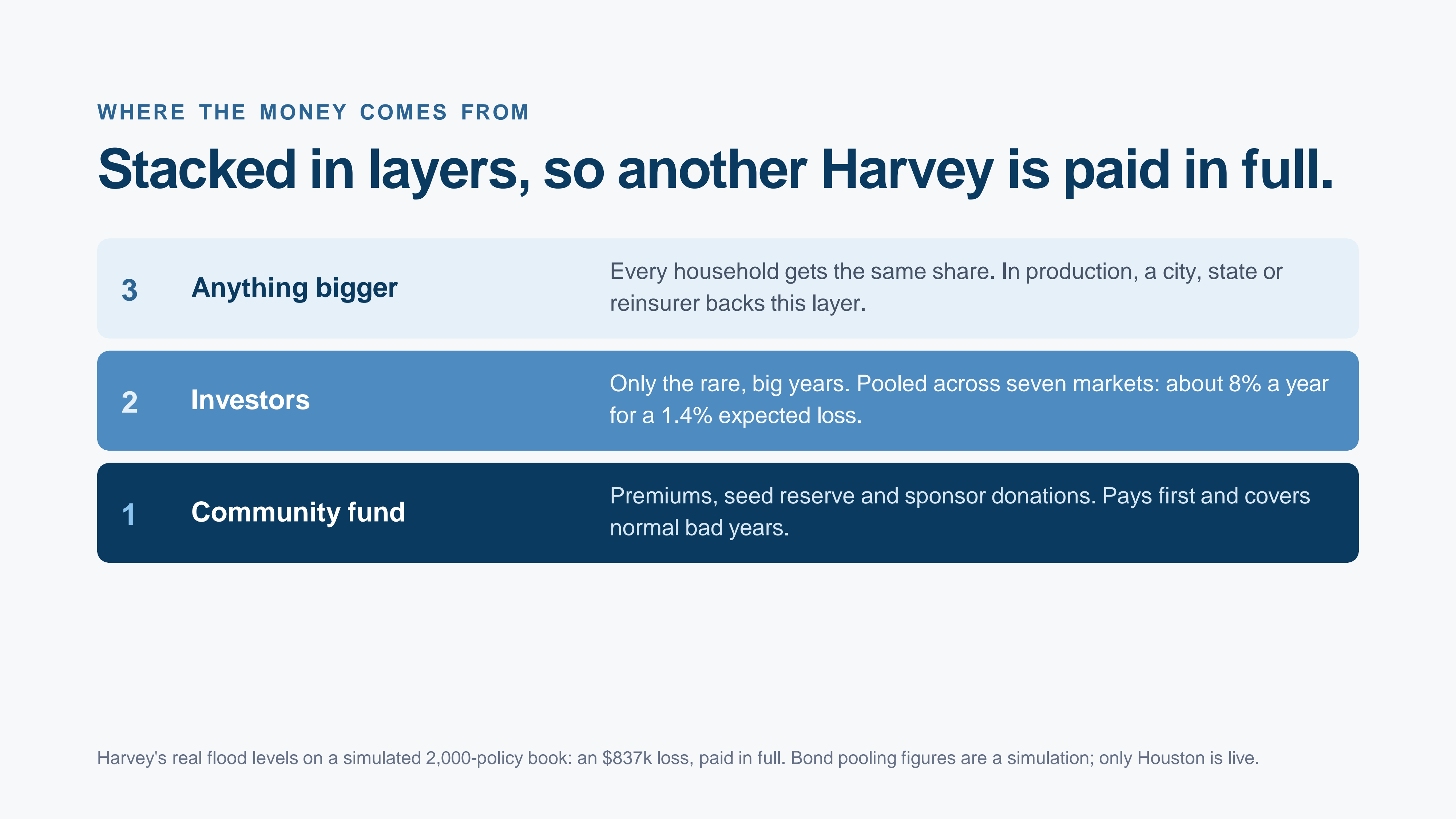
where \( \mathbb{E}[L] \) is the expected annual loss implied by the priced rates. That is a worst-observed-year standard, not a modelled 1-in-200, and we say so. On our simulated 2,000-policy book over seven gauges, \( \mathbb{E}[L] \) is about $168k and \( K \) about $669k. Harvey (water year 2017) is the worst year: a $837k loss, paid in full (\( f_{\text{fin}} = 1 \)). The premium reserve covers the first $200k and the catastrophe bond the remaining $637k, so bond investors lose about 95% in a Harvey year. That is the trade they are paid for.
Paying fairly in a big storm. If the pool can't cover everyone at once, everyone in the storm gets the same share, whatever order their gauges cross in. With available funds \( A \) (reserve plus bond capital at the start of the run), \( E_{\text{risk}} \) the payouts of active policies on gauges under a flood watch when the storm opens, and \( E_{\text{trig}} \) the payouts on gauges that actually triggered:
$$ f_{\text{int}} = \min\Big(1 , \frac{A}{E_{\text{risk}}}\Big) \qquad f_{\text{fin}} = \max\Big(f_{\text{int}} , \min\Big(1 , \frac{A}{E_{\text{trig}}}\Big)\Big) $$
Each triggered policy gets \( f_{\text{int}} B \) immediately, and a true-up of \( (f_{\text{fin}} - f_{\text{int}}) B \) when the storm closes. Losses hit the premium reserve first, then the catastrophe bond, whose NAV per unit falls accordingly.
Evidence and books. Each payout Memo is atlas:v3: followed by \( \mathrm{SHA256}(\text{preimage}) \), where the preimage fixes the gauge, the latched reading, its time, the run, the storm and the event, byte for byte across Python, the bot and the browser. Every run reconciles, separately for the vault and for the payout float:
$$ \text{opening balance} + \sum \text{this run's ledger rows for that account} = \text{on-chain balance} $$
Challenges we ran into
- Gauges fail in the floods that matter. In the real Harvey record, several gauges went dark for 13 to 99 hours mid-flood (Whiteoak Bayou came back with a single value). A crossing seen across a gap is an artifact, so those gauges are not covered. A naive jump filter also deleted real Harvey rises (Brays went from 27.0 to 30.4 to 34.9 ft in two readings), so the loader rejects only spikes that jump away and straight back, and the replay allows larger moves across a gap.
- History isn't always comparable. Gauge datums and channels change over decades. We start each gauge's priced record the year after USGS flags a datum change, so an old peak measured on a different zero can't distort today's price.
- Some places are too risky to insure cheaply. Greens Bayou crosses its minor flood stage about once a year, which would have meant a 105 aUSD premium for 500 aUSD of cover. We dropped it rather than hide that, and moved triggers to the moderate flood stage.
- Never paying twice. Crash recovery, expired blockhashes and retried submits all had to resolve to exactly one payout and exactly one ledger entry.
- Books that survive a demo reset. Reset tops balances back up for the next judge, so absolute totals drift. We reconcile per run against opening balances instead, and book each transaction to the run open at its block time.
- Devnet reality: public RPC rate limits, and wallets that differ in how they accept a server-signed transaction.
Accomplishments that we're proud of
- A real devnet payout triggered by a replay of the real Harvey record, with the evidence hash on-chain and the books reconciled. Then a reset and a second run, paid and reconciled again.
- One atomic purchase, storm-level fair shares with a true-up, and a payout path that can't double-pay.
- Two full audits of our own code before submission, with every fix re-tested end to end through the dashboard on devnet.
What we learned
Parametric insurance is mostly a data problem and a trust problem. The data problem is choosing triggers from records that change under you. The trust problem is proving the payout followed the rule, which is what the hash, the public ledger and the reconciliation are for. And time-series databases make the actuarial work (annual peaks, scenario years, rolling aggregates) much simpler than we expected.
What's next for Atlas
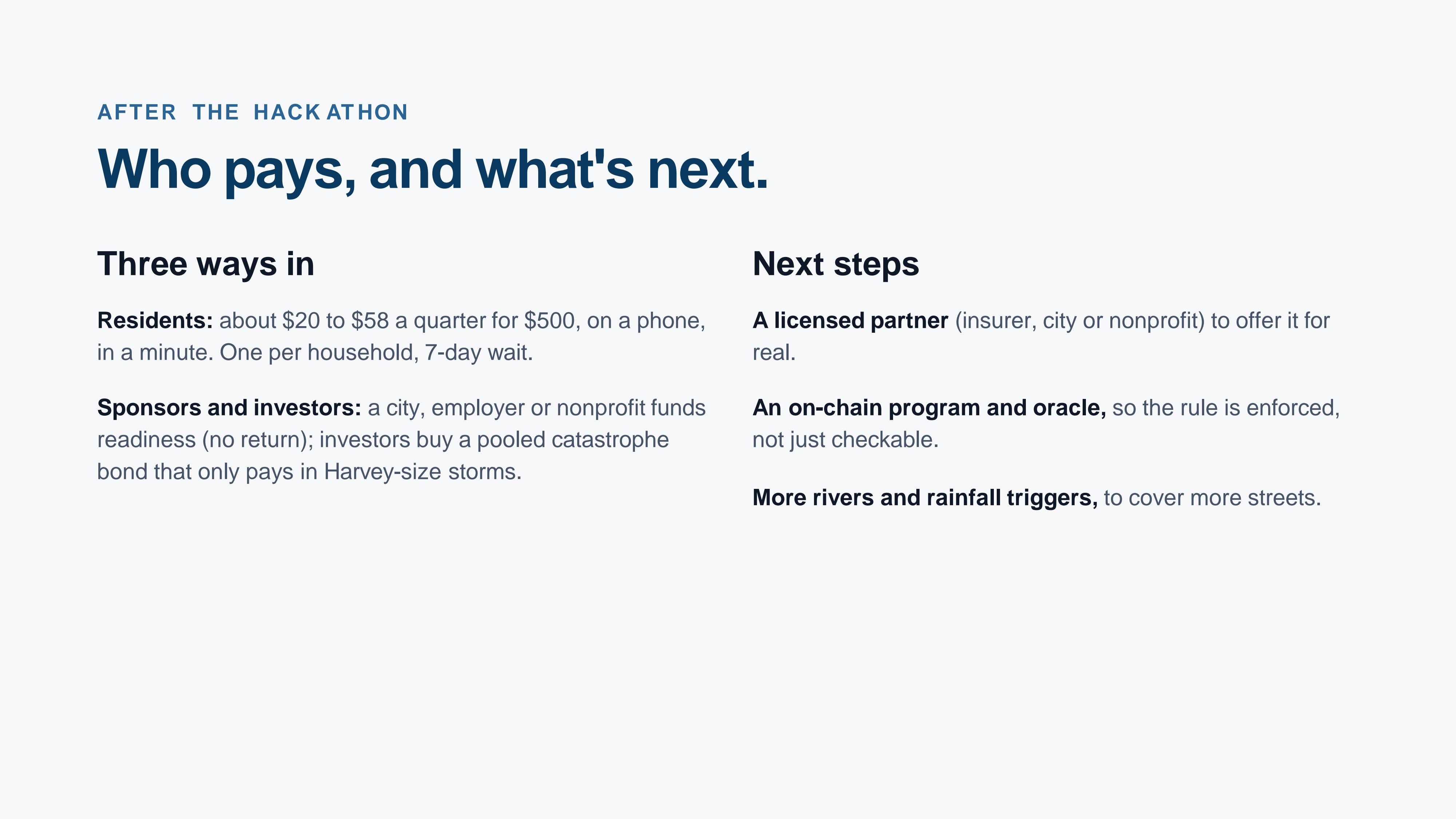
- An on-chain program that enforces the payout rule, and an oracle (e.g. Switchboard) for gauge readings, so no server decides to pay.
- Rainfall and multi-gauge triggers to reduce basis risk; NWS flood stages for every trigger.
- A licensed partner (insurer, city programme or nonprofit) to sell it, and a cash-out path through an off-ramp or a linked card.
Limitations (honest version)
- Basis risk: payouts follow a gauge, not your street.
- Devnet and test money only; not a licensed insurance product, and the bond token would likely be a security.
- The bot decides to pay; the Memo makes that auditable, not enforced.
- The catastrophe numbers come from a simulated 2,000-policy book (the spread over gauges is an assumption); on-chain capital is seeded test money.
- No seasonality yet: the price uses a yearly rate for a 90-day term, so cover bought in the quiet season is overpriced and cover bought before hurricane season is underpriced.


Log in or sign up for Devpost to join the conversation.