-
-
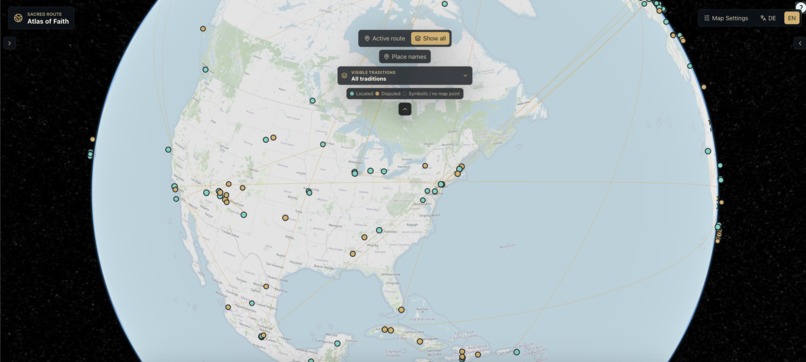
Different map views
-
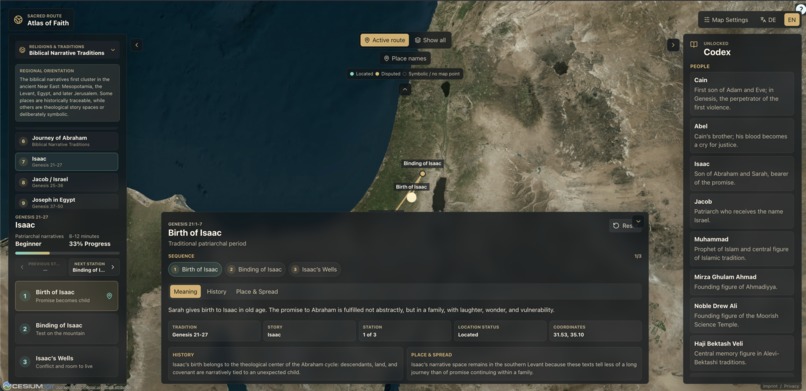
Details for every route point
-
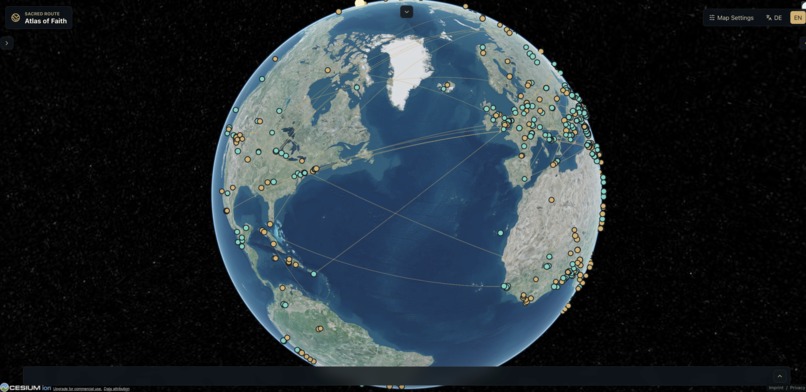
Atlas of Faith
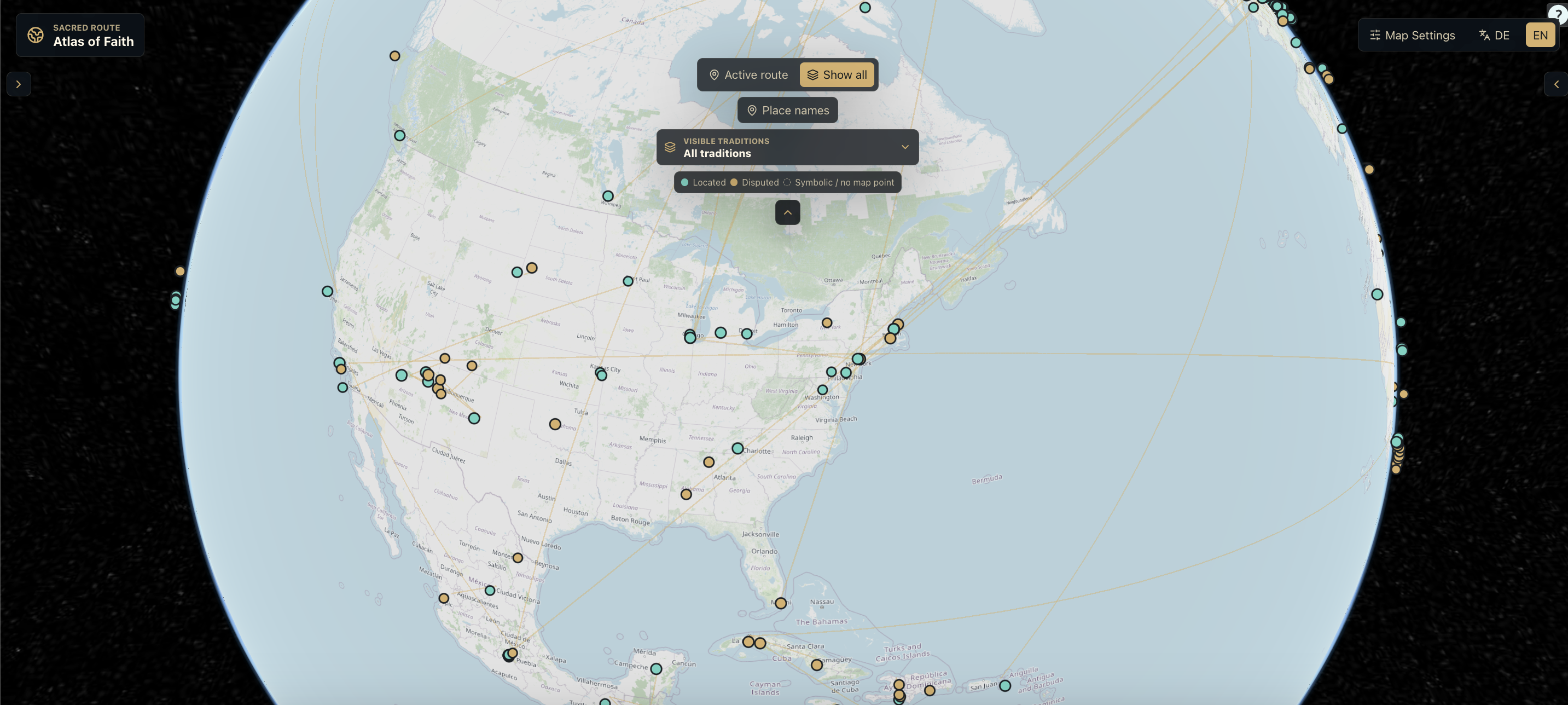
Inspiration
I did not start Atlas of Faith with a product roadmap. My father was visiting me. He is 70, religious, and had tried AI a few times, but he was not yet convinced that it could be genuinely useful. I wanted to show him something he could actually explore, rather than giving him another abstract explanation of what AI might be able to do.
Because the Bible was familiar to him, my first thought was: what if I put its places and journeys on a globe? I used ChatGPT to research ways of building a 3D world map and found CesiumJS. The first version was small: a globe, a few points, and a route connecting places from the journey of Abraham. But finished in under 15 minutes and ready when he arrived.
At first I thought this might become a game. You would travel from one location to the next and unlock parts of a story. That game did not really happen, at least not yet. Instead, I became interested in the map itself.
Seeing Ur, Haran, Canaan, and Jerusalem together changed the way I looked at the journey. The names became distances, directions, and landscapes. I could see where a story moved and how places related to one another. That was the moment when the project stopped being only a small Bible experiment.
I began adding other religions and traditions, including many that I previously knew very little about. The atlas became a learning tool for me as well. I scroll around the globe and find marks in regions far away and could directly zoom into the traditions. That feeling of discovery became the real idea behind Atlas of Faith.
What it does
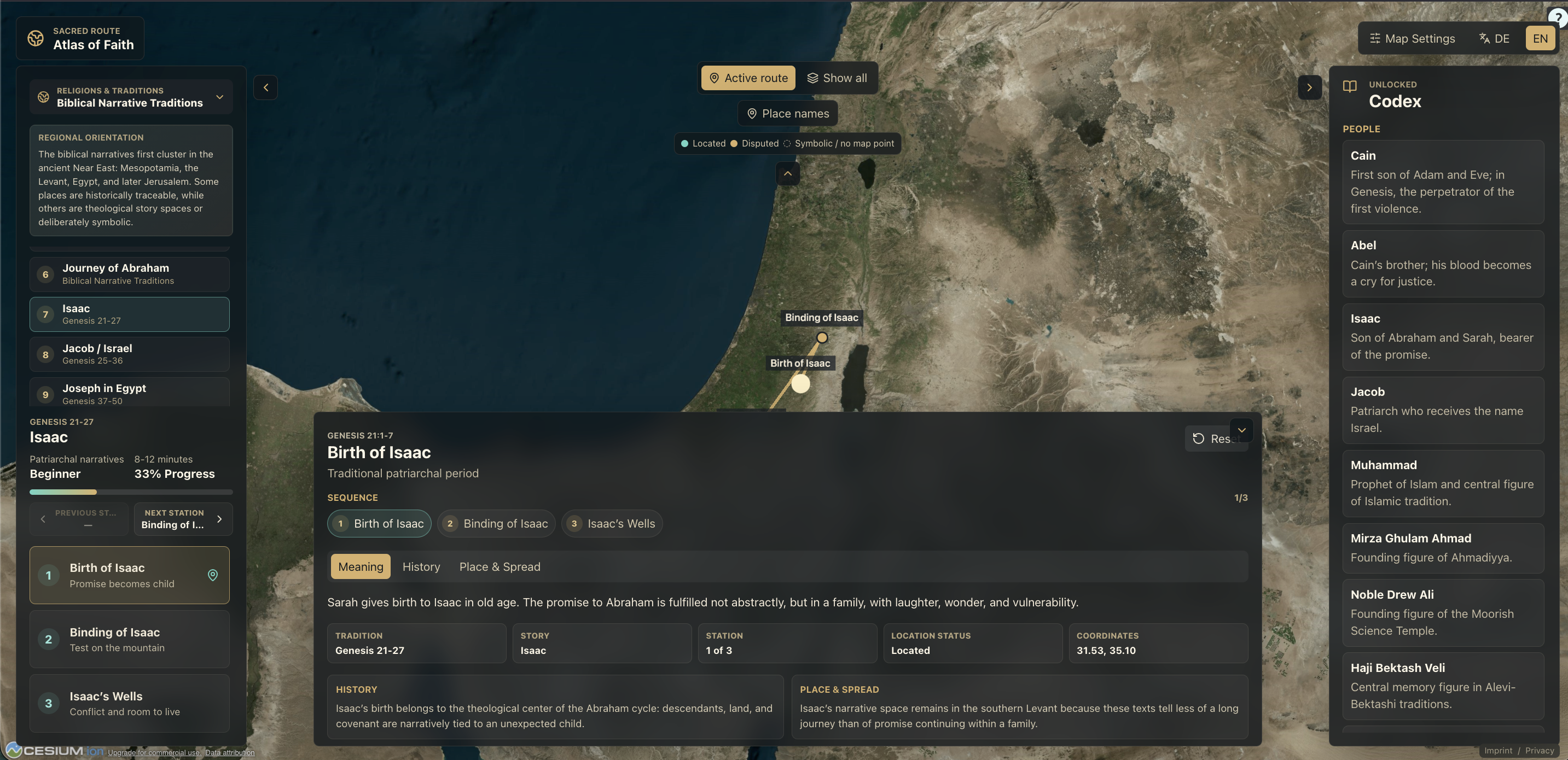
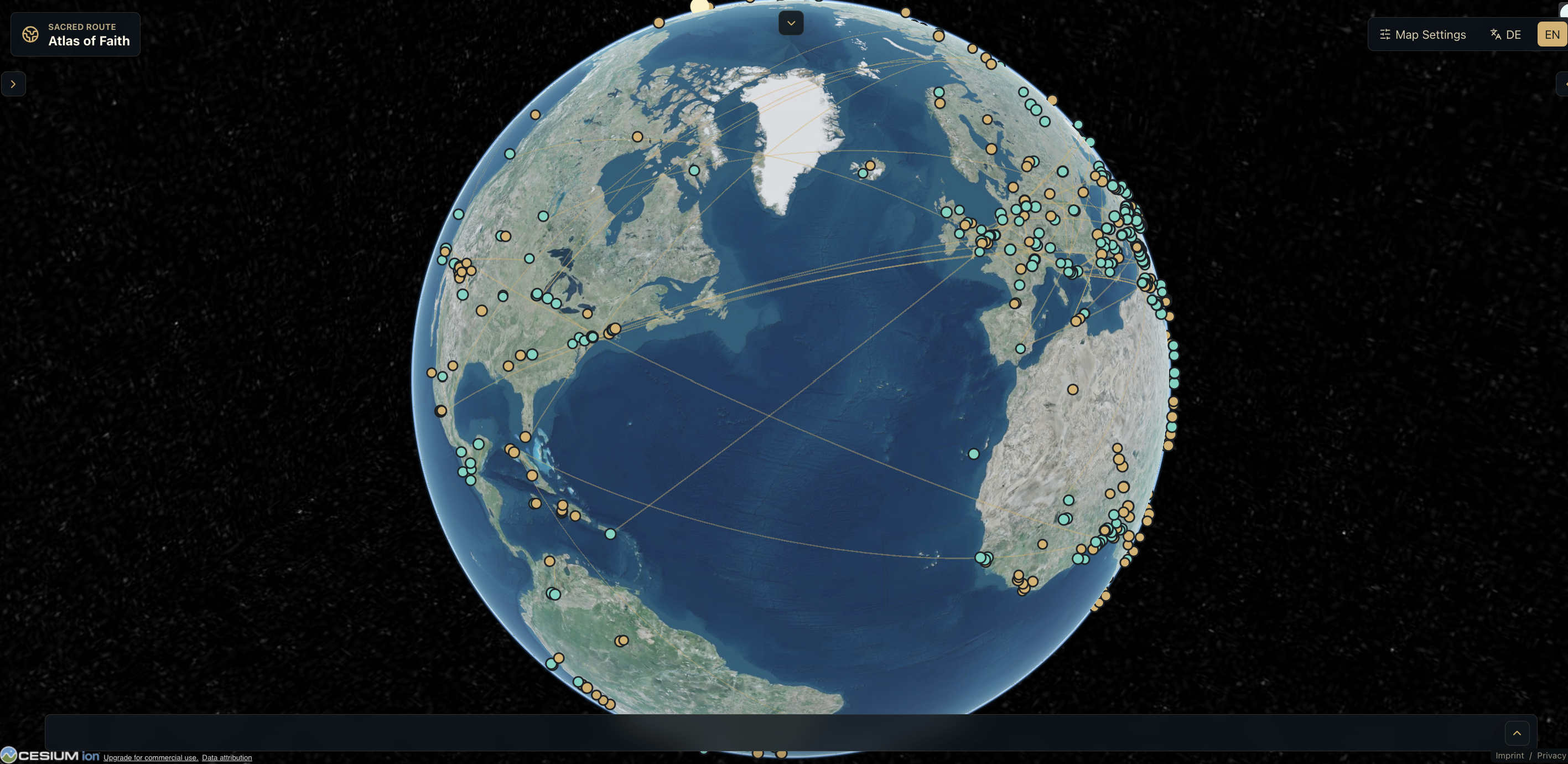
Atlas of Faith is a bilingual 3D atlas for exploring religious narratives, historical developments, and living traditions through geography. It currently contains 590 routes and 1,820 stations in German and English.
At each station, the information is divided into three questions:
- Meaning: What does this event, place, person, or practice mean within the tradition?
- History: What is historically documented, interpreted, or disputed?
- Place & Spread: Why is this location shown, and how does the tradition relate to the wider region?
I added these distinctions because a point on a map looks more certain than a paragraph of text. When users see a marker, they can easily assume that an event happened at exactly that location. In reality, some places are historically documented, some are traditional associations, some are only useful regional anchors, and others are symbolic.
For that reason, every station is marked as located, disputed, or symbolic. A creation story, for example, should not receive an apparently historical coordinate simply because the interface expects a point.
Users can follow routes on the globe, switch languages, open sources, compare traditions, and discover related people, places, and concepts in the atlas.
How I built it
The application is built with React, TypeScript, Vite, and CesiumJS, and is deployed with Cloudflare Pages.
I built Atlas of Faith entirely with Codex, using GPT-5.6 throughout the development process. Codex helped me turn the first idea into the interactive globe, expand and structure hundreds of route modules, redesign the three perspectives, detect misleading coordinates and repeated text, and build quality audits for 1,820 stations. I remained responsible for the concept, editorial direction, review, and final decisions.
So atlas of Faith already existed before Build Week, but it was a less structured project that had grown quickly from the original Bible route. During Build Week, I used Codex and GPT-5.6 to turn that large prototype into a more coherent educational product.
The most useful part of Codex was not generating another batch of routes. It was helping me inspect what I had already built. I exported all 1,820 stations into reviewable Markdown and JSON files, checked hundreds of route modules, and created audits for incomplete text, repeated wording, naming, source links, translation differences, and questionable map locations.
One audit initially found 7,552 editorial markers and spelling patterns that needed attention. Other checks showed that some supposedly specific source labels linked only to general encyclopedia pages. I also found stations with coordinates even though their own text said that no secure location was known.
Codex and GPT-5.6 helped me:
- replace the old game-oriented tabs with Meaning, History, and Place & Spread;
- introduce located, disputed, and symbolic map states;
- rename unclear categories, including replacing “Bible” as if it were a religion;
- remove repeated template language and inconsistent German spelling;
- build a source-diversity audit instead of guessing about source quality;
- prepare a 20-route editorial showcase with a stronger source standard;
- add direct links to routes and stations for the demo;
- improve the interface on smaller screens;
- document the project so another person can install and evaluate it.
I used AI for speed, comparison, and consistency, but I still had to decide what the product should claim, which wording felt responsible, and where the correct answer was to show uncertainty.
Challenges I ran into
The first challenge was scale. Adding the content with AI is fast, but reviewing it is not. Once the atlas contained hundreds of routes, repeated sentences and weak explanations were difficult to notice while clicking through the interface. Some sections looked complete because every field contained text, but the text did not always say enough about the actual tradition.
The second challenge was that “religion” is not a simple category. Scripture, oral tradition, ritual, migration, archaeology, community memory, and present-day identity do not fit into one shared route model without careful explanation. I also learned that some knowledge should not be mapped precisely. This is especially important for living and Indigenous traditions where places or practices may be local, protected, or inappropriate to detach from their communities.
Sources were another uncomfortable issue. The atlas had many links, but a large share came from only a few general websites. A large number of sources is not the same as a diverse or appropriate source base. I decided to show that limitation in the audit instead of hiding it.
What I am proud of
The number of routes is impressive to me, but I am more proud of the changes that make the map less misleading. The project now distinguishes belief, historical evidence, and geographic interpretation instead of presenting them as the same thing.
I am also proud that the atlas can now be reviewed outside the interface. All station texts can be exported, searched, compared, and handed to another person for feedback. That makes future specialist or community review much more realistic.
Most of all, the project became the useful AI example I originally wanted to create for my father. It started with a subject he cared about, but it also led me into traditions and parts of the world that I had never explored before.
What I learned
I learned that AI can help one person build something surprisingly large, but size creates its own problems. The faster content grows, the more important structure, audits, sources, and human judgment become.
I also learned that maps are not neutral. A polished globe can make uncertain information look authoritative. Sometimes the most honest design decision is not to draw a route or not to place a marker.
Finally, I learned that geography is a powerful starting point for curiosity. It does not replace reading, but it gives me a different reason to begin. I can notice a route, a migration, or an unexpected neighboring tradition and then decide what I want to understand next.
What's next
The next step is not simply adding more religions. I want to improve the existing material with more primary texts, academic sources, and sources published by the communities represented. Selected routes should also be reviewed by people with relevant subject knowledge.
The original game idea may return later as an optional learning mode. For now, I want Atlas of Faith to become a more trustworthy, understandable, and enjoyable way to discover how religion, history, and place connect.
Built With
- cesiumjs
- chatgpt
- cloudflare
- codex
- react
- sol5.6
- typescript
- vite


Log in or sign up for Devpost to join the conversation.