ATLAS — "Technology That Will Carry the World"
Inspiration
ATLAS was inspired by a simple but serious problem: every building contains critical knowledge, but that knowledge is usually scattered.
Emergency shutoff locations may exist on old blueprints. Door and access relationships may be stored in separate software. Maintenance history may be buried inside spreadsheets, work orders, emails, handwritten notes, or the memory of one experienced employee.
When something fails, teams often spend valuable time searching for information instead of acting on it.
We wanted to explore a different idea:
What if a building could preserve its own operational memory?
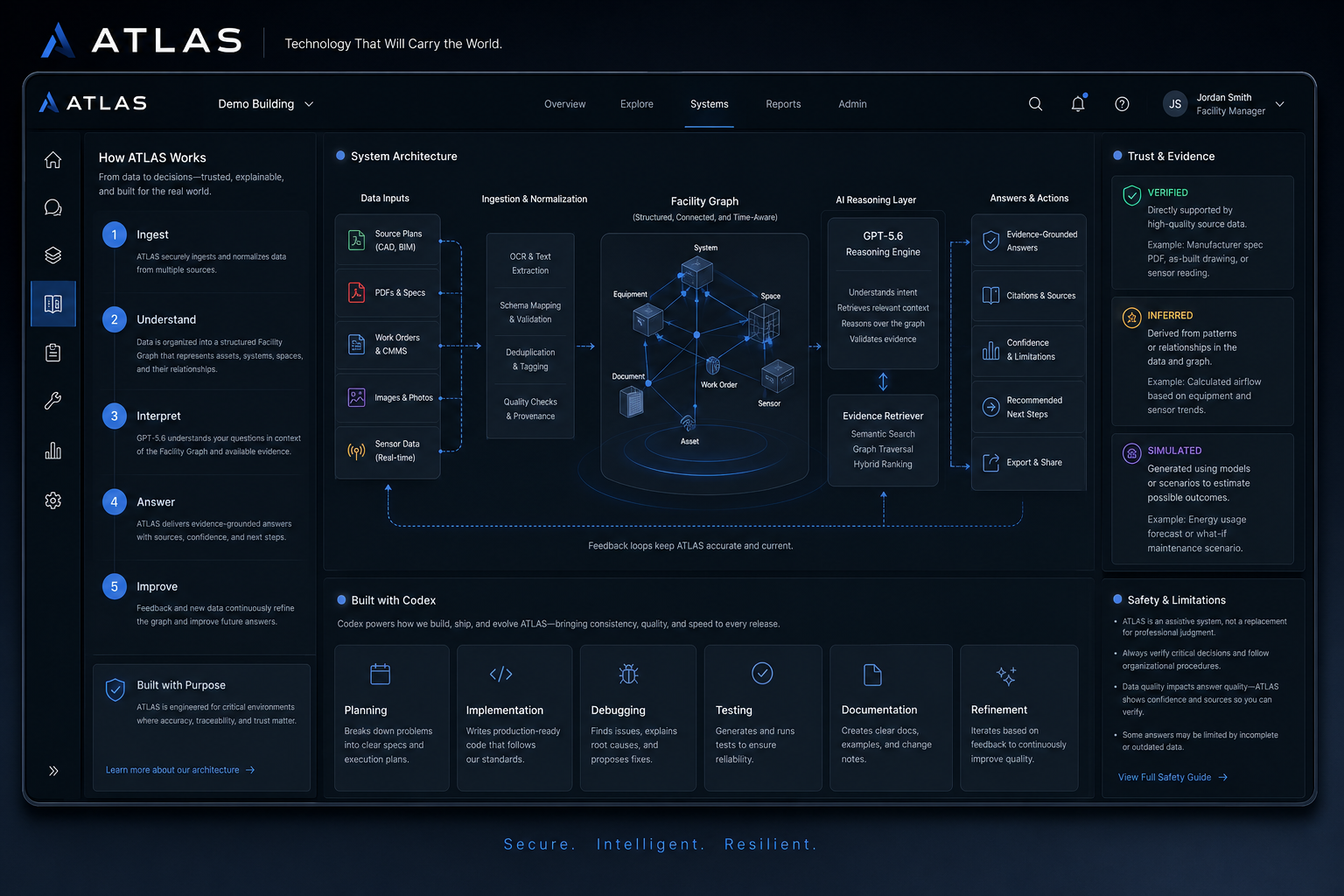
ATLAS was created as a resilient intelligence layer for physical infrastructure. Its purpose is to transform fragmented plans, records, images, maintenance history, and facility data into a living digital twin that people can explore, question, and verify.
The initial vision focuses on buildings, but the long-term concept could extend to hospitals, airports, schools, factories, ports, data centers, campuses, and other systems that depend on accurate spatial knowledge.
What ATLAS Does
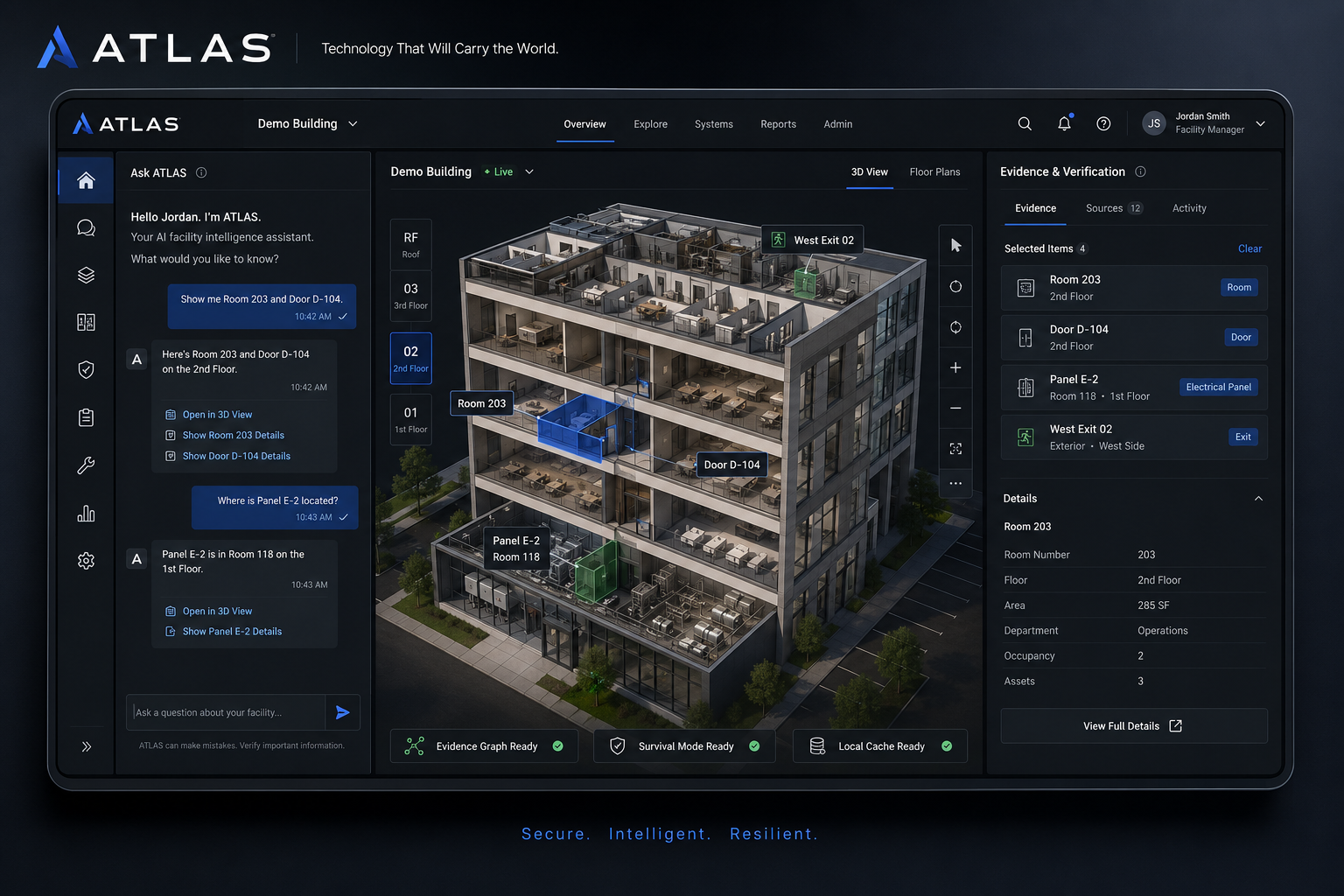
ATLAS presents facility information through an interactive digital environment.
Users can:
- Navigate a building by floor and room.
- Select doors, exits, equipment, and electrical assets.
- Ask operational questions in natural language.
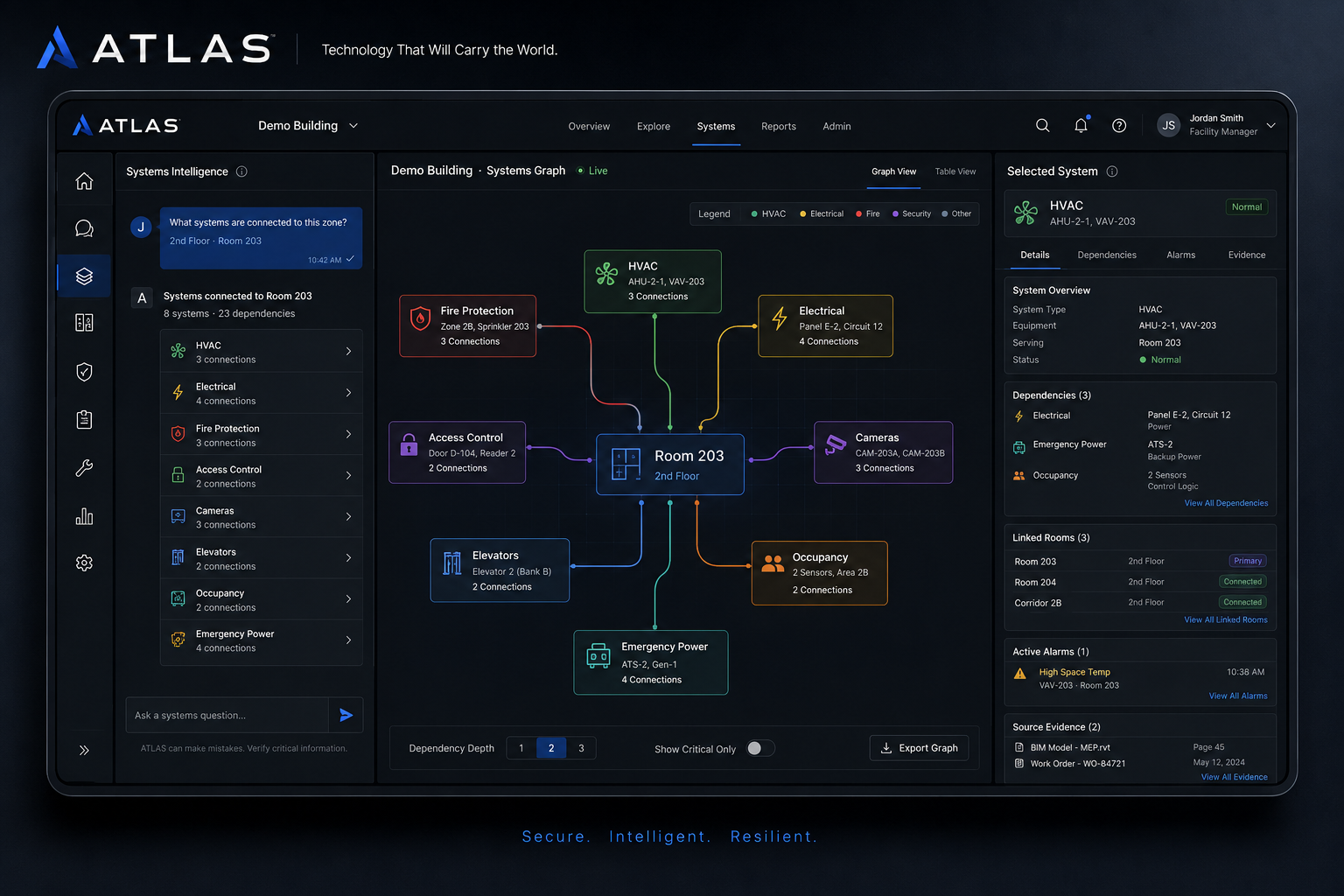
- View relationships between connected systems.
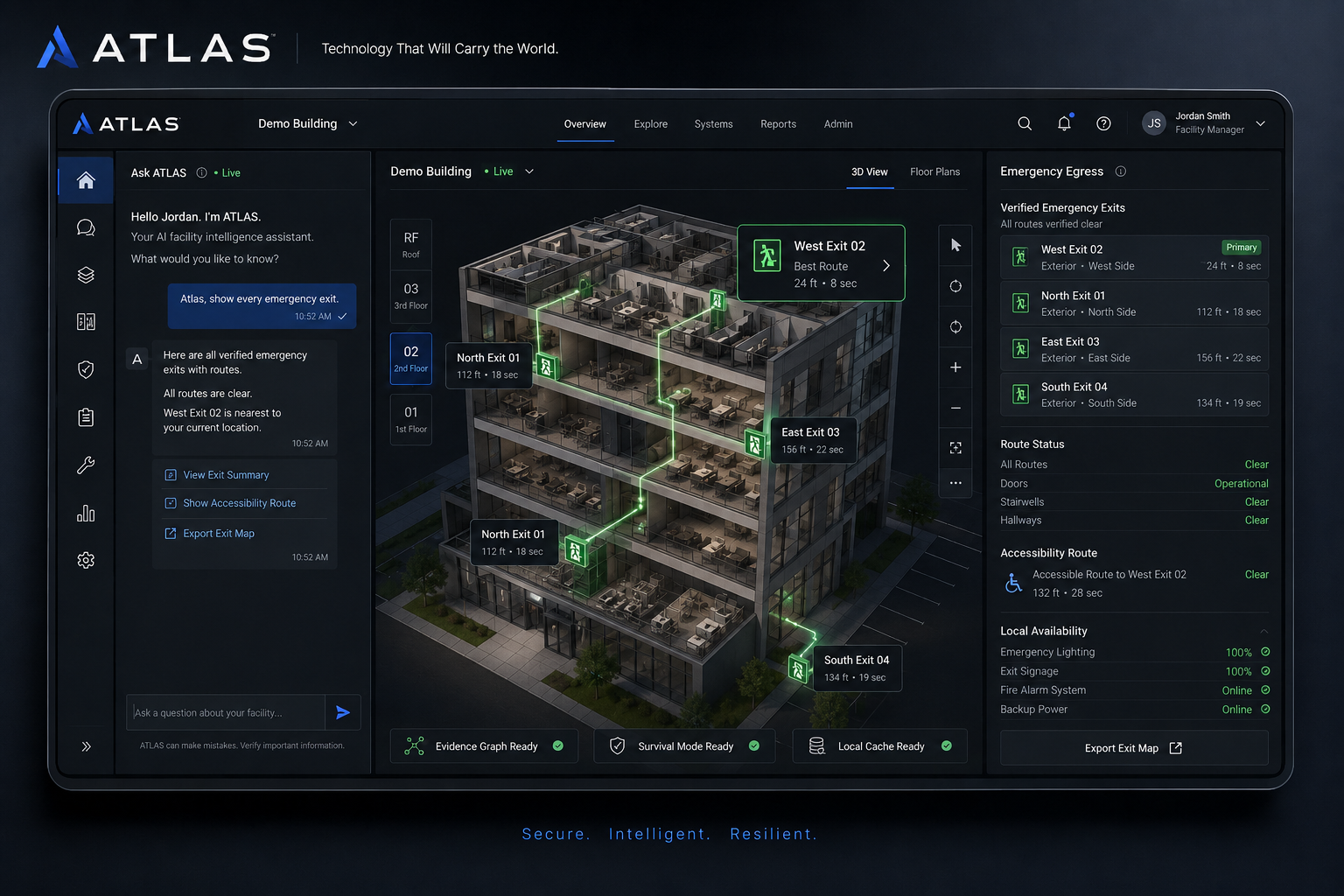
- Trace emergency routes.
- Review the evidence supporting each answer.
- Compare verified information with inferred relationships and simulated scenarios.
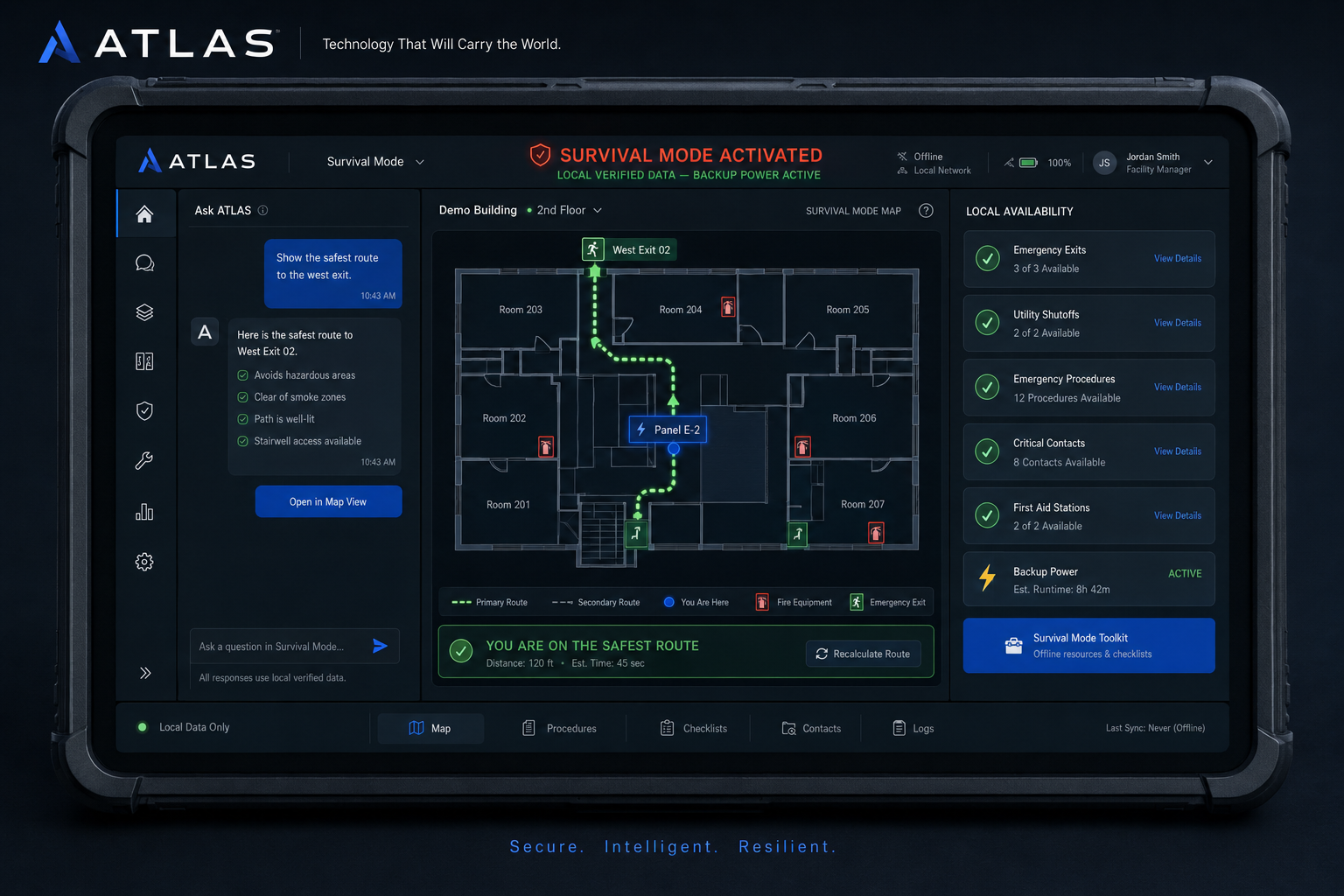
- Retain critical facility knowledge when the network becomes unavailable.
The prototype includes a demonstration facility with Room 203, Door D-104, Panel E-2, emergency exits, linked equipment, maintenance records, and source-plan revisions.
Example questions include:
- “Atlas, show every emergency exit.”
- “What depends on Door D-104?”
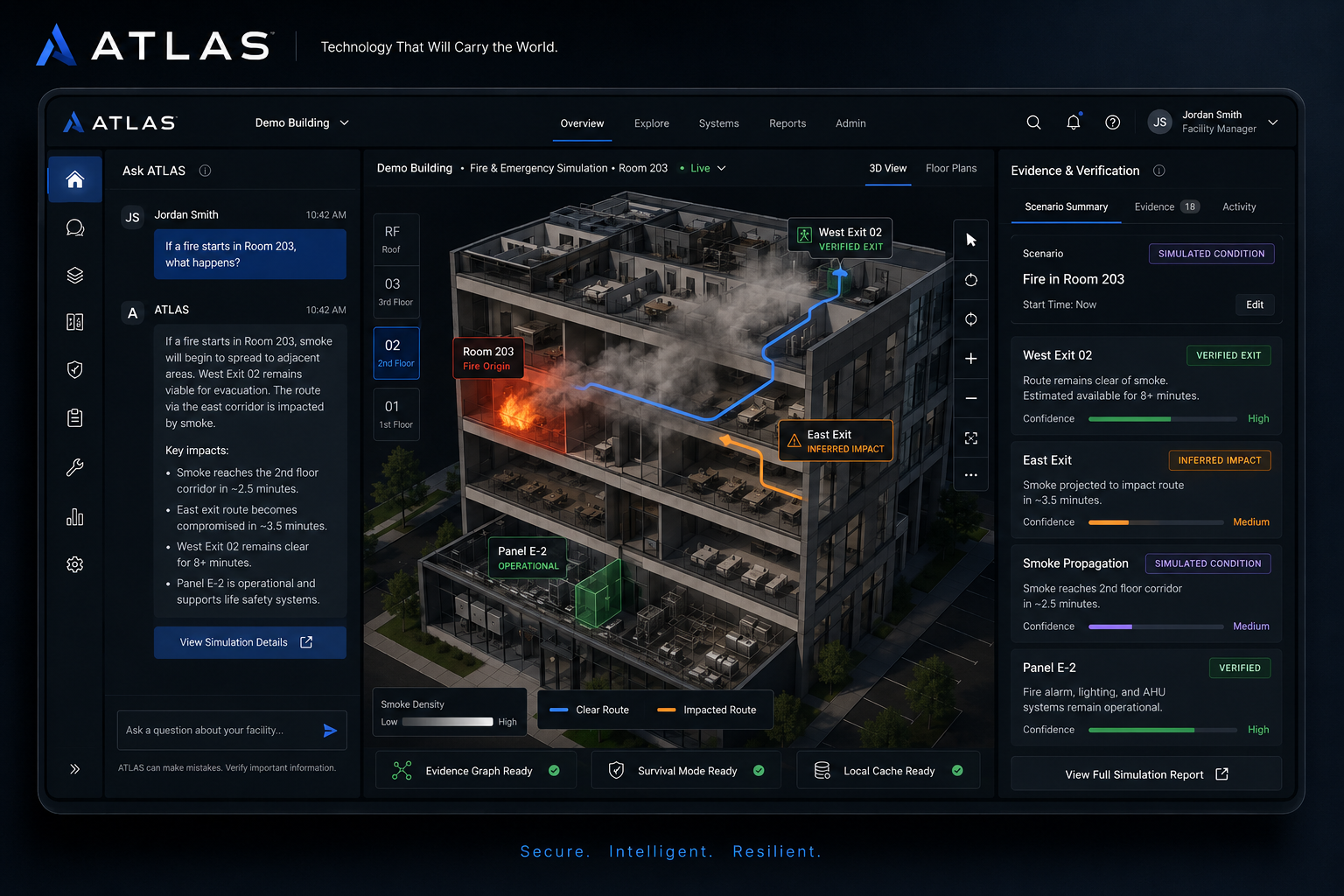
- “If a fire starts in Room 203, what happens?”
- “Show the safest route to the west exit.”
Trust and Verification
One of the most important parts of ATLAS is that it does not present every result as equally certain.
Information is divided into three categories:
VERIFIED
Information directly supported by authoritative plans, inspections, records, or field confirmation.
INFERRED
A relationship derived from available evidence but not yet directly confirmed.
SIMULATED
A condition created inside a hypothetical scenario, such as a fire, blocked route, or system outage.
This distinction is essential because facility teams need to understand not only the answer, but also where the answer came from and how much confidence they should place in it.
ATLAS is not intended to replace engineers, inspectors, emergency responders, or life-safety professionals. It is designed to help those professionals locate, connect, and interpret information more effectively.
How We Built It
We began by defining the central user experience rather than attempting to build every possible facility-management feature.
The interface was organized into three primary sections:
- A conversational panel for questions and commands.
- A central spatial viewer for the building model.
- An evidence panel showing sources, records, verification status, and linked dependencies.
The first prototype was built as an interactive web application with a dark enterprise interface, restrained electric-blue branding, and readable facility data.
The demonstration model includes:
- Multiple floors and rooms.
- Emergency exits and evacuation routes.
- Door and room relationships.
- Electrical assets and shutoff locations.
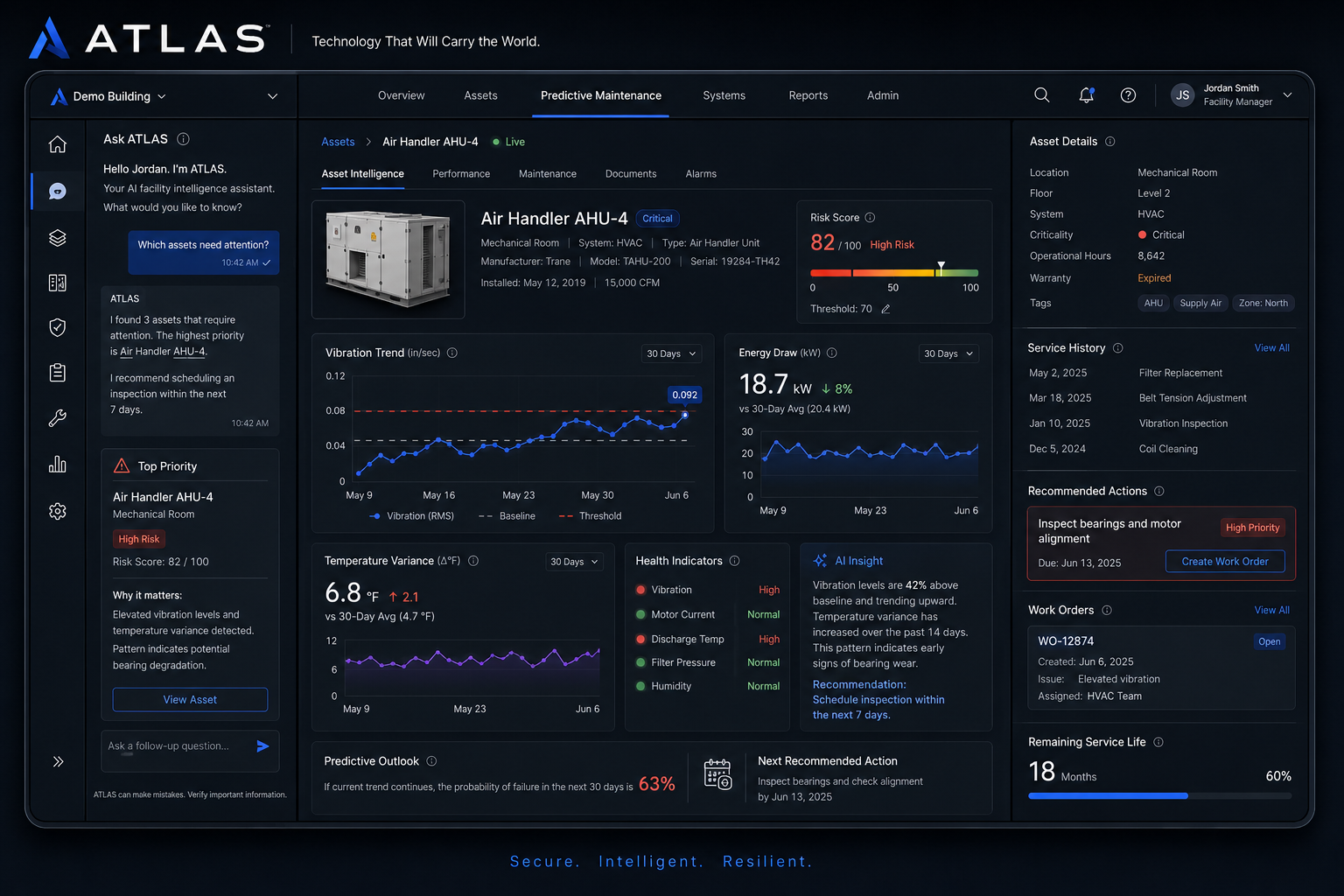
- Maintenance and inspection records.
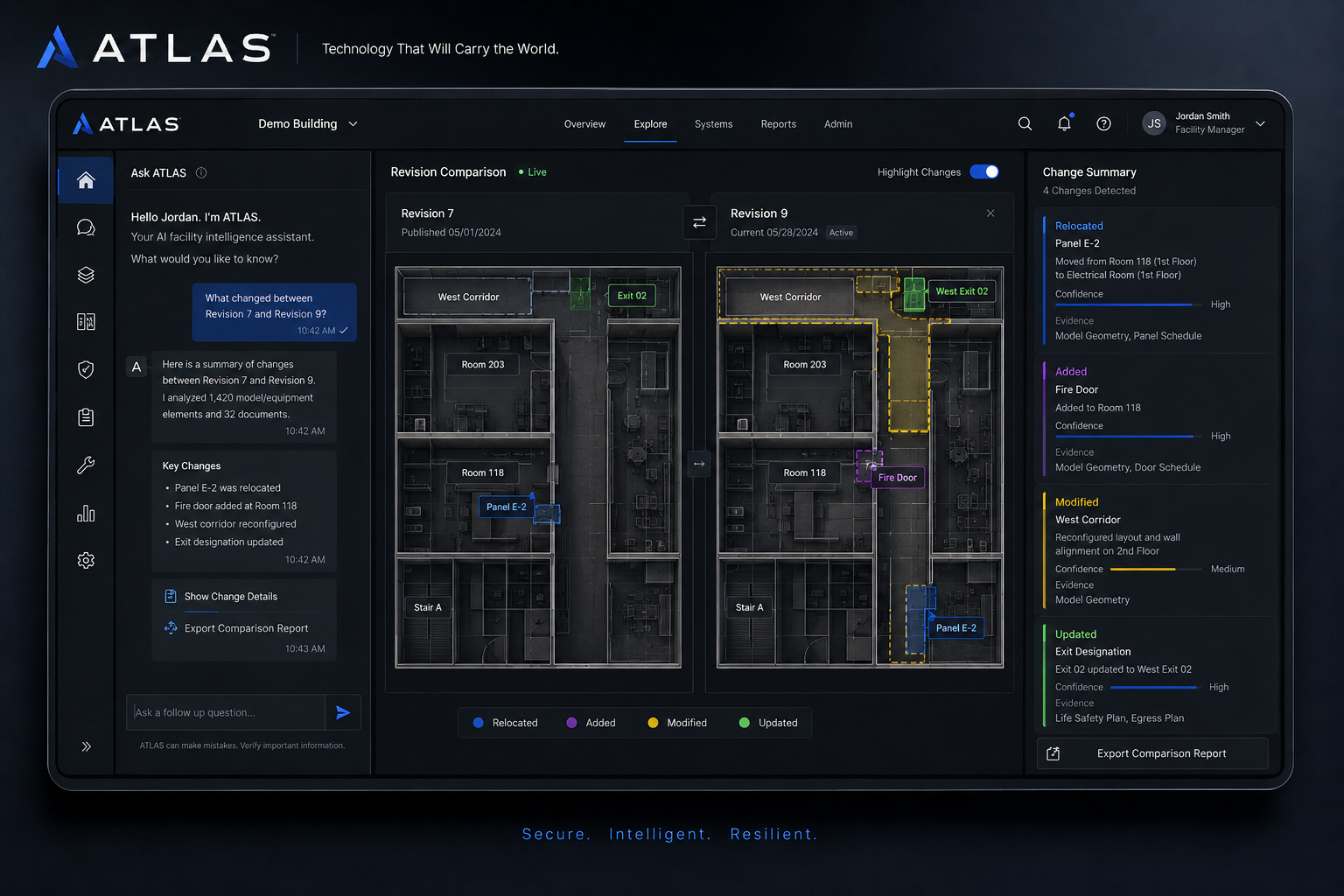
- Conflicting plan revisions.
- Fire-compartment relationships.
- Verified, inferred, and simulated data layers.
- An emergency simulation mode.
- A network-disconnection control.
- An offline Survival Mode.
We deliberately avoided using decorative science-fiction graphics. The goal was to make ATLAS feel like a believable product that a facility manager, emergency team, airport operator, hospital engineer, or infrastructure organization could realistically use.
Survival Mode
A major feature of the project is Survival Mode.
Many modern systems depend on cloud access, network connectivity, and centralized software. However, those systems may become unavailable during a power failure, cyber incident, communications outage, or physical emergency.
When ATLAS detects a network interruption, the interface reduces itself to an essential local emergency view.
Survival Mode preserves access to:
- Verified emergency exits.
- Electrical shutoff locations.
- Fire equipment.
- Important procedures.
- Room and asset locations.
- Locally stored evidence.
- Emergency route guidance.
- Backup-power status.
The prototype does not claim that every advanced calculation can continue offline. Instead, it demonstrates a more honest approach: preserve the most important verified knowledge locally and make the system’s limitations visible.
What We Learned
Building ATLAS taught us that the most difficult part of a digital twin is not simply creating a three-dimensional model.
The real challenge is trust.
A useful facility-intelligence system must answer several questions at the same time:
- What is known?
- Where did the information come from?
- When was it last verified?
- What changed between plan revisions?
- Which relationships are documented?
- Which relationships are inferred?
- Which conditions exist only inside a simulation?
- What information remains available when connected systems fail?
We also learned that spatial information becomes much more useful when it is connected to evidence.
A highlighted room is not enough. A user should also be able to see the source plan, work order, maintenance record, inspection date, and dependency path associated with that room.
This changes the experience from simply viewing a model to understanding the operational history of the facility.
Challenges
Data Consistency
Facility information often contains contradictions. Two plans may show different layouts, a maintenance record may describe a field modification, and the most recent software record may not match the physical building.
The prototype addresses this by displaying source history and verification status instead of silently selecting one source as correct.
Spatial Relationships
It was important to make relationships understandable without overwhelming the user.
ATLAS uses controlled route layers, highlighted rooms, dependency lines, and evidence panels rather than filling the screen with excessive overlays.
Simulation Accuracy
Emergency simulations can easily appear more authoritative than they really are.
We addressed this by clearly labeling simulated conditions and separating them from verified geometry and inferred effects.
Offline Resilience
Building a system that continues working without a network requires decisions about what data should be stored locally, how recently it was verified, and what capabilities should remain active.
The prototype focuses on essential emergency information instead of pretending the full cloud platform remains available.
Interface Credibility
Another challenge was preventing the product from looking like a fictional movie interface.
We prioritized readable typography, restrained animation, realistic controls, consistent panel layouts, and clear evidence states. Every visual effect needed to support a real operational purpose.
Future Development
The next phase of ATLAS would focus on importing real facility documents and converting them into structured spatial records.
Future capabilities could include:
- PDF and blueprint ingestion.
- Building Information Modeling integration.
- Field-verification workflows.
- Photograph and equipment recognition.
- Work-order integration.
- Asset history tracking.
- Role-based access.
- Audit trails.
- Encrypted offline facility packages.
- Multi-building campuses.
- Mobile emergency access.
- Real-time sensor integration.
- Advanced dependency mapping.
- Facility change detection.
- Controlled engineering and emergency-response integrations.
A full production version would also require collaboration with facility engineers, fire and life-safety professionals, cybersecurity teams, inspectors, emergency responders, and building operators.
Why It Matters
Buildings are becoming more connected, but their knowledge is still fragmented.
ATLAS is an attempt to close that gap.
It transforms facility information from a collection of documents into a living spatial memory—one that can be explored, questioned, verified, and preserved when systems fail.
Today, ATLAS begins with buildings.
Tomorrow, it can help carry the systems the world depends on.
ATLAS — Technology That Will Carry the World.
Built With
- chatgpt
- descript
- kamai
- visla

Log in or sign up for Devpost to join the conversation.