ATLAS for Tableau
A Cognitive Decision Runtime for Tableau Cloud
Inspiration
Modern analytics tools excel at answering what happened, but they rarely help users understand whether an insight should be trusted or when acting on it is risky. In real business environments, poor decisions are often caused not by missing data, but by overconfidence in unstable or misleading insights.
While working with dashboards, it became clear that Tableau — like most BI tools — treats every number as equally reliable and leaves judgment entirely to the human analyst. Confidence, intent, and risk are implicit, unmeasured, and invisible.
ATLAS for Tableau was inspired by a simple question:
What if analytics systems could reason about decision reliability while users explore data, instead of assuming every insight is safe to act on?
What It Does
ATLAS transforms Tableau dashboards into decision-aware systems.
Instead of only visualizing metrics, ATLAS continuously evaluates and exposes three cognitive signals during analysis:
- Insight Confidence – how reliable the current insight is based on volatility and stability
- Decision Intent – why the user is analyzing the data (e.g., performance review, risk investigation, exploration)
- Decision Risk – whether acting on the current insight may be unsafe
These signals update in real time as users interact with Tableau dashboards, helping prevent decisions made on unstable or misleading analytics.
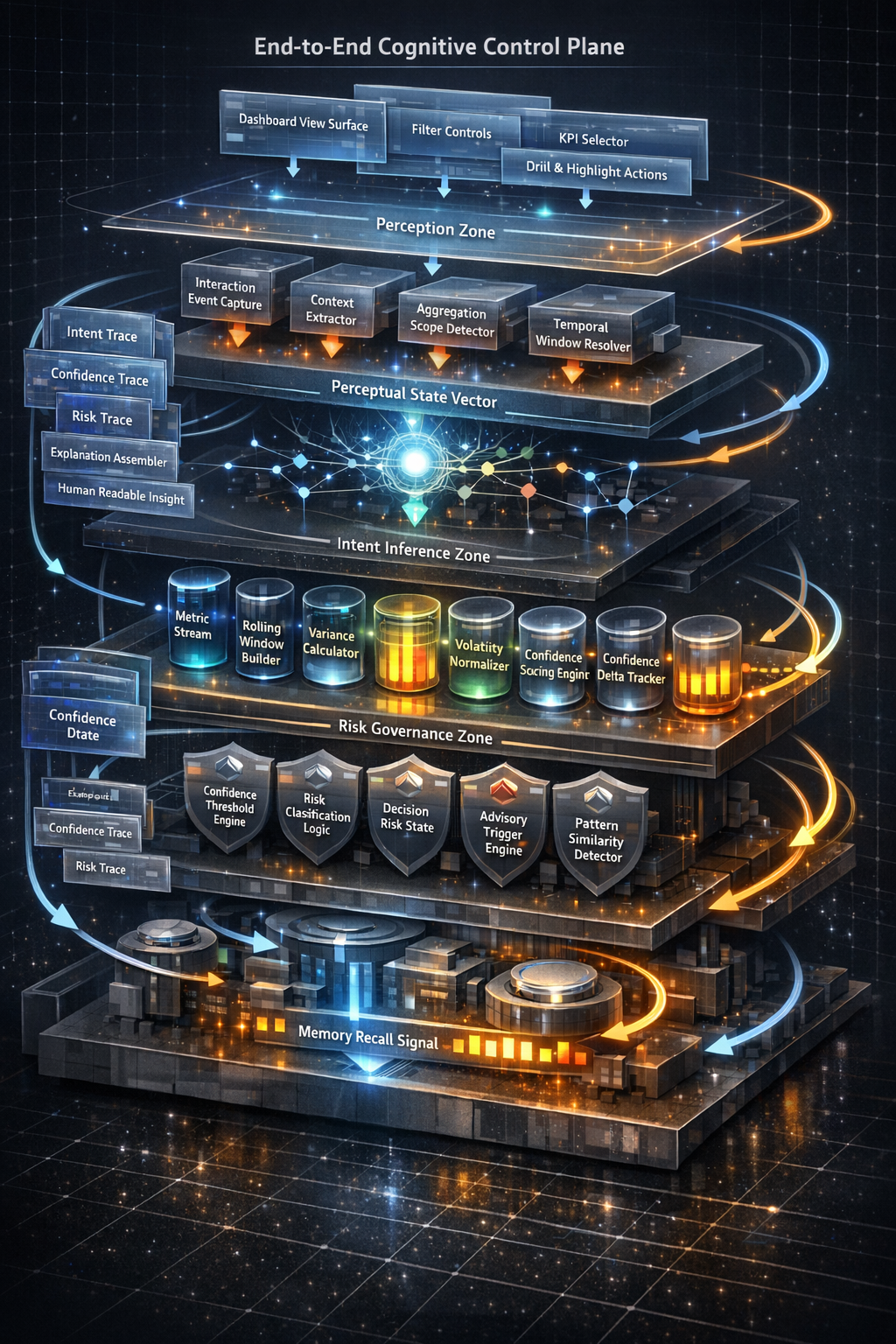

Cognitive Architecture: Decision Cognition Runtime (DCR)
ATLAS introduces a world-first, non-AI computational cognitive architecture implemented entirely using Tableau Cloud.
Architecture Name
Decision Cognition Runtime (DCR)
Why This Is World-First
- Tableau does not natively model decision confidence, intent, or risk
- BI tools focus on data state, not decision state
- ATLAS introduces cognition using deterministic computation, not AI or machine learning
This makes the system:
- Fully explainable
- Enterprise-safe
- Stable and reproducible
- Aligned with governance requirements
Core Architectural Layers
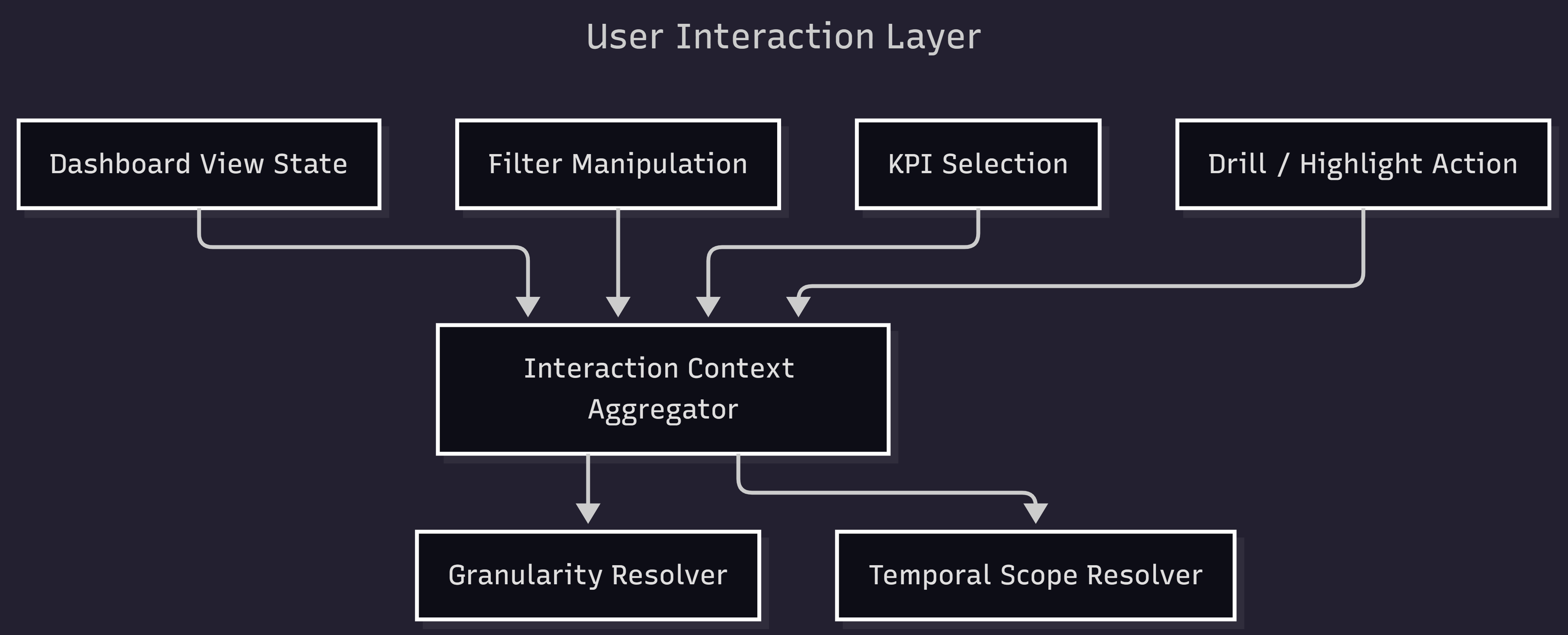
User Interaction Layer
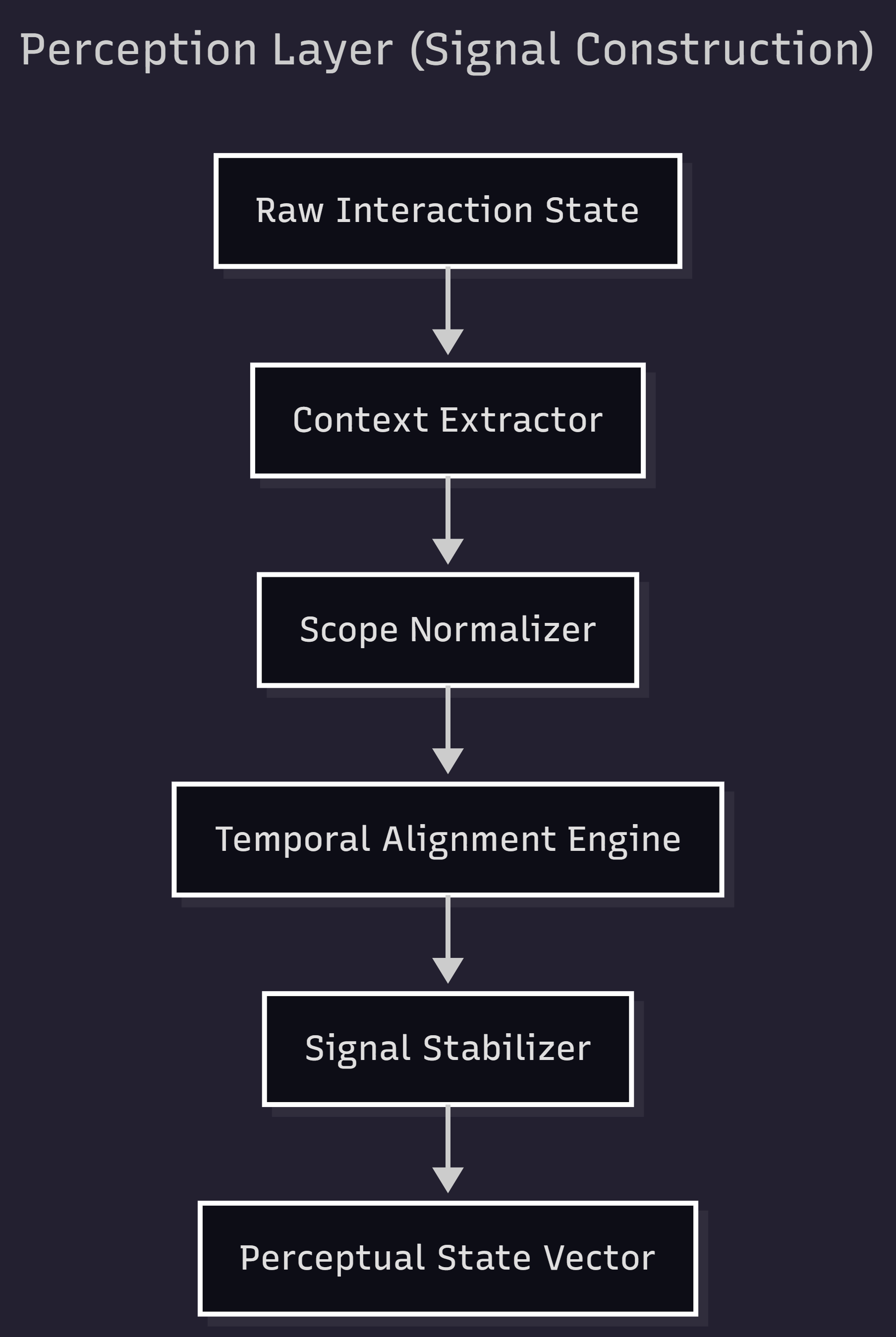
Tableau dashboards, filters, and selectionsPerception Layer
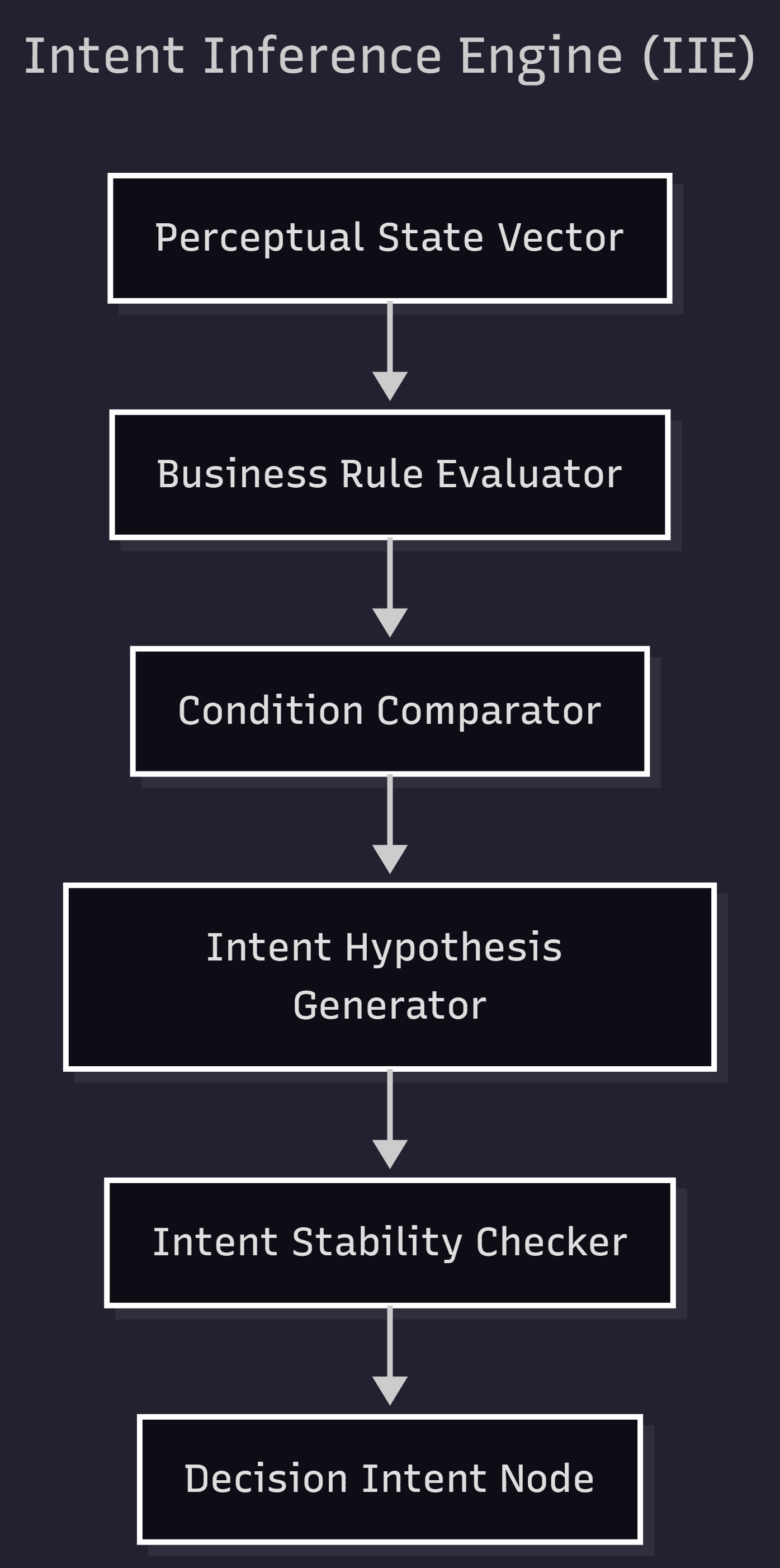
Captures interaction-driven analytical signalsIntent Inference Engine (IIE)
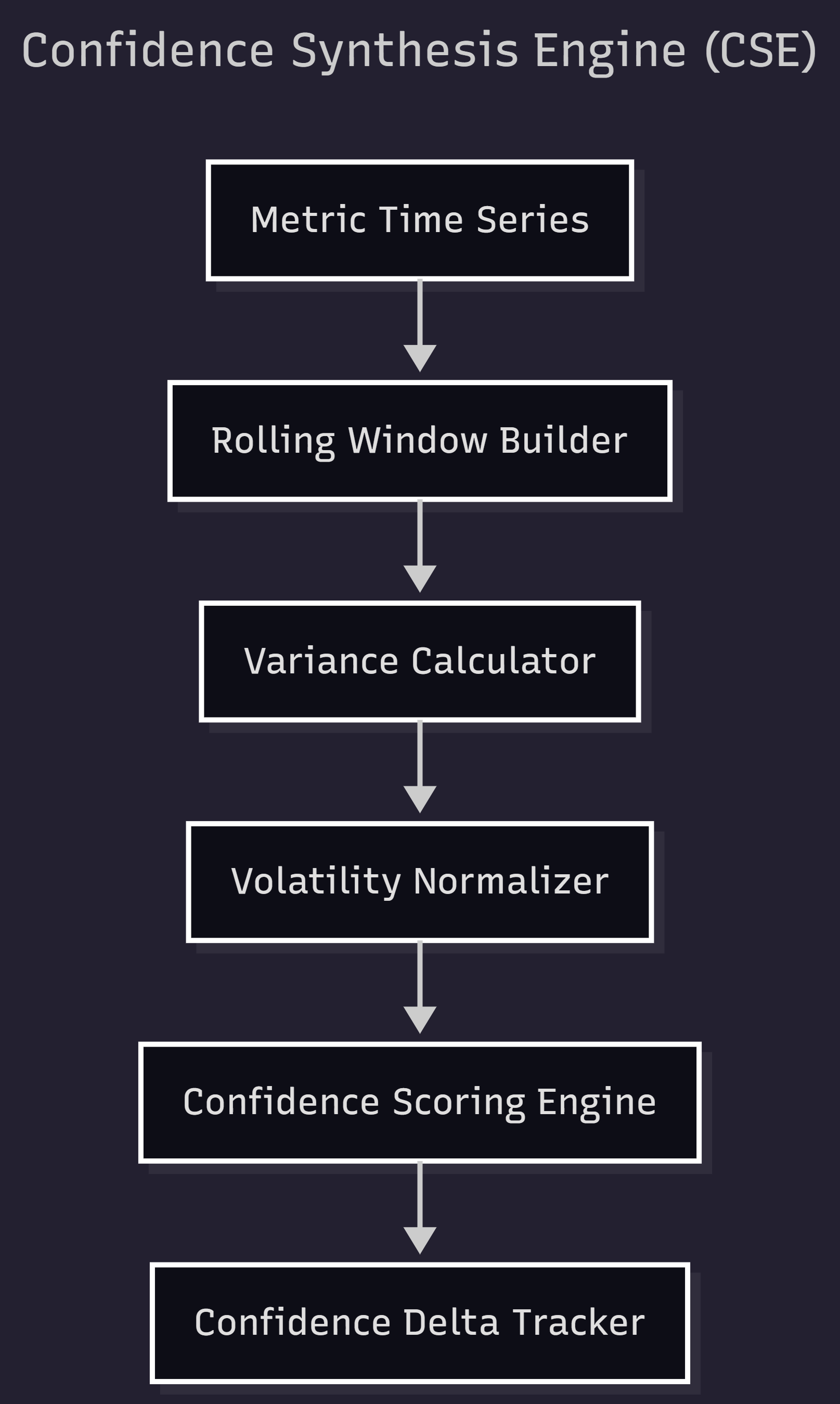
Rule-based inference of analytical intentConfidence Synthesis Engine (CSE)
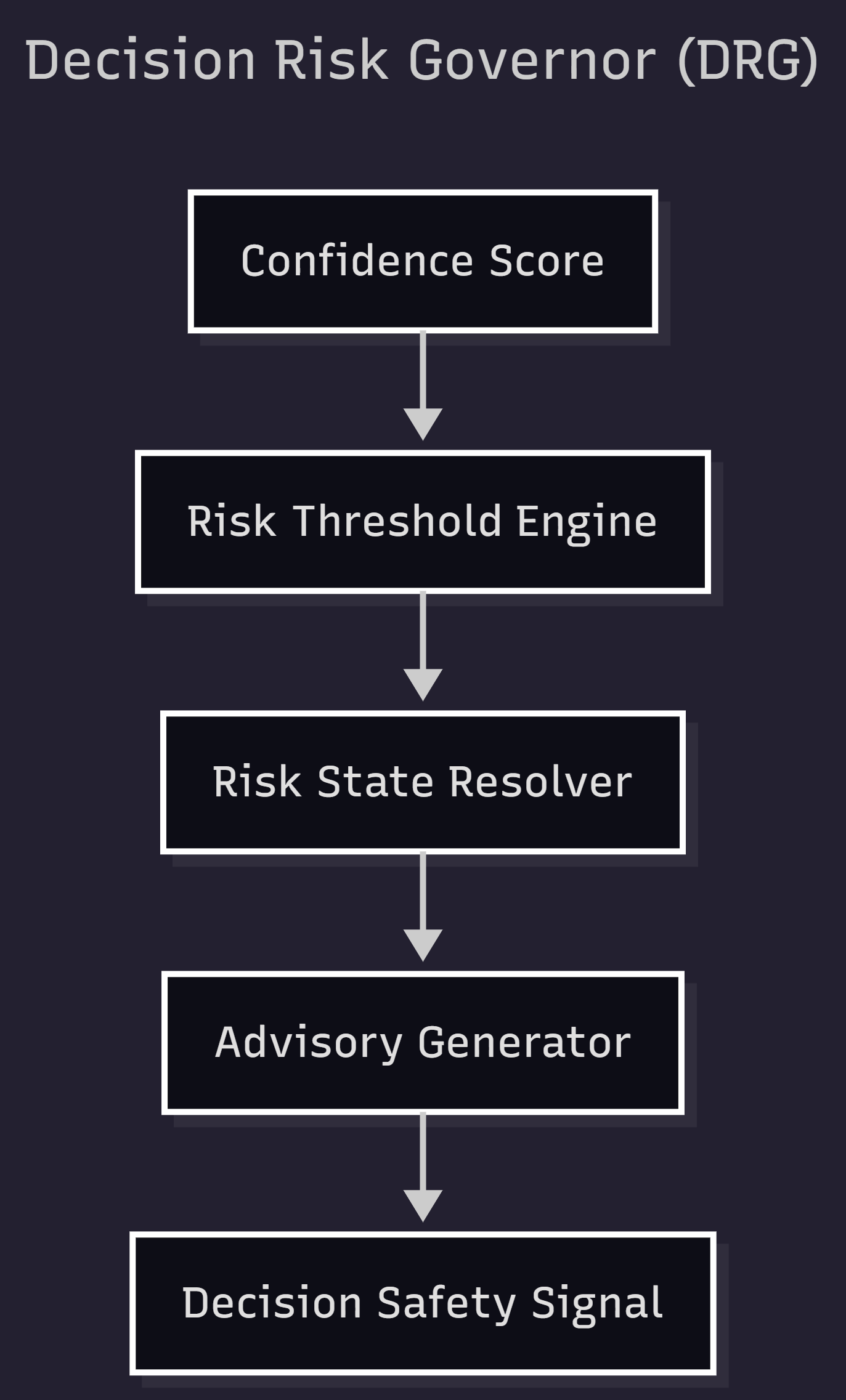
Computes insight reliability using volatility metricsDecision Risk Governor (DRG)
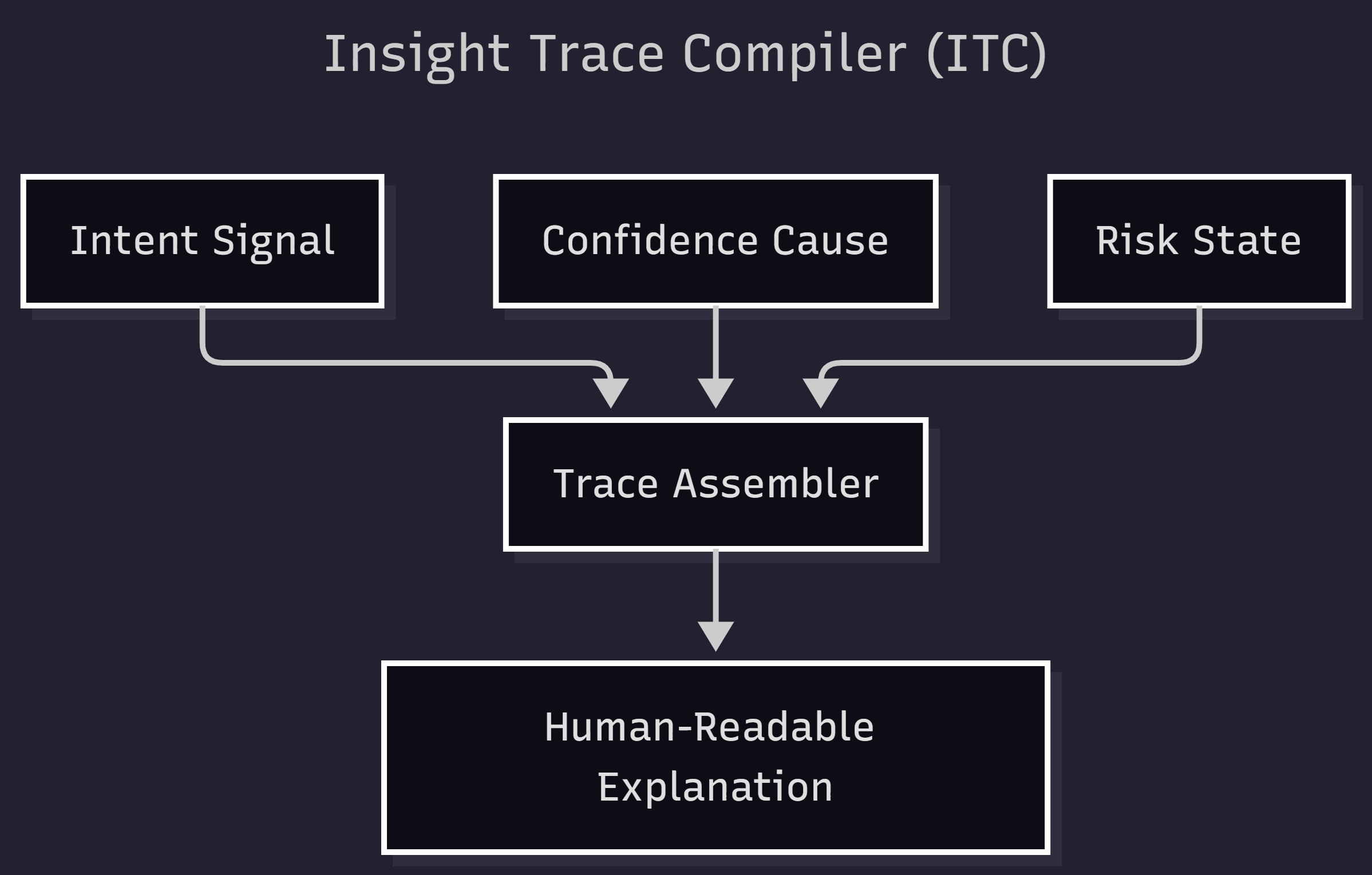
Classifies decision safety and triggers advisoriesInsight Trace Compiler (ITC)
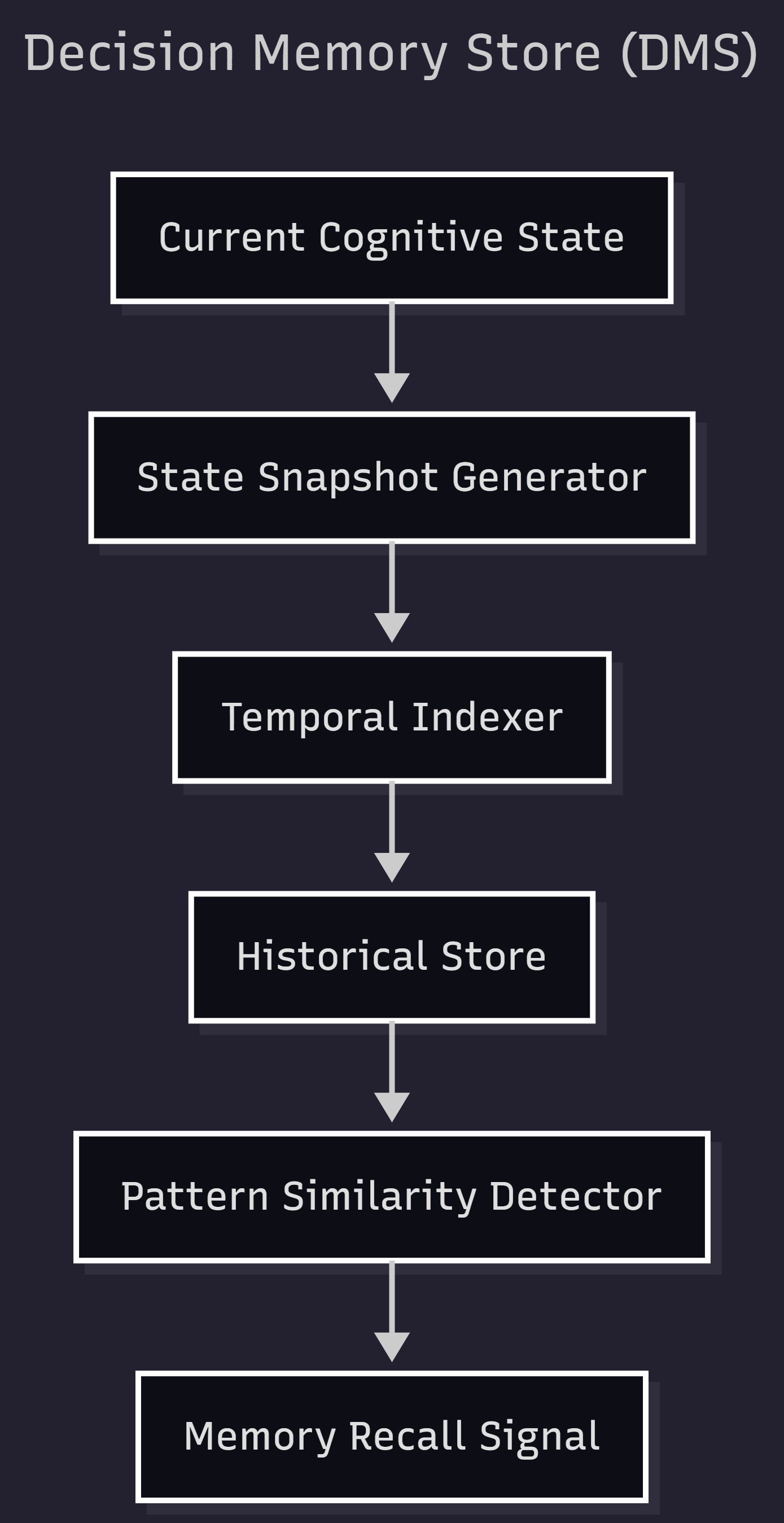
Produces human-readable explanationsDecision Memory Store (DMS)
Visualizes analytical context over time
This architecture does not exist in Tableau today and represents a new abstraction layer for analytics.
How Atlas Was Built ?
ATLAS was built entirely on Tableau Cloud, using only supported Tableau Developer Platform capabilities.
No AI models, external APIs, or third-party services were used.
Key techniques include:
- Advanced calculated fields
- Window functions for volatility analysis
- Context-aware recomputation
- Dashboard actions as decision signals
- Cross-dashboard analytical state
Core Computational Models
Insight Confidence Model
IF WINDOW_STD(SUM([Profit])) > 3000 THEN 35
ELSEIF WINDOW_STD(SUM([Profit])) > 1500 THEN 55
ELSEIF WINDOW_STD(SUM([Profit])) > 500 THEN 70
ELSE 90
END
This converts data volatility into a measurable confidence score.
Decision Intent Inference
IF ATTR([Segment]) = "Consumer" AND SUM([Sales]) > 150000 THEN "Performance Review"
ELSEIF ATTR([Segment]) = "Corporate" AND SUM([Profit]) < 0 THEN "Risk Investigation"
ELSE "Exploratory Analysis"
END
Decision Risk Classification
IF [ATLAS – Insight Confidence] < 50 THEN "HIGH RISK"
ELSEIF [ATLAS – Insight Confidence] < 75 THEN "MEDIUM RISK"
ELSE "LOW RISK"
END
Dashboards & Features
ATLAS is implemented as a coordinated set of four dashboards, each representing a distinct stage of decision cognition. Together, they function as a continuous runtime rather than isolated reports.
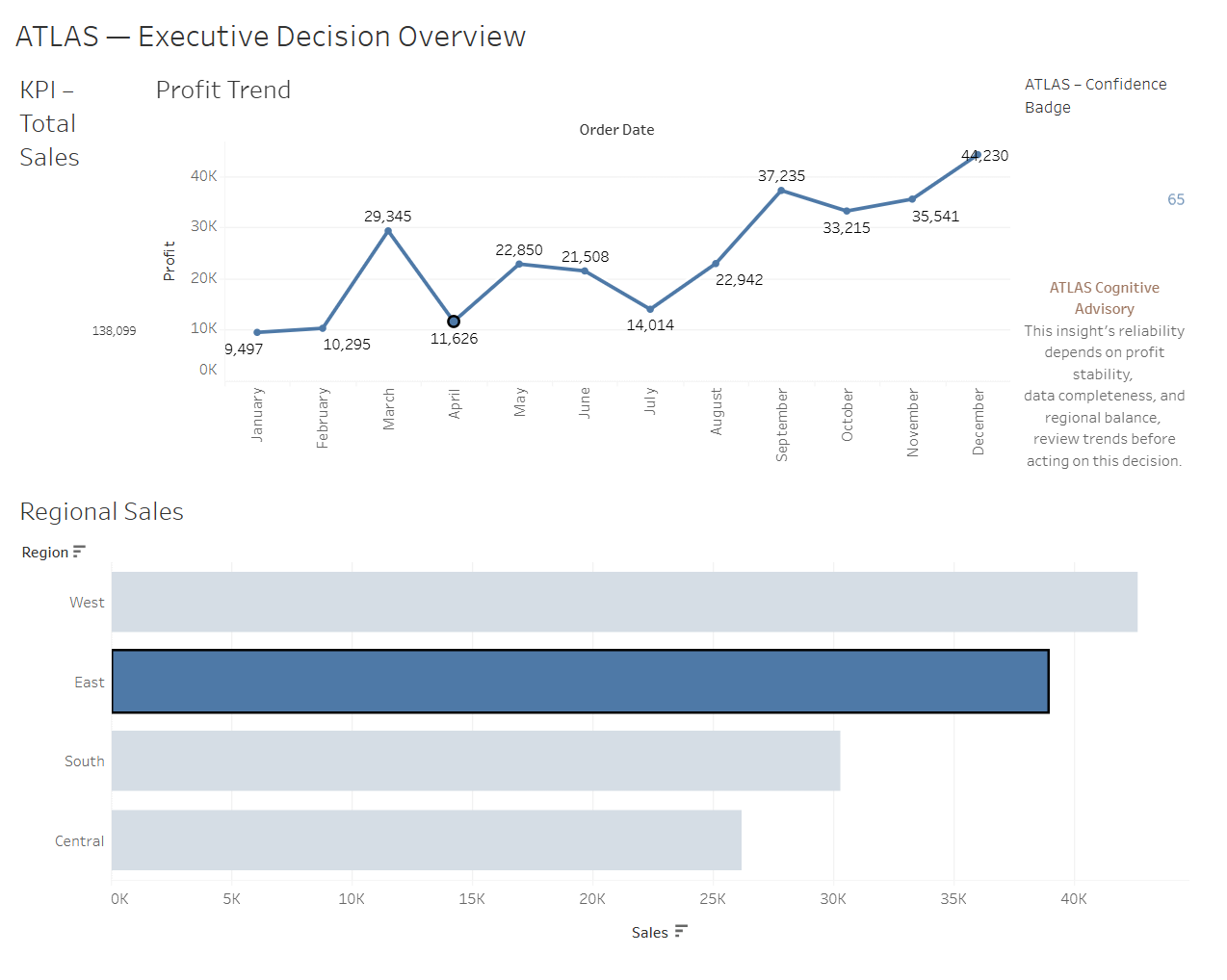
1. Executive Decision Overview
This dashboard serves as the primary interface for business leaders and decision-makers.
Features:
- Core KPIs augmented with live insight confidence
- Interactive profit trends that act as decision signals
- Regional exposure analysis with dynamic recomputation
- A cognitive risk advisory that updates in real time
Purpose:
To ensure executives understand not only what the numbers say, but whether the insight is reliable enough to act on.
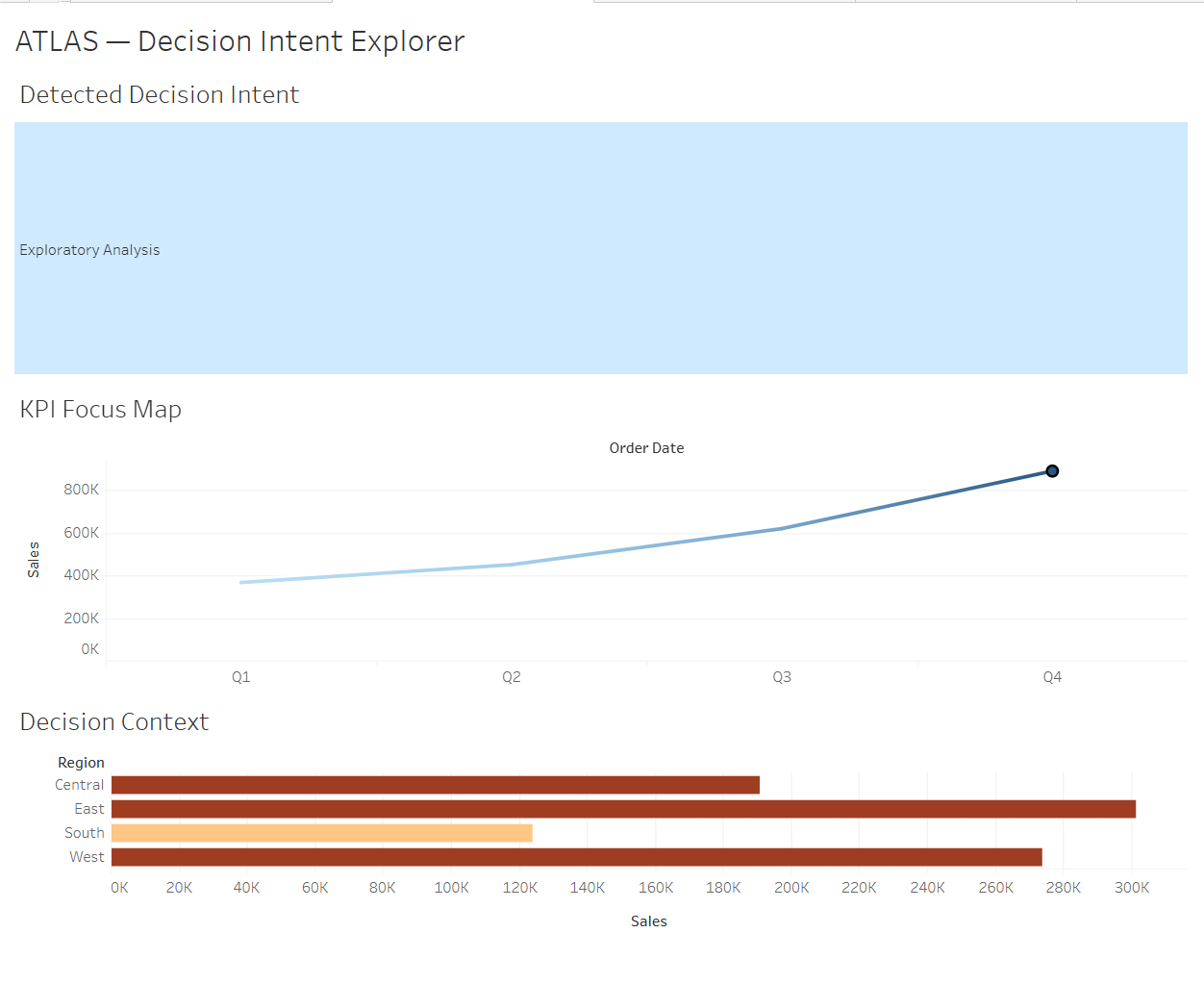
2. Decision Intent Explorer
This dashboard makes the system’s inferred understanding of the user’s analytical goal visible.
Features:
- Real-time detection of analytical intent (performance review, risk investigation, exploration)
- KPI focus behavior across interactions
- Context-sensitive confidence recalculation
Purpose:
To surface why the analysis is being performed and make analytical intent explicit, explainable, and auditable.
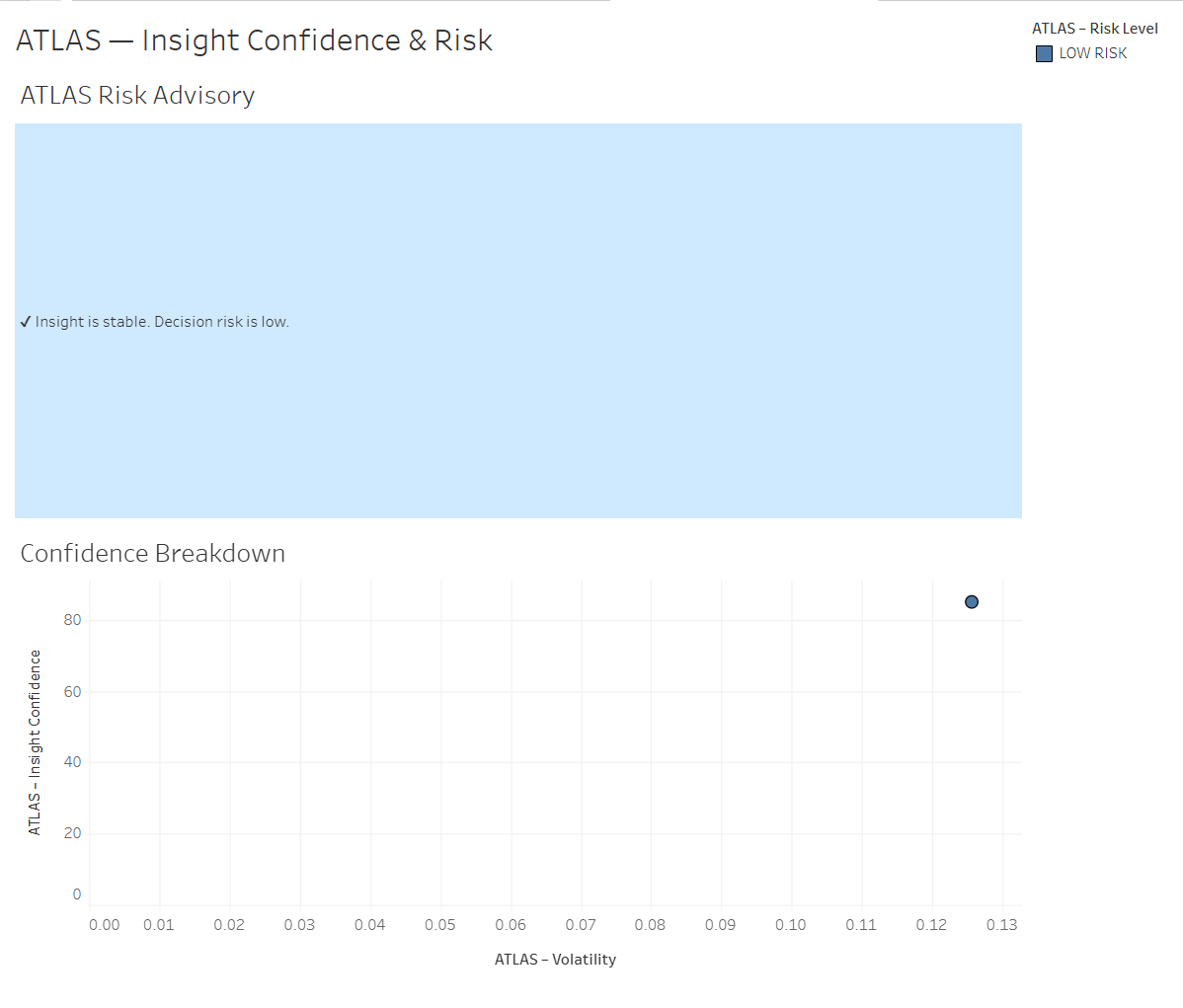
3. Insight Confidence & Risk Analyzer
This dashboard explains why confidence changes as analysis progresses.
Features:
- Volatility versus confidence visualization
- Explicit decision risk classification
- Contextual advisories when insights become unstable
Purpose:
To audit insight reliability and prevent misinterpretation of volatile or misleading trends before action is taken.
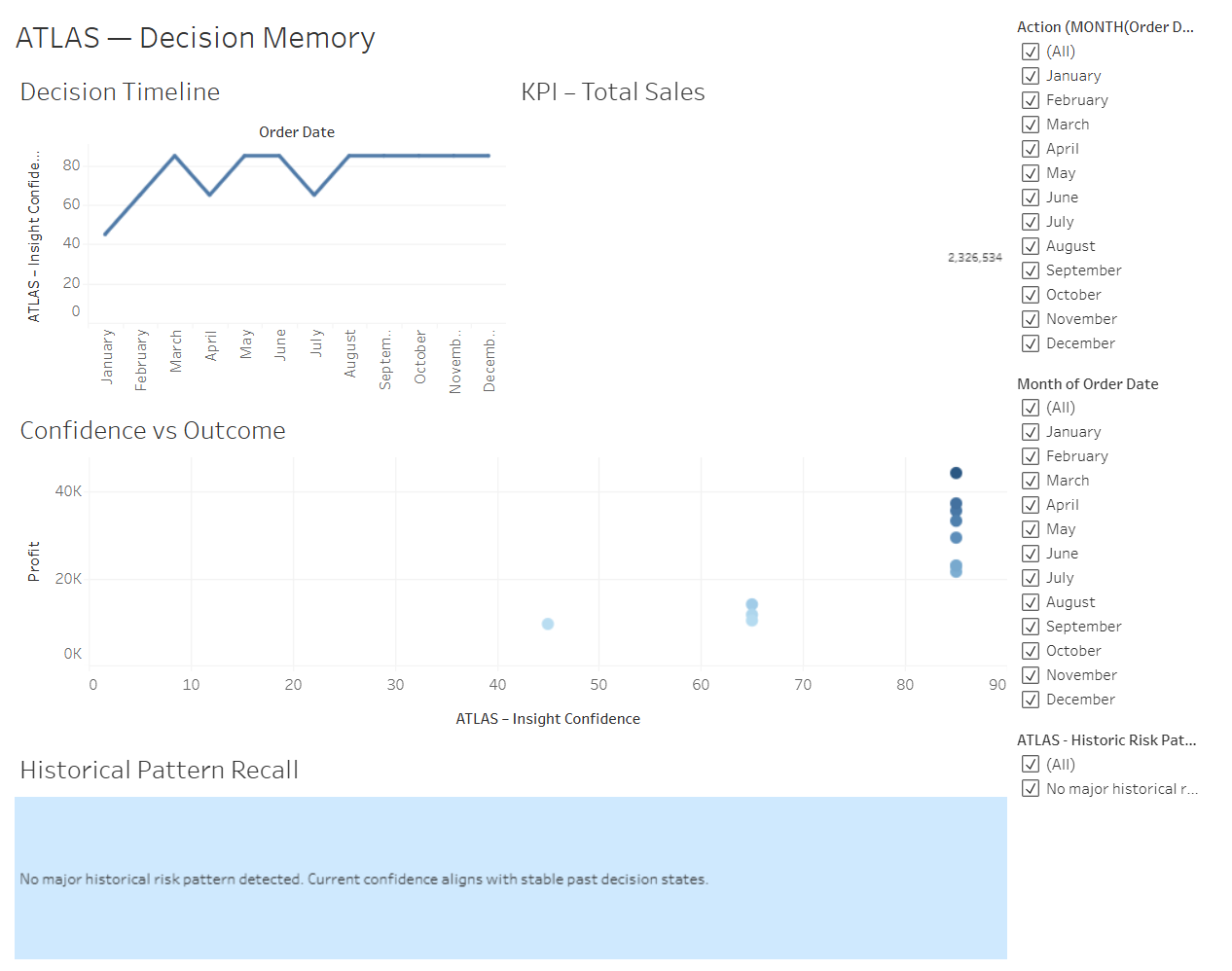
4. Decision Memory
This dashboard introduces the concept of analytical memory.
Features:
- Confidence evolution over time
- Confidence versus outcome matrix
- Historical pattern recall indicators
Purpose:
To provide historical context, enabling users to reflect on past analytical states and improve future decision-making.
Together, these dashboards expose the runtime stages of decision cognition directly inside Tableau.
Challenges We Ran Into
- Designing cognitive behavior without using AI or machine learning
- Making confidence and intent fully explainable while remaining stable
- Ensuring all cognitive signals updated live without impacting Tableau performance
- Avoiding overfitting logic to a single dataset or scenario
Accomplishments That We’re Proud Of
- Introduced a new analytical abstraction without modifying Tableau itself
- Demonstrated cognition using deterministic, transparent computation
- Built a fully functional and stable system using only Tableau Cloud
- Avoided AI hype while still delivering adaptive, intelligent behavior
What We Learned
- Intelligence in analytics does not require AI
- Tableau’s computation engine is capable of supporting cognitive systems
- Making uncertainty visible builds more trust than adding more metrics
Results
- Continuous, live confidence and risk evaluation
- Clear differentiation between stable and unstable insights
- Improved interpretability of analytical outcomes
- Reduced likelihood of acting on misleading or volatile data
Impact & Benefits
ATLAS enables organizations to:
- Avoid risky or premature decisions
- Improve trust in analytical outputs
- Accelerate confident, informed decision-making
- Preserve analytical context across time and users
Feasibility
ATLAS is:
- Fully deployable on Tableau Cloud
- Free to test and evaluate
- Deterministic and reproducible
- Scalable across dashboards, teams, and organizations
No proprietary hardware or third-party services are required.
What’s Next for ATLAS for Tableau
With additional time, ATLAS could:
- Integrate with Tableau Extensions for a persistent cognitive side panel
- Support organization-wide decision memory across users
- Connect with workflow tools for decision logging
- Extend confidence models to include data freshness and completeness
Uniqueness & World-First Approach
ATLAS for Tableau is not a traditional dashboard solution and does not attempt to automate analytics using AI or machine learning. Its uniqueness lies in introducing a new analytical abstraction within Tableau Cloud: decision cognition as a first-class capability.
What Makes ATLAS Unique
Most business intelligence systems focus on data state:
- Metrics
- Trends
- Filters
- Aggregations
ATLAS focuses on decision state:
- How reliable is the current insight?
- Why is the user analyzing the data?
- Is it safe to act on this analysis now?
This shift from data-centric analytics to decision-centric analytics is the core uniqueness of ATLAS.
World-First: A Non-AI Computational Cognitive Architecture
ATLAS introduces a world-first, non-AI cognitive architecture implemented entirely using Tableau’s native computation and interaction model.
Unlike existing approaches that rely on opaque AI models, ATLAS achieves cognition through:
- Deterministic rules
- Transparent calculations
- Interaction-driven recomputation
- Explainable reasoning
This ensures the system is:
- Fully explainable
- Enterprise-safe
- Auditable
- Reproducible
No comparable Tableau solution today explicitly models confidence, intent, risk, and memory as analytical outputs.
Why Avoiding AI Is a Strength
By deliberately avoiding AI and machine learning, ATLAS ensures:
- Complete explainability of every decision signal
- Predictable and stable behavior
- No dependency on training data or external services
- Alignment with enterprise governance and compliance needs
This makes ATLAS suitable for high-stakes decision environments where trust and transparency matter more than automation.
Built With
- Tableau Cloud
- Tableau Developer Platform
- Tableau VizQL Calculations
- Dashboard Actions
- Window Functions
- Sample Superstore Dataset
Try It Out
- Tableau Cloud Demo: (link provided in submission)
- GitHub Repository: (link provided in submission)


Log in or sign up for Devpost to join the conversation.