Inspiration
Atlas is built for the moments when finance teams have to make a high-stakes operating decision from messy context: spreadsheets, invoices, contracts, policies, forecasts, CRM data, security evidence, and prior board decisions. Instead of letting the decision happen across scattered tabs and loose opinions, Atlas turns the question into a disciplined finance-leadership process with evidence, debate, numbers, conditions, and a CFO-style final call.
What it does
Atlas Finance is an AI finance decision room for companies. A team can ask whether to approve spend, hire people, renew a vendor, delay a project, or respond to a risk. Atlas pulls the relevant operating evidence into one shared picture, has specialist finance agents argue the tradeoff, challenges weak claims, and produces a recommendation a CFO could defend in front of a board.
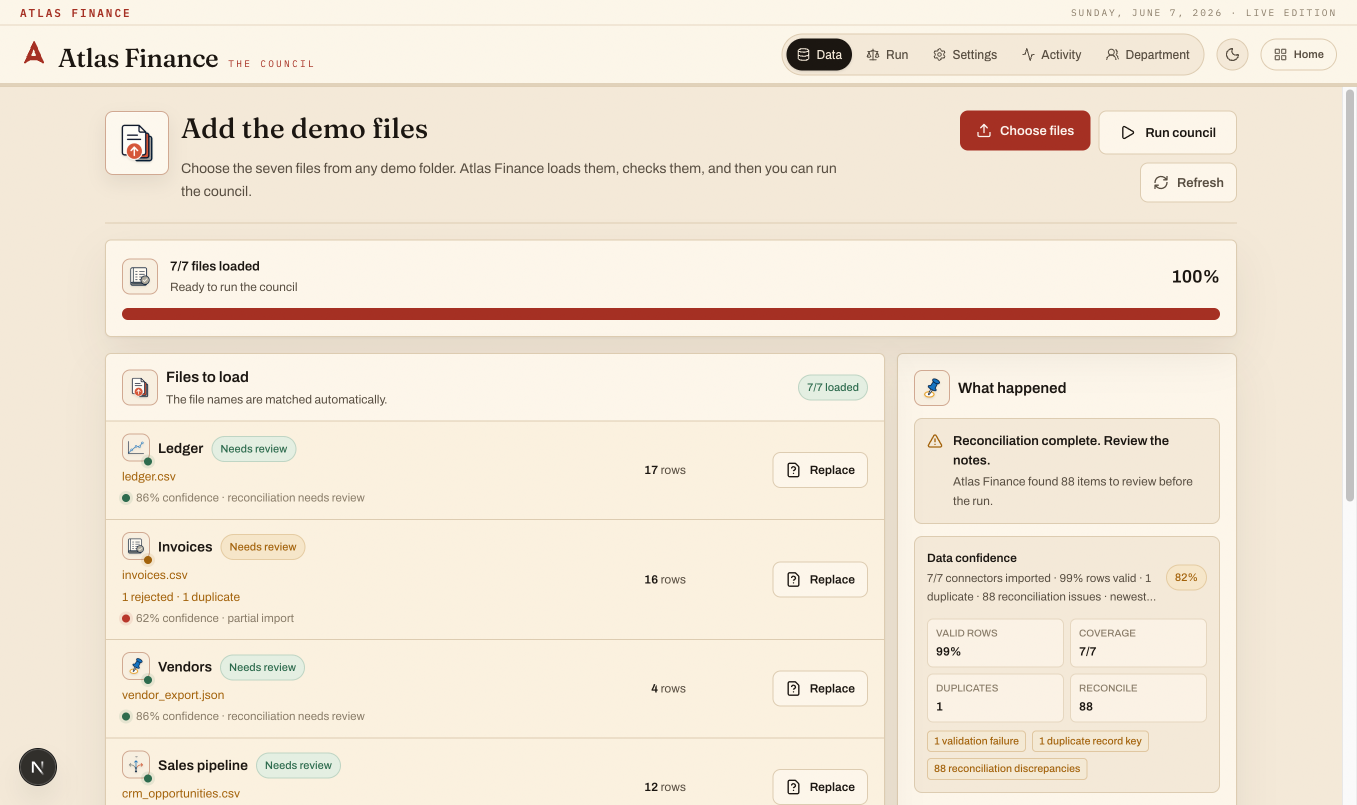
The product is especially useful for decision chaos: when the facts are spread across finance exports, vendor obligations, policies, customer pipeline, and risk signals. The live app lets an operator load company data, ask a decision question, watch the council debate, inspect supporting evidence, and review the final recommendation with confidence, burn/runway impact, and governance notes.
How we built it
Atlas uses a Next.js 16 frontend for the decision room, dashboards, settings, and upload surfaces. A FastAPI + LangGraph backend runs the finance debate graph. OpenAI powers the specialist roles, role-specific reasoning, structured outputs, evidence selection, cross-examination, and final CFO synthesis. Redis is the live data and memory layer: it stores company financials, vendors, uploaded source data, reconciliation results, policy search, decision history, streams, and pub/sub activity. W&B Weave is the trust and improvement layer, tracing each agent step, capturing reliability scores, building replay/evaluation packets, and gating prompt/model changes against prior decisions. CopilotKit/AG-UI streams the agent state into the live frontend.
Challenges
The hard part was making the system honest under demo pressure. Atlas is live-only: no mocked LLM output, no fake traces, no hard-coded sponsor responses, and no browser-only fallbacks. The agent has to be grounded in uploaded or seeded operating data, the UI has to show which evidence each role used, and the reliability layer has to make weaknesses visible rather than hiding them.
What we learned
Useful finance agents need more than a final answer. They need durable evidence, role separation, traceability, replayable evaluation, and a clear human decision surface. The strongest pattern was treating the finance council like an operating system: data ingestion, debate, audit, persistence, and learning all have explicit contracts.
What's next
The next version would connect Atlas to live operational observability streams, including Splunk-style incident and telemetry data, so finance, reliability, and security signals can be debated together before major spend, vendor, or risk decisions.
Built With
- copilotkit
- fastapi
- langgraph
- next.js
- openai
- python
- react
- redis
- typescript
- vercel
- w&b-weave


Log in or sign up for Devpost to join the conversation.