


Inspiration
Independent tourism businesses are expected to act as hosts, destination organizations, concierges, content teams, and conversion experts at the same time. Their best local knowledge is fragmented across accommodation pages, maps, guides, booking systems, and conversations. Guests receive disconnected information, while operators learn almost nothing from what visitors actually request.
In May 2025, Bacchus Holiday Homes began with no established brand, no connected visitor journey, and no digital destination infrastructure. Fourteen months later, Project Atlas connects three operating accommodations and direct booking with roughly 240 curated regional places, a destination Explorer, interactive map, mobile Live Guide, AI Concierge, and an on-site Traveller Hub.
That live transformation proved the problem, audience, and deployment path. During OpenAI Build Week, we added the missing operating loop: Atlas Mission Control.
What it does
What it does
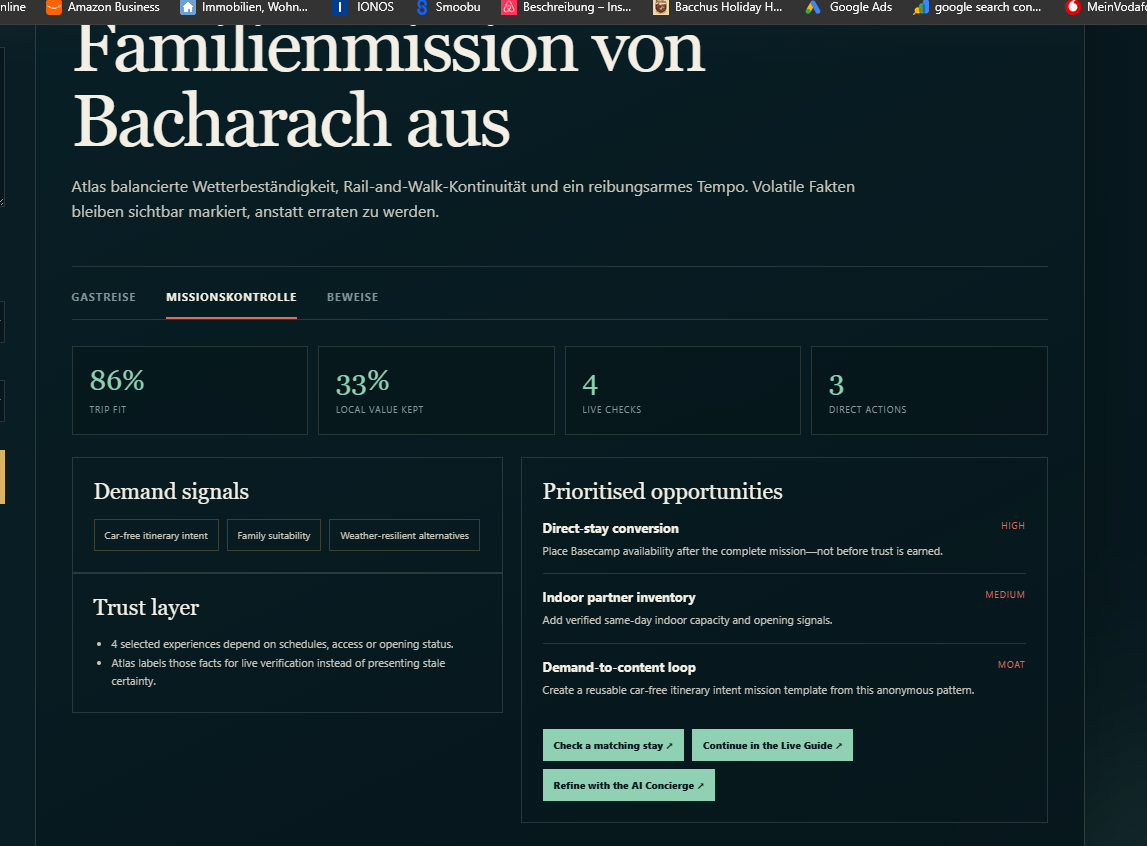
Atlas turns one natural-language visitor request into two useful outcomes.
For the guest, it:
interprets audience, mobility, pace, weather sensitivity, and interests; builds a coherent one-to-three-day mission from curated local knowledge; links every recommendation to an inspectable Atlas source; marks mutable information such as opening status, access, and timetables for a live check; ends each stop with a practical route, guide, or booking action.
For the operator, the same request becomes anonymous demand intelligence: family suitability, car-free continuity, weather-resilient demand, trust risks, conversion opportunities, and prioritized content or partner actions. No personal traveler profile is stored.
Most travel AI stops after producing an answer. Atlas closes the loop from intent to evidence, mission, action, and operating signal.
How we built it
Atlas Mission Control uses Node.js, Express, vanilla JavaScript, and a responsive browser interface. A deterministic planner controls constraint inference, place selection, scoring, diversity, journey structure, and provenance.
GPT-5.6 receives only the already-grounded mission through the OpenAI Responses API and strict structured output. It may refine the interpretation and operator opportunities, but it cannot introduce new places, opening hours, schedules, prices, or other mutable facts. OpenAI requests use store: false. If the API or reasoning layer is unavailable, the grounded application continues to work and clearly labels the fallback.
Codex accelerated the complete workflow: product architecture, data model, ranking engine, API, interface, tests, safeguards, public judge mode, GitHub publication, and documentation. The most important product decision developed with Codex was the hybrid boundary between deterministic grounding and model reasoning.
Challenges we ran into
Separating stable destination knowledge from volatile schedules and availability. Preventing an AI model from inventing locally plausible but unverified facts. Serving guests and operators in one coherent experience instead of two disconnected dashboards. Making the public demo useful without requiring an account or API key. Clearly separating a new hackathon extension from the pre-existing real-world ecosystem.
Accomplishments that we're proud of
Accomplishments A complete runnable product rather than a concept mock-up. A visible provenance and live-verification contract for every recommendation. A privacy-conscious intent-to-signal loop without traveler profiling. A resilient deterministic product with an optional GPT-5.6 reasoning layer. Immediate applicability to a real destination network, three accommodations, and roughly 240 curated places.
What we learned
The strongest role for AI in destination management is not generating more tourism copy. It is connecting visitor intent, trustworthy evidence, direct action, and organizational learning while remaining honest about which facts can change.
What's next for Atlas Destination OS
Add live timetable, weather, and opening-status connectors with source-level freshness policies. Connect accommodation availability and consented local partner inventory. Aggregate anonymous demand patterns into a weekly trust, revenue, and product sprint. Replicate the operating model for additional towns without losing local provenance.
Built With
- api
- codex
- css3
- express.js
- github
- githubaction
- gpt-5.6
- html5
- javascript
- node.js
- openai
- responseapi

Log in or sign up for Devpost to join the conversation.