-
-
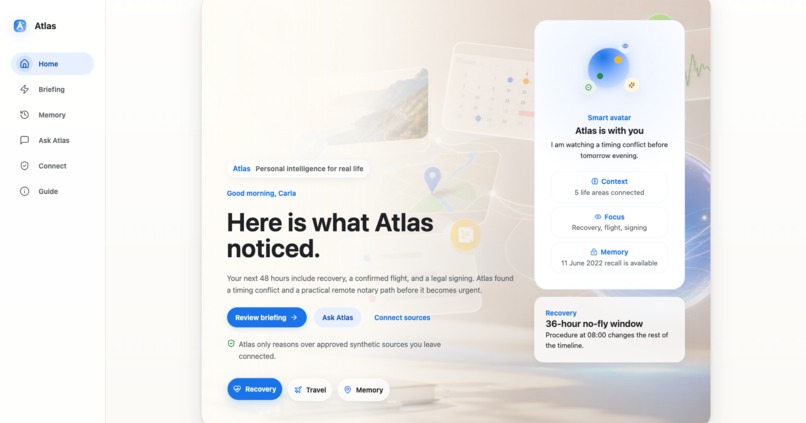
Atlas Landing page
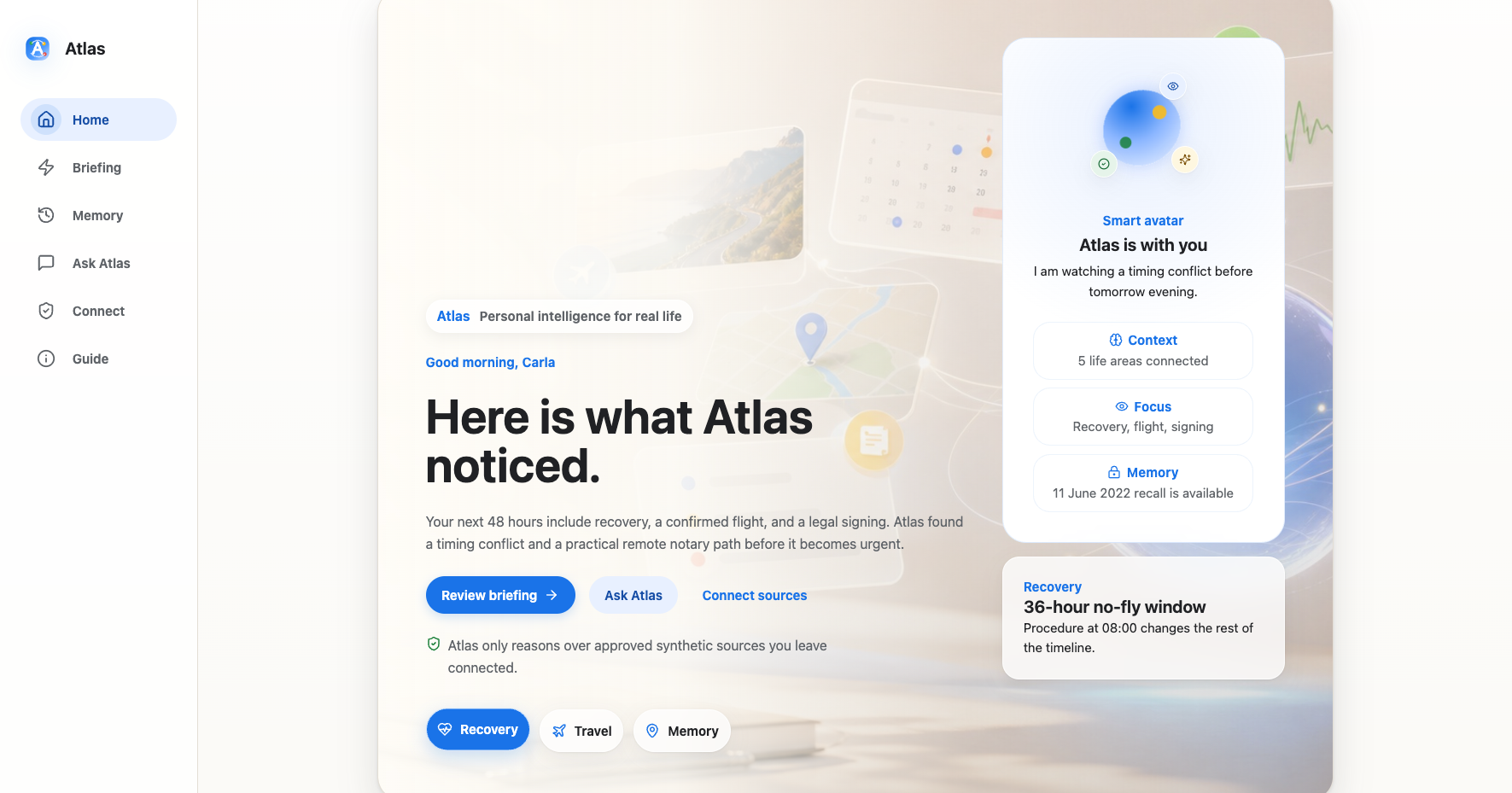
Atlas: Ambient Life Intelligence
Inspiration
Atlas started from a product question: what if Google could become the daily life intelligence layer that helps people understand their real day, not just search, email, and calendar separately?
Modern life is fragmented. A medical instruction can live in a PDF. A flight can live in Gmail. A signing deadline can live in Calendar or Docs. A financial consequence can sit inside a contract. Each app may be correct on its own, but the user still has to connect the whole story manually.
Atlas imagines a personal intelligence companion that reads only approved signals, turns them into a calm daily life story, shows evidence, and suggests a safe next step that still requires user approval.
The important product idea is not simply “AI with integrations.” The important idea is consent-first reasoning: Atlas should know exactly which life areas it is allowed to use, refuse when a required source is disconnected, and cite evidence for important conclusions.
What it does
Atlas turns approved life signals into a daily narrative across:
- Health
- Travel
- Family
- Money
- Work
- Integrity
- Memory
The prototype includes:
- Daily Life Story Mode with Daily story, Risk lens, and Next step views
- source toggles that simulate Google Account consent scopes
- evidence cards for important claims
- Ask Atlas preset questions with source-gated refusal
- memory recall with confidence and uncertainty notes
- Add to Atlas for simulated extra context
- a guided product tour for judges
- a Guide / Trust & security section with the future agent architecture
- a capped live proof panel for the Gemini and MongoDB MCP path when server-side secrets are configured
Demo scenario: the Post-Op Compliance Trap
The main demo is a hidden cross-app conflict.
Atlas sees that:
- a procedure happens at 08:00
- the recovery instruction says no flying for 36 hours
- a flight is booked for 19:30
- a legal signing is scheduled for Friday 09:00
- a legal deadline is Friday 12:00
- missing the signing creates a $250,000 valuation risk
- Clause 8.1 allows a remote notary workaround
Individually, these are ordinary facts. Together, they create a serious life conflict.
Atlas explains the situation in plain language, shows the supporting evidence, calculates that the flight falls inside the no-fly window, and suggests the safer remote-notary path. It does not claim to perform the action. The next step still requires user approval.
This is what makes the concept stand out: Atlas is not another dashboard and not another generic chatbot. It is a life-story agent that connects scattered, approved evidence into something the user can understand and act on.
Why it stands out
Most AI assistants still wait for the user to type a prompt and provide context. Atlas is situation-first. It starts from the signals already around the user and asks what they need to understand before they even know what to ask.
The design also treats trust as part of the product surface:
- consent is visible
- source access changes the answer
- missing sources produce refusal instead of guessing
- evidence is shown next to claims
- actions require approval
- the live proof route is capped and can be disabled after judging
That combination is different from a normal calendar alert, task app, or chatbot. Atlas is designed to synthesize life context, not simply store it.
How it was built
The product UI is a React and Vite prototype with synthetic local data. It does not use real Gmail, Calendar, Drive, health, finance, legal, travel, or personal data.
The repository also includes a functional proof path for the hackathon architecture:
- Google ADK LlmAgent artifact configured for Gemini 3
- Google Cloud Agent Builder instructions for the Atlas Life Story Agent
- MongoDB-shaped synthetic seed collections
- official MongoDB MCP server integration in read-only mode
- local proof scripts for source-gated reasoning
- budget-guarded Gemini / Vertex AI proof scripts
- capped Vercel API route for a hosted live proof panel
- default post-judging cutoff: 2026-07-16T07:00:00Z
- required email notification before any non-cached hosted live generation attempt
The hosted product demo is intentionally safe and synthetic. The capped proof route is separate: it only accepts the fixed post-op query, rejects arbitrary prompts and extra query parameters, runs MongoDB MCP read-only, caps Gemini output, caches successful responses, and requires server-side secrets before it can make a live call.
Challenges
The hardest product challenge was making Atlas feel like a useful life companion instead of a technical dashboard. It would be easy to build a wall of toggles, alerts, and trace logs. The better product shape is calmer: a story first, evidence when needed, and controls that are visible without overwhelming the user.
The hardest technical challenge was staying honest about what is live and what is a proof. The product UI is synthetic by design, but the repository includes the real agent proof pieces so judges can inspect how the concept maps to Gemini, Google Cloud Agent Builder, and MongoDB MCP.
What I learned
The hackathon helped me test my product thinking. The strongest AI product here was not a bigger chat box. It was a more careful system for deciding what the agent is allowed to know, when it should speak, when it should refuse, and how it should show evidence.
Atlas became clearer through those constraints. Better product design is not only about adding intelligence. It is about designing the boundaries around intelligence.
Links
Live demo: https://smart-life-atlas.vercel.app/
Source code: https://github.com/CarlasHub/smart-life-atlas
Demo video file: https://smart-life-atlas.vercel.app/smart-life-atlas.mp4

Log in or sign up for Devpost to join the conversation.