-
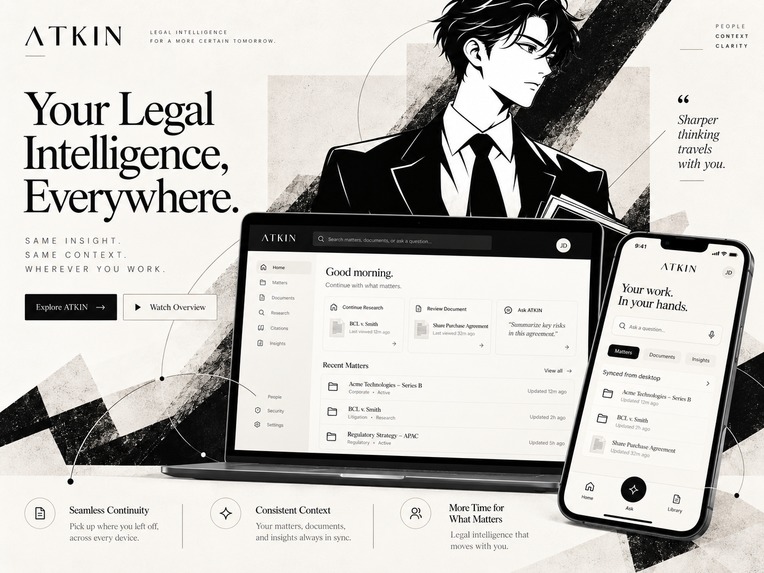
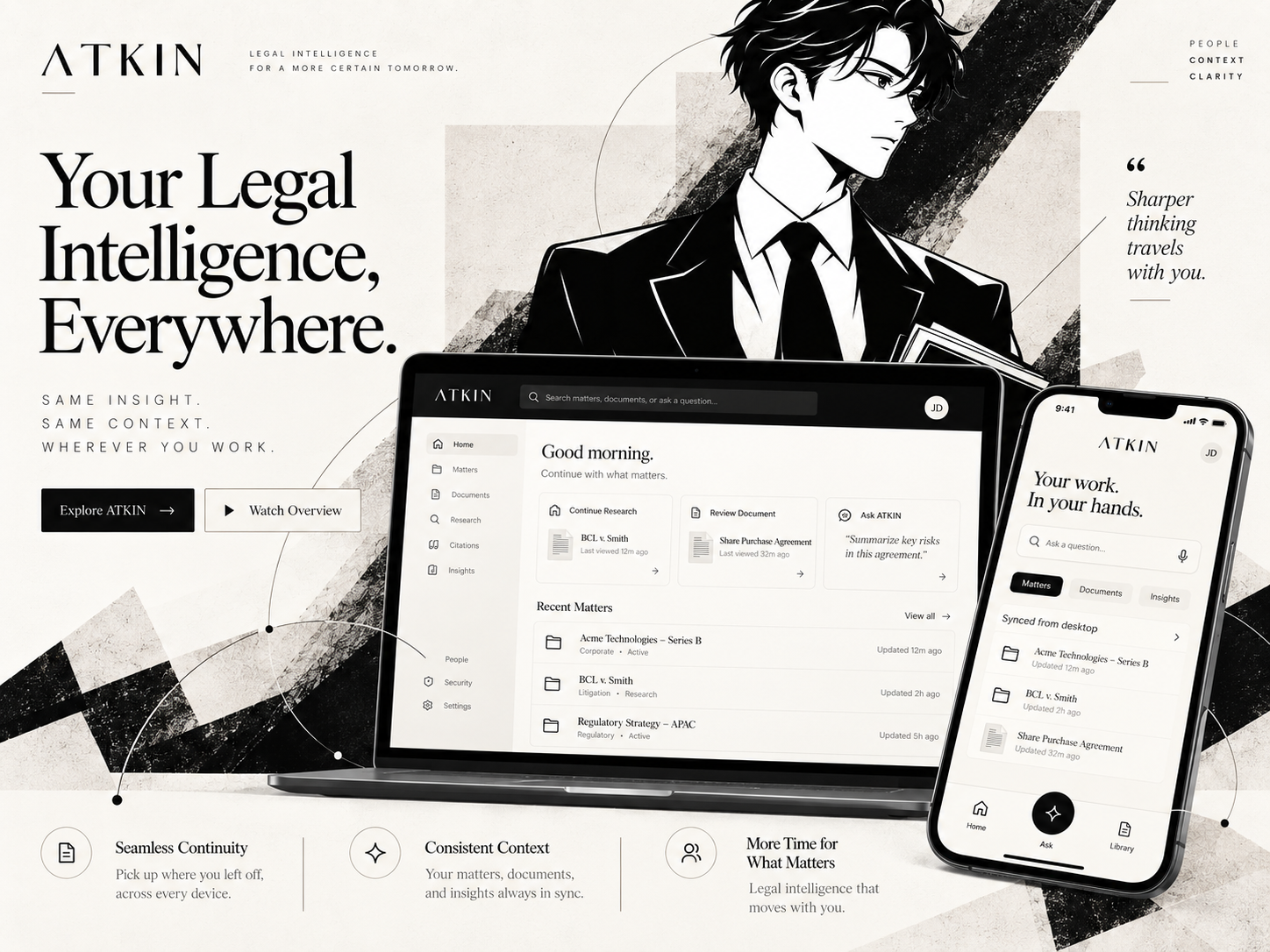
Seamless connectivity across all platforms
-

Cover Image
-
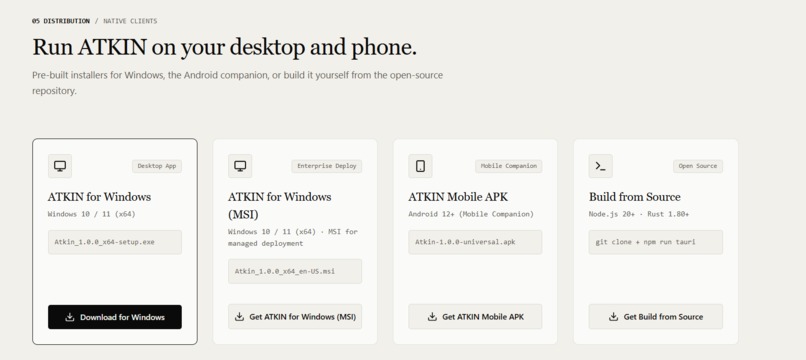
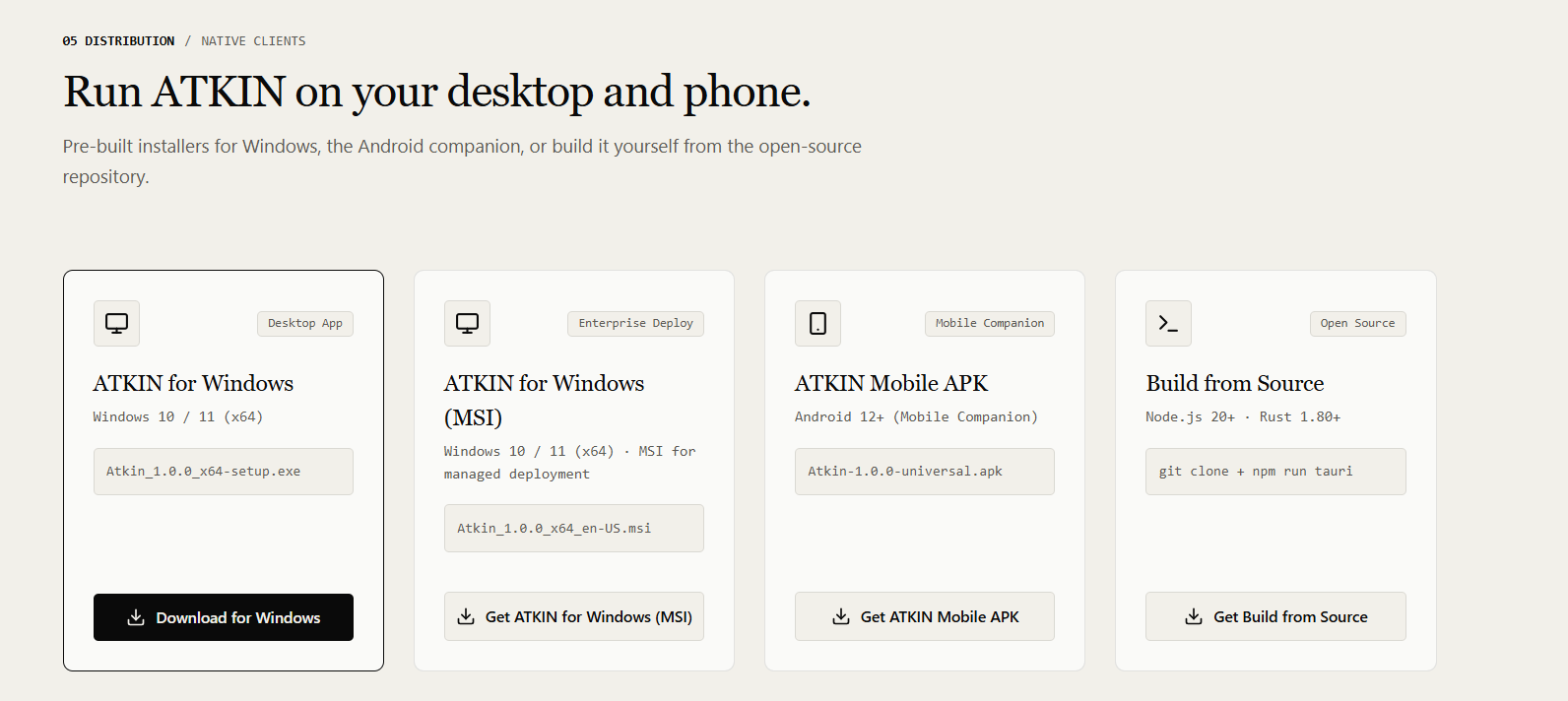
Download to start your private legal os
-
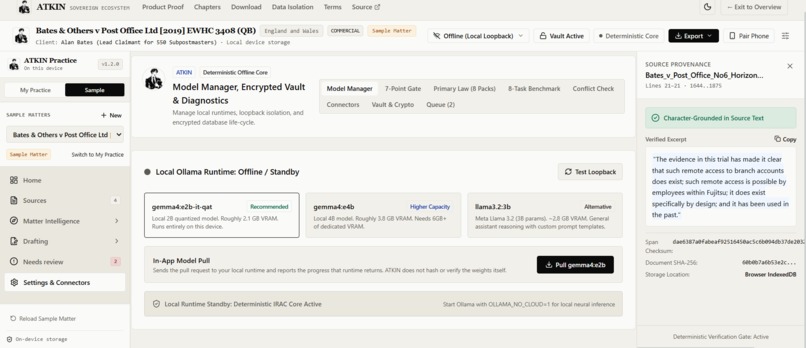
Core engine
-
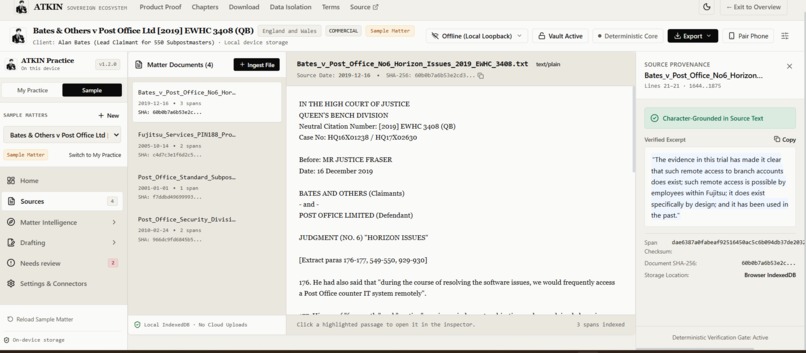
Core engine 2
-
And core engine 3
-
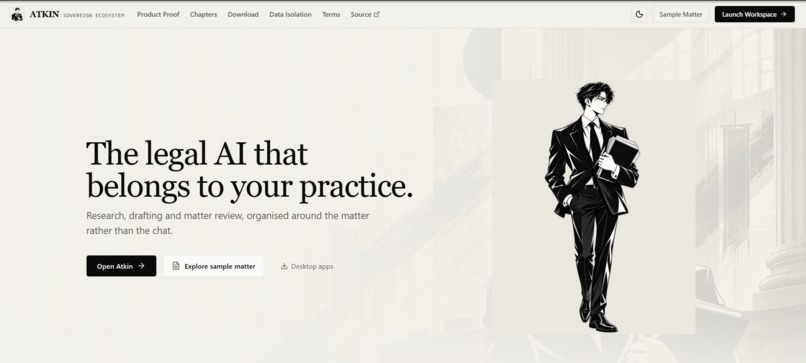
Hero should be simple, but the system should be complex and well structured like lawyers

Inspiration
Legal work has a strange AI problem.
The most capable AI systems are general-purpose assistants, while the information a lawyer actually works with lives across contracts, correspondence, research, notes, timelines, drafts, evidence and separate client matters.
We wanted to explore a different idea:
What if lawyers had their own AI workspace rather than sending legal work into a generic chatbot?
That became ATKIN.
ATKIN is a private, matter-native AI workspace for legal work. The underlying model is treated as replaceable compute. The durable intelligence layer, including the matter, sources, conversations, research, drafts, memory, tasks and audit history, belongs to ATKIN and the user.
Our north star became:
The intelligence can change. The legal workspace remains yours.
What it does
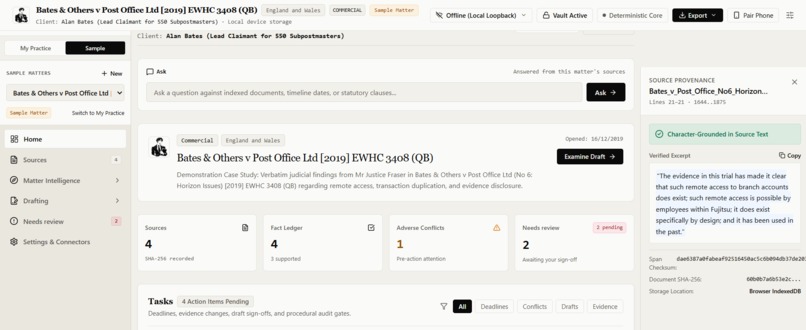
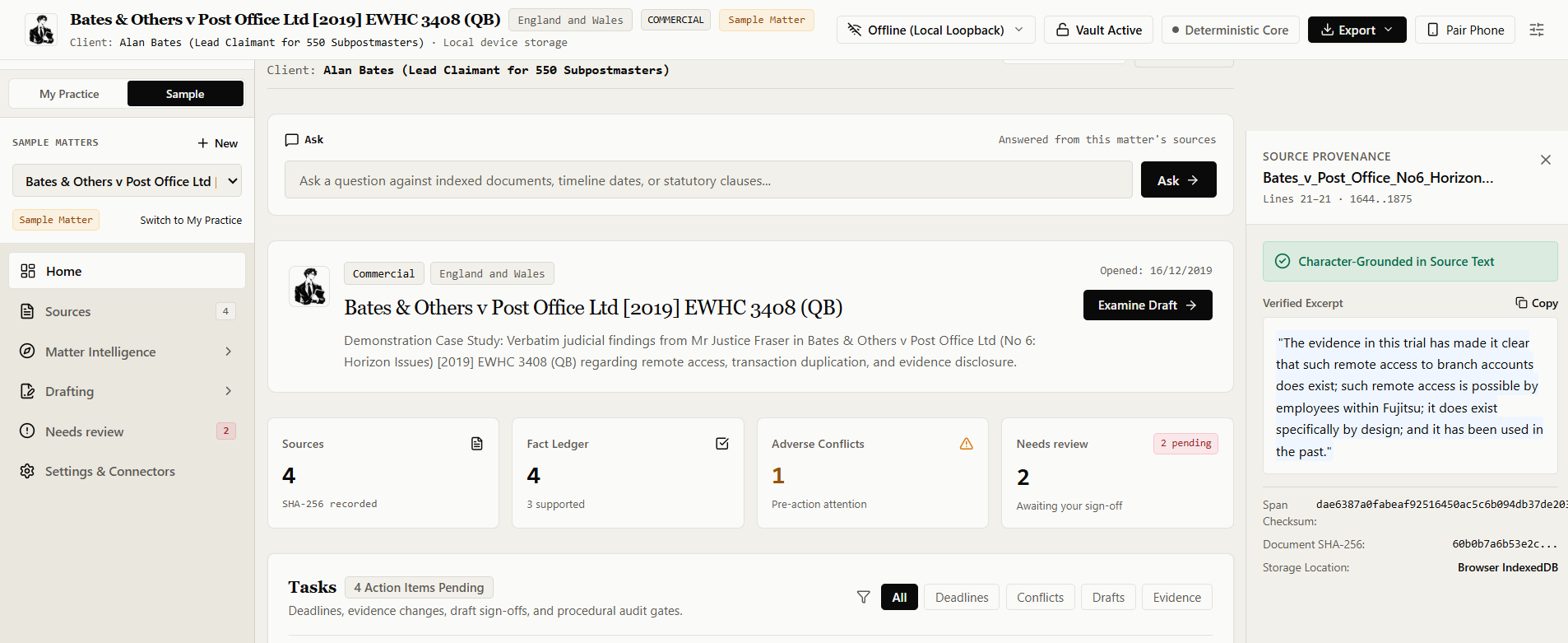
ATKIN organizes AI around a legal matter, not around an isolated chat.
A matter can contain its own:
- sources and document versions
- persistent conversations
- facts and issues
- research
- timelines
- drafts and work products
- tasks
- memory
- reusable workflows
- execution and audit history
Source-grounded Ask
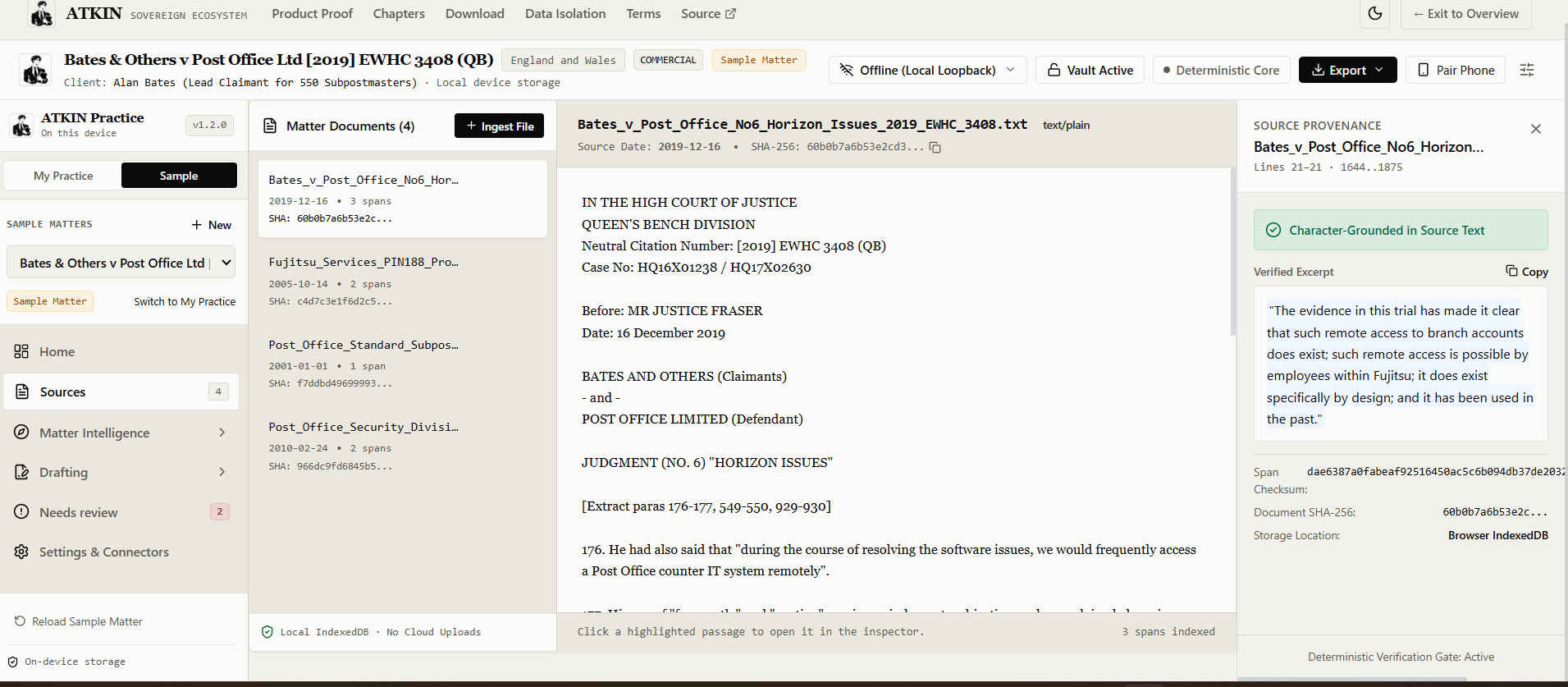
A lawyer can ask questions about the documents inside a matter.
ATKIN retrieves the relevant source material and binds important claims back to the exact source instead of treating generated text as evidence.
Citations can be opened back into the underlying material.
If the selected sources do not establish something, ATKIN is designed to abstain rather than invent an answer.
For example, if a user asks for a fact that does not exist in the selected agreement, ATKIN can respond that the selected material does not establish it instead of silently using unrelated information.
Matter isolation
Legal AI becomes dangerous if one client's information can leak into another matter.
ATKIN therefore treats the matter as a core isolation boundary across retrieval, citations and memory.
Research
ATKIN includes a research workspace for turning a legal question into structured work:
- understand the question
- determine scope and jurisdiction
- gather relevant material
- inspect sources
- extract findings
- verify citations
- preserve the result with the matter
The goal is not to hide the research process behind a single generated paragraph. The lawyer should be able to see where important findings came from.
Work Products
ATKIN can turn legal work into persistent editable outputs such as:
- research notes
- advice drafts
- contract analysis
- chronologies
- evidence summaries
- legal memoranda
Work Products are versioned rather than silently overwritten.
If a supporting source changes, ATKIN can mark dependent work as needing review instead of pretending that the old draft is still current.
Memory
ATKIN has durable memory for useful information such as preferences, matter context and reusable workflows.
Memory is scoped so that information from one matter is not automatically available inside another.
Users remain able to inspect and control what is retained.
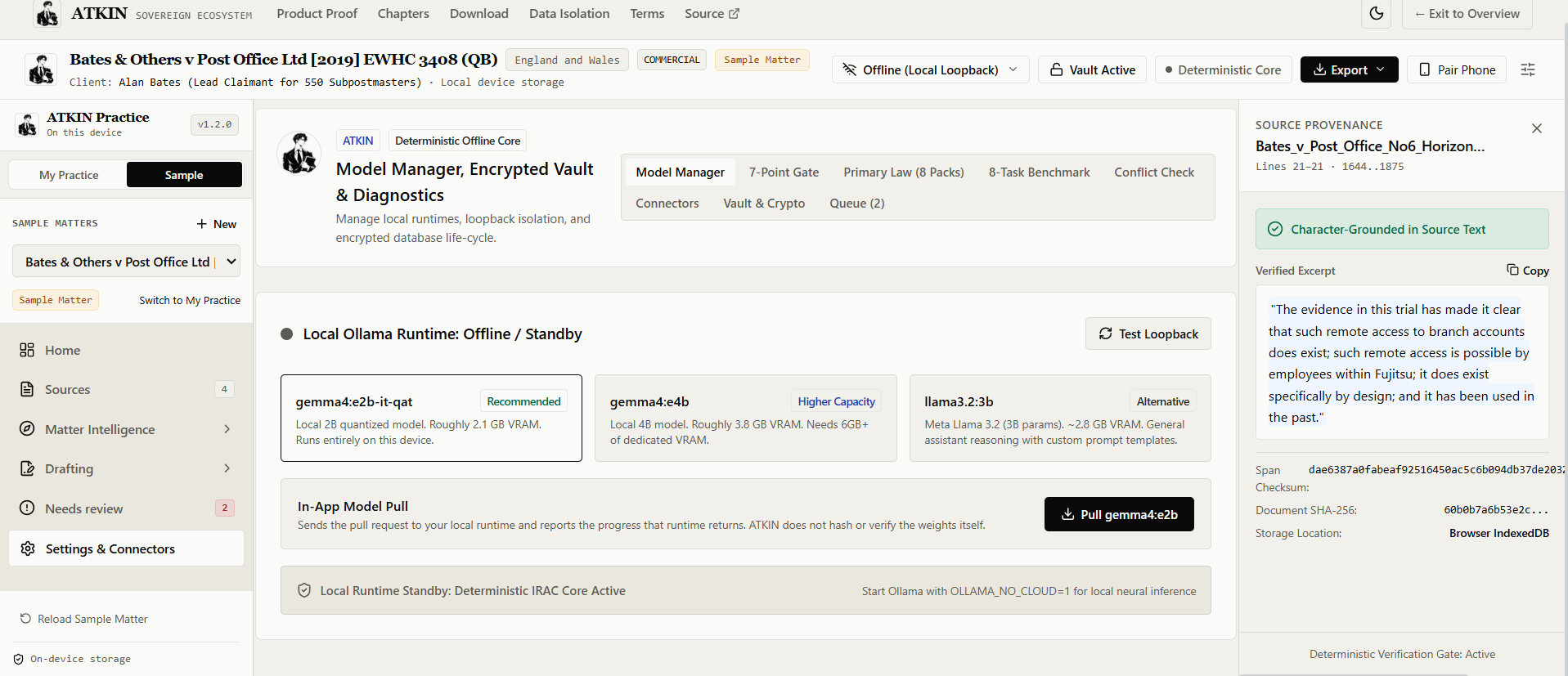
Model sovereignty
ATKIN does not make one model provider the product.
The architecture separates the legal workspace from the model runtime, allowing the system to work with local models and configurable providers.
That means changing the underlying AI does not require throwing away the user's matters, sources, drafts or memory.
How we built it
ATKIN is built as a layered legal AI system rather than one giant prompt.
At its core is an execution layer we call ASTRA, which coordinates the steps around an AI request.
A simplified flow looks like:
User request
    ↓
Matter and privacy scope
    ↓
Context planning
    ↓
Source and memory retrieval
    ↓
Model / tool routing
    ↓
Generation or deterministic execution
    ↓
Citation verification
    ↓
Audit record
    ↓
Persistent result

We deliberately separate deterministic operations from model reasoning.
For example, things such as integrity checks, persistence, source validation and other operations that can be performed reliably in code should not depend on an LLM guessing correctly.
CitationGate
One of the most important components is CitationGate.
Instead of allowing the same model that generated an answer to declare its own citation valid, CitationGate independently verifies that:
- the referenced source exists
- the source belongs to the active matter
- the referenced material exists
- the source version is valid
- the quoted material matches the underlying source
During adversarial testing, we discovered and fixed a real cross-matter citation boundary issue where caller-controlled matter metadata was not sufficient. The verifier now checks the stored document's matter identity directly.
That bug was exactly why we wanted an independent verification layer.
Persistence
ATKIN uses a durable local data layer for core workspace state including matters, conversations, drafts, tasks, memory, skills and research state.
We built process-restart tests rather than only testing save() followed immediately by load() in the same process.
Audit and recovery
ATKIN also contains a hash-linked audit system for important state changes.
We added adversarial tests that mutate, delete, reorder and replace audit records to ensure tampering is detected.
We also built workspace backup and restore tests, including corruption rejection.
Performance
As the product grew, the initial frontend bundle became too large.
We split heavy product surfaces into deferred chunks and reduced the initial JavaScript payload substantially while keeping the core experience fast.
Challenges we faced
Making citations trustworthy
Generating a citation-looking string is easy.
Proving that it actually points to the correct source, correct matter and correct text is much harder.
We spent significant time attacking our own citation system rather than simply making the UI look convincing.
Preventing cross-matter leakage
Legal information is unusually sensitive.
Matter isolation had to apply not only to the visible interface, but also to retrieval, memory and citation verification.
Separating demo data from real user state
Hackathon products often look impressive because sample content is deeply hardcoded into the application.
We wanted ATKIN's demo environment to remain useful while ensuring a new personal workspace starts clean.
Making AI uncertainty visible
A legal AI product should not turn uncertainty into confidence theatre.
We removed unsupported claims such as absolute accuracy, automatic admissibility or guaranteed grounding and replaced them with observable product states.
Building a real product instead of more features
The hardest challenge became deciding what not to build.
We repeatedly removed or simplified features when they made the product feel more like a prototype.
The final focus became five workflows:
1. Matter + Sources
2. Ask + exact citation
3. Research
4. Work Product
5. Model and data sovereignty
What we learned
The biggest lesson was that a better legal AI product is not necessarily created by adding a larger model.
The surrounding system matters just as much.
We learned that legal AI needs explicit concepts for:
- provenance
- matter boundaries
- source versions
- contradictions
- abstention
- approvals
- durable work
- human review
We also learned that trust is a user experience problem as much as a model problem.
A lawyer should be able to distinguish:
- what the source says
- what the user supplied
- what ATKIN inferred
- what external research found
- what the AI generated
- what a lawyer approved
Keeping those categories separate became one of the core design principles of ATKIN.
Why ATKIN
General AI products start with a conversation.
ATKIN starts with the matter.
That small architectural difference changes the product:
Generic AI
Chat + files + tools

ATKIN
Matter + sources + facts + research + work products
+ memory + approvals + models + audit

ATKIN is our attempt to make AI fit the structure of professional legal work instead of forcing legal work into the structure of a chatbot.
What's next
The longer-term goal is for ATKIN to become an open, model-independent legal AI workspace that can connect to the tools lawyers already use while maintaining explicit control over:
- where information is stored
- where inference occurs
- what a model can access
- which external services are connected
- what ATKIN remembers
- which actions require human approval
The model should be replaceable.
The lawyer's work should not be.

### Built with

I would use these tags. They give judges the technical story without stuffing the section with every library in the repository.

```text
React
TypeScript
Vite
Tauri
IndexedDB
Dexie.js
Ollama
Local LLMs
RAG
AI Agents
Legal Tech
Generative AI
NLP
Document AI
Prompt Engineering
MCP
Cryptography
SHA-256
Progressive Web App
Android
Vitest
Playwright
Tailwind CSS
Web APIs
Local-first
Built With
- agents
- ai
- android
- cryptography
- dexie.js
- document
- engineering
- generative
- indexeddb
- legal
- llms
- local
- mcp
- natural-language-processing
- ollama
- progressive
- prompt
- rag
- react
- sha-256
- tech
- typescript
- vite
- vitest
- web


Log in or sign up for Devpost to join the conversation.