-
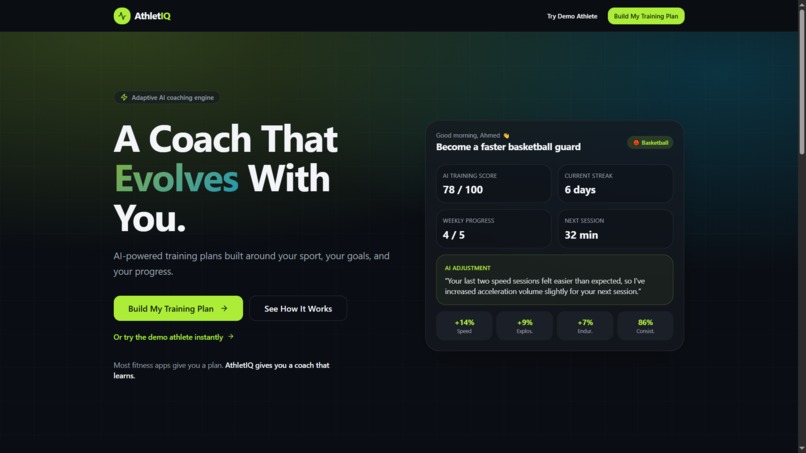
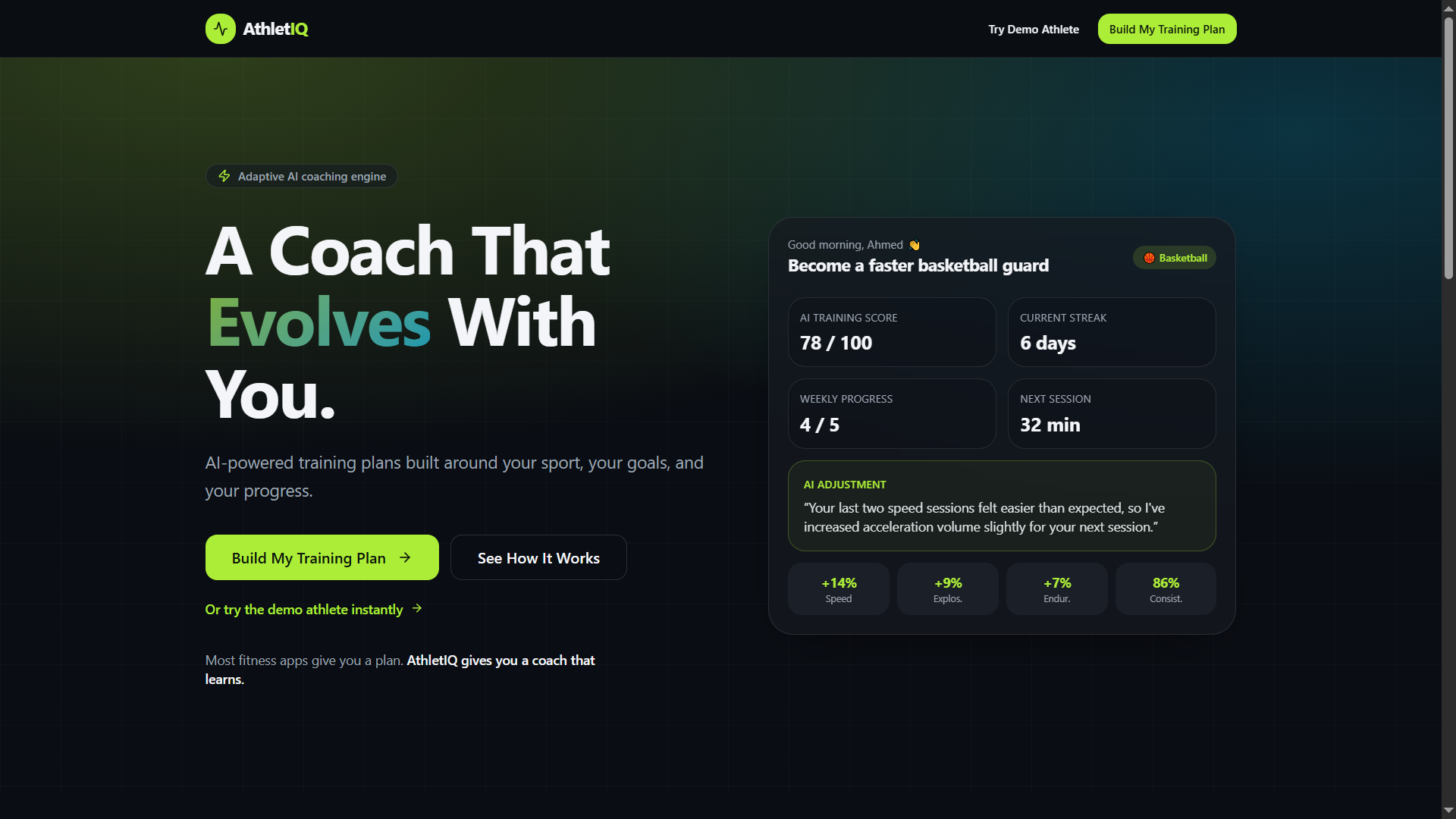
Home page
-
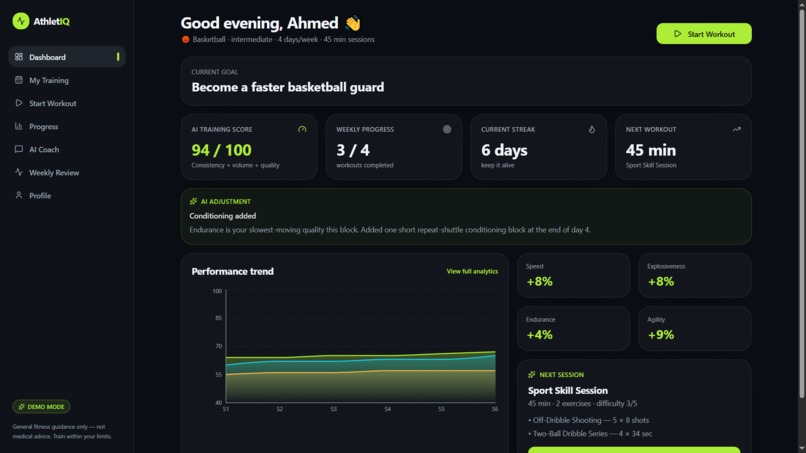
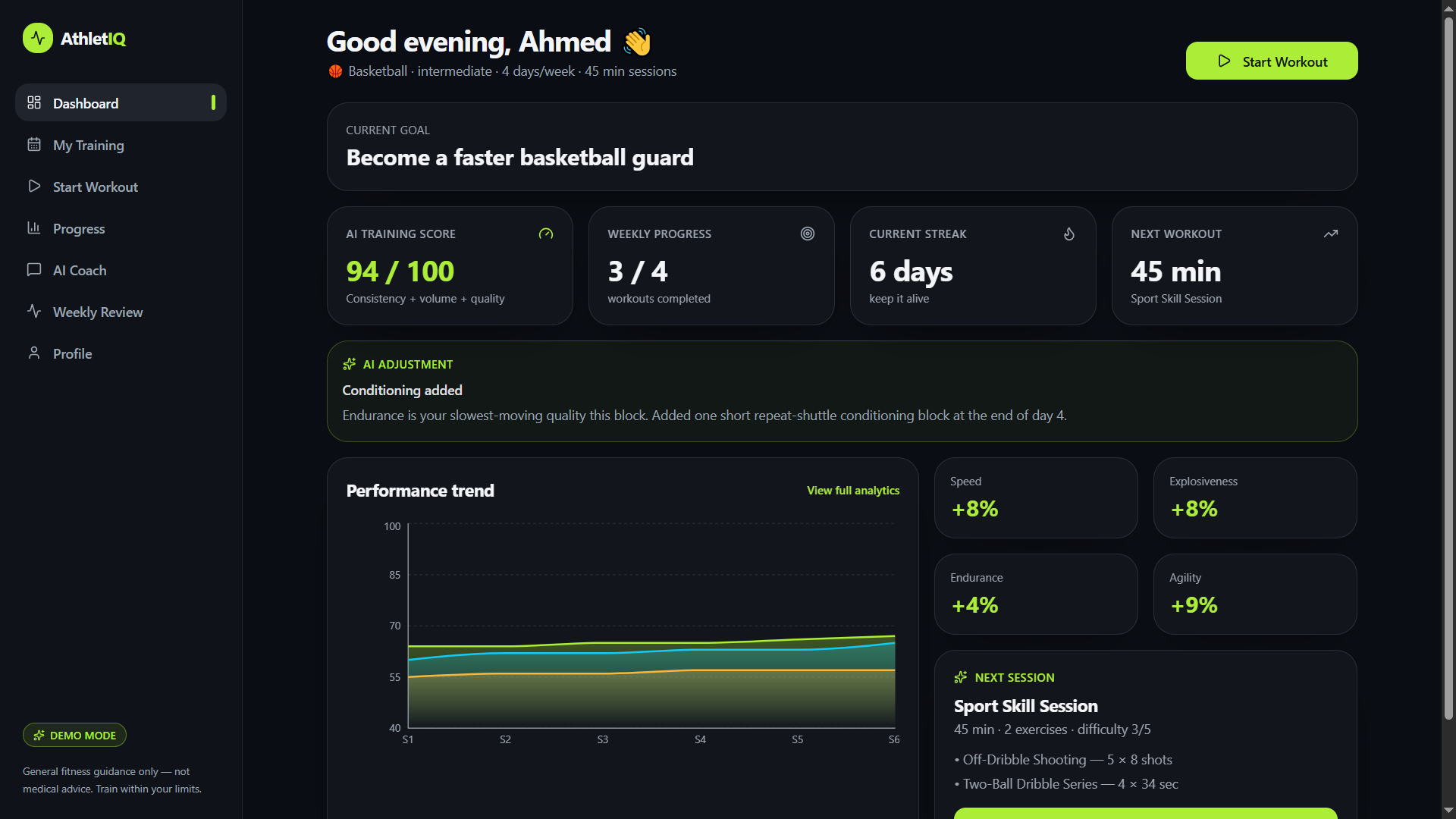
Dashboard
-
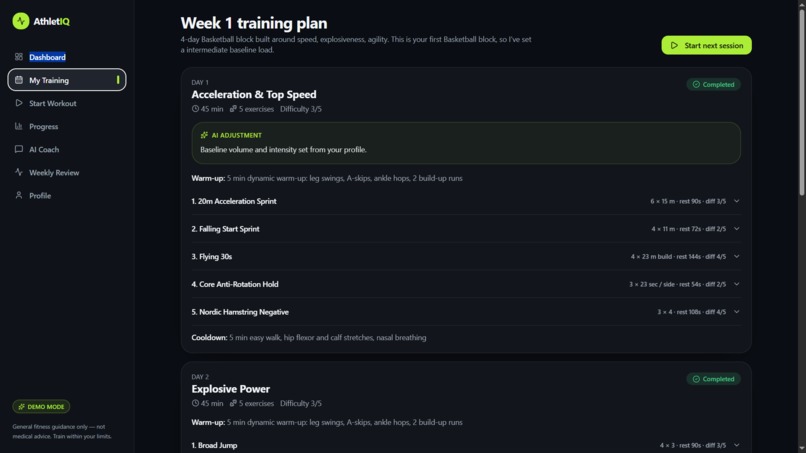
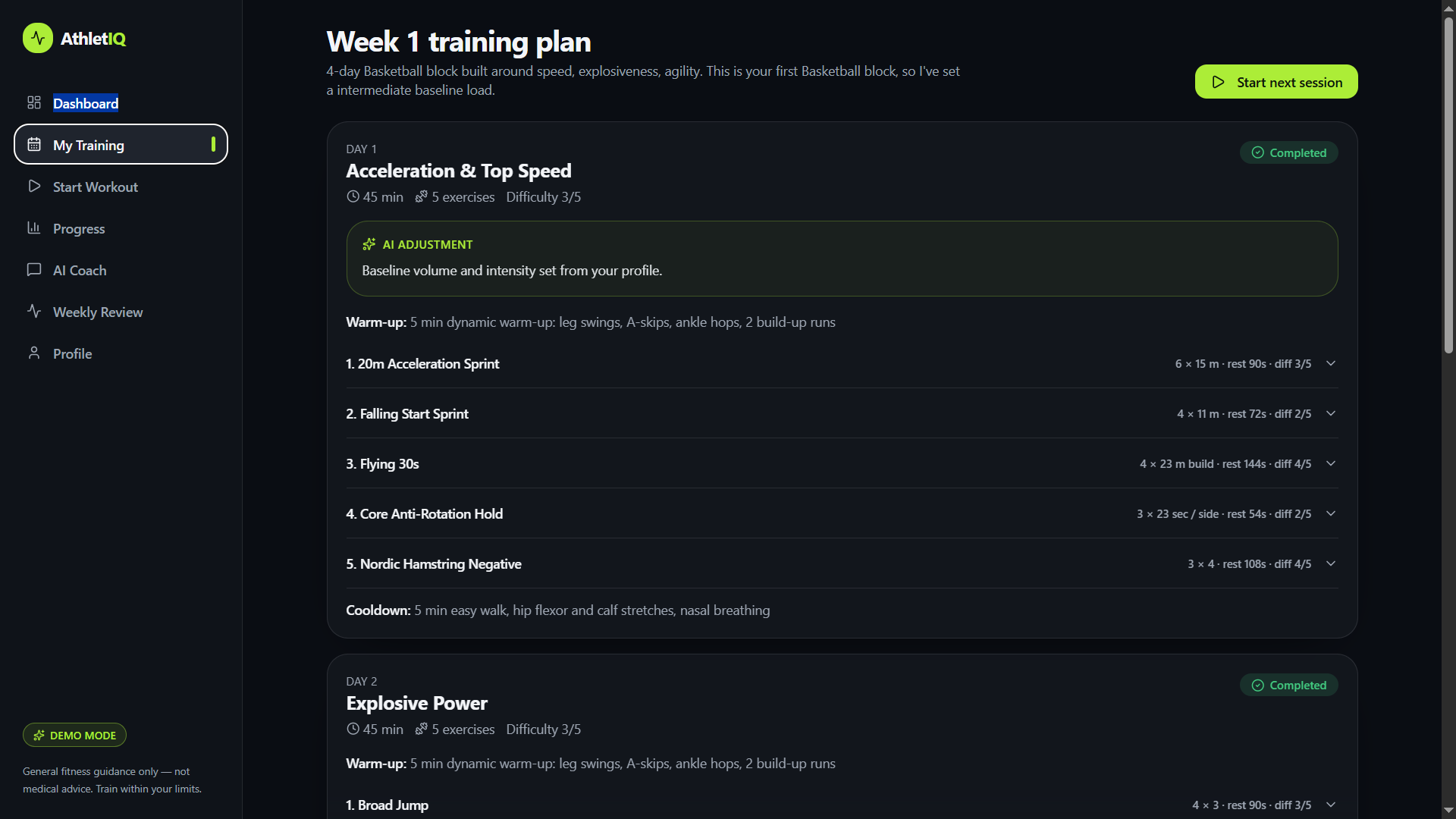
Training Page
-
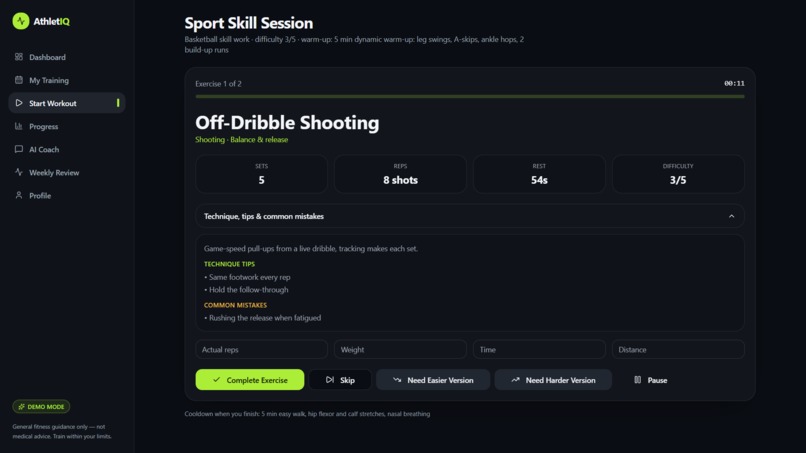
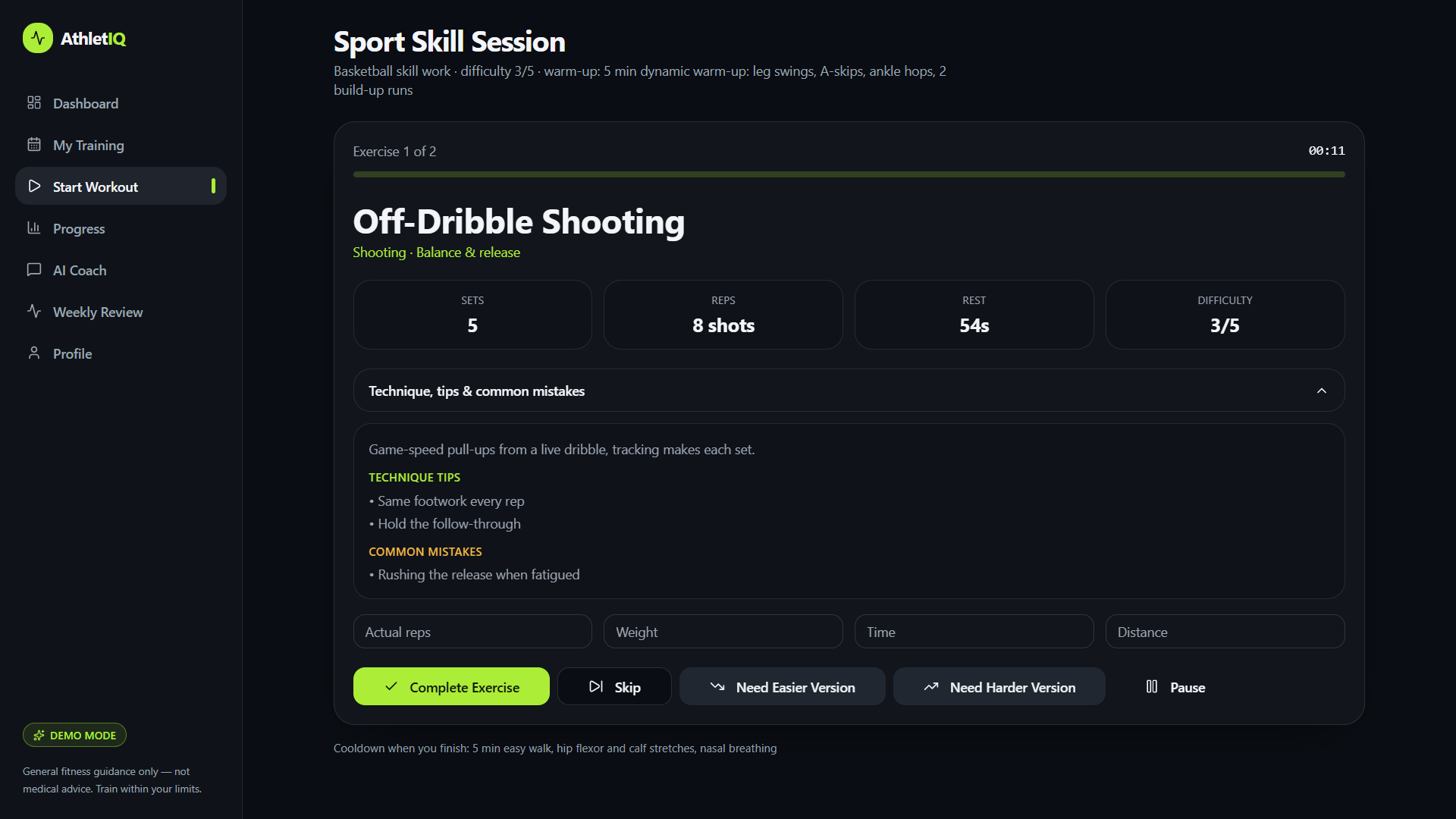
Workout Page
-
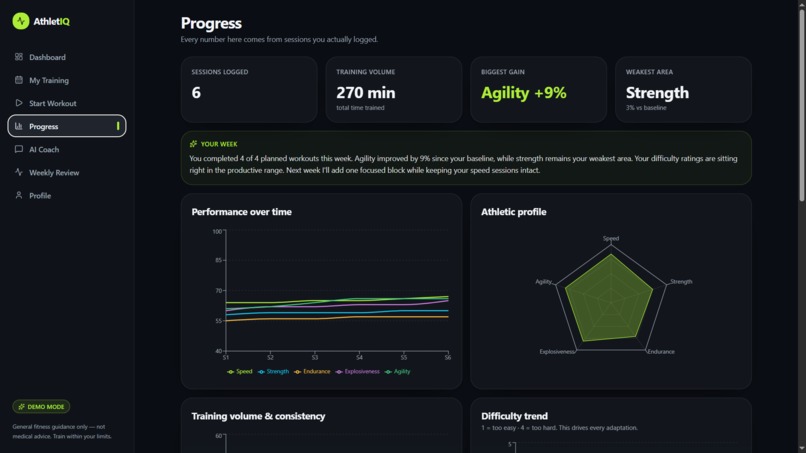
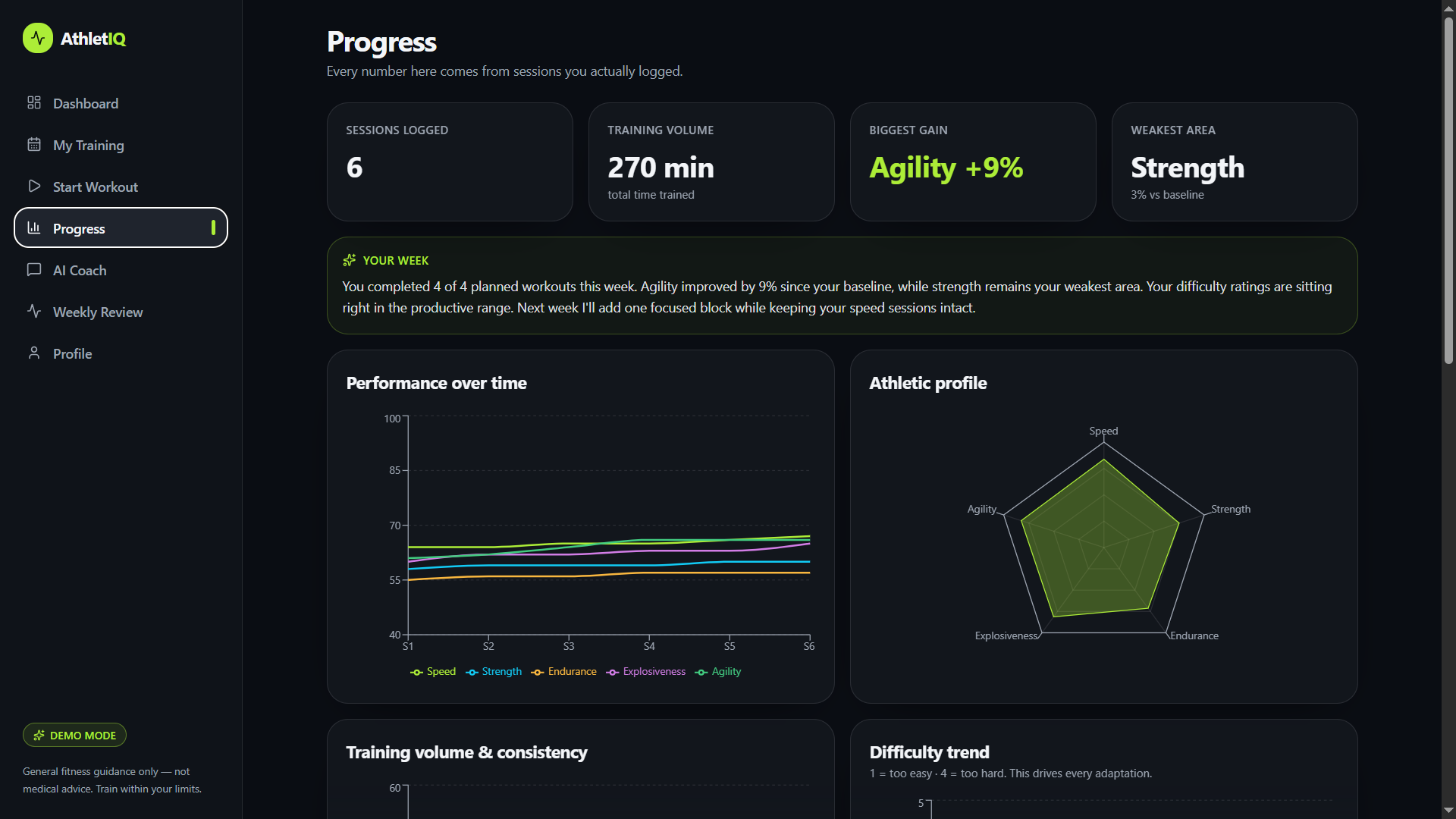
Progress Page
-
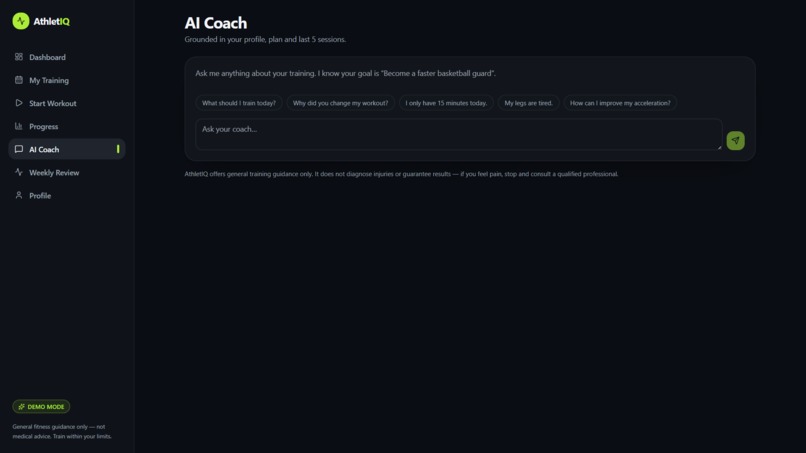
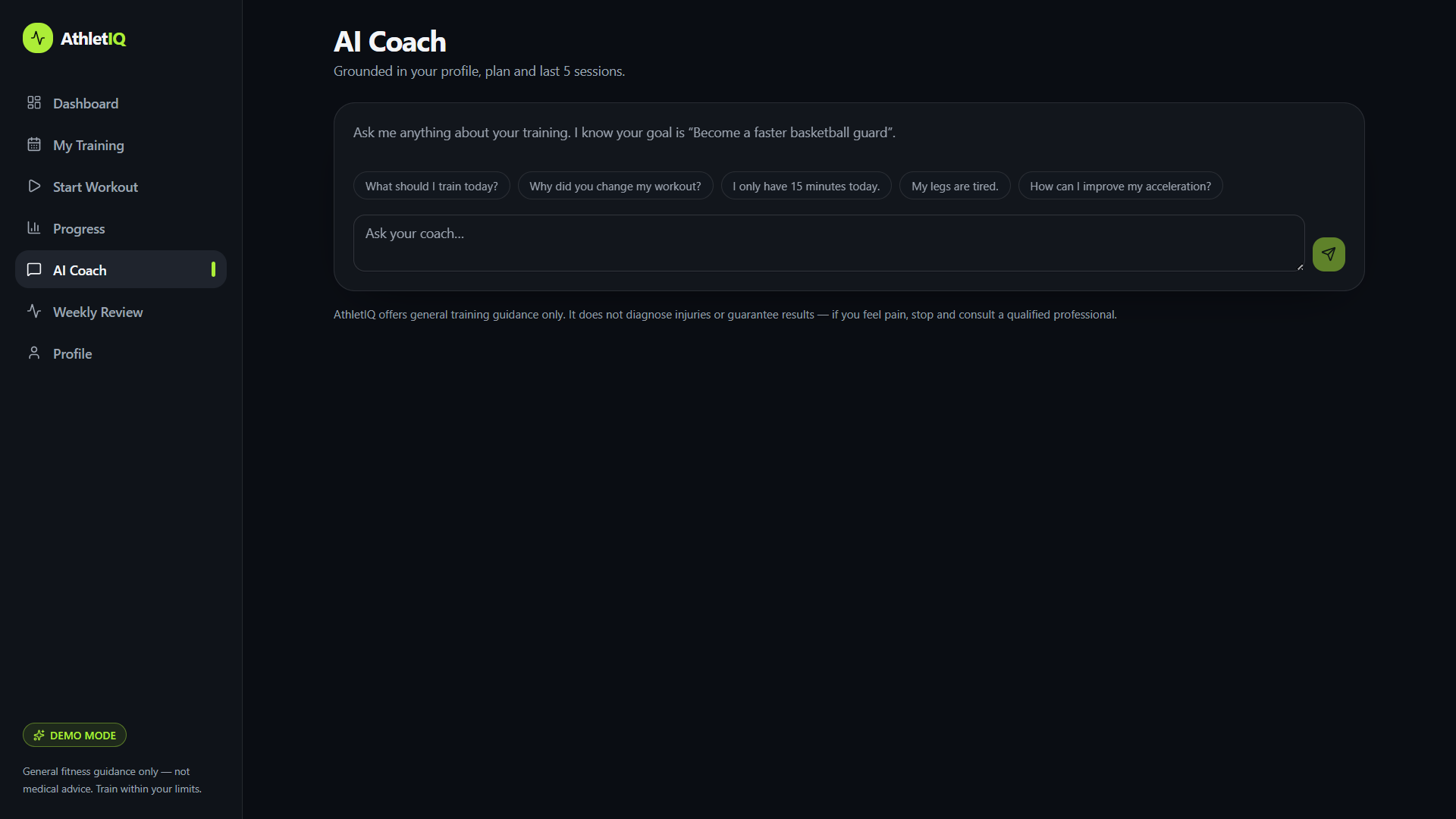
AI Coach Page
-
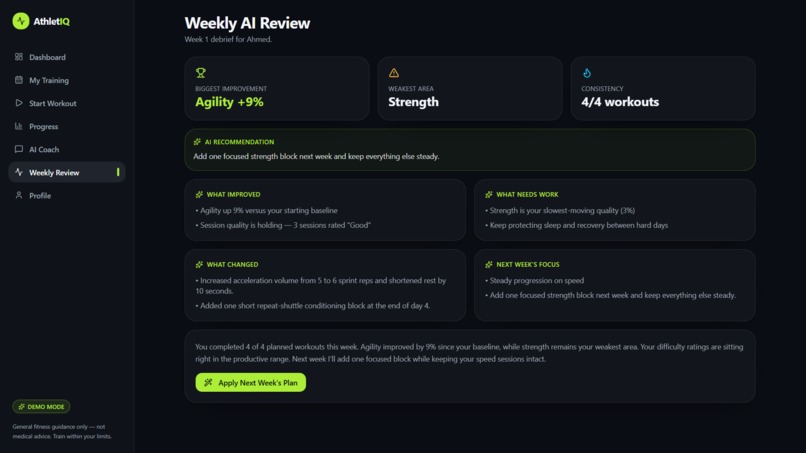
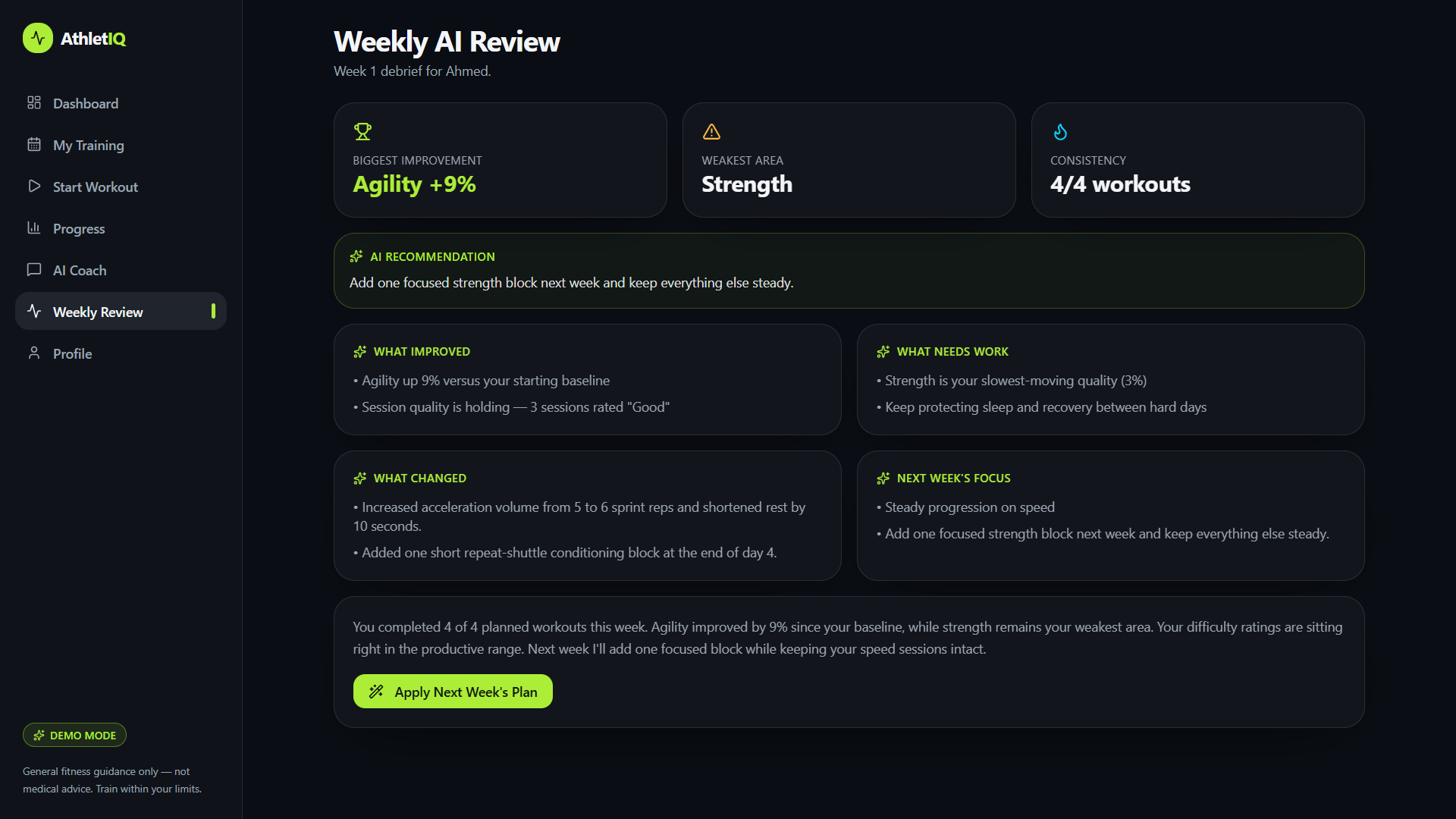
Weekly AI Review Page
-
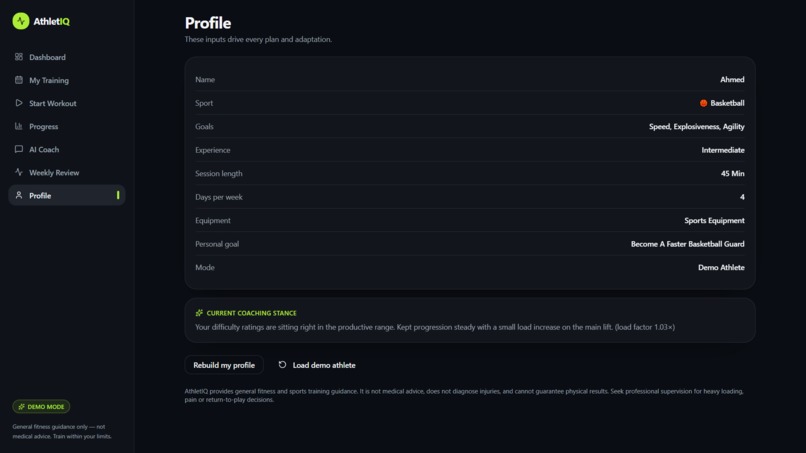
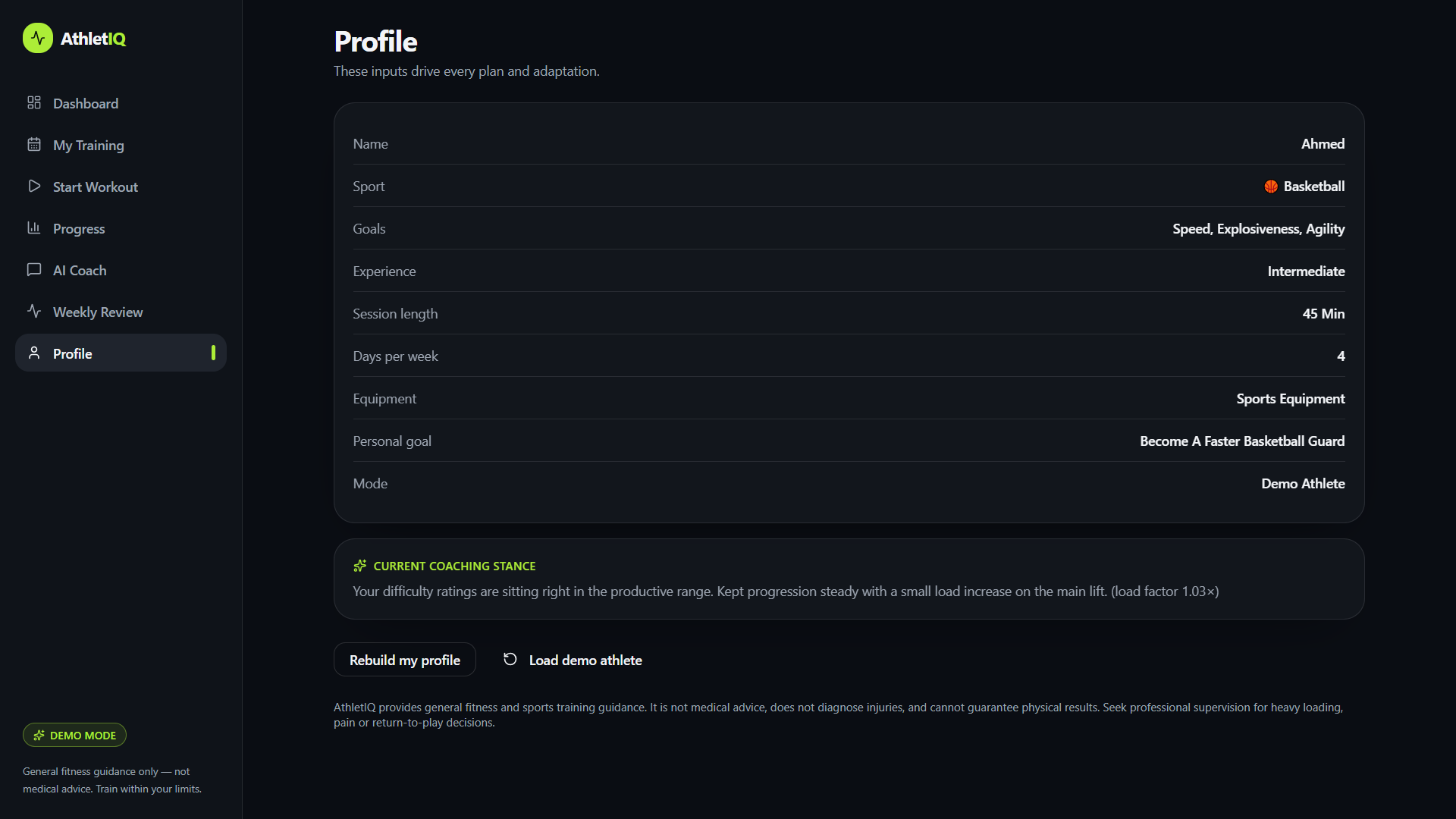
Profile page
AthletIQ
Your body is different. Your training should be too.
Most fitness applications give users predefined workout plans.
But athletes are not predefined.
Two people can play the same sport, have completely different goals, different experience levels, different schedules, different equipment, and different physical profiles.
That inspired us to build AthletIQ — an AI-powered sports coach designed to create training that adapts to the individual athlete.
💡 Inspiration
We noticed that many workout applications follow a simple model:
Choose a workout → Complete it → Repeat.
But real training isn't that static.
An athlete might have a great day one day and feel exhausted the next. A beginner and an advanced athlete shouldn't receive the same program. If a workout is too easy, the next session should become more challenging. If it is too difficult, the training should adapt.
We wanted to build something closer to a personal coach, rather than another workout library.
That became our core idea:
What if an AI coach could learn from an athlete and continuously adapt their training?
🧠 What AthletIQ Does
AthletIQ starts by learning about the athlete.
The user provides information such as:
- Age
- Height
- Weight
- Sport
- Position
- Experience level
- Goals
- Training frequency
- Available time
- Equipment
- Training environment
The AI uses this information to generate a personalized training strategy.
Instead of giving every athlete the same workout, AthletIQ creates a plan around the individual's goals and circumstances.
For example:
A beginner basketball player training for 30 minutes without gym equipment should not receive the same program as an advanced basketball player training for an hour in a full gym.
🔄 The Adaptive Training Loop
Personalization doesn't stop when the plan is generated.
After completing a workout, athletes can provide feedback:
- Too Easy
- Good
- Challenging
- Too Hard
They can also record performance data such as repetitions, time, distance, or weight.
The AI analyzes this information and can adjust future training.
The loop is:
Athlete Profile → AI Analysis → Personalized Plan → Workout → Feedback → AI Analysis → Adaptation → New Workout
This makes AthletIQ a continuously adapting coaching system rather than a static workout generator.
👁️ AI Movement Analysis
We also wanted AthletIQ to understand how an athlete moves, not only what they train.
The AI Movement Scan allows users to provide exercise footage for general movement and form feedback.
The system can look at things such as:
- Body positioning
- Movement consistency
- Balance
- Alignment
- Range of motion
- Exercise technique
It can then provide actionable coaching feedback.
For example:
"Your knee alignment appears inconsistent during part of the movement. Try slowing down and focusing on controlled form."
AthletIQ is designed as a training and form-feedback tool, not a medical diagnostic system. If an athlete reports pain or a possible injury, the application encourages them to stop the relevant activity and seek qualified professional guidance.
🛠️ How We Built It
AthletIQ was built as a modern responsive web application using:
- React
- TypeScript
- Vite
- Tailwind CSS
- Supabase
- AI / LLM integration
- AI vision / movement analysis
- Recharts
- Lovable
We designed the application around modular AI services so that different AI capabilities can operate independently.
The AI layer is responsible for tasks such as:
- Athlete analysis
- Personalized training generation
- Workout adaptation
- Progress analysis
- Weekly reviews
- AI coaching
- Exercise alternatives
- Movement/form feedback
Structured outputs allow the application to turn AI decisions into actual workouts, progress cards, recommendations, and plan changes.
🧪 What We Learned
One of the biggest things we learned is that adding AI to an application is not enough.
A chatbot alone doesn't make a product intelligent.
The AI needs to be connected to the application's actual state and user data.
For AthletIQ, that meant building a loop where:
AI decisions → affect the workout → create new user data → influence the next AI decision.
We also learned how important it is to design AI outputs in a structured way so they can reliably control parts of a real application instead of only generating text.
🚧 Challenges
1. Making Personalization Actually Meaningful
One of our biggest challenges was avoiding a generic workout generator.
We didn't want to simply change the wording of the same workout for every athlete.
Instead, the system considers multiple inputs and uses them to influence the structure, duration, exercises, difficulty, and training focus.
2. Making AI Adaptation Visible
It wasn't enough for the AI to say:
"I'll adjust your next workout."
The change needed to actually appear in the user's training plan.
We therefore designed the adaptive system so feedback can influence subsequent workouts.
3. Balancing AI With Safety
Fitness and sports training can involve real physical risks.
We deliberately avoided presenting AI as a doctor or injury-diagnosis system.
The application focuses on general training and movement feedback and directs users toward qualified professionals when health or injury concerns arise.
4. Building a Product, Not Just a Prototype
Another challenge was turning multiple AI capabilities into one coherent experience.
Instead of creating separate AI features, we connected them through a single athlete profile and training history.
🚀 What Makes AthletIQ Different?
AthletIQ isn't trying to replace every sports coach.
It is designed to make personalized training more accessible.
The key difference is the adaptive loop:
Most fitness apps give you a plan. AthletIQ gives you a coach that learns.
The goal is simple:
Understand the athlete → create a plan → observe performance → adapt → repeat.
🔮 What's Next?
There is much more we could build with additional time.
Future versions could include:
- More advanced computer-vision movement analysis
- Wearable integration
- Heart-rate and training-load data
- More sports and sport-specific drills
- Voice-based coaching
- More advanced performance analytics
- Coach and athlete collaboration
- Long-term AI training periodization
AthletIQ is only the beginning of our vision for adaptive AI-powered sports training.
❤️ Final Thought
Every athlete is different.
Their goals are different. Their experience is different. Their schedule is different. Their progress is different.
So their training shouldn't be identical.
AthletIQ — Your body is different. Your training should be too.
Built With
- ai
- analysis
- css
- integration
- llm
- movement
- react
- recharts
- supabase
- tailwind
- typescript
- vision
- vite

Log in or sign up for Devpost to join the conversation.