Inspiration
Project information rarely lives in one place. It is scattered across documents, Discord messages, task boards, meetings, and individual team members. As that information becomes outdated, teams develop different understandings of the same project.
The problem is not simply a lack of tools. Platforms such as Jira and Notion store information, but they still depend on people remembering to update them. Following up with every team member also carries a social cost, so important questions are often asked too late.
We created Athena around a simple idea: an AI assistant can proactively follow up without creating social friction. Like Athena appearing as Mentor in The Odyssey, our system sees the whole board, guides each contributor, and helps the team act before hidden problems become delays.
What it does
Athena is an active, AI-powered project brain that combines a live knowledge graph with a proactive Discord bot.
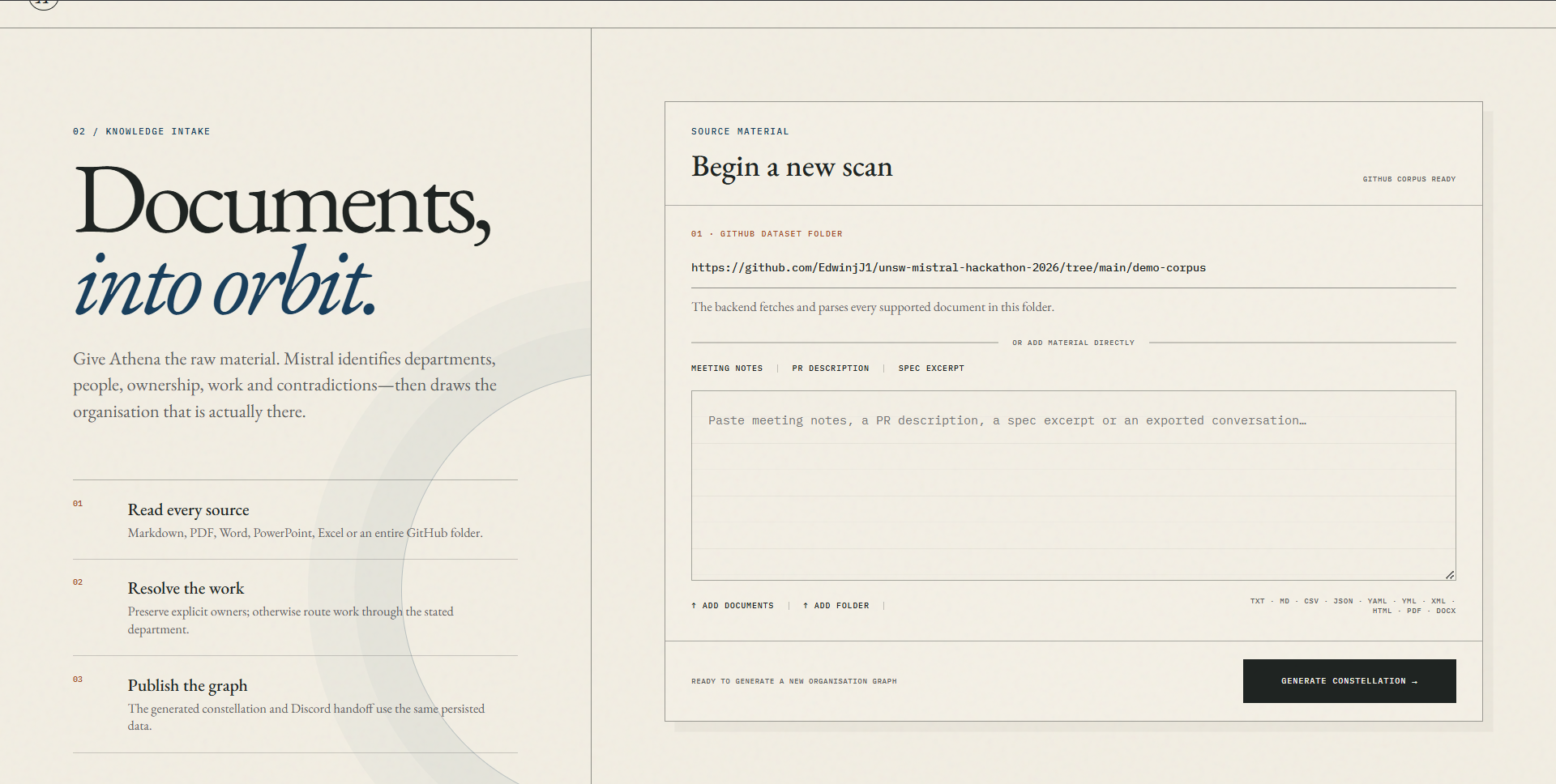
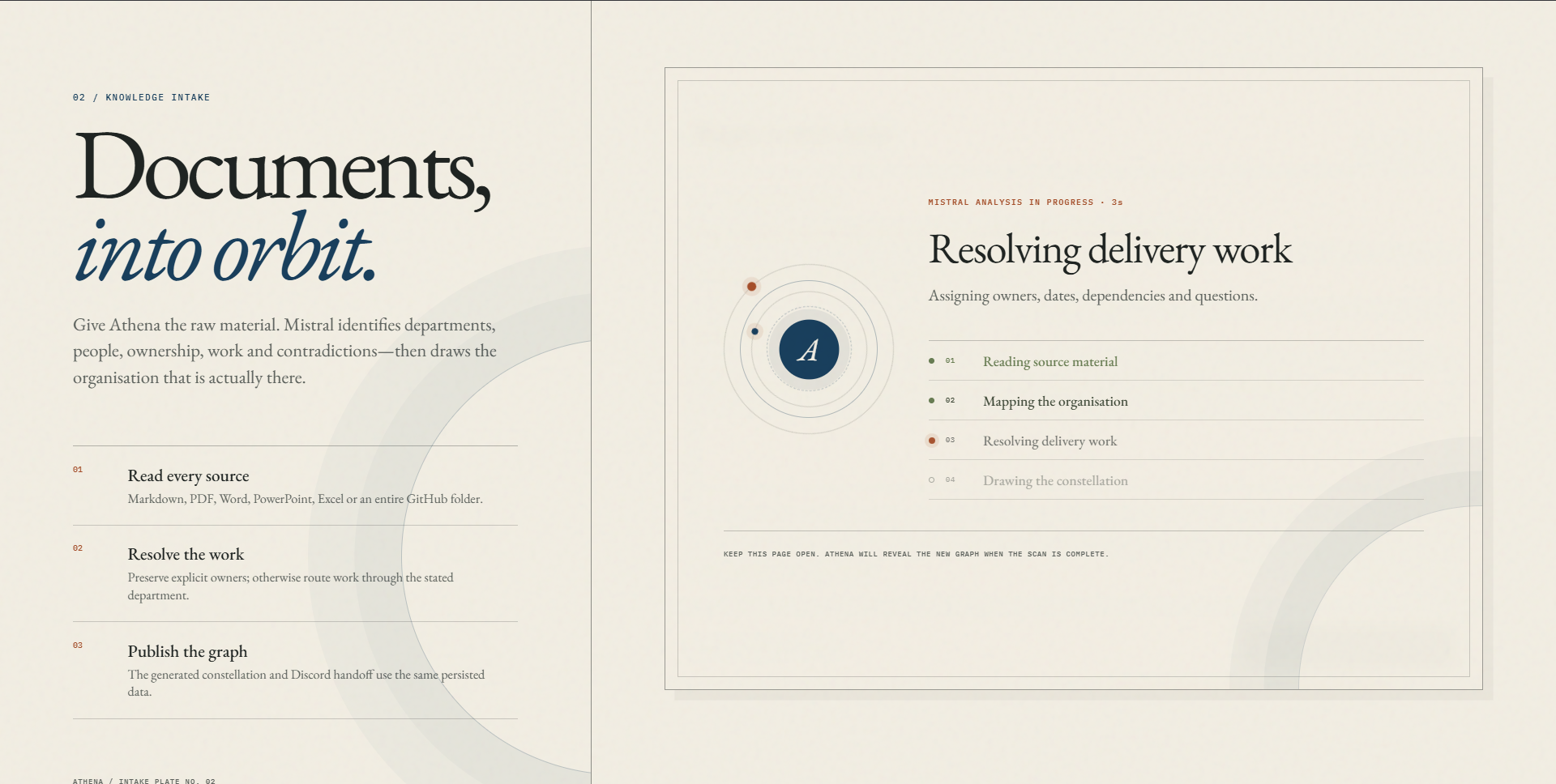
Users can import project documents, meeting notes, specifications, pull request descriptions, spreadsheets, presentations, or a GitHub document folder. Athena uses Mistral AI to identify:
- Teams and people
- Tasks and owners
- Deadlines and statuses
- Dependencies and blockers
- Missing ownership
- Contradictory information across teams
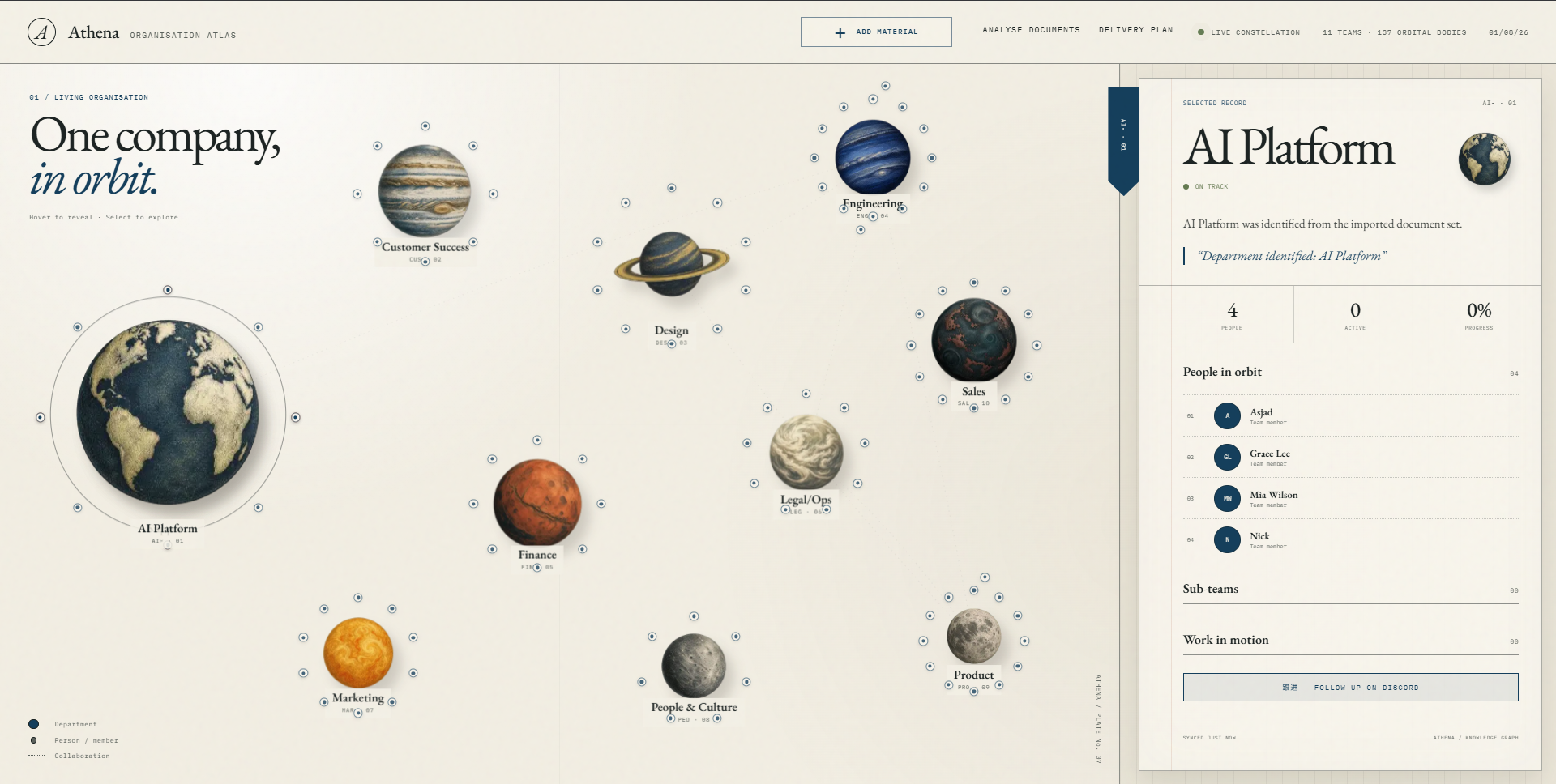
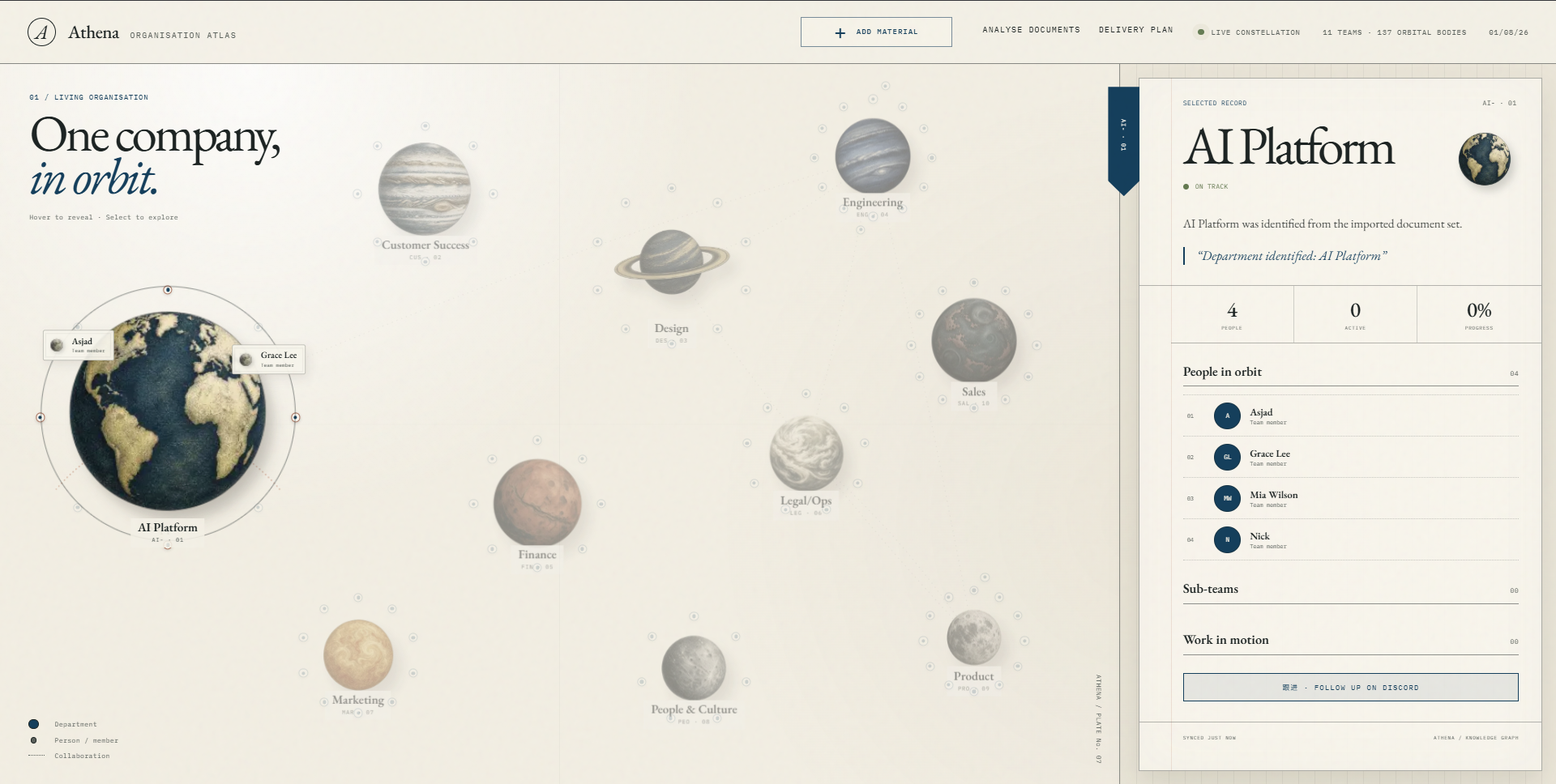
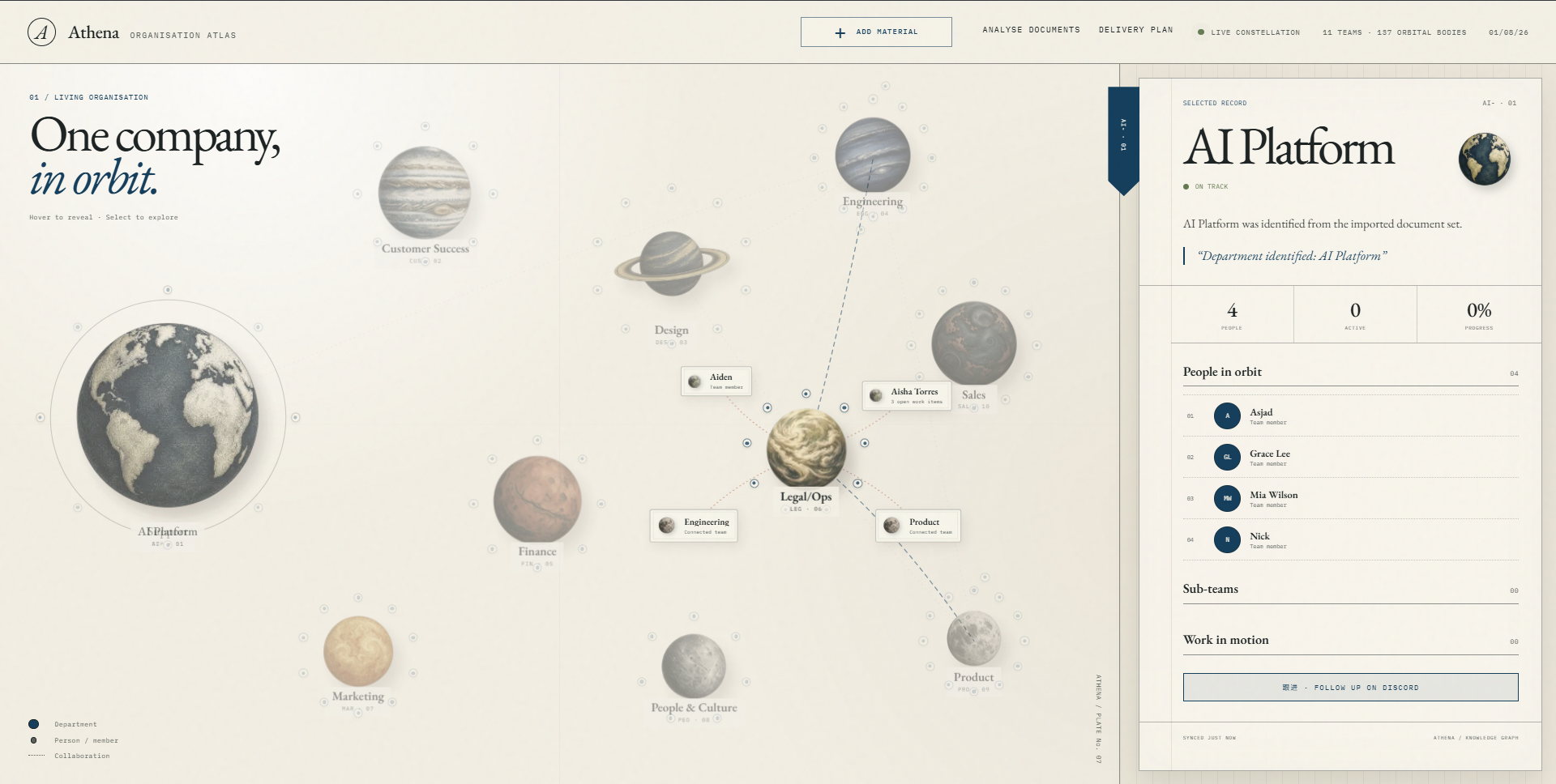
This information becomes an interactive organisation constellation. Teams, people, tasks, and dependencies are represented as connected nodes, allowing users to understand the state of an entire project at a glance.
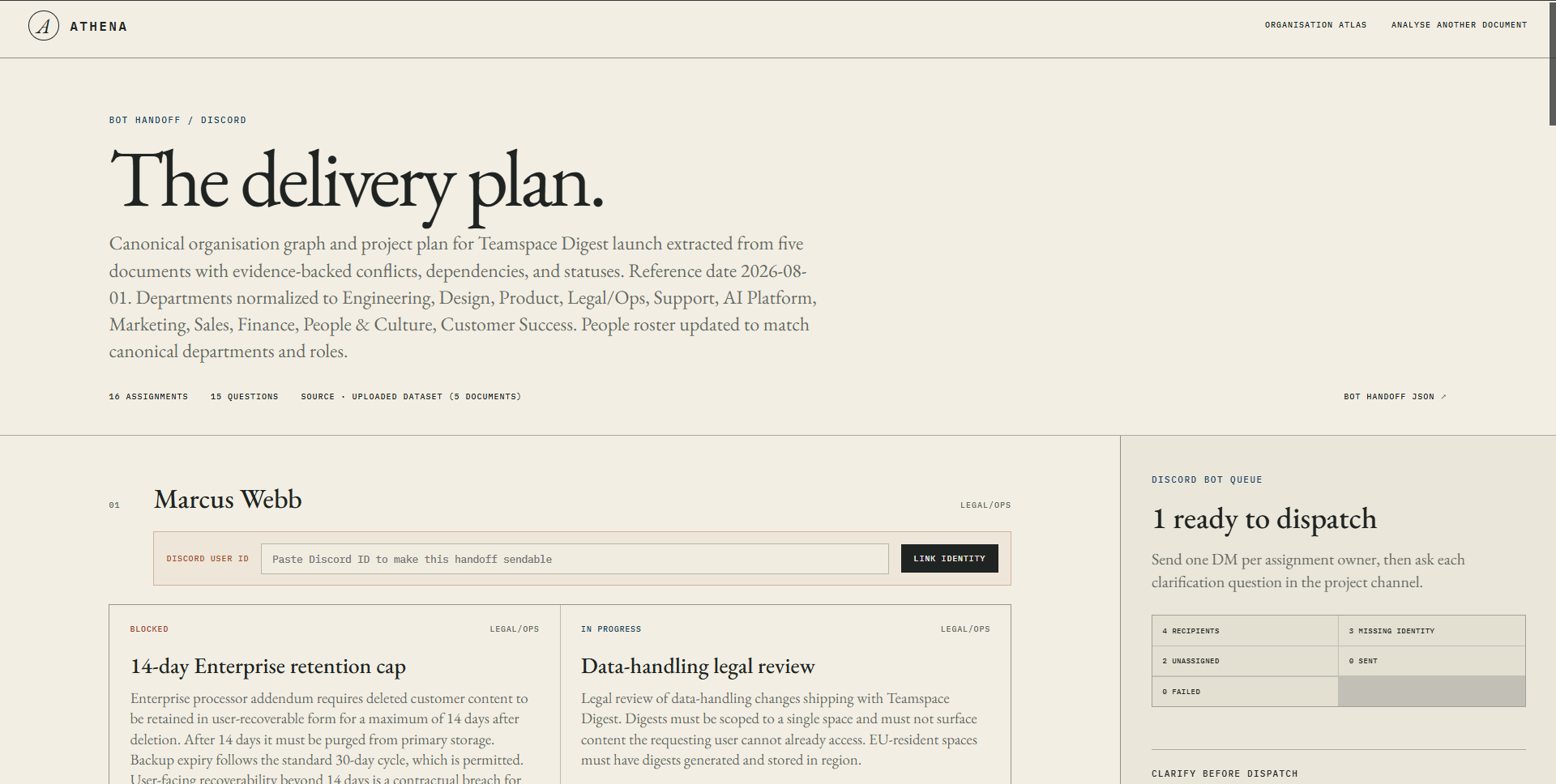
Athena then generates a delivery plan and sends personalised Discord messages to task owners. Instead of asking a generic “Any updates?”, it explains what each person owns, when it is due, what it depends on, and who they need to contact.
When someone replies, Athena classifies the message, extracts a structured update, and writes it back to the shared graph. The interface updates to reflect the latest project state.
The hidden signal
Athena becomes especially valuable when different teams hold conflicting beliefs.
For example, Engineering may report that authentication has been deployed, while Operations still believes the authentication handover is incomplete. Both statements may be honest, but no individual team member has enough context to identify the contradiction.
Because Athena brings every update into one connected graph, it can surface the conflict, preserve the original sources, and generate a focused clarification question for the relevant owners.
How we built it
Athena is built with Next.js and TypeScript, with a shared graph model used across the frontend, API, AI pipeline, and Discord bot.
We use:
- Mistral AI for document understanding, message triage, structured extraction, plan generation, message composition, and contradiction detection
- SQLite as the persistent graph store
- Next.js API routes for ingestion, graph updates, planning, and Discord handoff
- Discord.js for proactive task delivery and progress follow-ups
- An interactive force-directed graph for visualising teams, people, work, and dependencies
Every meaningful update is represented as a structured graph delta. This gives all parts of the system one consistent way to create or update nodes and relationships.
We also preserve a source reference for each fact so users can trace an AI-generated insight back to the original document or message.
Challenges we faced
One major challenge was converting unstructured project information into a stable graph without creating duplicate people or tasks. We addressed this by giving the model existing graph context and applying updates through a consistent upsert-based delta format.
Another challenge was making AI behaviour reliable enough for a live demonstration. We separated the workflow into specialised calls instead of relying on one large prompt, added schema validation, and designed deterministic fallbacks for critical paths.
Connecting AI-generated plans to real Discord identities was also challenging. We created an explicit identity-linking and handoff flow so assignments can be reviewed before any message is dispatched.
Finally, we had to make complex project state understandable at a glance. The constellation interface uses visual hierarchy, status, node relationships, and drill-down panels to turn raw project data into an actionable view.
What we learned
We learned that AI is most useful in project management when it does more than summarise. Its real value comes from continuously connecting information, preserving evidence, detecting inconsistencies, and prompting the right human at the right time.
We also learned that structured outputs and traceability are essential. Users are more likely to trust an AI-generated insight when they can inspect the source and understand why the system reached that conclusion.
Accomplishments that we are proud of
We are proud that Athena closes the complete information loop:
- Project knowledge is imported.
- Mistral converts it into a structured graph.
- Athena(mistral) generates an actionable delivery plan.
- The Discord bot contacts the appropriate owners.
- Human replies update the shared graph.
- Athena detects new blockers and contradictions.
- The next follow-up uses the latest state.
This transforms Athena from a passive dashboard into an active coordination system.
What's next for Athena
Next, we would expand Athena with integrations for tools such as Jira, Confluence, Slack, Microsoft Teams, and GitHub. We would also add organisation-level permissions, configurable follow-up policies, richer historical analysis, and smarter escalation rules.
Our longer-term goal is for Athena to become a trusted coordination layer across an organisation—not replacing project managers, but giving them a continuously updated view of the whole board and helping them intervene where human judgment matters most.
Built With
- css
- discord
- github
- mistral
- react
- sqlite
- typescript
- vitest


Log in or sign up for Devpost to join the conversation.