-
-
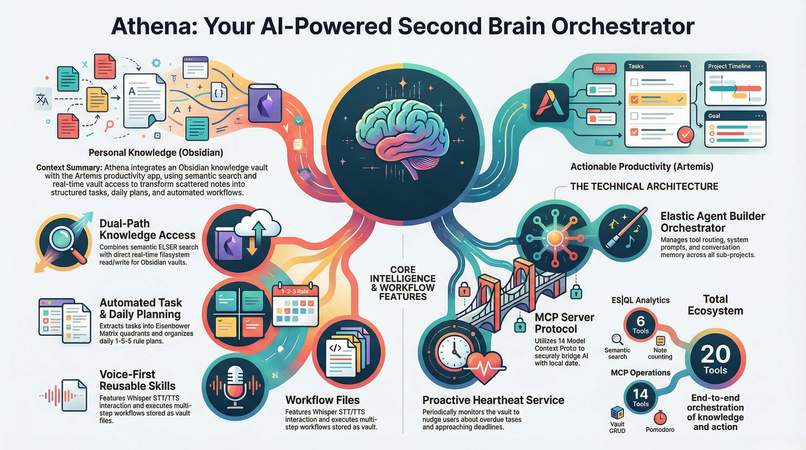
Athena-system-infographics
-
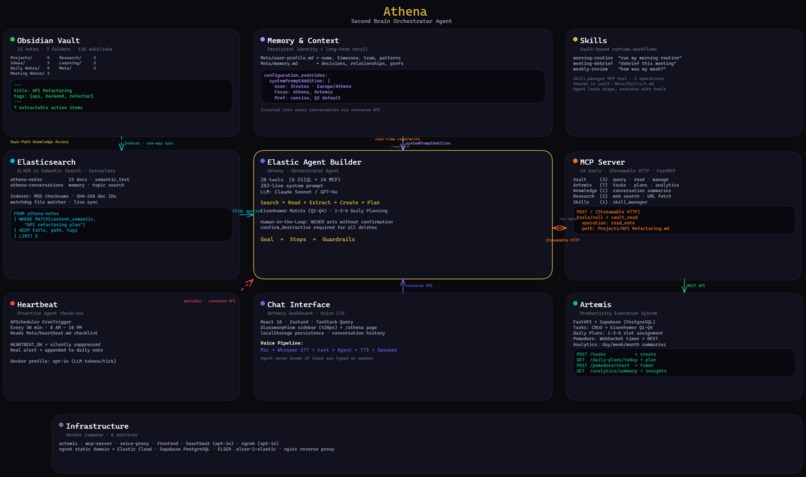
Athena-Architecture
-
Athena-logo
-
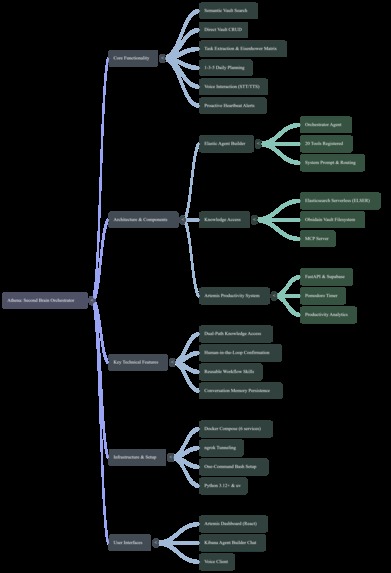
Athena-mermaid
Inspiration
Every knowledge worker faces the same problem: thinking tools and doing tools don't talk to each other.
I capture everything in Obsidian, meeting notes, project plans, research, half-formed ideas. But turning those notes into actual work means manually reading through files, copy-pasting action items into a task manager, and deciding what matters today. That's cognitive overhead that compounds daily.
I wanted a single conversational interface — text or voice — that could search my notes semantically, extract tasks with intelligent priority classification, plan my day, and write new notes back into my vault. Not a generic chatbot. An agent that lives in my second brain.
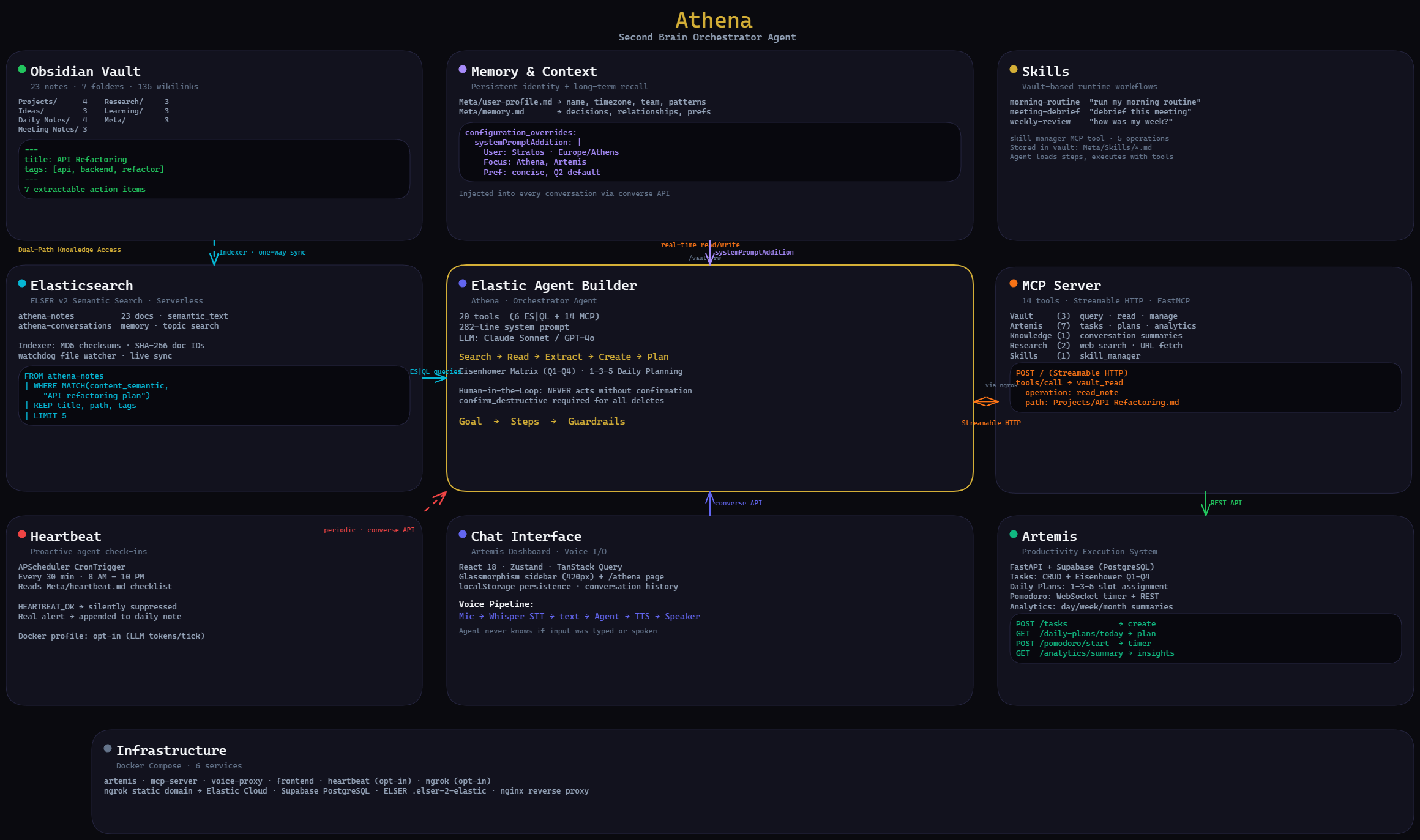
When Elastic Agent Builder launched, the architecture clicked: Elasticsearch handles semantic search and analytics over my vault, MCP tools handle real-time reads and writes, and Agent Builder orchestrates the whole thing with a 280-line system prompt that defines Athena's persona, workflows, and guardrails.
What it does
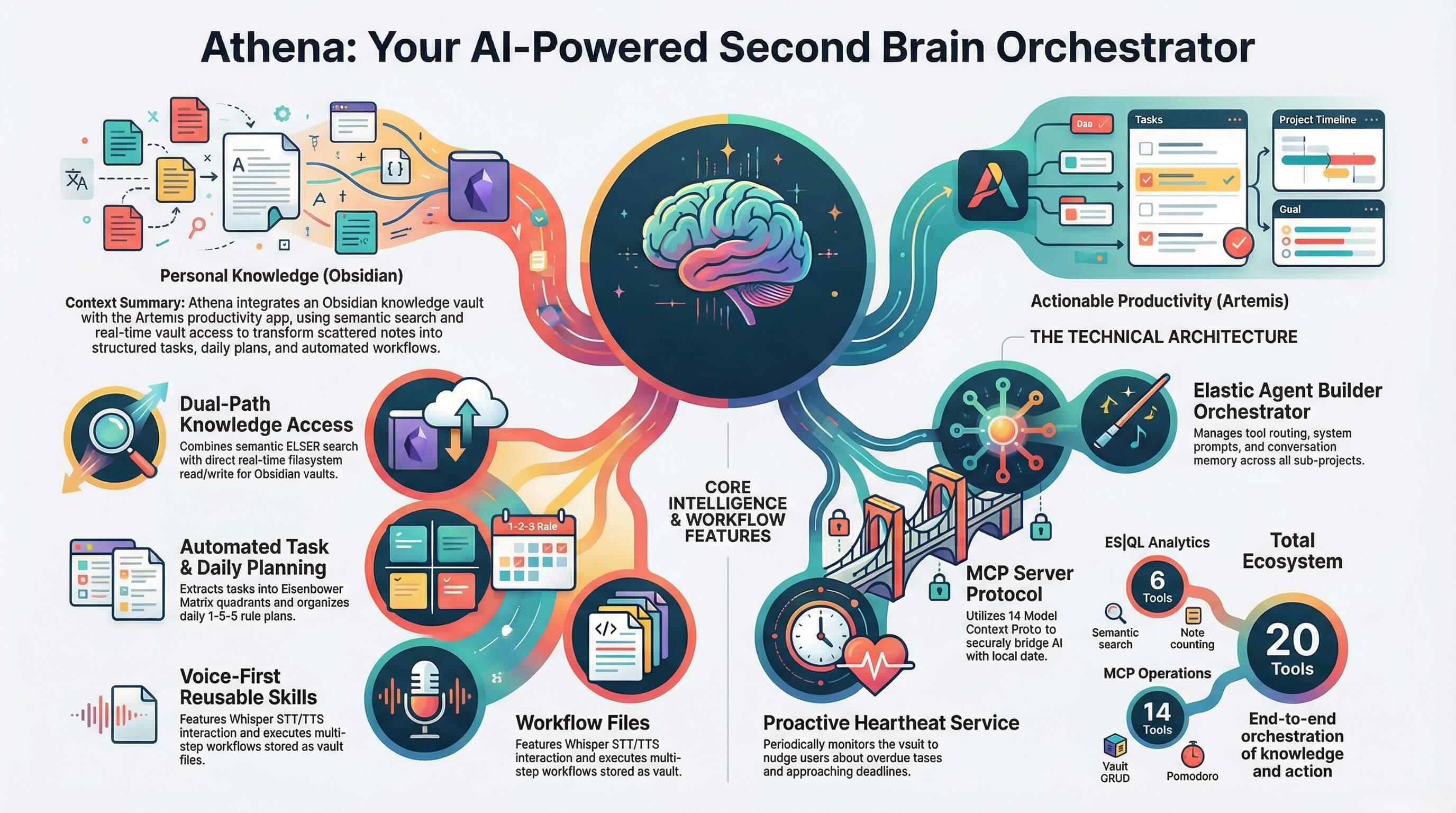
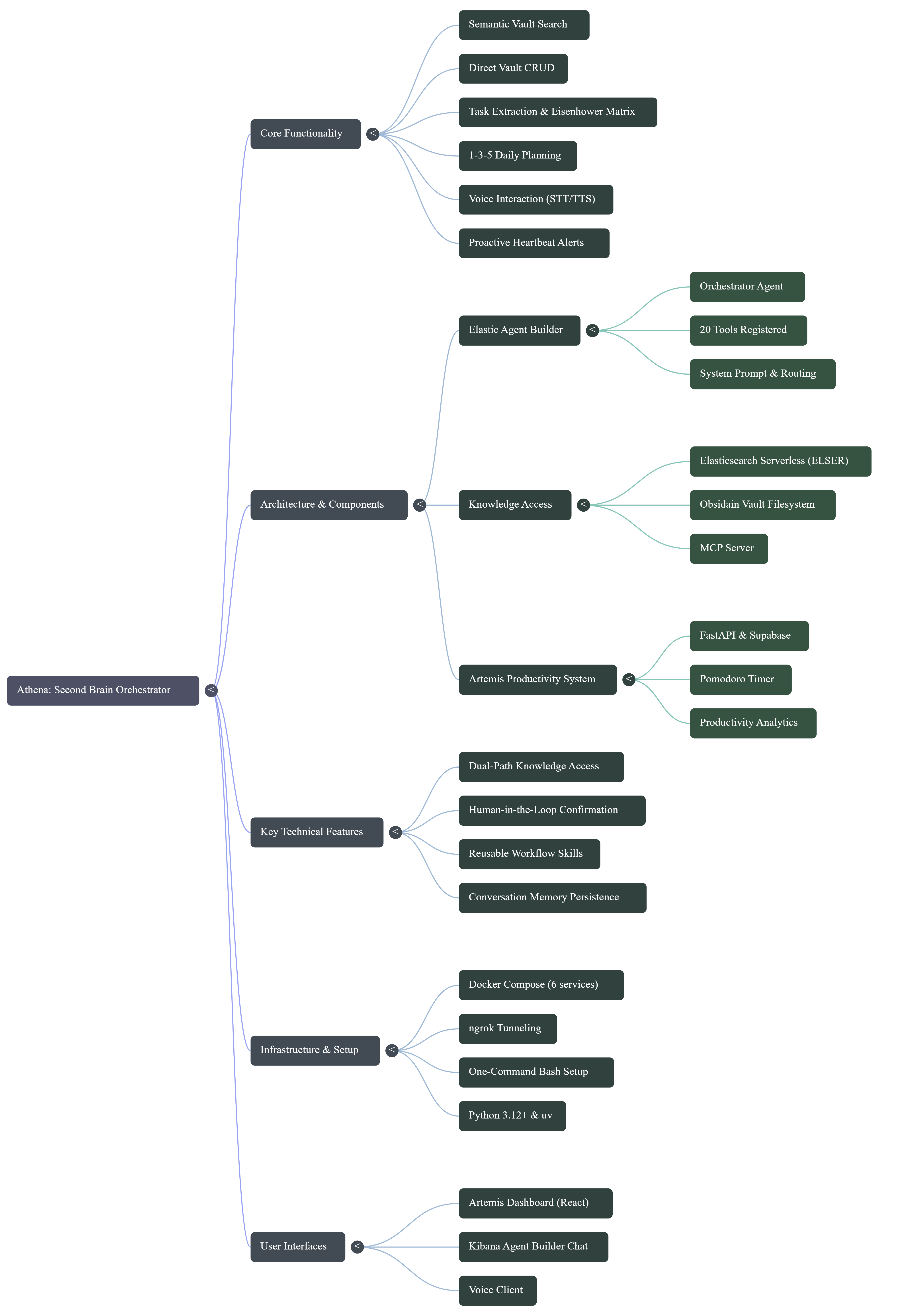
Athena is a conversational AI agent that bridges an Obsidian vault (knowledge) with Artemis (my productivity app) through 20 tools — 6 ES|QL queries and 14 MCP tools.
Semantic knowledge search — Ask "what did I write about API versioning?" and Athena finds conceptually related notes using ELSER embeddings, then reads the full content directly from the vault filesystem.
Task extraction with Eisenhower classification — Athena reads a note, identifies buried action items, classifies each into an Eisenhower Matrix quadrant with reasoning, and waits for your confirmation before creating them.
1-3-5 daily planning — Analyzes pending tasks by priority and deadline, proposes a structured plan (1 major, 3 medium, 5 small tasks), and assigns on approval.
Bidirectional vault access — Creates new notes, appends to daily journals, edits existing content, and organizes your vault, all through conversation.
Voice interaction — Speak to Athena using Whisper STT, hear responses via OpenAI TTS. The agent never knows if input was typed or spoken, voice is a pure I/O layer.
Persistent memory — Conversation summaries saved to Elasticsearch and daily notes. User profile and agent memory injected into every session for continuity.
Proactive heartbeat — A background service periodically checks for overdue tasks and approaching deadlines, writing alerts to your daily note.
Reusable skills — Multi-step workflows (morning routine, weekly review) stored as vault Markdown files that Athena loads and executes on trigger phrases.
Human-in-the-loop is non-negotiable. Athena proposes, you approve, then it acts. No silent task creation, no unauthorized edits, no surprises.
How I built it
The fundamental design insight is dual-path knowledge access: semantic search and direct filesystem access serve different needs, and you need both. Elasticsearch with ELSER handles meaning-based queries, aggregations, and cross-note analytics. Direct vault access via MCP tools handles real-time reads, writes, and structural operations with zero sync delay.
Challenges I ran into
MCP transport. The MCP spec moved from SSE to Streamable HTTP during development. The key lesson was mounting at / rather than a sub-path, not obvious from the docs.
Agent Builder API. The Kibana API uses different field names than the documentation suggests in places (instructions not system_prompt, serverUrl not url). Tool registration and connector configuration required careful API exploration.
Dual-path consistency. When Elasticsearch and the vault filesystem can both answer "what notes do I have?", keeping them in sync requires a checksum-based dedup strategy in the indexer and clear tool selection guidance in the system prompt.
System prompt engineering. Getting Agent Builder to reliably follow the human-in-the-loop pattern — always present before executing — required explicit guardrails, workflow patterns, and classification examples. The prompt went through dozens of iterations to reach 280 lines.
Accomplishments that I'm proud of
- 20 tools working end-to-end — 6 ES|QL + 14 MCP tools, all registered in Agent Builder and responding correctly
- 3-tool vault consolidation — Instead of 12 single-purpose tools, three tools with operation parameters keep the agent's tool selection clean and accurate
- Voice as a pure I/O layer — Zero backend changes for voice support. The agent is modality-agnostic by design
- 280-line system prompt — Persona, tool selection matrix, 9 workflow patterns, Eisenhower classification, 1-3-5 planning, memory management, and guardrails in one coherent document
- Proactive heartbeat — Athena doesn't just respond. It periodically checks on you and writes alerts to your daily note when deadlines approach
- Full productivity suite — Dashboard, tasks, daily planning, pomodoro timers, analytics, and a dedicated Athena chat page with a polished glassmorphism UI
What I learned
Context engineering is the real skill. Building an agent isn't about the LLM, it's about designing the right tools, writing precise system prompts, and giving the model enough context to make good decisions. The 280-line system prompt matters more than which model you choose.
Elasticsearch as a memory layer is powerful. Storing conversation summaries with semantic embeddings means Athena can recall past discussions by meaning, not just keywords. Combined with vault-injected user profiles, this creates genuine session continuity.
The "fewer tools, more parameters" pattern scales. Consolidating 12 vault operations into 3 tools with operation parameters reduced Agent Builder's decision space and improved tool selection accuracy dramatically.
Human-in-the-loop requires explicit design. Agents want to be helpful and act immediately. Making them reliably stop, present, and wait for confirmation requires explicit workflow patterns and guardrails in the system prompt, not just a single instruction.
Built With
- docker
- elastic-agent-builder
- elser
- es|ql
- fastapi
- mcp
- ngrok
- openai-whisper
- python
- react
- tailwindcss
- typescript


Log in or sign up for Devpost to join the conversation.