-
-
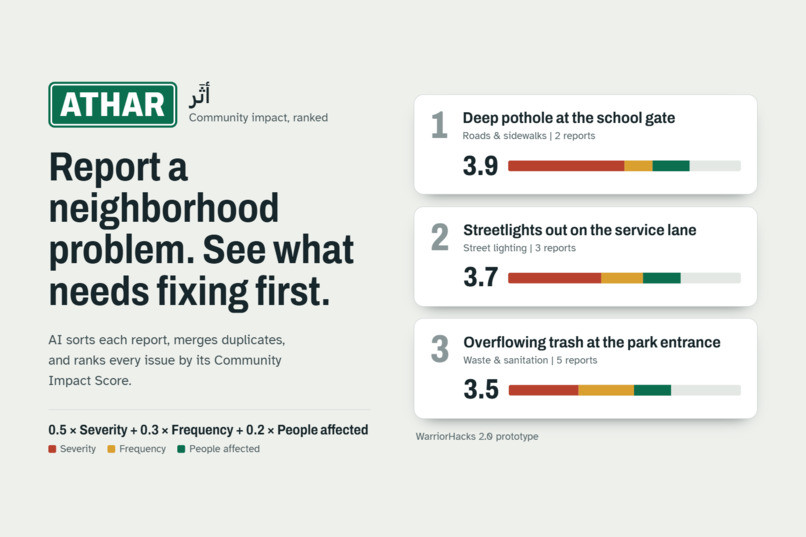
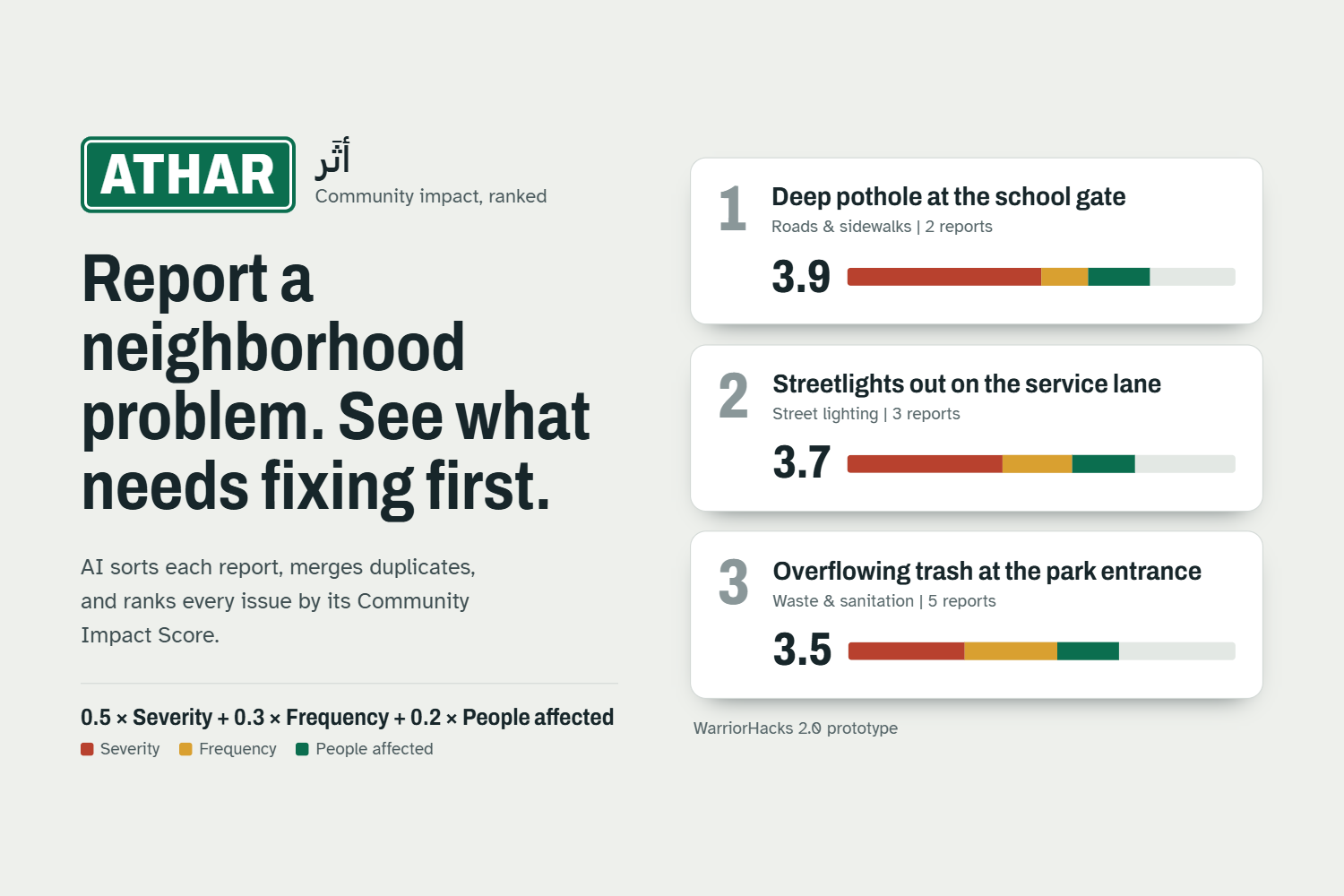
ATHAR AI ranks neighborhood issues by a Community Impact Score combining severity, frequency, and people affected.
Inspiration
Every neighborhood has recurring problems: piled-up trash near a park, broken streetlights, potholes. People notice them every day, but scattered complaints rarely turn into a clear picture of what needs attention first. I wanted to build a tool that turns individual reports into prioritized, actionable insight.
What it does
ATHAR AIis an AI-powered platform for reporting neighborhood issues and prioritizing them.
- Smart reporting: Users describe a problem in plain language, in Arabic or English.
- AI analysis: The AI categorizes the issue, summarizes it, suggests a priority level with a clear explanation, and proposes practical next steps.
- Duplicate detection: Similar reports are grouped into a single issue, so one problem reported ten times counts as one strong signal instead of ten separate tickets.
- Impact dashboard: Shows the most frequent issues, report counts, the reasons behind each priority, and the suggested solutions.
The core feature is the Community Impact Score. It ranks issues by more than report count, combining severity, frequency, and how many people are affected:
$$\text{Impact} = 0.5 \times \text{Severity} + 0.3 \times \text{Frequency} + 0.2 \times \text{People Affected}$$
Each factor is rated from 1 to 5. The formula is transparent and the AI explains each score, so the ranking is easy to understand and question. It's a decision-support tool, not a black box.
How I built it
- Python + Streamlit for the web app, the forms, and the dashboard
- Gemini API for classification, summarization, priority reasoning, and solution suggestions
- Custom CSS for right-to-left Arabic and mobile-friendly layouts
- GitHub + Streamlit Community Cloud for version control and deployment
Challenges I ran into
- Getting Streamlit to display Arabic properly in right-to-left layouts
- Writing prompts that return consistent, structured output from the AI
- Designing a scoring formula that is meaningful without overclaiming accuracy
- Scoping the project to something I could finish as a solo beginner in a few days
What I learned
I learned how to integrate a large language model into a real application, design structured prompts, and deploy a working web app. I also learned to scope down: starting with one focused problem and making it work well beats building many half-finished features.
What's next for ATHAR AI
- Image uploads, so the AI can analyze photos of issues
- Map-based visualization of issues by neighborhood
- Expansion to other community problems, such as food waste in restaurants
- Possible partnerships with municipalities in Saudi Arabia

Log in or sign up for Devpost to join the conversation.