Inspiration ⊹₊˚‧︵‿₊⊱·✶·⊰₊‿︵‧˚₊⊹
Artists often receive feedback in isolated moments—a classroom critique, a comment online, or a quick reaction from a friend. These responses may be encouraging, but they rarely help artists understand how their creative choices evolve across multiple works.
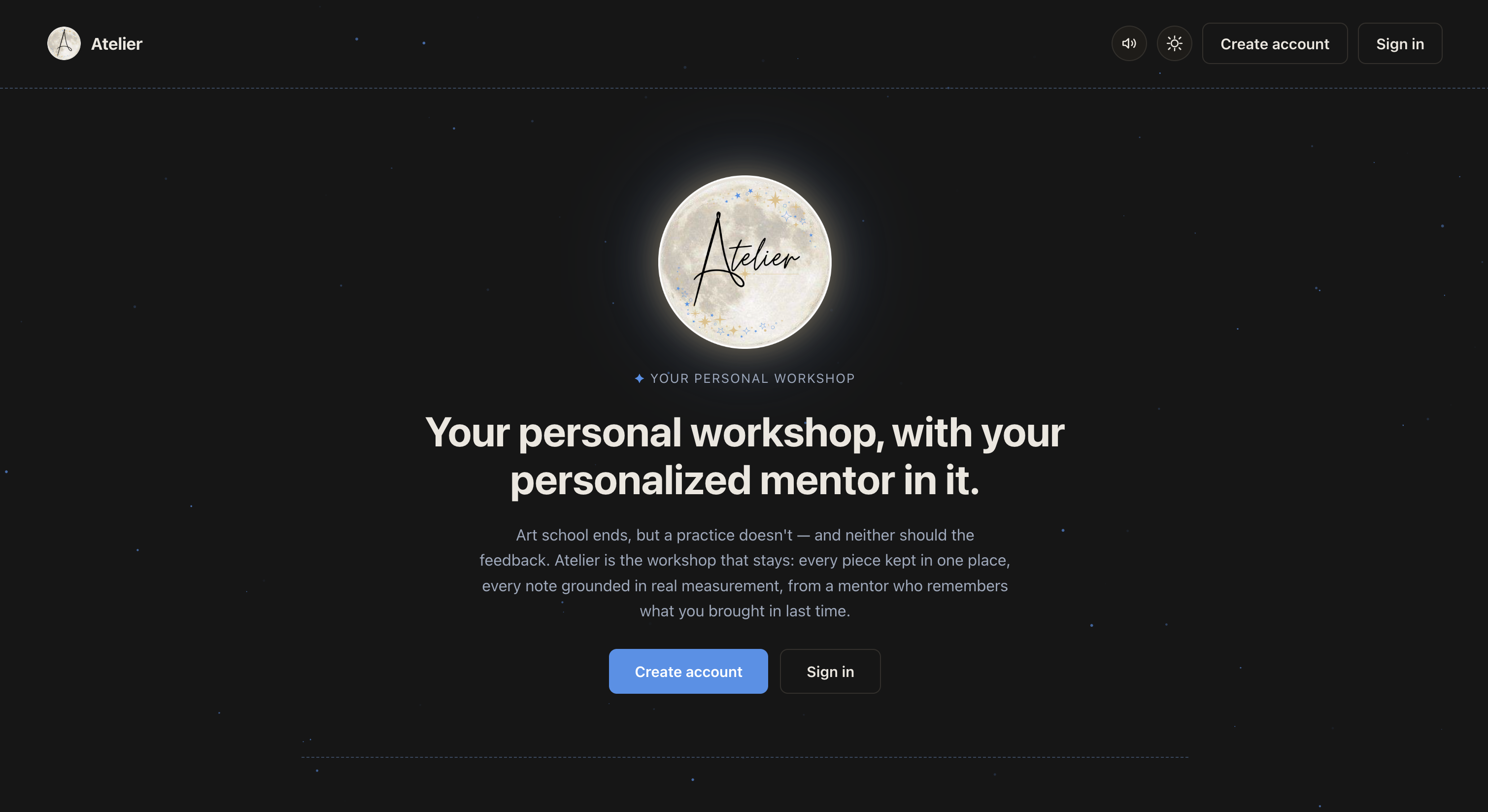
I created Atelier: Your personal workshop, with your personalized mentor in it. to give artists a private studio mentor between human critiques. Instead of judging whether a piece is “good,” Atelier observes formal choices, explains what it notices, and remembers how the artist’s practice changes over time.
A mentor that watches your art grow—not a bot that grades one upload.
What it does ⊹₊˚‧︵‿₊⊱·✶·⊰₊‿︵‧˚₊⊹
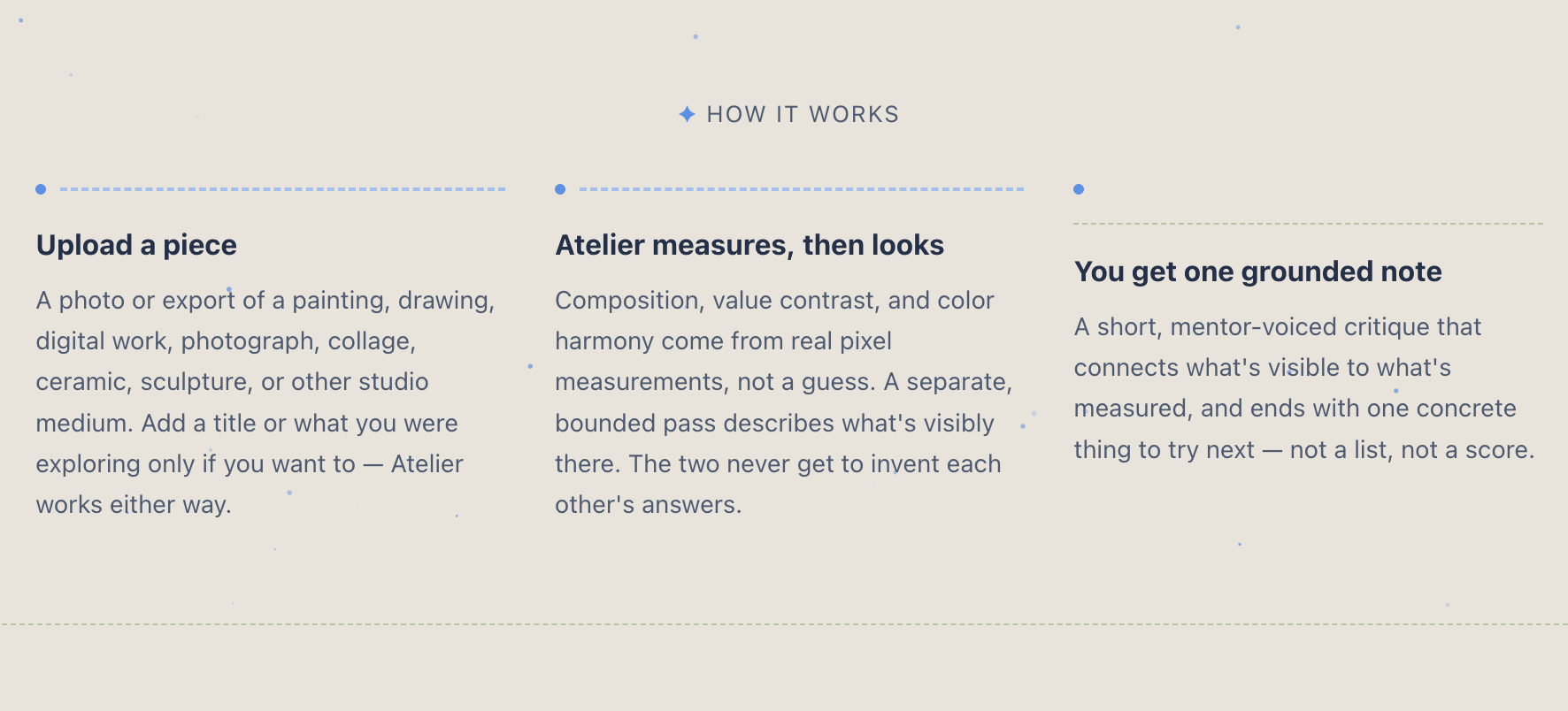
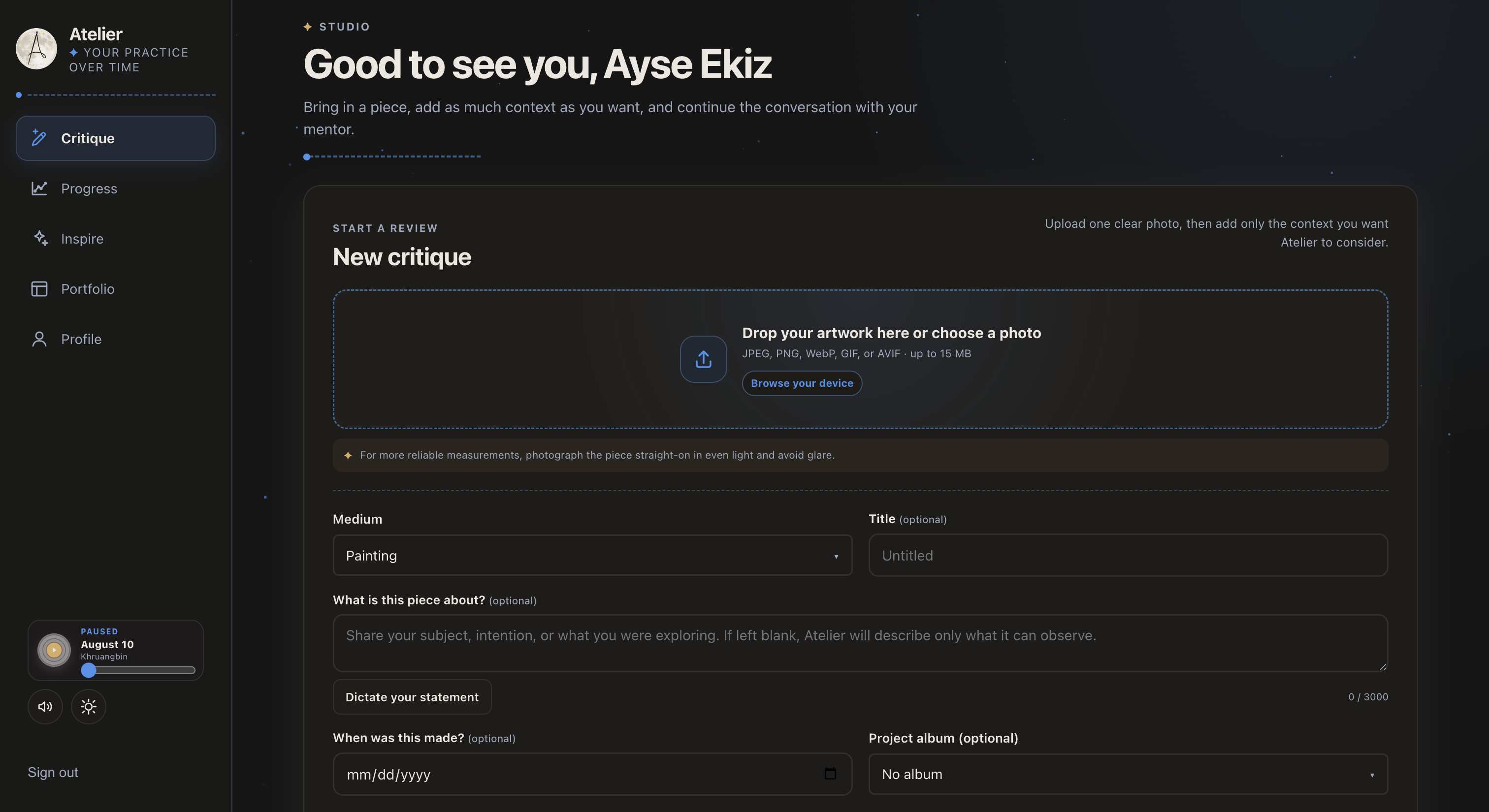
Artists can upload paintings, drawings, digital art, photography, collage, ceramics, sculpture, and other media. They may also add a title, artist statement, creation date, and project album—but this context is always optional.
Atelier then:
- Measures composition, focal placement, value contrast, value distribution, and color relationships using deterministic image-processing code.
- Uses GPT‑5.6 Sol to describe visible subject matter without generating scores or claiming to know the artist’s intent.
- Produces concise, studio-style feedback grounded in the artist’s words, visible evidence, and measured formal signals.
- Displays an interactive visual overlay with a rule-of-thirds grid, focal-point marker, and value heatmap.
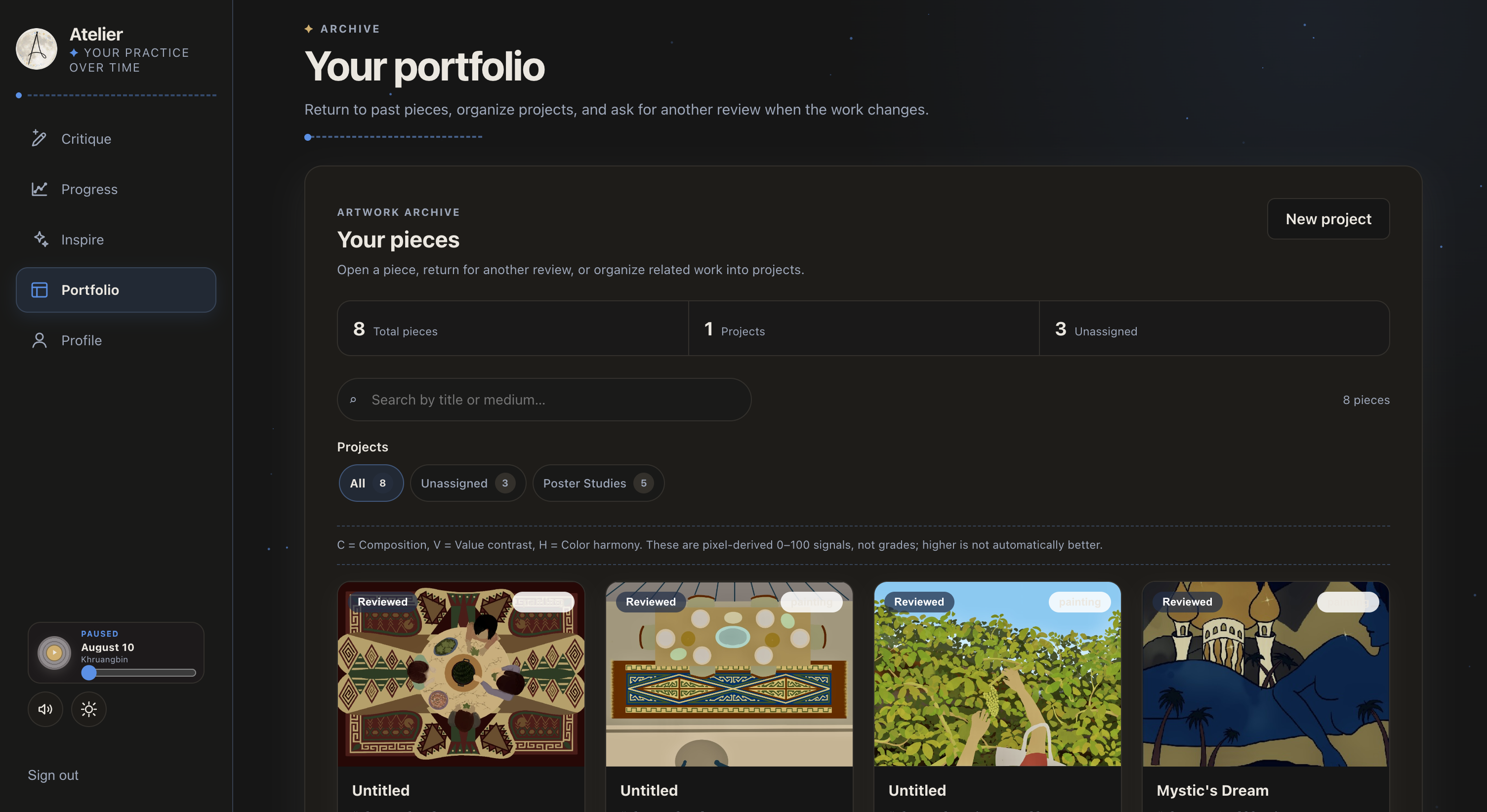
- Saves the artwork, critique, measurements, and context to a private portfolio.
- Lets artists add context later and request another review without losing previous critiques.
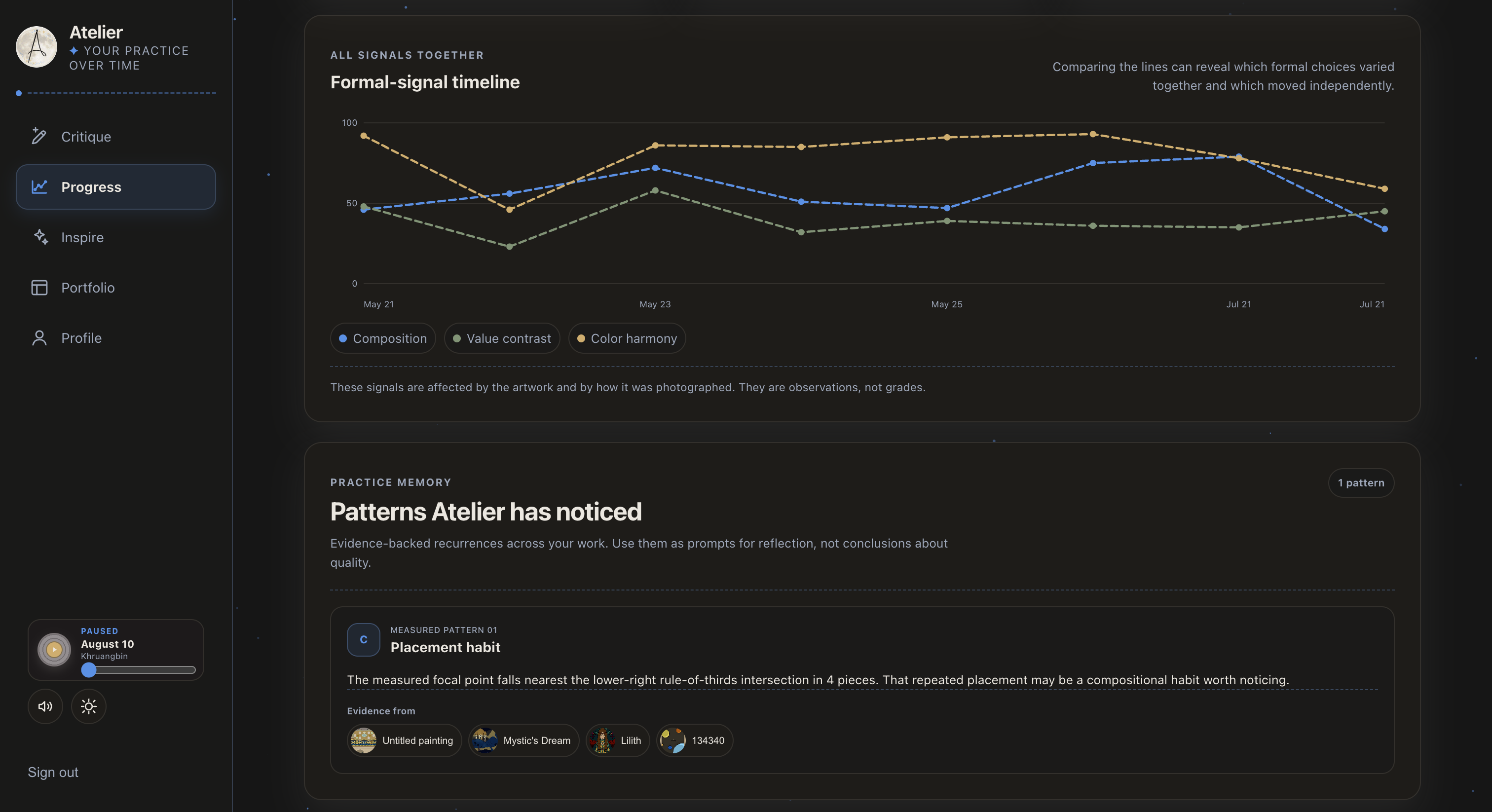
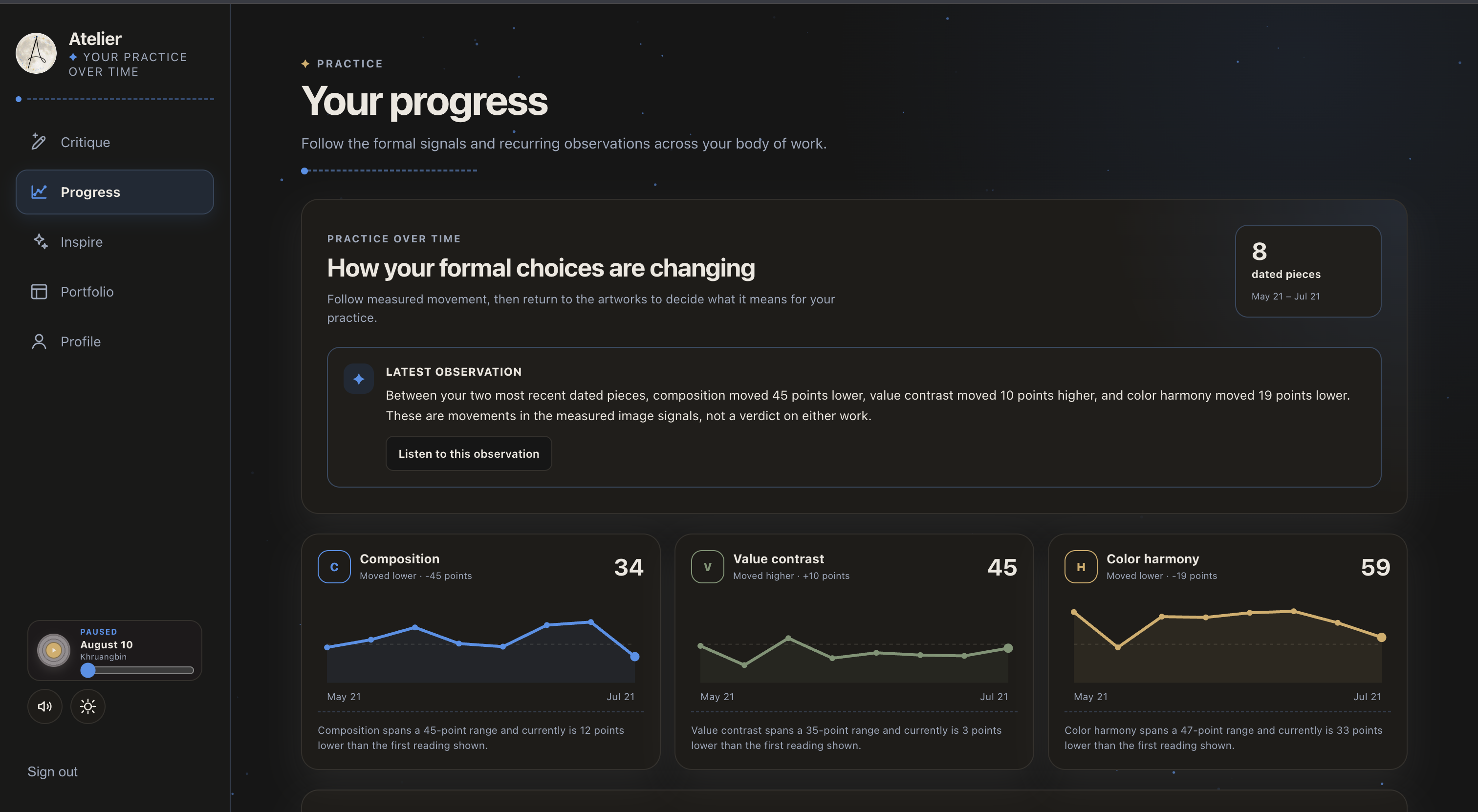
- Tracks formal signals and recurring choices across dated works.
- Supports project albums, goals, notes, artwork discussions, voice dictation, and critique narration.
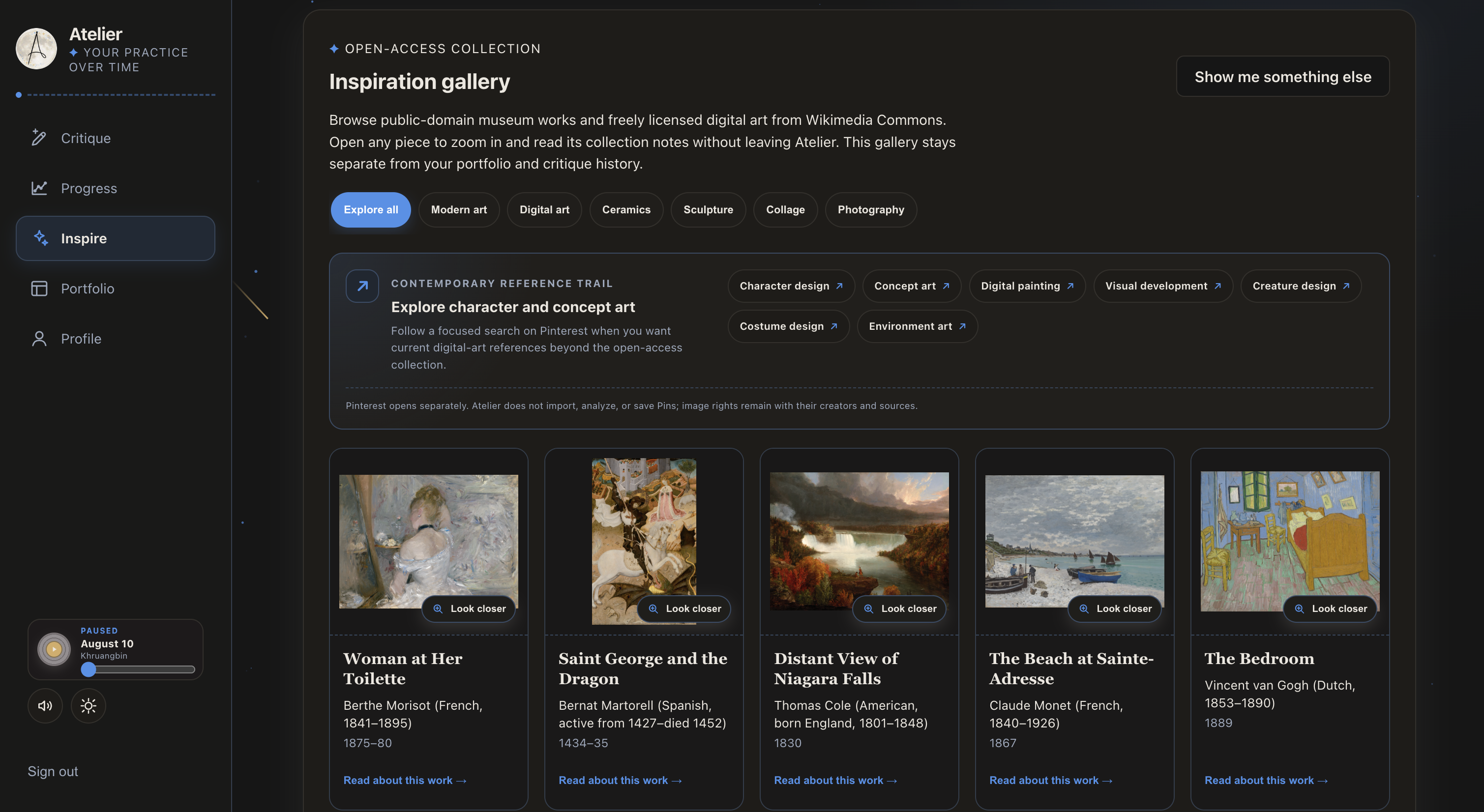
- Provides an attributed inspiration gallery spanning traditional, modern, and digital media.
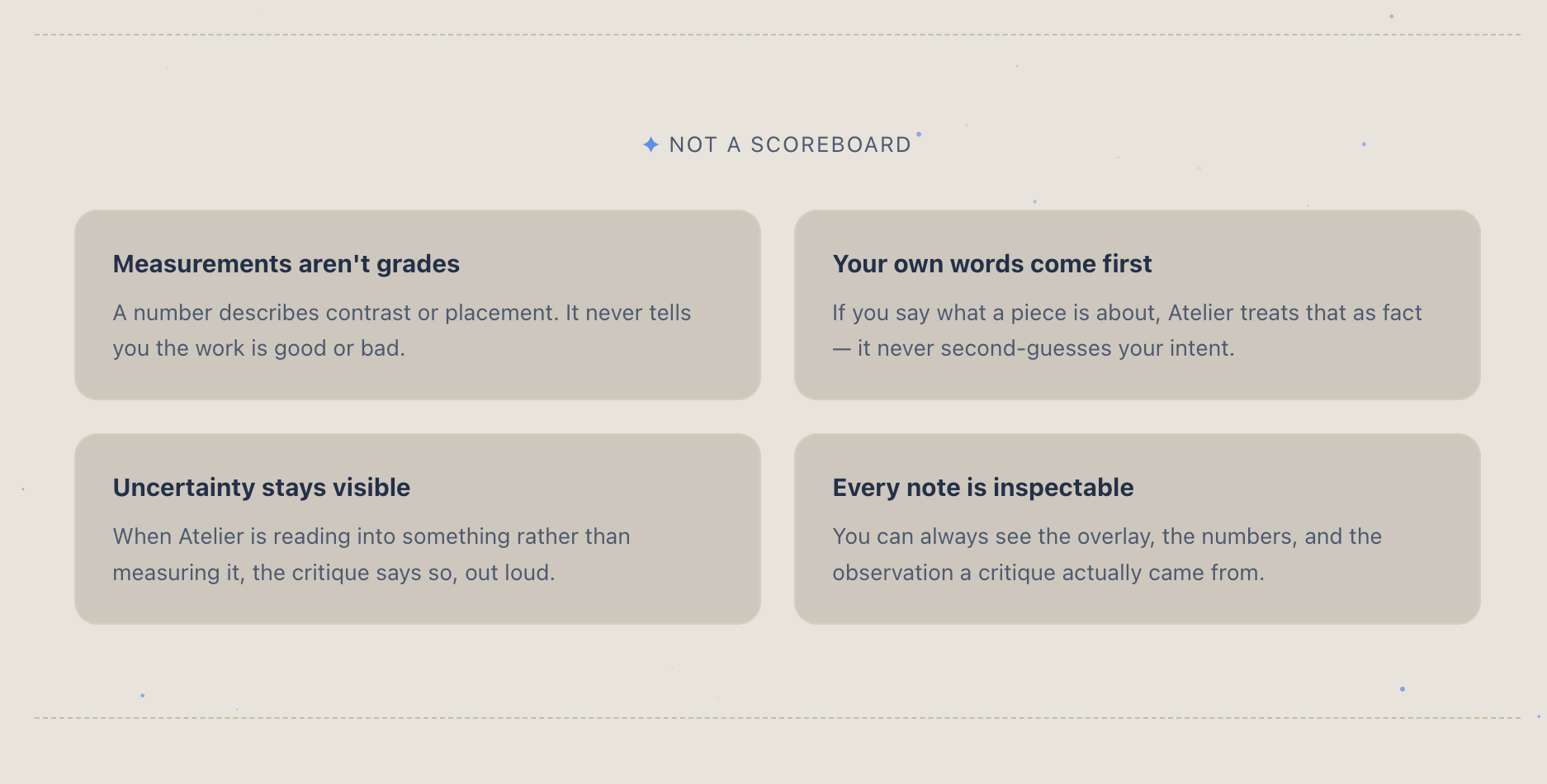
Atelier treats measurements as observations, not grades. A higher number does not automatically mean a better artwork.
How I built it ⊹₊˚‧︵‿₊⊱·✶·⊰₊‿︵‧˚₊⊹
Atelier uses a React and Vite frontend with a Node.js and Express backend.
Deterministic artwork analysis
The project’s central technical decision was to keep formal analysis deterministic. The computer-vision service uses Sharp and project-owned JavaScript algorithms:
- Value contrast: Luminance standard deviation measures contrast across the image.
- Value distribution: An 8×8 luminance grid generates the value overlay.
- Focal-point detection: Fine and coarse Sobel edge detection are combined with color rarity to locate locally distinctive regions.
- Composition signal: Distance from the focal point to rule-of-thirds intersections measures compositional placement.
- Dominant palette: Deterministic k-means with farthest-point seeding extracts dominant colors.
- Color relationships: Weighted hue relationships estimate analogous, triadic, and complementary structures.
Bounded AI roles
GPT‑5.6 Sol is used in three deliberately limited roles:
Visible-subject observation: A downscaled artwork image is used to produce structured descriptions of visible subject matter. The model is prohibited from generating formal scores, quality judgments, or claims about artistic intent.
Critique synthesis: A separate critique request receives the artist’s optional context, the fallible visual observation, and deterministic measurements. It transforms these inputs into concise mentor feedback and one concrete experiment the artist can try.
Artwork conversations: Per-artwork discussions use the Responses API and
previous_response_id, allowing artists to continue exploring a piece without replaying the entire conversation.
The frontend renders analytical overlays with Canvas and longitudinal charts with plain SVG. Local JSON and image-file storage keep the hackathon build simple, transparent, and independently testable.
Optional ElevenLabs integration provides speech-to-text dictation and critique narration across four mentor voice styles. The inspiration gallery uses attributed, open-access records from the Art Institute of Chicago and Wikimedia Commons.
How Codex helped ⊹₊˚‧︵‿₊⊱·✶·⊰₊‿︵‧˚₊⊹
Codex served as my implementation and verification partner throughout Build Week. It helped translate product requirements into working vertical slices, refine the deterministic computer-vision algorithms, build frontend and backend services, and investigate real failures instead of relying only on visual code review.
Codex was especially useful for:
- Debugging Node test-runner and account-isolation issues.
- Improving focal-point detection without replacing it with AI scoring.
- Verifying EXIF orientation and saved-file MIME extensions.
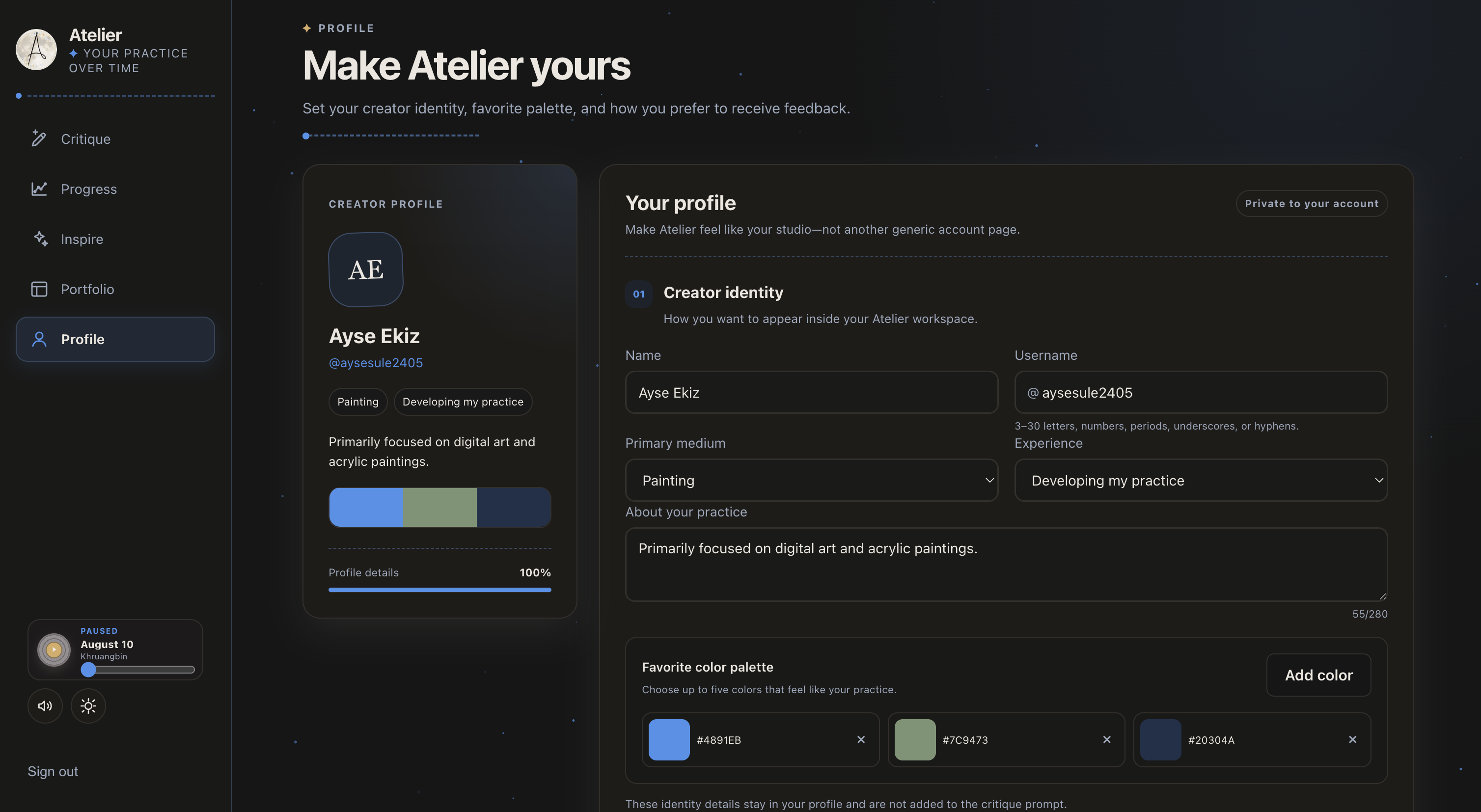
- Building review history, projects, profiles, discussions, and voice features.
- Running responsive and keyboard-only browser walkthroughs.
- Testing error handling, model-call fallbacks, and mobile layouts.
- Preparing technical documentation and submission materials.
The product positioning, data boundaries, mentor voice, and critique-prompt decisions remained human-reviewed.
Challenges I ran into ⊹₊˚‧︵‿₊⊱·✶·⊰₊‿︵‧˚₊⊹
Separating measurement from interpretation
The hardest challenge was separating measurable visual properties from subjective interpretation.
Allowing a vision model to score the artwork would have been easier, but it would make the results difficult to inspect and undermine Atelier’s core idea. Maintaining independent services for deterministic analysis, visual observation, and critique synthesis required more engineering—but created a more transparent and trustworthy product.
Finding meaningful focal regions
A simple global edge centroid often selected frames, canvas texture, or the busiest part of an image rather than its most visually distinctive anchor.
I improved focal-point detection by combining:
- Border exclusion
- Multiple Sobel scales
- Color rarity
- Local distinctiveness windows
Respecting artistic ambiguity
I also had to design feedback that respected ambiguity instead of pretending the system could fully understand a work.
Atelier follows a clear evidence hierarchy:
- The artist’s statement is authoritative.
- AI-generated visual observations are explicitly fallible.
- Deterministic measurements describe pixels—not artistic quality.
Preserving critique history
Making editing and repeated critiques trustworthy required an append-only review history. New context can produce a new critique, but it never silently overwrites earlier analysis or feedback.
Accomplishments that I’m proud of ⊹₊˚‧︵₊⊱·✶·⊰₊︵‧˚₊⊹
I am proud that Atelier is more than a prompt wrapped around an upload form. It offers a complete working loop:
Artwork upload → deterministic analysis → visual observation → critique → evidence overlay → private portfolio → longitudinal reflection
The current backend suite includes 83 passing tests, covering:
- Deterministic computer-vision behavior
- Upload validation
- Account isolation
- Review history
- Profiles and notes
- Longitudinal patterns
- Artwork discussions
- Voice routes
- Graceful AI failures
The interface has also been verified at desktop, 375px, and 320px widths with:
- Keyboard navigation
- Visible focus handling
- Responsive dialogs
- Reduced-motion support
- Light and dark themes
What I learned ⊹₊˚‧︵‿₊⊱·✶·⊰₊‿︵‧˚₊⊹
I learned that useful AI art feedback depends as much on boundaries as capability. The model becomes more valuable when it is clearly told what it may observe, what it must not claim, and which evidence belongs to the artist.
I also learned that longitudinal context changes the product completely. Once Atelier remembers earlier work, critiques become part of an ongoing creative practice rather than isolated verdicts.
What’s next for Atelier ⊹₊˚‧︵‿₊⊱·✶·⊰₊‿︵‧˚₊⊹
After Build Week, I would like to add:
- Production authentication, database storage, and private object storage.
- HEIC/HEIF conversion for easier mobile uploads.
- Artist correction of AI-observed subject matter, with provenance preserved.
- Medium-specific analytical boundaries and critique guidance.
- Instructor views for asynchronous classroom feedback.
- Artist-selected reference pieces for comparison.
- More open-access museum and contemporary-art collections.
- Properly licensed ambient soundtracks and additional studio personalization.
Atelier’s long-term goal is not to replace teachers, peers, or human critique. It is to help artists arrive at those conversations with a clearer record of what they made, what they intended, and how their practice is changing.
Built With
- art-institute-of-chicago-api
- canvas-api
- css3
- elevenlabs
- express.js
- gpt-5.6-sol
- html5
- javascript
- multer
- node-test-runner
- node.js
- openai
- react
- sharp
- svg
- vite

Log in or sign up for Devpost to join the conversation.