-
-
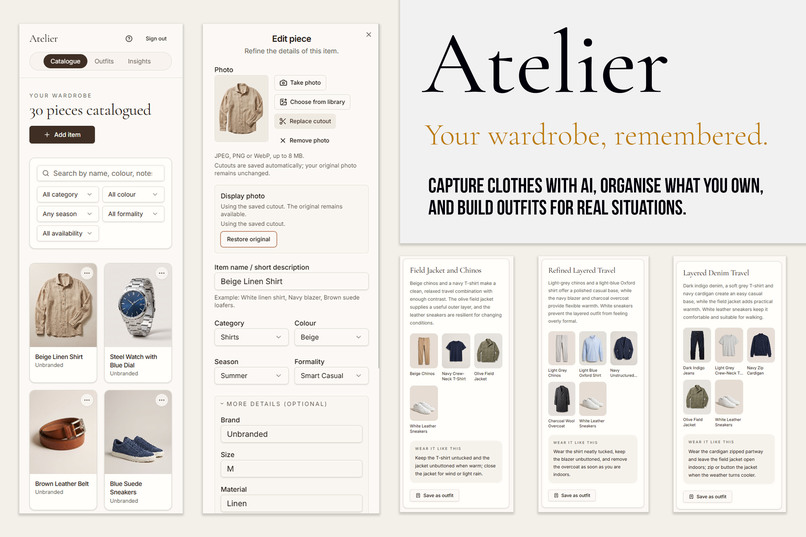
Atelier turns clothing photos into an organised wardrobe and uses GPT-5.6 to build outfits from pieces you already own.
Inspiration
Atelier began during a summer trip to Italy with my girlfriend. We were staying near Lake Como during a particularly hot week, and she suggested that I buy a linen shirt instead of wearing my usual cotton T-shirt.
I was hesitant at first. Back home, I already had a wardrobe full of shirts and trousers that I rarely wore. Despite owning plenty of clothes, I kept reaching for the same few trousers, T-shirts and hoodies because they felt familiar and required no thought.
Then I bought a linen shirt in Italy and wore it in the summer heat. I immediately understood why people love the material. It felt comfortable, looked more refined than a T-shirt and made me reconsider the clothes I already owned.
When I returned home, I opened my wardrobe with a new question: how could I actually wear all these shirts properly?
I started asking ChatGPT for outfit advice based on the clothes I already had. The suggestions were useful, but after several long conversations, I realised that chat was not the ideal place to organise an entire wardrobe, remember every item and preserve reliable combinations for later.
So I decided to build an application that would first solve my own problem: help me understand what I own, reduce the time I spend deciding what to wear and stop me from defaulting to the same small rotation of clothes.
That is how Atelier began: not as a technology demonstration, but as a personal tool I genuinely wanted to use every day.
What it does
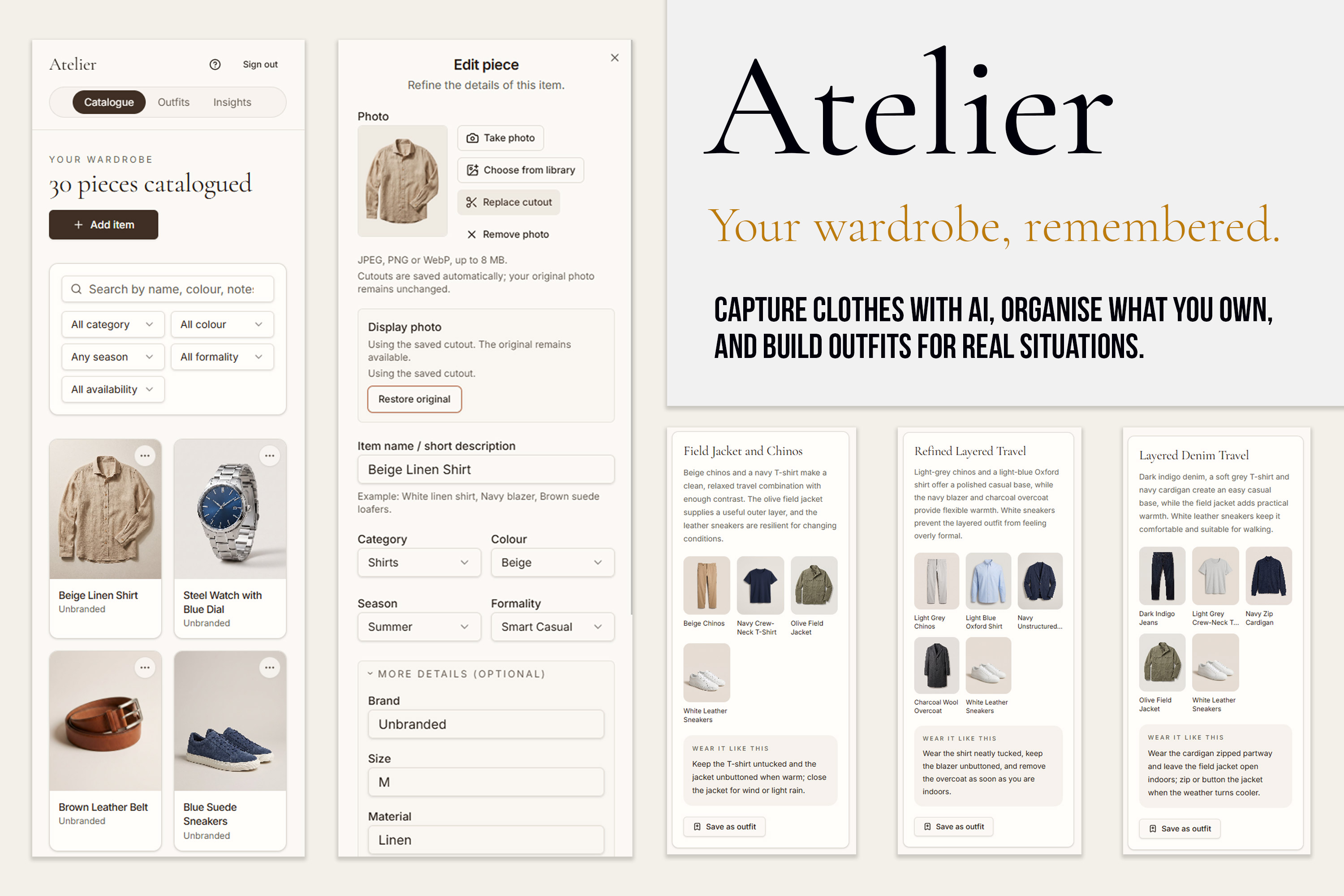
Atelier is a calm, mobile-first personal wardrobe operating system for men.
It helps users catalogue their clothes, understand what they already own, preserve reliable outfit combinations and receive context-aware recommendations using only pieces from their real wardrobe.
AI Wardrobe Capture
A user can photograph or upload a clothing item and ask Atelier to analyze it.
GPT-5.6 generates editable wardrobe suggestions such as:
- Item name
- Category
- Color
- Season
- Formality
- Material
- Fit
- Practical styling notes
The output is treated as a draft, not a final decision. Users can inspect, correct or reject every suggestion before saving anything.
The Notes field is designed to offer useful fashion guidance rather than simply describe what is already visible in the photograph.
Wardrobe Cutouts
Users can generate a clean, catalogue-ready garment cutout while preserving the original photograph.
The processed image is stored separately, and users can:
- Preview the cutout
- Switch between the original and processed image
- Restore the original at any time
- Replace an existing cutout only after confirmation
This makes the Catalogue calmer and easier to scan without destroying the source image.
AI Outfit Advisor
The Outfit Advisor creates up to three distinct combinations using only currently available pieces in the authenticated user’s wardrobe.
The user provides context such as:
- Occasion
- Desired formality
- Temperature
- Weather or environmental conditions
- An optional personal constraint
For example:
Warm summer dinner, smart casual, 27°C, use my new linen shirt.
Each recommendation contains real wardrobe pieces, a short explanation and practical instructions for how to wear the outfit.
The Advisor does not invent garments and does not turn the experience into a shopping list.
Advisor to Lookbook
A recommended outfit can be opened inside Atelier’s existing outfit editor.
The user can:
- Inspect the selected pieces
- Change their order
- Add or remove garments
- Edit the outfit name, occasion and notes
- Save the result to the Lookbook
Saved outfits remain available after navigation and refresh and can later be opened through a read-only Outfit Details view.
Catalogue and Lookbook
Atelier also includes:
- A searchable and filterable wardrobe Catalogue
- Availability controls for temporarily unavailable items
- Manual outfit creation
- Drag-and-drop outfit composition
- Visual Lookbook cards
- Detailed wardrobe-item views
- Outfit-detail views
- Mobile-first onboarding and guidance
The goal is not to automate personal taste. Atelier handles repetitive organisation while keeping the user in control of every final decision.
How I built it
I built Atelier as a solo, non-technical founder with a professional background in design, video production and creative direction.
The application uses:
- React 19
- TypeScript
- TanStack Router, Start and Query
- Tailwind CSS
- Radix UI
- dnd-kit
- Zod
- Supabase Auth, Postgres, Storage, RLS and Edge Functions
- OpenAI Responses API with GPT-5.6
- Poof background-removal API
- Bun tests and tooling
- GitHub Actions
- Cloudflare Workers for production deployment
Lovable helped establish and visually develop the earlier product, while GitHub became the source of truth for branches, pull requests and stable releases.
Before OpenAI Build Week, Atelier already included:
- Email authentication
- A manual wardrobe Catalogue
- Wardrobe photographs and metadata
- Search and filtering
- Manual outfit creation
- Drag-and-drop outfit composition
- A mobile-first Lookbook
During Build Week, I meaningfully extended the existing product with three connected workflows.
1. AI Wardrobe Capture
The user uploads or photographs a garment, and a Supabase Edge Function sends the prepared image to GPT-5.6 through the OpenAI Responses API.
The model returns strict structured output designed specifically for wardrobe organisation rather than a generic visual caption.
The response is normalised, validated and returned as editable suggestions. Nothing is saved automatically.
2. Wardrobe Cutouts
A separate authenticated Edge Function retrieves the user-owned source image from private Storage, sends it to the background-removal provider and validates the returned transparent WebP.
Original and processed images remain separate, and replacement behaviour includes stale-source and ownership protection.
3. AI Outfit Advisor
The Advisor Edge Function authenticates the user and loads wardrobe data through caller-scoped Row Level Security.
Unavailable items are excluded before the model receives any wardrobe information.
Instead of sending real database UUIDs, image paths or garment photographs, Atelier creates temporary references such as w01, w02 and w03.
GPT-5.6 must return those references through a strict JSON schema. The server then validates every result and rejects unknown, duplicated or invented garment references before mapping them back to real wardrobe items.
OpenAI response storage is disabled with store: false.
Working with Codex
Codex was an engineering partner throughout Build Week.
I used it to:
- Inspect the existing repository
- Understand unfamiliar code
- Turn product requirements into scoped technical plans
- Implement features on dedicated branches
- Create reviewable pull requests
- Diagnose asynchronous and persistence bugs
- Add runtime validation
- Write deterministic regression tests
- Strengthen GitHub Actions checks
- Review changes before merging
The work was deliberately divided into small pull requests rather than one large uncontrolled implementation.
The stable main branch remained protected as the production baseline, and the build-week-2026 branch was preserved as the final judging state.
Challenges we ran into
The biggest challenge was not simply recognizing a garment from a photograph. The real challenge was creating an AI experience users could trust.
AI can be uncertain or overly confident, so Atelier needed to present suggestions without treating them as unquestionable facts. Every generated field remains editable, and nothing is automatically written to the wardrobe database.
Another challenge was protecting manual work during asynchronous operations. A delayed AI response must not overwrite a newer photograph, replace more recent user input or destroy fields the user has already corrected.
The Outfit Advisor introduced another trust problem: preventing the model from recommending garments the user does not own.
To solve that, wardrobe data is loaded server-side, unavailable items are filtered out, database IDs are replaced with temporary references and model output is validated again before results reach the interface.
Background removal required a similarly defensive workflow. The original image must never be overwritten, a successful processed result should not be lost, and replacing an existing cutout should be explicit because it consumes an external provider credit.
Mobile usability was equally important. Atelier is primarily used on a phone, often while standing in front of a wardrobe or photographing clothes. Forms, result cards, image previews, dialogs and outfit controls therefore needed to remain clear and comfortable on small screens.
Finally, Atelier was an existing working application rather than a project created from an empty repository. Every new feature had to be introduced without destabilising authentication, wardrobe management, search, image handling or manual outfit creation.
Accomplishments that I’m proud of
I am proud that Atelier uses AI as an assistant rather than an authority.
AI Wardrobe Capture gives the user a useful structured starting point but does not hide uncertainty or save anything without approval.
The Outfit Advisor does not invent garments, expose internal database identifiers or recommend shopping for new products. It works with the authenticated user’s existing and available wardrobe.
I am also proud that the individual AI features form one complete product journey:
- Photograph a garment
- Generate editable wardrobe metadata
- Create a clean catalogue cutout
- Ask for an outfit suited to a real situation
- Receive suggestions using only owned pieces
- Save the preferred result to the Lookbook
- Return to it later
Another important accomplishment was establishing a disciplined development workflow as a non-technical solo founder.
With Codex and GPT-5.6, I worked with feature branches, pull requests, strict schemas, RLS, Edge Functions, runtime validation, automated testing and stable releases while remaining focused on product decisions and real-world usability.
Most importantly, Atelier is already a product I use with my own wardrobe. It has changed how I interact with the clothes I own, helped me preserve combinations that work and reduced the time I spend deciding what to wear.
What I learned
I learned that good AI product design is often about restraint.
The fastest or most automatic workflow is not necessarily the most useful one. For personal information such as someone’s wardrobe, an editable suggestion can be more valuable than an automatic decision.
I also learned that image recognition alone does not create a useful wardrobe assistant. A description such as “blue long-sleeved shirt” may be visually correct but still adds little value. The output needs to help the user organise, distinguish and eventually wear the item.
Building the Outfit Advisor reinforced the importance of defensive AI architecture. Prompt instructions are not enough on their own. Model input should be minimised, structured output should be constrained and every result should be validated before becoming part of the product experience.
Working with Codex taught me the importance of dividing development into small, testable tasks. Narrow prompts, clear acceptance criteria and scoped pull requests produced better results than attempting to build several interconnected features at once.
I also learned that a non-technical founder can participate meaningfully in software development without pretending to be an experienced engineer. My role is to understand the user problem, make product decisions, test the real experience and use AI tools to close the technical gap responsibly.
What’s next for Atelier
The next step is to deepen Atelier’s understanding of the user’s wardrobe without making the product feel more complicated.
Planned improvements include:
- Packing support for trips
- Duplicate-purchase warnings
- Wardrobe-gap analysis
- Cross-device Advisor history
- Improved outfit personalisation based on saved and rejected combinations
- Better use of season, location and weather context
- Smarter detection of underused wardrobe pieces
- Outfit planning for several days or events
- Optional wardrobe statistics and insights
- Continued improvements to garment naming, colour and material interpretation
The long-term vision is for Atelier to become a calm personal wardrobe operating system for men: a tool that helps people buy less, use more of what they already own, reduce unnecessary decisions and dress with greater confidence.
Built With
- cloudflare
- codex
- dnd-kit
- edge-functions
- github
- gpt-5.6
- lovable
- openai
- radix-ui
- react
- responses-api
- supabase
- tailwind-css
- tanstack-query
- tanstack-router
- typescript
- vite
- zod


Log in or sign up for Devpost to join the conversation.