ATAN – Autonomous Disaster Response Agent Network
Inspiration
The idea for ATAN didn't start with AI.
It started by watching how difficult disaster response can be.
Every time we see floods, landslides or earthquakes, we also see rescue teams trying to coordinate many different tools at the same time. Drones, radios, maps, cameras, weather reports and communication systems are all available, but someone still has to make sense of everything while making critical decisions.
That made us ask a simple question.
What if AI could become part of the rescue team instead of just another tool?
Not another chatbot.
Not another drone application.
But an AI that understands a mission, coordinates the right resources and quietly helps responders behind the scenes.
That's how ATAN was born.
What it does
ATAN is a disaster response platform built around one idea:
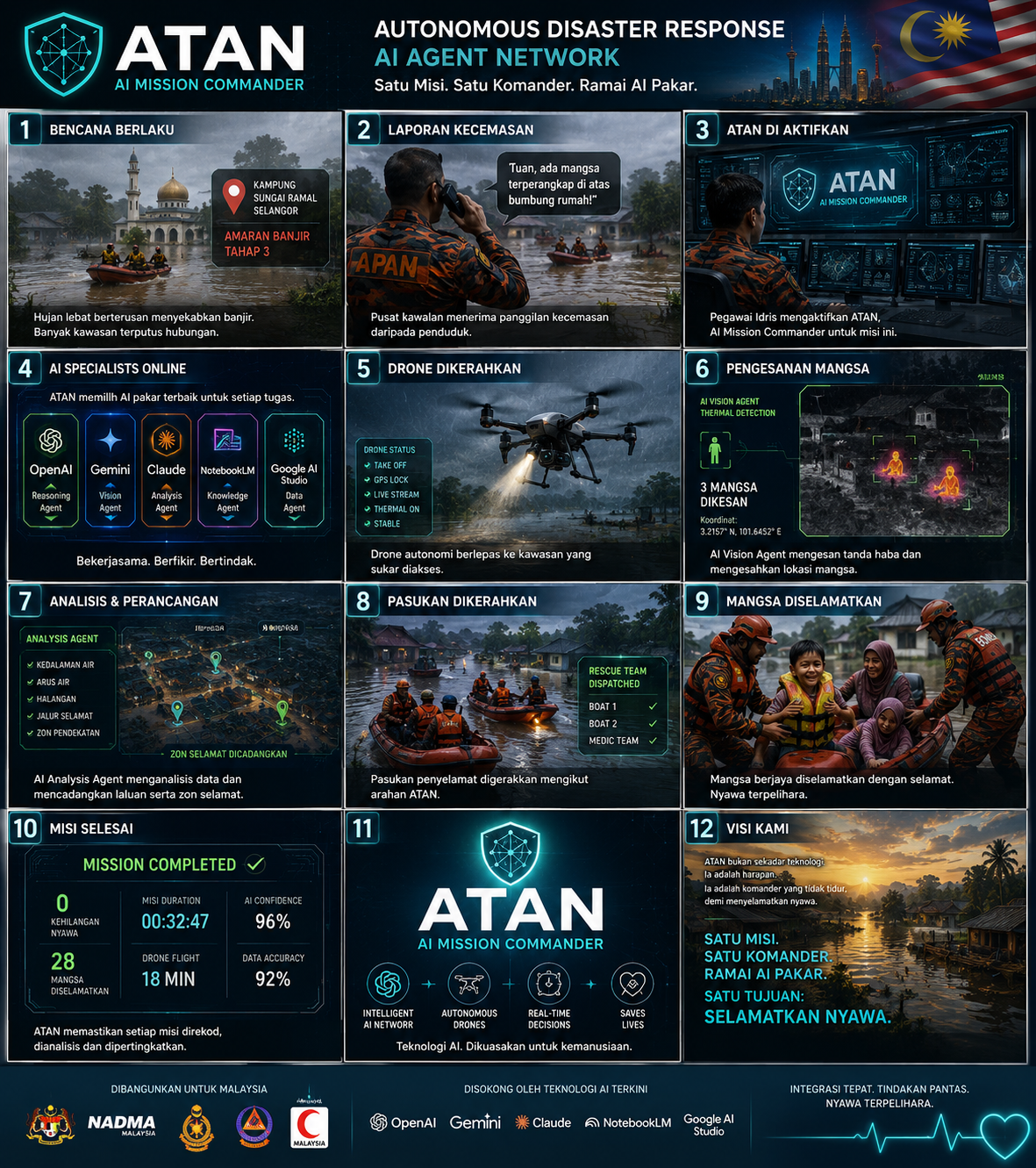
One mission. One commander. Many AI specialists.
At the centre of ATAN is a Mission Commander.
The responder doesn't need to decide whether to use ChatGPT, Gemini, NotebookLM or any other AI.
The Mission Commander does that automatically.
It understands the mission, decides which AI is best suited for each task and assigns the work accordingly.
For example, OpenAI helps with mission planning and reasoning.
Gemini assists with multimodal analysis.
NotebookLM retrieves operational knowledge and emergency procedures.
Future versions will also support Claude for advanced document reasoning and Hermes for local offline AI.
The responder simply says:
"ATAN, locate survivors in Sector Bravo."
From there, ATAN plans the mission, coordinates AI agents, communicates with autonomous drones, analyses live video, verifies possible survivors and prepares a mission report.
The responder focuses on people.
ATAN focuses on coordination.
How we built it
We knew from the beginning that no single AI is the best at everything.
Instead of building one large AI assistant, we designed ATAN as a team of specialised AI agents working together under one Mission Commander.
The platform combines OpenAI, Gemini, NotebookLM, Raspberry Pi, computer vision, autonomous drones, FastAPI, WebSockets and MAVLink communication into one coordinated workflow.
Every AI has a job.
Every device has a purpose.
The Mission Commander keeps everything moving in the right direction.
Challenges we ran into
The hardest part wasn't connecting APIs.
It was making different AI models, hardware and services work together naturally.
Each AI has different strengths.
Each platform works differently.
Getting them to communicate smoothly while keeping the experience simple for responders took much more work than we expected.
We are still improving that coordination every day.
Accomplishments that we're proud of
We're proud that ATAN doesn't ask users to choose the right AI.
It quietly makes those decisions in the background.
To us, that's what AI should do.
Technology shouldn't create more decisions for people during an emergency.
It should remove them.
What we learned
This project changed how we think about AI.
The future probably isn't one super AI doing everything.
It's many specialised AI systems working together under one intelligent coordinator.
That simple idea changed the way we designed the entire platform.
What's next for ATAN
Disaster response is only the first mission.
The same architecture can be expanded into search and rescue, wildfire monitoring, environmental protection, smart agriculture and industrial inspection.
Our goal isn't to build another AI assistant.
Our goal is to build an AI Mission Commander that helps people make better decisions when every second matters.


Log in or sign up for Devpost to join the conversation.