-
-
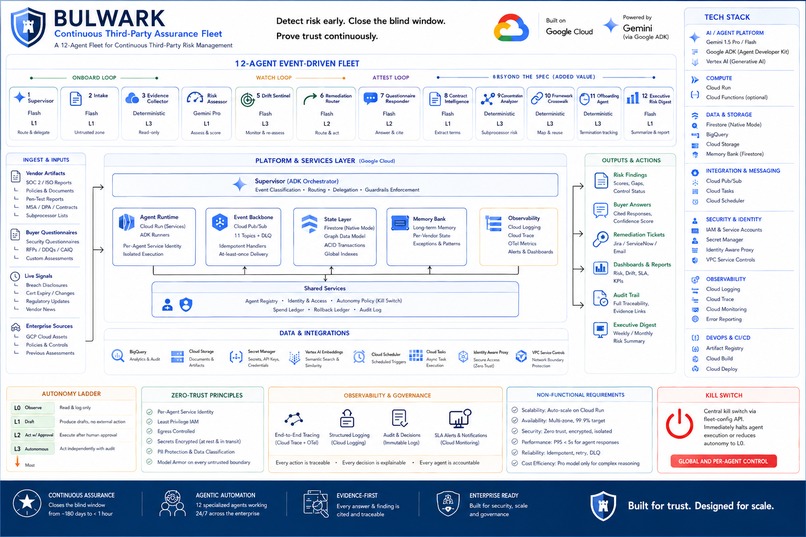
Architecture
-
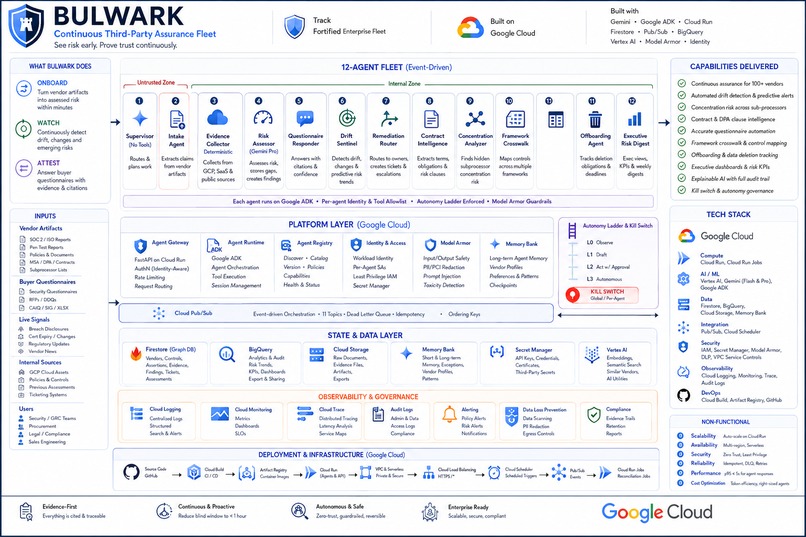
LLD
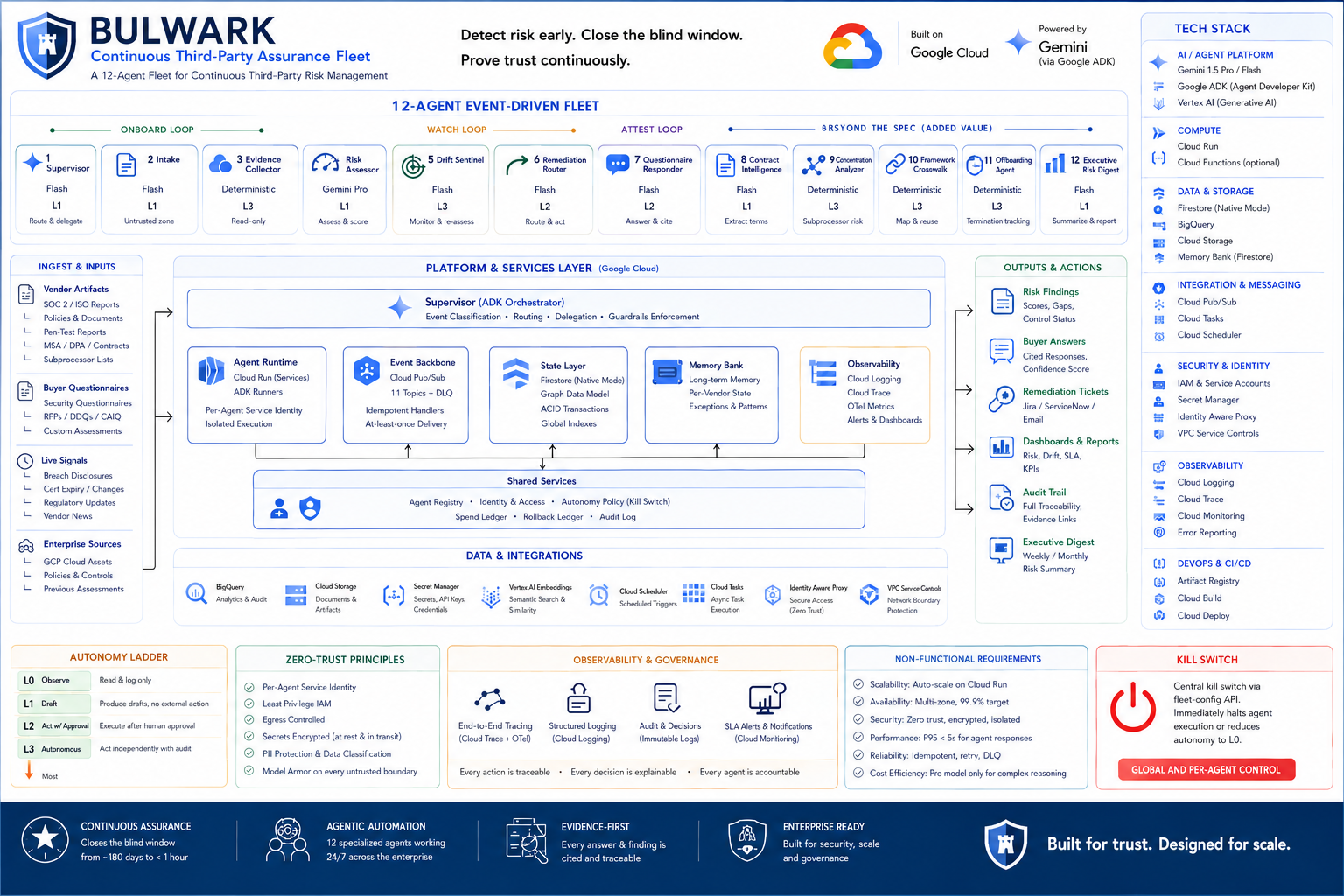
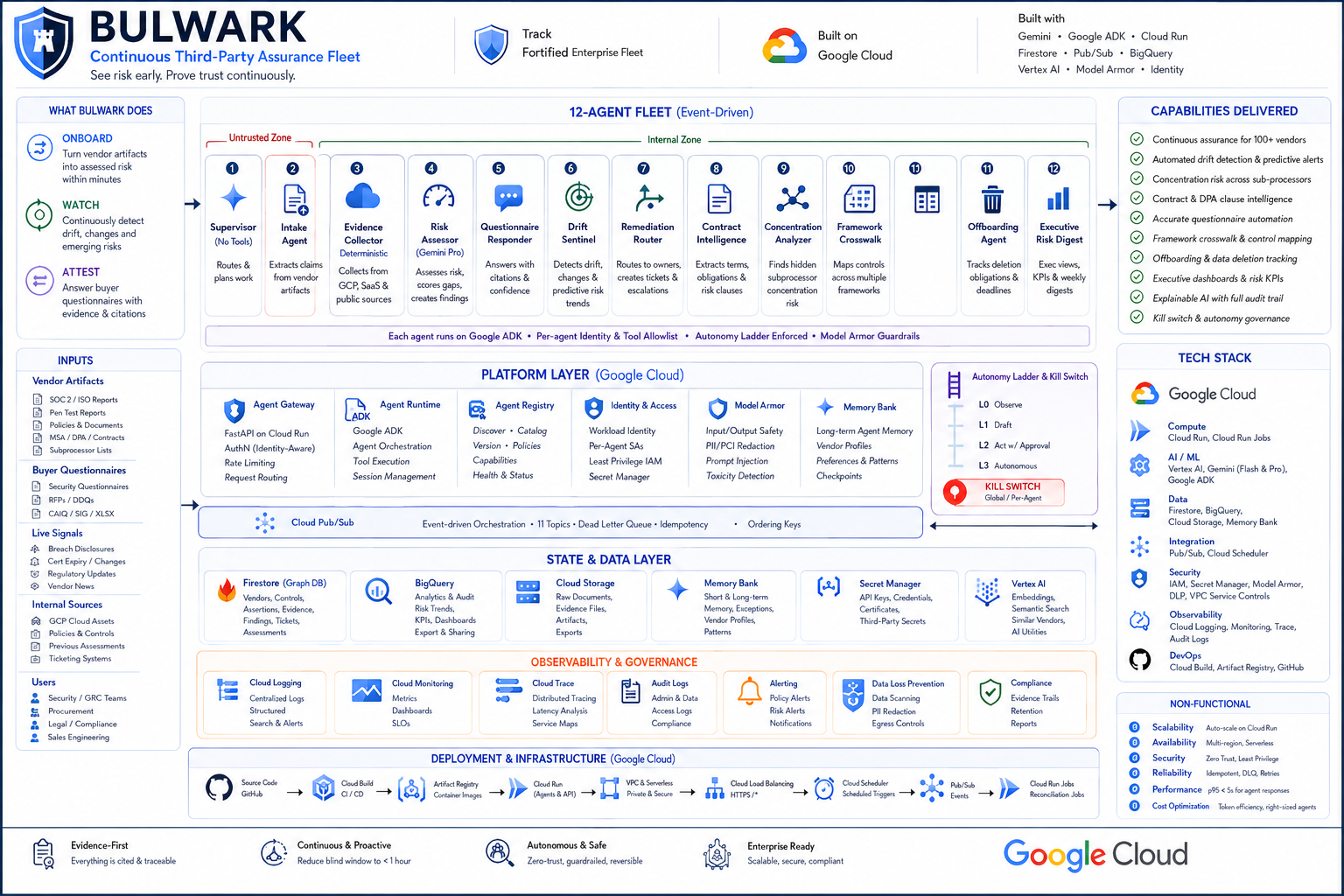
Inspiration
Third-party risk review runs on a fixed calendar - a vendor gets a full review once, then nothing until the next cycle, weeks or months later. Anything that changes in between (a certificate expiring, a control drifting, a breach at the vendor, a subprocessor quietly added) sits invisible the whole time: the blind window. On top of that, the most expensive parts of the process are still entirely manual - a security analyst reading a SOC 2 report by hand, a paralegal reading a vendor contract against a legal playbook clause by clause, an executive clicking through dozens of dashboards hoping to notice the one urgent item. And no manual process ever asks the one question that actually predicts correlated failure: do a dozen "independently diversified" vendors secretly share the same subprocessor? The 2024 CrowdStrike outage is exactly that blind spot turning into an incident.
What it does
BULWARK is a 12-agent fleet, built for the Fortified Enterprise Fleet track, that runs continuous third-party assurance in both directions:
- Assessing your vendors. Forward a SOC 2 report, ISO cert, pen-test summary, or contract and the fleet screens it for prompt injection, extracts structured claims, cross-references them against your control framework and independently observed evidence, decides whether anything is actually a gap, and - only if so - opens a ticket and drafts a follow-up citing the exact codes. Weeks later, a scheduled sweep notices an expiring certificate or your own controls drifting and reopens the affected assessment with no one asking.
- Answering buyers' security questionnaires from the same evidence graph, with a citation on every confident answer and an honest abstention wherever the evidence doesn't support one.
- Reviewing contracts automatically. Contract Intelligence reads MSAs/DPAs and flags deviations from a legal playbook (liability caps, breach-notification windows, audit rights, subprocessor flow-down) instead of a paralegal re-deriving them by hand.
- Catching hidden portfolio risk. Concentration Analyzer clusters every subprocessor disclosed across the whole vendor portfolio and flags where multiple vendors - especially critical-tier ones - secretly depend on the same one, the exact blind spot standard per-vendor review structurally can't see.
- Cutting redundant compliance work. Framework Crosswalk reports how much of a target framework (ISO 27001, NIST CSF) a vendor already satisfies via its existing SOC 2 findings, so a compliance team knows exactly which controls still need fresh evidence instead of starting from zero for every framework they carry.
- Predicting risk before it's a gap. Drift Sentinel's fourth signal flags a control's residual risk climbing across three consecutive reassessments - reactive gap detection becomes predictive early-warning.
- Tracking the data-deletion clock a vendor termination creates.
The Offboarding Agent starts the deadline every DPA's
termination_assistanceclause obligates on offboarding, and Drift Sentinel's fifth signal flags it the moment it's missed - a real, auditable data-retention exposure that otherwise lives in a spreadsheet, if it's tracked at all. - Summarizing the fleet for someone with two minutes, not twenty. Executive Risk Digest turns the fleet's 44 API endpoints of state into a short, prioritized narrative grounded only in the week's actual urgent items.
- A real dashboard, not just
curl/jq. A React frontend over the same API surface -- fleet health and the kill switch, per-vendor findings with the full reasoning chain, the risk-trend chart, concentration risks, the executive digest, trace timelines, light/dark theme, and search/filter/sort on every table. Submitting a vendor's SOC 2 or contract is a real file upload (PDF/DOCX/TXT), extracted server-side and screened by Model Armor before any LLM call -- not a paste box -- with a vendor dropdown over your existing portfolio instead of retyping a name.
How we built it
Twelve Google ADK agents (seven Gemini-Flash-backed, one
Gemini-Pro-backed for the one genuinely complex judgment call, four
deliberately non-LLM because their job is a lookup, not reasoning)
wired together entirely through a Pub/Sub-shaped event bus - no agent
module ever calls another agent module directly, which
tests/test_orchestrator_wiring.py asserts mechanically. Every
Fortified Enterprise Fleet pillar from the track brief is implemented
as real, tested code rather than a diagram: Agent Registry, Agent
Runtime (ADK Runners + run checkpointing), Memory Bank (per-vendor
exceptions that persist across weeks of sweeps), Agent Identity (a
per-agent zero-trust grant table), Agent Gateway (API-key auth + rate
limiting + an autonomy ladder), Model Armor (blocking prompt injection
before any LLM call), and Agent Observability (OpenTelemetry spans plus
a persisted reasoning-chain record replayable per finding).
FastAPI is the Agent Gateway's HTTP surface; Firestore is the control-evidence graph (in-memory fallback for local dev, same code path either way); Cloud Run is the deployment target (scale-to-zero); Cloud Scheduler drives the sweep cadences; Pub/Sub mirrors the event bus when live.
Resilience beyond a single model provider: if ANTHROPIC_API_KEY is
set and a Gemini turn fails before producing any output, the fleet
retries that one turn against Claude (Haiku for the seven Flash-tier
agents, Sonnet for Risk Assessor's Pro-tier reasoning) instead of
failing the request outright -- off by default, and scoped to "before
any output" specifically so a turn that already made a real side effect
(create_finding, open_ticket) is never silently retried and
duplicated.
Challenges we ran into
- Keeping the fleet genuinely event-driven under load-bearing scrutiny
- a test asserts mechanically that no agent module imports another, not just that the diagram says so.
- Making the kill switch and the circuit breaker share one code path
(
set_global_autonomy(0)) instead of two flags that could silently disagree about whether the fleet is allowed to act. - Deciding where a security-critical decision belongs: in a prompt (arguable, bypassable) or in code (not). The untrusted-provenance routing gate and the citation-validation gate on findings are both deliberately code, not instructions.
- Scoping every "beyond the spec" addition (Contract Intelligence, Concentration Analyzer, Framework Crosswalk, the Offboarding Agent, Executive Risk Digest, the risk-trend and offboarding-overdue signals) to reuse existing infrastructure - the same Model Armor gate, the same event-bus pattern, Drift Sentinel's existing LLM-judgment step - rather than bolting on a parallel system each time.
- Deciding what "reversible" honestly means: most L3 autonomous actions get a compensating-action record, but confirming a vendor's data deletion deliberately doesn't - it certifies a real-world fact, and pretending a database rollback could un-delete actual data would be dishonest about what rollback means in this system.
- Realizing
Finding(overwritten in place per vendor+control on every reassessment) structurally cannot show a risk trajectory, and adding an append-onlyAssessmentSnapshothistory underneath it rather than trying to reconstruct trend data that was never being kept.
Accomplishments that we're proud of
- All seven Fortified Enterprise Fleet pillars implemented as live, tested code, with an honest "what's live vs. what's documented" table rather than implying broader GCP bindings than a hackathon build actually has.
- 199 passing tests requiring zero live Gemini credentials - every deterministic mechanism (guardrails, citation validation, the autonomy ladder, the event bus's DLQ and idempotency dedup, the circuit breaker, rollback, the crosswalk lookup, the trend detector, the offboarding-deadline tracker) is exercised directly.
- Six genuinely novel capabilities that solve real, underserved enterprise pain instead of adding more checklist coverage to the spec.
- A reasoning-chain record on every finding, replayable via one API call - "why did the agent decide this" gets a structured answer, not a re-run.
What we learned
- Not every agent in a fleet needs to be an LLM call - four of the twelve agents here are deliberately plain Python, because comparing values, clustering names, looking up a control's equivalent, or comparing a deadline to today is a lookup, not reasoning, and skipping the model call removes an entire class of prompt-injection risk on exactly the agents with the broadest read access.
- A circuit breaker that doesn't share code with the kill switch isn't really a circuit breaker - there should only ever be one "is the fleet allowed to act" answer to get right.
- Mock data belongs in a table with a straight face about which parts are mocked; that's a better story for judges than pretending a hackathon build has live bindings to six different GCP security products.
What's next for BULWARK
- Wire
contract.terms_extractedinto Remediation Router the same wayfinding.createdalready is, so a critical playbook deviation opens a ticket automatically instead of just being queryable. - Replace the mock internal-evidence sources and playbook with real Cloud Asset Inventory / Security Command Center / DLP bindings behind the same function signatures - the shape is already there.
- Wire
document_extraction.py's server-side PDF/DOCX parsing into Evidence Collector's own ingestion path, not just the manual-upload route, so a scheduled evidence pull gets the same real-file handling a human submitter does. - Wire the Executive Risk Digest to a real weekly Cloud Scheduler cadence with an email/Slack delivery target once the recipient workflow is chosen.
Built With
- fastapi
- gemini
- gemini-flash
- google-adk
- google-cloud-firestore
- google-cloud-run
- multi-agent
- vertex-ai

Log in or sign up for Devpost to join the conversation.