Inspiration
Most writing apps still treat thoughts like files: pages, folders, documents, lists.
But that is not how I think.
An idea has a place. It appears beside another thought, drifts into the background, returns later, and sometimes becomes important again.
So I started Asympta Writing with a simple question:
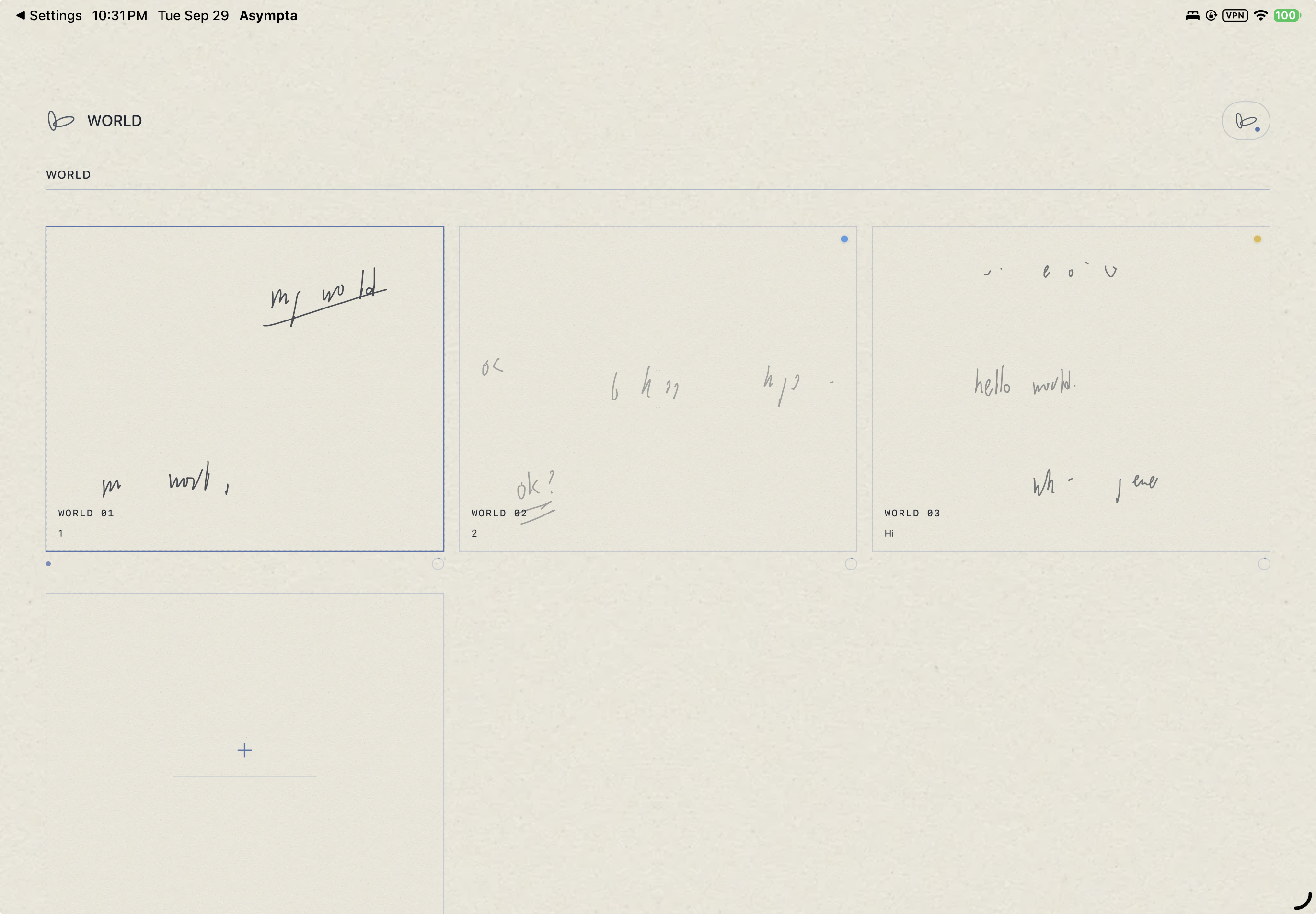
What if handwriting could exist as a world instead of a document?
What it does
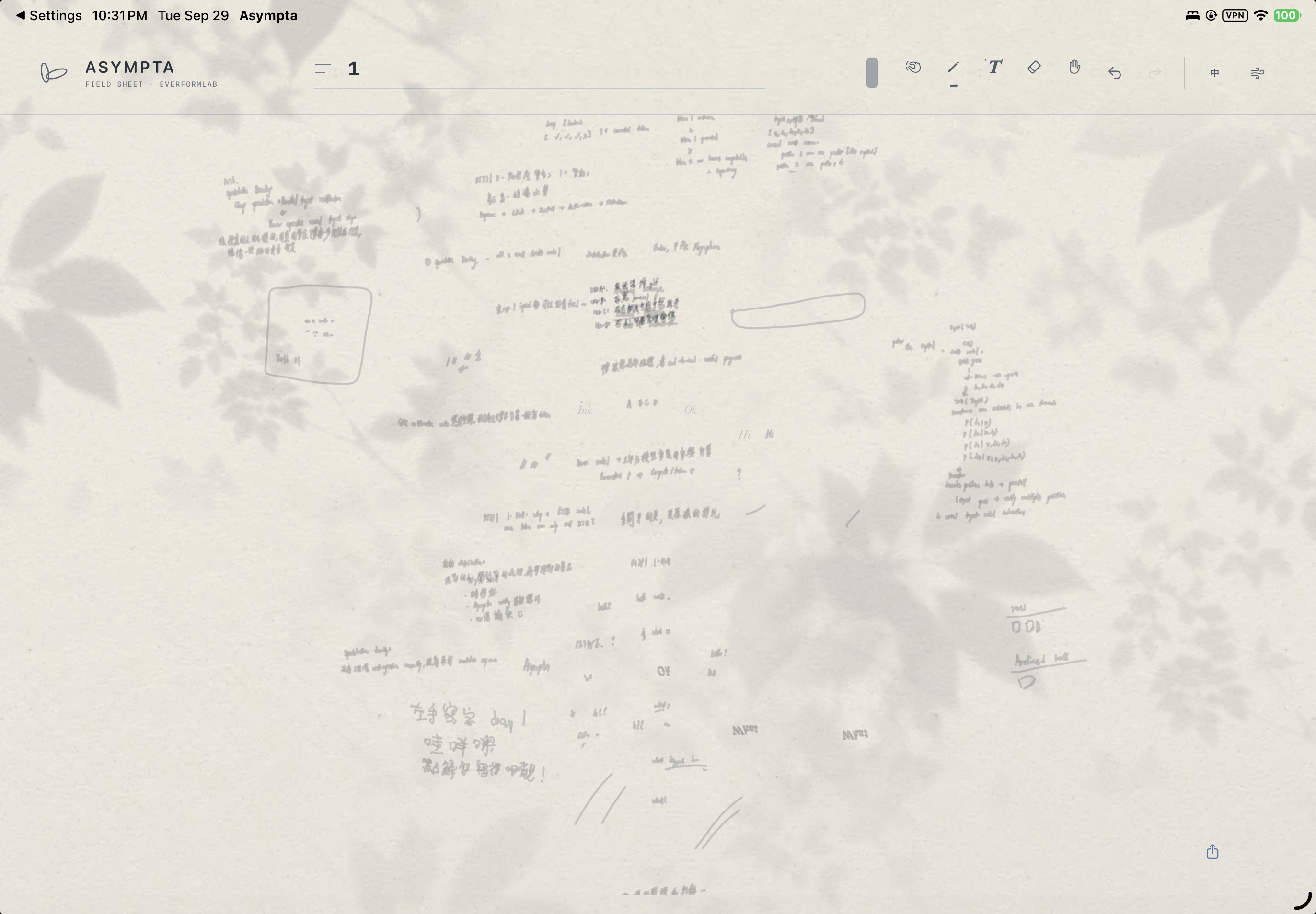
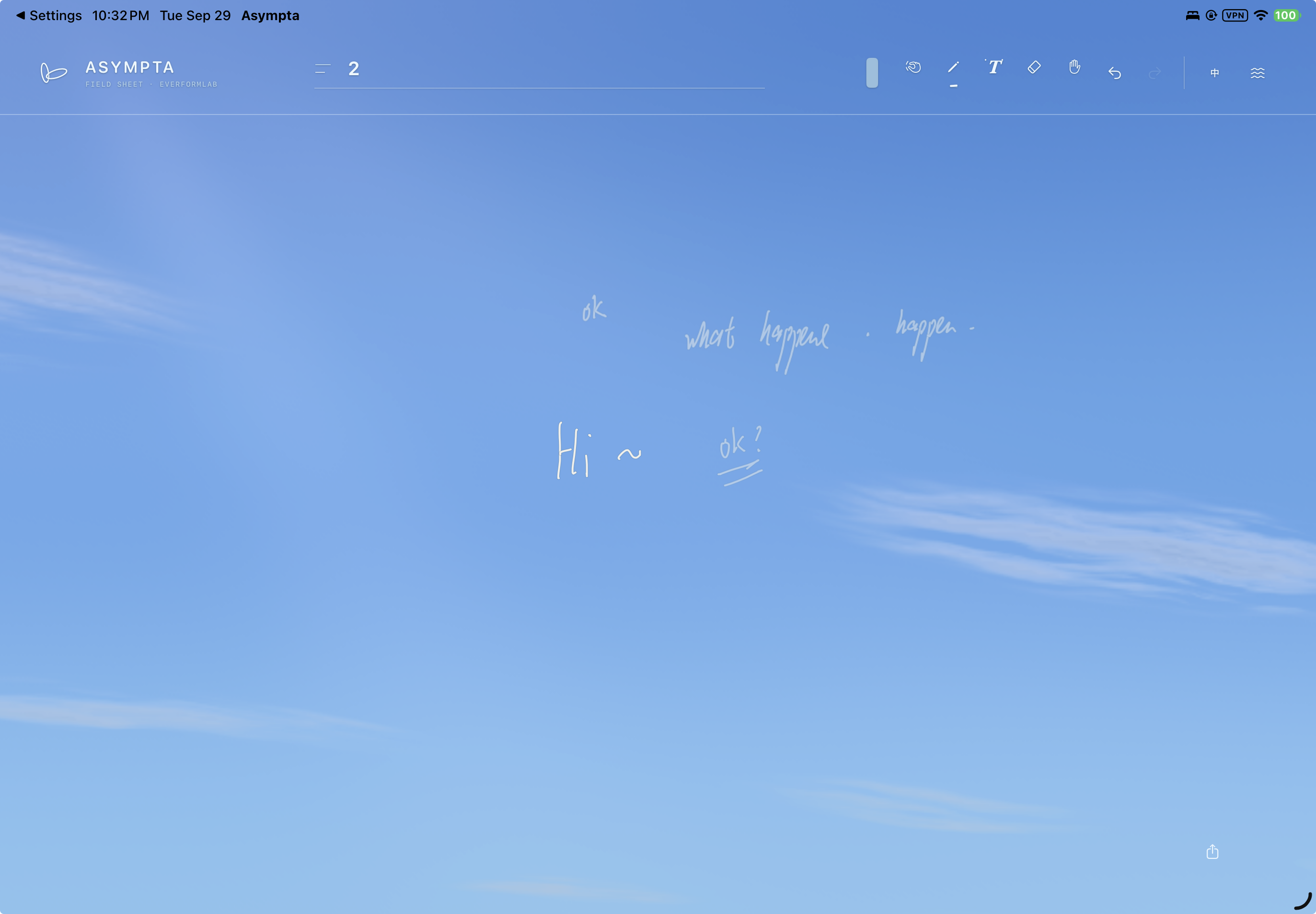
Asympta Writing is an infinite spatial canvas for handwriting.
You write naturally with Apple Pencil, but instead of filling pages, your writing remains positioned inside one continuous world.
Recent thoughts stay present. Older contexts gradually fade into the background and can quietly return, helping the canvas preserve history without becoming visually overwhelming.
There are no traditional pages to manage. Space itself becomes part of memory.
The goal is simple:
keep the feeling of writing on paper, while giving thought more room than paper can provide.
How I built it
Asympta is built natively in Swift for Apple platforms.
At its core is a shared world-coordinate system. Strokes exist in world space independently from the camera, so panning and zooming never change their actual position.
The canvas uses Core Graphics with custom handling for:
- Apple Pencil input
- coalesced touch samples
- predicted stroke previews
- precise stroke endings
- anchored zooming and panning
- contextual fading and movement
- partial stroke erasing
- persistent world coordinates
A viewport-aware bounds cache prevents the renderer from repeatedly processing every point in large drawings.
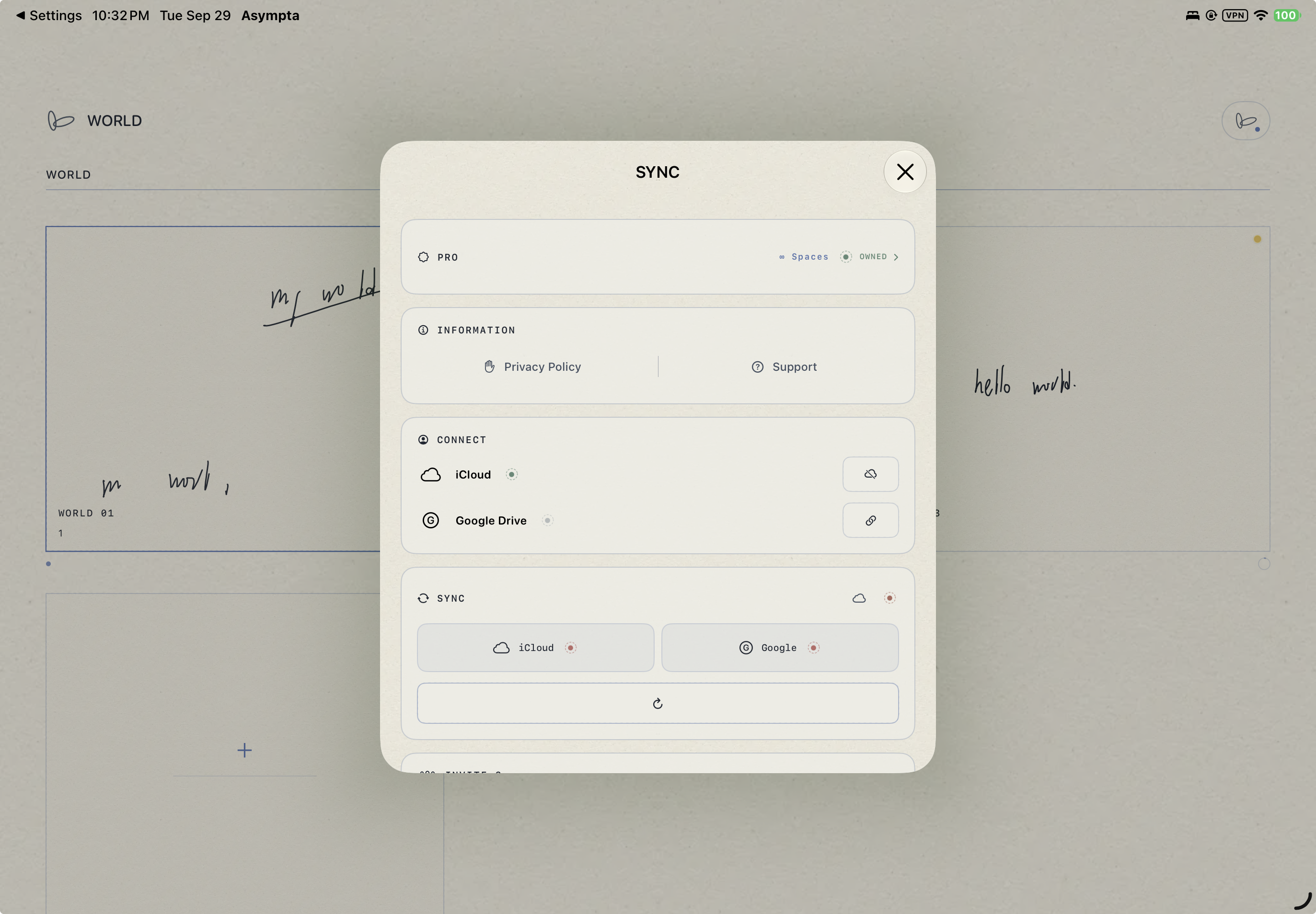
The app also persists worlds, strokes, camera state, and contextual metadata, and supports iCloud synchronization.
For monetization, Asympta uses a simple lifetime model rather than turning writing into another recurring subscription: the free version supports the core experience, while Asympta Lifetime unlocks unlimited Spaces and additional backup capabilities.
Challenges
The hardest part was not creating an infinite canvas.
It was making the canvas disappear as a piece of technology.
A handwriting app can technically work while still feeling wrong.
A few milliseconds of latency, an incorrect predicted endpoint, a camera movement while the Pencil is touching the screen, or a stroke shifting during zoom can immediately break the illusion of writing directly on a surface.
Another challenge was history.
If everything stays visible forever, the canvas becomes noise. If old writing simply disappears, context is lost.
Asympta therefore treats history as something that can breathe: nearby past contexts can slowly reappear while most background content remains quiet.
Performance created another constraint. An infinite world cannot behave as if every stroke is equally relevant every frame, so rendering and spatial lookup had to become increasingly viewport-aware as the canvas grew.
What I learned
The biggest lesson was that a writing tool is defined less by the number of features it has than by the number of interruptions it removes.
Every layer—input sampling, camera behavior, rendering, persistence, animation, and interface—affects the feeling of the pen.
I also learned that spatial interfaces need strong invariants.
A stroke must remain where it was written.
The camera must never interfere with the pen.
History should preserve context without competing with the present.
Once those rules became clear, many engineering decisions became easier.
Asympta Writing is still evolving, but its direction has become much clearer:
not a better collection of digital pages, but a place where thought can live.
Built With
- apple-pencil
- cloudkit
- core-graphics
- google-drive-api
- icloud
- ios
- ipados
- revenuecat
- storekit-2
- swift
- swiftui
- uikit
- xcode
- xcode-cloud


Log in or sign up for Devpost to join the conversation.