Inspiration
AI agents are becoming increasingly capable, but most of them still live inside isolated chat windows.
They can reason, search, plan, and use tools, yet the real world is not a single tool. A simple goal such as “prepare dinner for tonight” can involve understanding a person's preferences, finding nearby businesses, checking availability, purchasing goods, coordinating delivery, and adapting when something changes.
At the same time, businesses have their own agents, resources, schedules, inventory, and constraints.
We imagined a different interface for this future:
What if AI agents existed inside a shared world where people, businesses, services, and other agents could coordinate directly?
That became Asympta World.
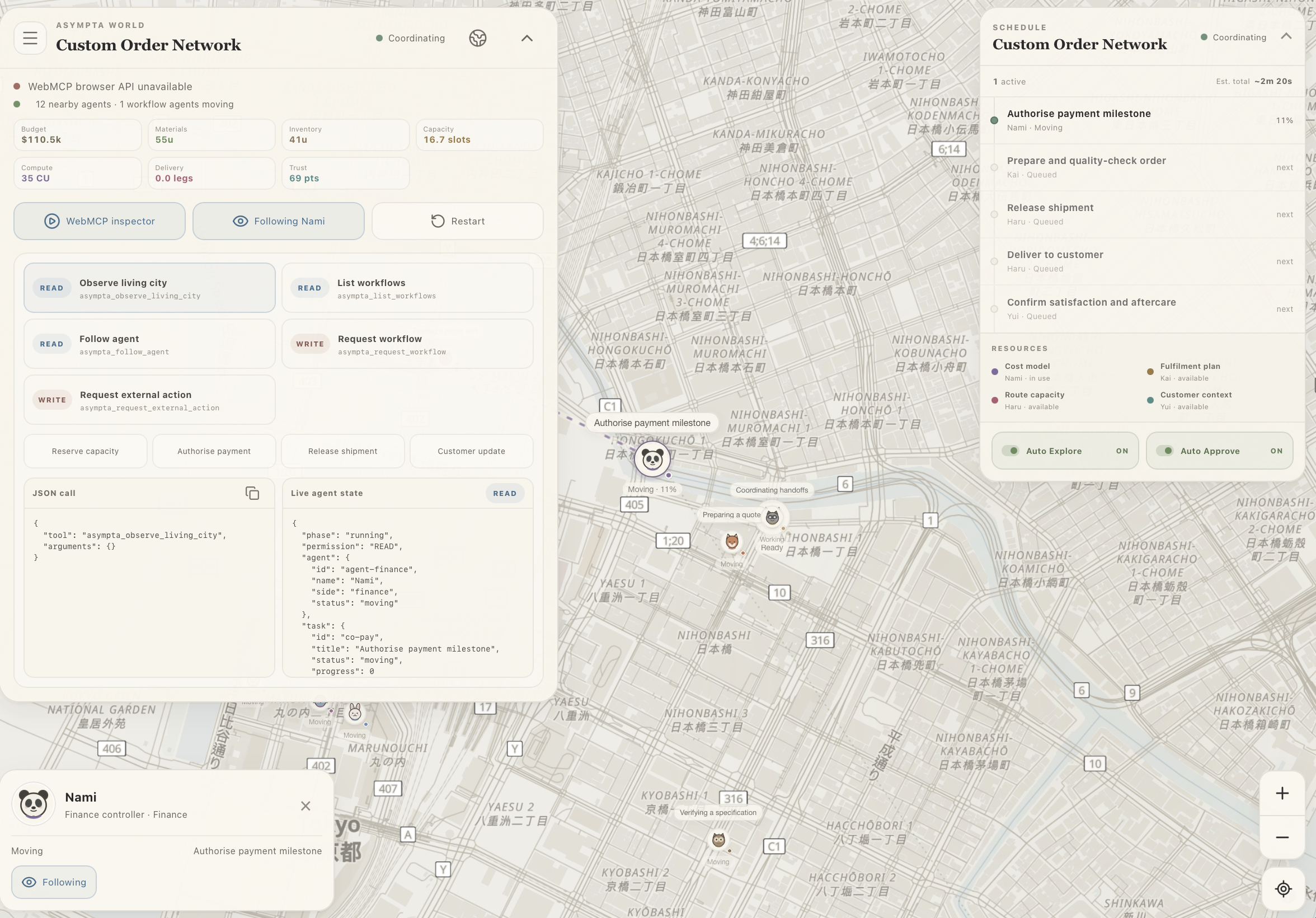
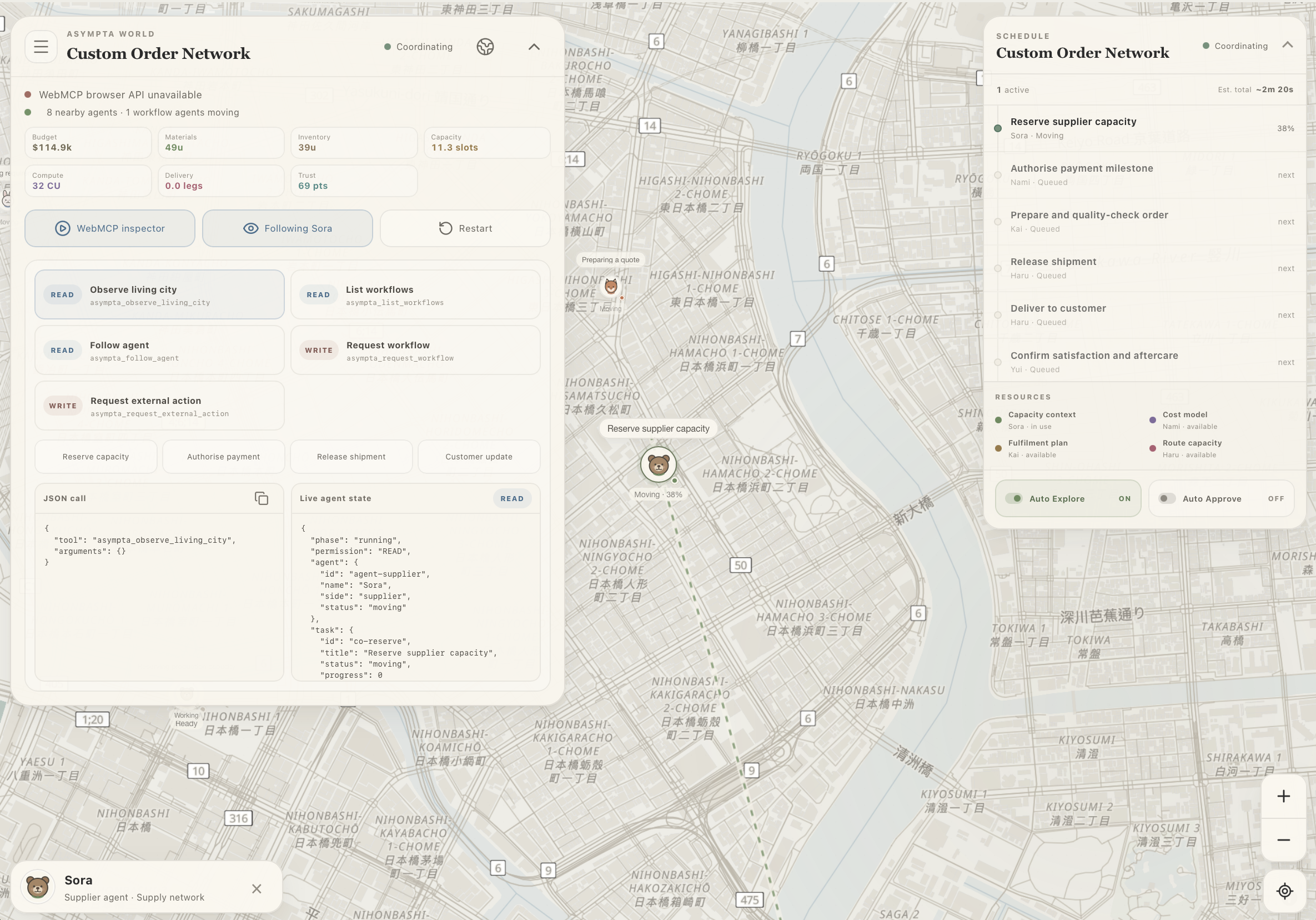
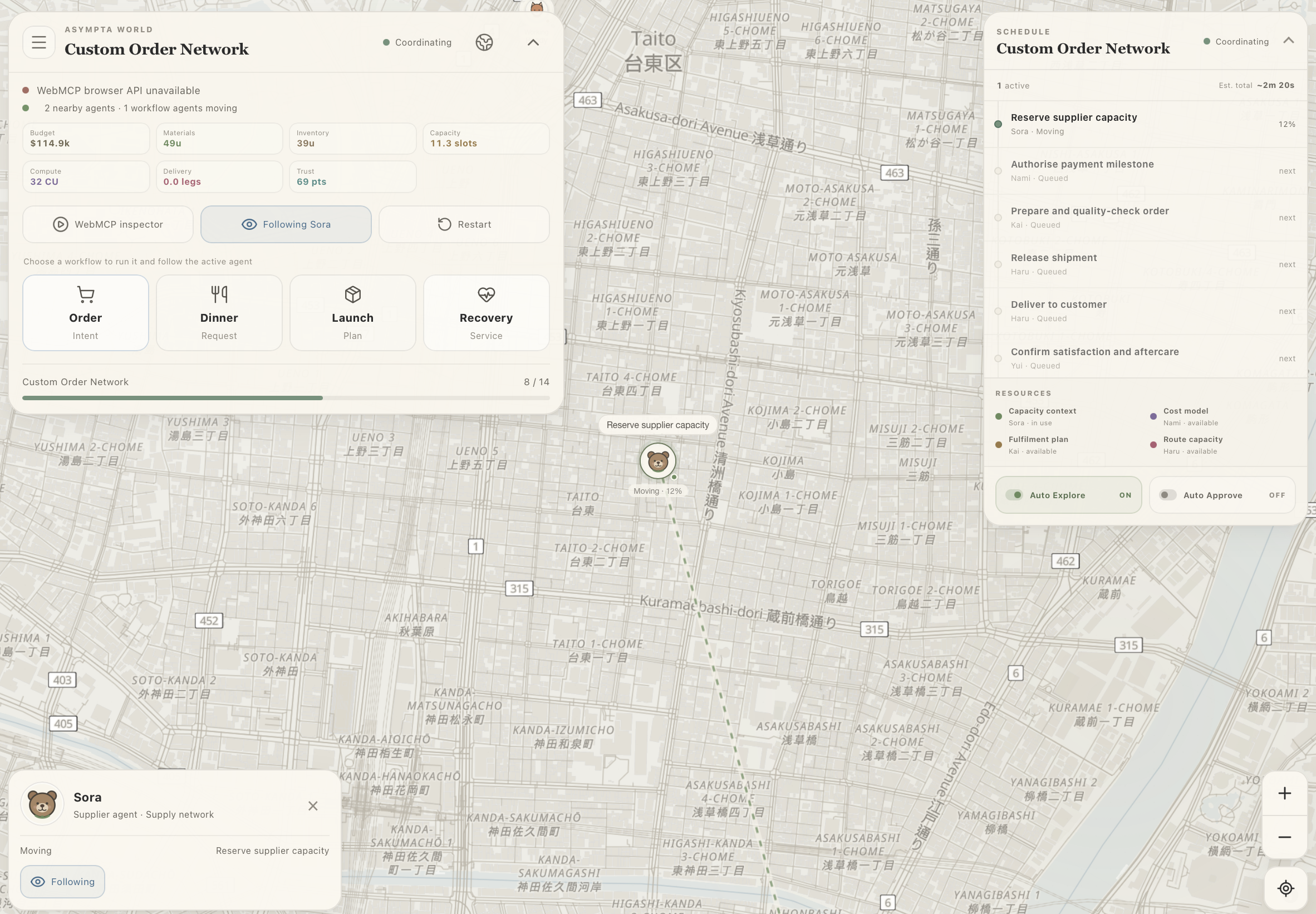
Instead of showing AI as a sequence of hidden API calls, Asympta World turns agent activity into a visible, spatial, living system. You can watch agents move through the world, communicate, discover services, coordinate tasks, exchange information, and complete real-world workflows.
The inspiration is simple:
AI should not only answer. It should be able to participate.
What it does
Asympta World is a living AI world where people, businesses, and autonomous agents coordinate, communicate, trade, and complete real-world tasks together.
The interface is built around an explorable world map.
A person can give an agent a goal. The agent then begins moving through the world and interacting with the entities required to complete it.
For example, a task may involve:
- understanding the user's intent,
- discovering relevant businesses or services,
- communicating requirements,
- checking resources or availability,
- coordinating multiple participants,
- performing actions,
- adapting when conditions change,
- and returning the completed result to the user.
The important difference is that Asympta World models both sides of an interaction.
A restaurant is not simply an API endpoint. Its side of the world may have its own agent coordinating orders, ingredients, preparation, scheduling, communication, and delivery.
A supplier may interact with the restaurant.
A delivery service may interact with both.
The user's agent coordinates across all of them.
This creates something closer to a miniature digital economy than a traditional chatbot.
Asympta World also makes autonomous activity understandable:
- agents visibly move toward relevant locations,
- task progress reflects estimated completion time,
- the camera can automatically follow active work,
- agent status and communication can be observed,
- scheduled tasks can exist inside the same world,
- Auto Explore allows agents to discover useful next actions,
- active parts of the map react visually when work is happening,
- and the interface supports multiple languages across both UI and agent context.
The goal is to make autonomous systems feel observable, understandable, and alive instead of invisible.
How we built it
Asympta World is built as an interactive web application with a simulation and coordination layer underneath the visual world.
The world
The map acts as the primary interface rather than a traditional dashboard.
It is designed as a large, zoomable environment where agents, businesses, resources, and activity can exist spatially.
We developed a lightweight visual system that can display many active entities while keeping movement smooth and the interface readable.
The simulation engine
Underneath the map is a world simulation representing:
- agents,
- people,
- businesses,
- resources,
- tasks,
- workflows,
- locations,
- events,
- and relationships.
Rather than hard-coding every interaction as an animation, the simulation maintains world state and lets the interface reflect what is actually happening.
This allows agents to move, exchange information, react to events, and participate in multi-step processes.
Agent workflows
Tasks are represented as sequences of coordinated actions.
An agent can transition through states such as discovery, travel, communication, negotiation, execution, waiting, and completion.
The visual world reflects those states.
We also built estimated workflow timing so that progress follows the expected duration of the underlying task rather than an arbitrary animation percentage.
Business-side simulation
One of the most important architectural decisions was to simulate more than the user's agent.
Businesses and services can participate as active entities in a workflow.
This lets us demonstrate agent-to-business, business-to-supplier, and multi-party coordination rather than treating every external service as a passive database lookup.
WebMCP and tool interaction
Asympta World is designed around the idea that agents should interact with capabilities exposed by the web instead of requiring every website to be manually rewritten into a custom integration.
WebMCP provides an important building block for this model: websites can expose structured capabilities that agents can discover and use.
Asympta World explores what happens when those capabilities exist inside a shared spatial coordination layer.
Instead of thinking:
User → Agent → Website
we started thinking in terms of:
Person ↔ Agent ↔ Business Agent ↔ Services ↔ Other Agents
with the world itself providing the context connecting them.
Challenges we ran into
Making an agent feel like it actually exists in the world
It is easy to place an agent icon on a map. It is much harder to make the agent's movement correspond meaningfully to what the system is actually doing.
We had to connect task state, destination selection, animation, camera movement, and progress so that they behave as one system.
Showing complex activity without overwhelming the user
A real workflow can involve many simultaneous actions.
Displaying everything creates visual noise. Hiding everything makes the world feel fake.
We experimented with temporary activity indicators, contextual agent status, dialogue bubbles, fading map activity, automatic camera following, and progressive disclosure to find a better balance.
Modeling the supply side
Many agent demonstrations stop once an order is sent.
But the interesting part often begins after that.
A business may need to confirm inventory, prepare materials, coordinate staff, request something from a supplier, schedule fulfillment, and arrange delivery.
Representing these processes forced us to think about the world as a network of interacting systems instead of a single user's workflow.
Performance
A living world means many moving objects, effects, state transitions, and UI updates.
We repeatedly had to reduce unnecessary rendering work, control how much context was displayed at once, and make activity effects temporary rather than permanently accumulating.
The principle became:
The world can become more complex without rendering cost growing at the same rate.
Localization
Another unexpected challenge was keeping language changes consistent across a live simulation.
Static interface text is straightforward to translate. Dynamic agent statuses, workflow messages, task descriptions, and rapidly changing state are more difficult.
We had to treat language as part of the world state rather than merely translating the surrounding UI.
Designing something that feels like a product
It was easy for an agent simulation to start looking like a debugging dashboard.
We deliberately kept returning to the question:
Would somebody actually want to explore and use this?
That pushed us toward a calmer map interface, fewer permanent controls, contextual information, smoother motion, and a visual language closer to a real product than a developer demo.
Accomplishments that we're proud of
The biggest accomplishment is that Asympta World became more than an animation of an AI agent.
It became a working model of a different way to think about agent interfaces.
We are particularly proud that:
- agents visibly move through the environment as tasks progress,
- workflows can span multiple participants,
- businesses are represented as actors rather than passive endpoints,
- task progress corresponds to estimated execution time,
- the world can automatically follow important activity,
- autonomous exploration can coexist with user-directed tasks,
- scheduled and live workflows can share the same environment,
- activity across the map can be visualized without permanently cluttering it,
- and the same interface can represent both digital actions and real-world economic activity.
Most importantly, Asympta World gives people an intuitive way to understand something that is normally invisible:
what an autonomous agent is doing on their behalf.
What we learned
The project changed how we think about AI agents.
At first, the natural abstraction was:
one user, one agent, many tools.
But real-world activity rarely works that way.
A more realistic model is a network of:
People + Agents + Businesses + Resources + Services
connected through continuously changing relationships.
The agent is not necessarily the center.
It is one participant coordinating within the network.
We also learned that observability is part of the user experience of autonomy.
If an AI system can perform actions for several minutes without showing meaningful state, users lose confidence in it.
Movement, location, communication, estimated time, progress, and visible handoffs are therefore not simply visual effects. They can become a language for explaining agent execution without exposing internal chain-of-thought.
Another lesson was that the interface for an agent economy may look very different from today's software.
Traditional applications organize functionality into pages and menus.
A world interface organizes functionality around:
- entities,
- locations,
- relationships,
- events,
- and goals.
That opens a much larger design space.
What's next for Asympta World
The current version of Asympta World demonstrates the world, coordination, and interaction layer.
The next major step is to connect that world to real frontier AI agents.
We hope to work with OpenAI and other AI model providers so that the agents inside Asympta World are not only simulations, but are powered by real reasoning, multimodal understanding, tool use, planning, and autonomous execution capabilities.
Our vision is not to make Asympta World dependent on one model.
Instead, we want it to become a shared environment where different AI models and agent systems can participate based on their strengths.
An OpenAI-powered agent might handle complex reasoning and computer interaction. Other models could specialize in coding, research, commerce, local services, robotics, or domain-specific tasks.
Asympta World would provide the world and coordination layer, while model providers provide the intelligence.
In simplified form:
Asympta World + OpenAI & other model providers + WebMCP & tools + businesses → a real-world agent economy
We hope to collaborate with OpenAI, other model providers, developers, businesses, and platform builders to make this ecosystem real.
WebMCP-style capabilities could allow websites and businesses to expose actions that agents can discover dynamically. Instead of every agent requiring a manually built integration, the web itself could become an environment that agents understand and operate within.
From there, we want to expand toward:
- real OpenAI and third-party model-powered agents,
- multi-model agent collaboration,
- persistent personal agents,
- agent-to-agent communication,
- real business integrations,
- payments and transactions,
- logistics and delivery coordination,
- dynamic supply chains,
- user-created agents and businesses,
- reputation and trust systems,
- persistent world state,
- and a marketplace of agent-accessible capabilities.
Ultimately, we do not see Asympta World as another AI model.
We see it as a world where AI models can live, cooperate, and act.
OpenAI and other model providers can supply increasingly powerful intelligence.
Businesses and the web can supply capabilities and resources.
Humans can supply goals, creativity, judgment, and intent.
Asympta World connects them.
Today, people open applications and operate software themselves.
Tomorrow, they may simply express an intention and watch a network of AI agents, businesses, services, and humans coordinate to make it happen.
Asympta World is our attempt to build the world in which that future can happen.
Built With
- actions
- agentic
- agents
- ai
- cloudflare
- css
- github
- interactive
- multi-agent
- next.js
- node.js
- p5.js
- react
- simulation
- systems
- tailwind
- three.js
- typescript
- vgpu
- vite
- web
- webmcp
- workers
- wrangler

Log in or sign up for Devpost to join the conversation.