Inspiration
Space exploration is entering a new era of autonomy. Yet, spacecraft, rovers, and satellites still struggle with unpredictable environments where communication delays of up to 20 minutes make real-time human control impossible. Every second counts when a rover navigates hazardous Martian terrain or a lander selects a safe touchdown zone.
We were inspired by the vision of an intelligent AI co-pilot that could assist space missions in making faster, safer, and more informed decisions. This vision drove us to build AstroPilot AI—an autonomous mission decision assistant that brings advanced AI reasoning directly to the frontier of space exploration.
What It Does
AstroPilot AI is an AI-powered mission decision system designed to support diverse space operations:
- Planetary Rovers: Navigate unknown terrain and avoid hazards autonomously
- Satellites: Analyze orbital conditions and optimize mission parameters
- Landers: Evaluate landing site safety and environmental risks
The system processes mission data, assesses risks, and generates intelligent, explainable recommendations using a combination of:
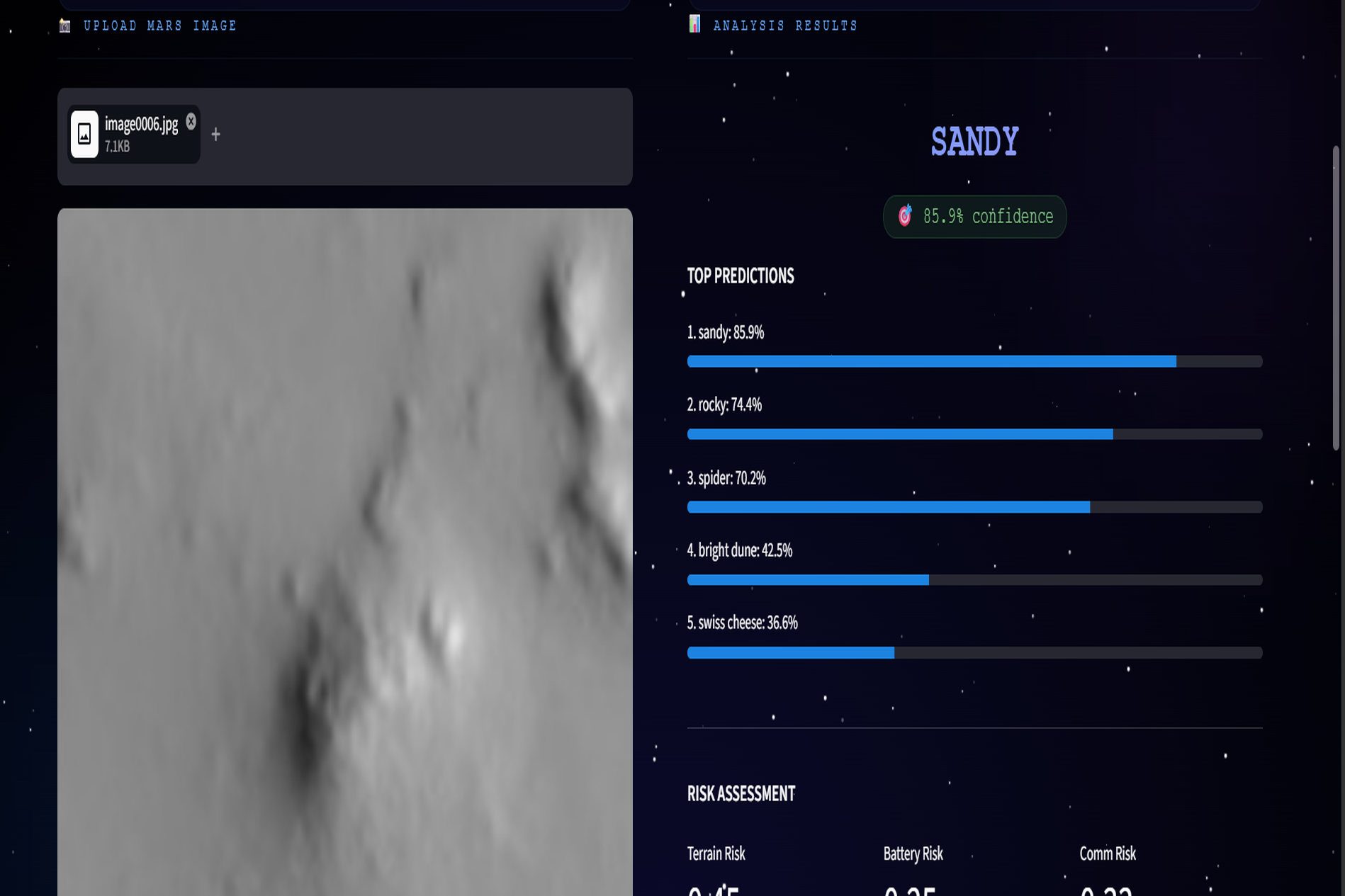
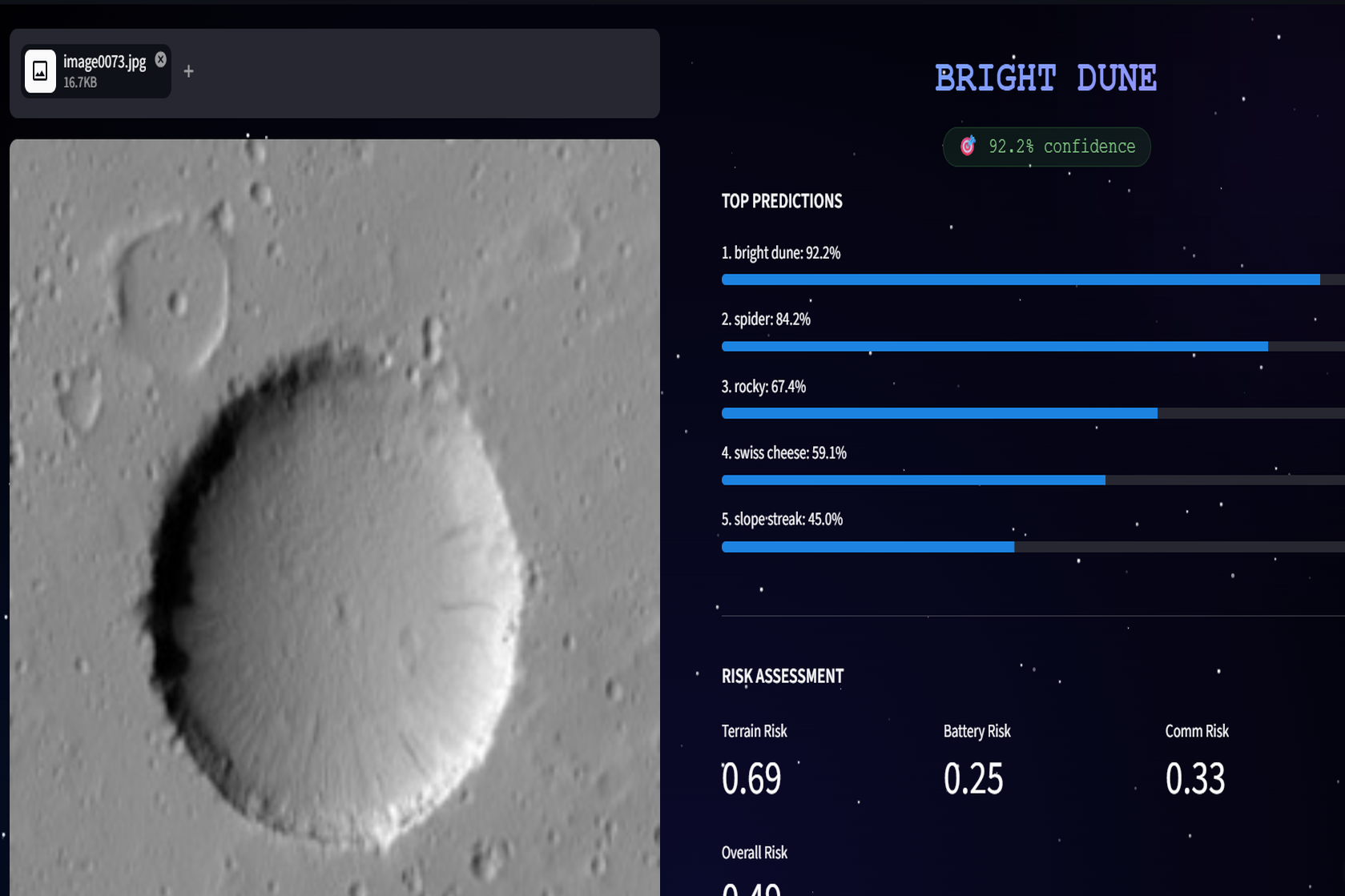
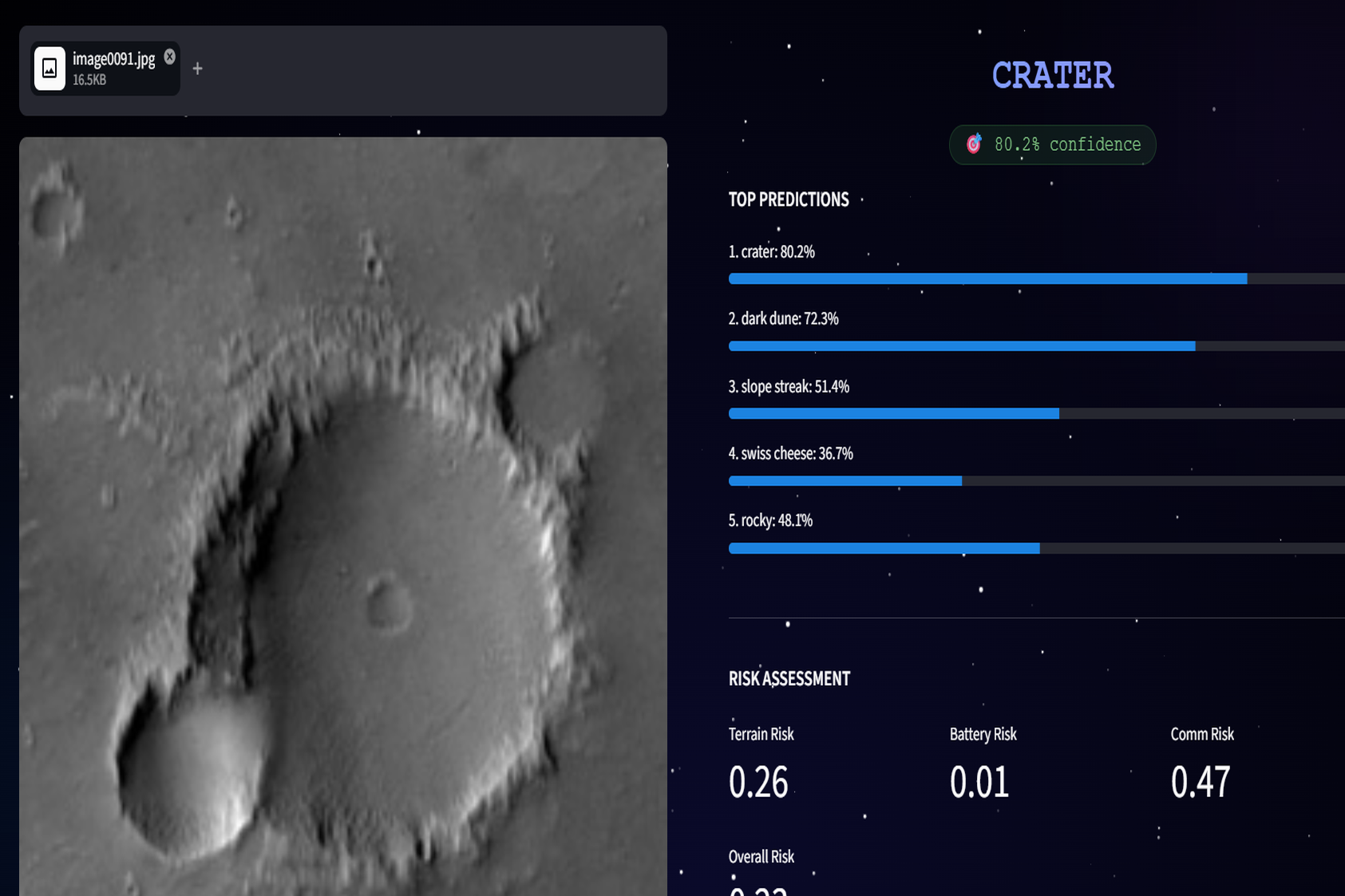
- Computer Vision (ResNet18 trained on 73,031 NASA HiRISE Mars images, 87.77% accuracy)
- Decision Intelligence (risk-weighted scoring across terrain, battery, and communication)
- GPT-5.6 Reasoning (natural language mission reports and explanations)
Unlike traditional black-box AI, AstroPilot AI explains why decisions are made—building trust and enabling engineers to understand autonomous system behavior.
How We Built It
AstroPilot AI is a modular system designed for flexibility and transparency:
AI Mission Assistant (GPT-5.6)
- Generates human-readable mission reports
- Provides natural language explanations for every decision
- Enables interactive communication between users and the autonomous system
Computer Vision Module
- Processes planetary imagery using a ResNet18 model
- Classifies 8 terrain types (rocky, crater, sandy, etc.)
- Achieves 87.77% test accuracy on NASA HiRISE dataset
Decision Engine
- Combines terrain risk, battery status, and communication delay
- Outputs actionable recommendations: CONTINUE, CHANGE ROUTE, CAUTION, or SAFE MODE
- Provides confidence scores for every decision
Interactive Web Dashboard
- Clean, intuitive interface for uploading images and viewing results
- Displays terrain classification, risk assessment, and AI-generated reports
- Built with Flask for easy local deployment
Development Acceleration: We leveraged Codex throughout development to accelerate coding, debugging, and documentation, allowing us to focus on system architecture and AI integration.
Challenges We Faced
Building an autonomous decision system requires balancing intelligence, reliability, and explainability:
- Integration Complexity: Designing a seamless workflow between computer vision, decision logic, and GPT-5.6 reasoning
- Explainability: Making AI decisions transparent and understandable—not treating the system as a black box
- Flexibility: Creating an architecture that adapts to different mission types (rovers, satellites, landers)
- Data Imbalance: Handling the HiRISE dataset with 61,054 "unknown" samples and rare terrain types like "impact ejecta" (only 231 samples)
Accomplishments We're Proud Of
- End-to-End AI Mission Assistant: A complete, working system that goes beyond simple prediction
- 88% Accuracy: Strong performance on real NASA planetary imagery
- Explainable AI: Every decision includes a clear, natural language justification
- Scalable Architecture: Designed to support rovers, satellites, and landers
- Real-World Dataset: Trained and evaluated on 73,031 NASA HiRISE images
What We Learned
This project deepened our understanding of how AI can support critical decision-making in extreme environments:
- Transparency Matters: Autonomous systems must communicate their reasoning clearly to build trust
- Integration is Key: Combining multiple AI components into a cohesive workflow is more challenging than building isolated models
- Data Quality Drives Performance: The imbalance in real-world datasets (73% "unknown" samples) significantly impacts model behavior
- Development Tools Accelerate Innovation: Codex enabled us to iterate faster and focus on high-level design decisions rather than boilerplate code
What's Next for AstroPilot AI
Our vision is to evolve AstroPilot AI into a complete mission control assistant for future space exploration:
- Real-Time Telemetry: Integrate live satellite and rover data streams
- Advanced Simulation: Incorporate realistic mission simulators for testing
- Enhanced Vision Models: Explore Vision Transformers and foundation models for better terrain understanding
- Multi-Agent Coordination: Enable collaboration between multiple rovers or satellites
- Lunar & Martian Landing Optimization: Focus on landing site selection and hazard avoidance
- Reinforcement Learning: Train autonomous exploration policies for unknown environments
AstroPilot AI aspires to be a trusted AI companion that helps humanity explore farther, safer, and more intelligently—enabling the next generation of autonomous space missions.
Built With
- codex
- gpt-5.6
- openai
- python


Log in or sign up for Devpost to join the conversation.