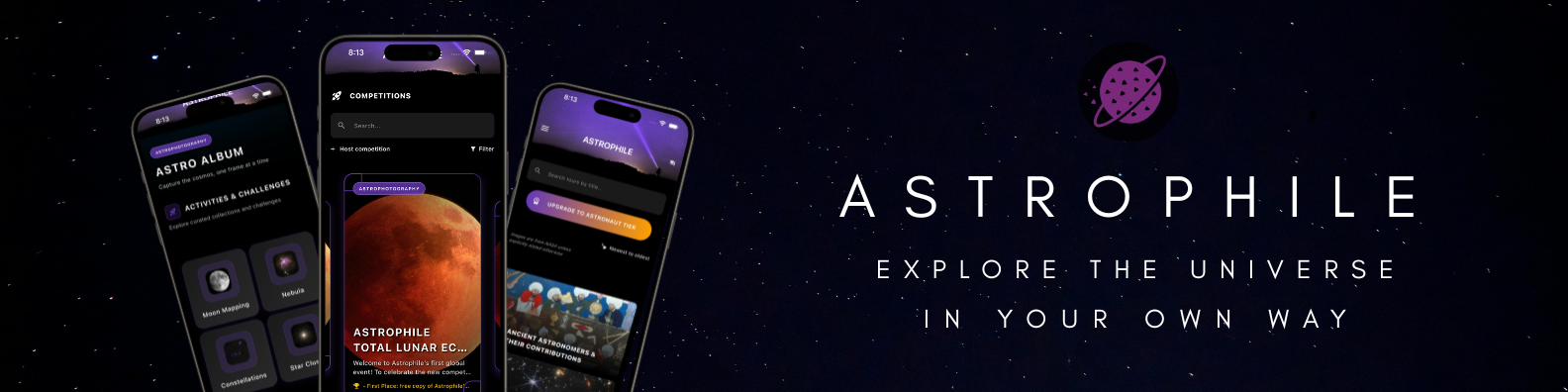
Astrophile Labs
Explore the Universe in your own way
Designing a space mission today requires large budgets, specialized teams, and years of engineering expertise. As a result, students, citizen scientists, and small startups cannot easily experiment with satellite or rover ideas, even when they have innovative solutions to real-world problems. There is no simple way to go from “I have an idea for a space mission” to “here is a working design, simulation, and code.” Astrophile Labs removes this barrier by using Gemini-powered AI engineers to instantly design, simulate, and prototype space missions — making space innovation accessible to anyone with an idea. What if designing a satellite or space mission didn’t require years of aerospace training? Today, creating even a simple CubeSat demands expert teams, complex tools, and high costs — locking out students, citizen scientists, and small startups from participating in space innovation. As a result, thousands of great ideas never get built. Astrophile Labs uses Gemini AI to act as a team of virtual aerospace engineers that can instantly transform a user’s idea into a mission design, simulation, and executable code — lowering the barrier to space exploration from years to minutes.
Inspiration
I've been passionate about space exploration for as long as I could remember, even if opportunities to contribute to this field are limited in my country. Either way, I always looked up at the stars. Later, when I got into programming I realized I could create the opportunities for others and myself through tech skills. I coded many projects, including Astrophile Labs which is probably my favorite. This project addresses the UN's 8th SGD Goal: Decent Work and Economic Growth,
What it does
Small satellites and notably cubesats are being increasingly used for commercial and scientific purposes, marking a monumental shift in the space industry by increasing affordability and expanding use cases. However, development costs remain high, teams of highly skilled engineers are always needed, and access to this technology is still geographically limited. Despite the overall exciting shifting, I believe more people should have access to space technologies, as many talented individuals could contribute to innovation in this field.
Astrophile Labs is an online platform that allows space and tech enthusiasts to get experience with cubesat development regardless of where they are and facilitate the journey for small teams already building them, all through exciting Gemini-powered features, including:
- promp-to-mission transformation
- simulations of orbit
- analysis of code logic and syntax
- generating required documents for cubesat launch
- conversations held by specialized Ai engineers
- mission report writing
- cubesat workshop creation
- display of public missions for globe collaboration
How we built it
This project was vibecoded using Google's Antigravity coding agent and Firebase as the back-end. I had to make sure every feature was actually useful and this was done by going on a deep dive on what are the pain points faced when building cubesats. I wasn't looking to create problems that don't exist or features that make it even more time-consuming. It was interesting as I felt like I learnt a lot about cubesats as well.
Challenges we ran into
I had to manage the rate limits and make sure the firebase functions were correctly deployed and connected to Gemini. The autopilot validation feature crashed multiple times before I figured out what was wrong, as well as the orbit simulations. I tackled these problems with Gemini mostly, as it managed the code and I managed the firebase backend. Certain challenges took a lot of time to solve although the solution was simple.
Accomplishments that we're proud of
It felt like I took vibe coding to a whole other level by making a platform that has potential applications above the skies and to anyone around the world. I'm mostly proud of the code analyser, the promp-to-mission feature and the cubesat virtual workshops, even if everything could use a lot of improvements.
What we learned
On the technical side, I learned a lot about cubesats themselves and what i takes to build on. On the other hand, I definitely learned to be a lot more patient and understand that I can't tackle every problem with the blink of an eye. I learned to control my reactions to when things don't go as planned and read thoroughly to find the errors. Understanding how to simplify complex problems is truly the reason that got me to finishing the project successfully as well.
What's next for Astrophile Labs
Astrophile Labs was a project created in the timeframe of the hackathon but it goes beyond that, as I want to create a startup called Astrophile in the future that creates technologies similar to this one. I would love to create a worldwide ambassadors program and come up with other standardized space vehicles not just for Earth orbit, but for deep space missions. I will be looking into implementing a dashboard to control cubesats directly from Astrophile Labs as an efficient control method for startups who use them for commercial and scientific purposes in the future as well.
Built With
- antigravity
- firebase
- typescript

Log in or sign up for Devpost to join the conversation.