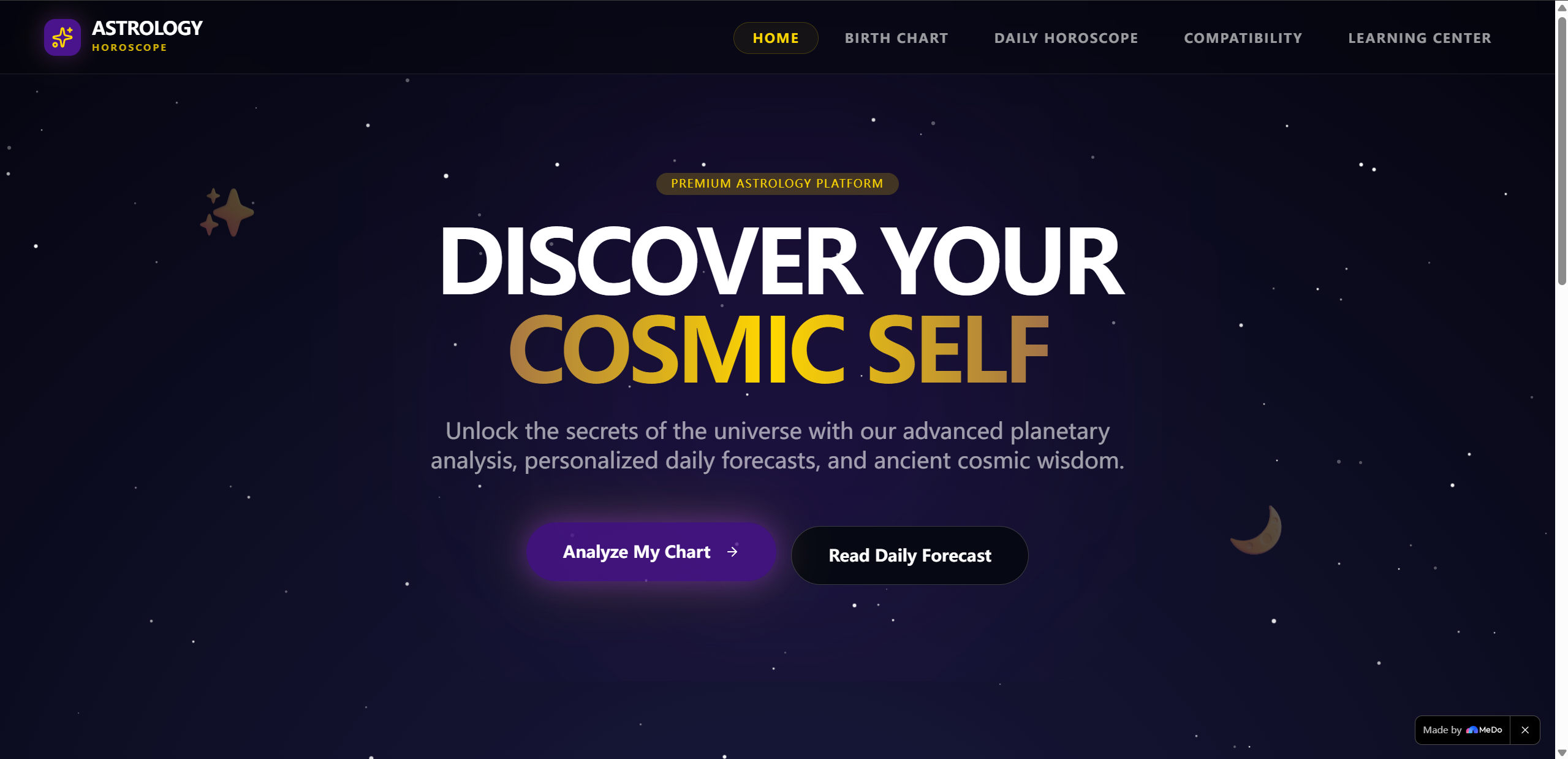
Inspiration Growing up, I’ve always been fascinated by how the stars connect to who we are—how a birth chart can feel like a roadmap to self-discovery, and how horoscopes spark daily joy and reflection. Living in [Western city, e.g., London/New York], I noticed so many friends craving a seamless, beautiful space to explore astrology beyond generic online tools—something that felt personal, visually stunning, and true to the cosmic wonder of astrology. That spark led me to build a platform that marries my love for design and astrology, creating a space where anyone can dive deep into their zodiac story. What it does This platform is a one-stop hub for all things astrology: generate a detailed birth chart tailored to your birth details, check daily horoscopes for any zodiac sign (complete with love, career, and health insights), explore compatibility between signs (romantic, friendship, career), and learn astrology basics to advanced concepts. Every corner is designed to feel like a cosmic journey—think swirling star backgrounds, interactive zodiac wheels, and glowing gold accents that mirror the warmth of the stars. How we built it I started with core HTML/CSS for the layout, leaning into responsive design to ensure it works seamlessly on phones, tablets, and desktops. For the magic—animated star particles, rotating zodiac wheels, and scroll-triggered animations—I used JavaScript (including Intersection Observer for scroll effects) and Canvas for dynamic particle fields. I focused on the visual language first: deep purples and golds to evoke the night sky, glassmorphism cards for a modern, ethereal feel, and smooth animations (like typewriter-style hero text and hover glow effects) to keep the experience immersive. All interactions (tab switching, zodiac wheel clicks, form submissions) were built with vanilla JS to keep it lightweight and fast. Challenges we ran into The biggest hurdle was balancing visual immersion with performance—too many animations risked slowing the site down, especially on mobile. I spent weeks fine-tuning animation timings, optimizing Canvas particle fields, and using CSS transitions instead of heavy JS animations where possible. Another challenge was making the zodiac wheel interactive yet intuitive: getting the hover highlights, smooth rotation, and click-to-navigate functionality to work flawlessly across devices took multiple iterations. Accomplishments that we're proud of Seeing the hero section come to life—full-viewport star backgrounds, rotating zodiac wheels, and animated CTAs—felt like bringing my vision to reality. I’m also proud of the responsive design: the platform looks and works just as beautifully on a small phone screen as it does on a desktop. Most importantly, testing with friends showed that the experience feels personal and engaging—exactly what I set out to create. What we learned I deepened my understanding of responsive design principles and performance optimization for animated UIs. Beyond tech, I learned to prioritize user experience over "cool" features: even the most stunning animation isn’t worth it if it confuses or frustrates users. I also gained a new appreciation for the small details—like gold text shadows or subtle hover lifts—that make a platform feel polished and intentional. What's next for this project I want to expand the learning center with more interactive content—like short quizzes or video tutorials—to make astrology education more engaging. I also plan to add personalized horoscope reminders (via browser notifications) and a feature to save favorite birth charts or compatibility results. Long-term, I’d love to integrate user feedback to refine the design and add more nuanced compatibility insights, making the platform an even more beloved daily companion for astrology lovers.
Built With
- canvas
- css
- html
- intersectionobserver
- javascript

Log in or sign up for Devpost to join the conversation.