Inspiration
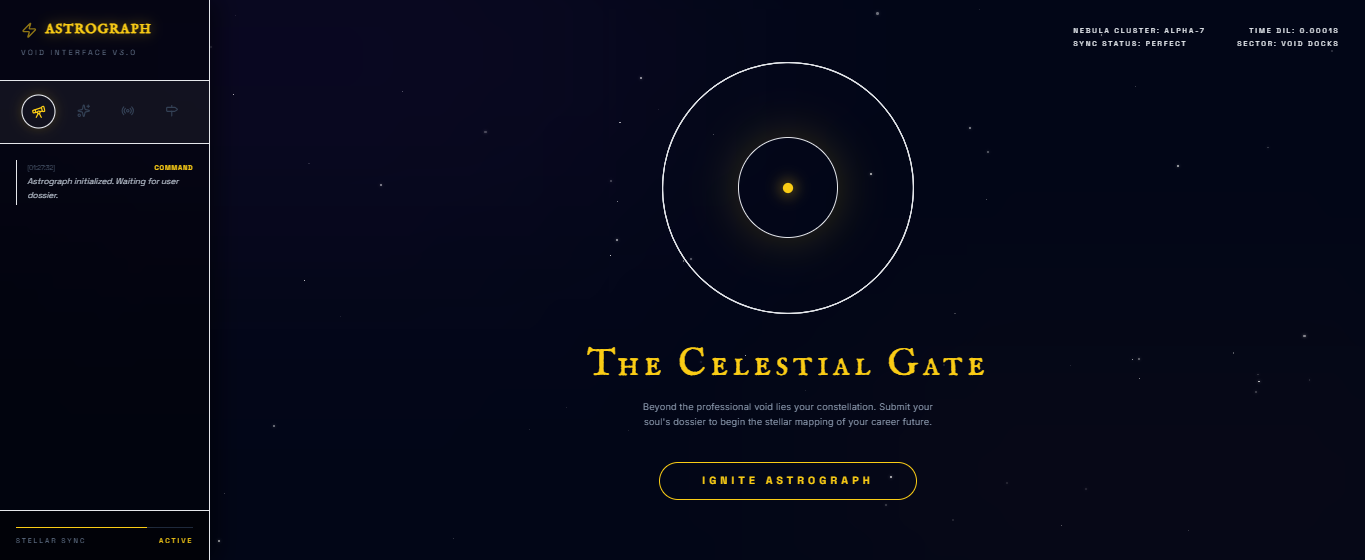
Traditional career planning feels like reading a technical manual for your own life. We observed a "Human Drift"—where professionals feel lost in a sea of generic job boards and clinical chatbots. We were inspired by ancient celestial cartography: just as early explorers used constellations to find their way through the dark, we wanted to help modern professionals find patterns in their skills to chart a unique course toward their future.
What it does
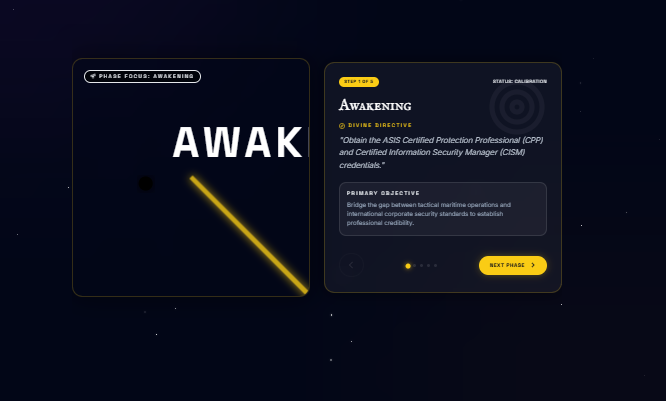
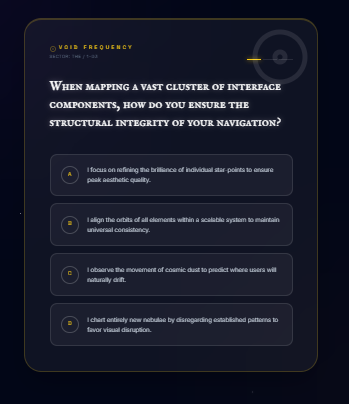
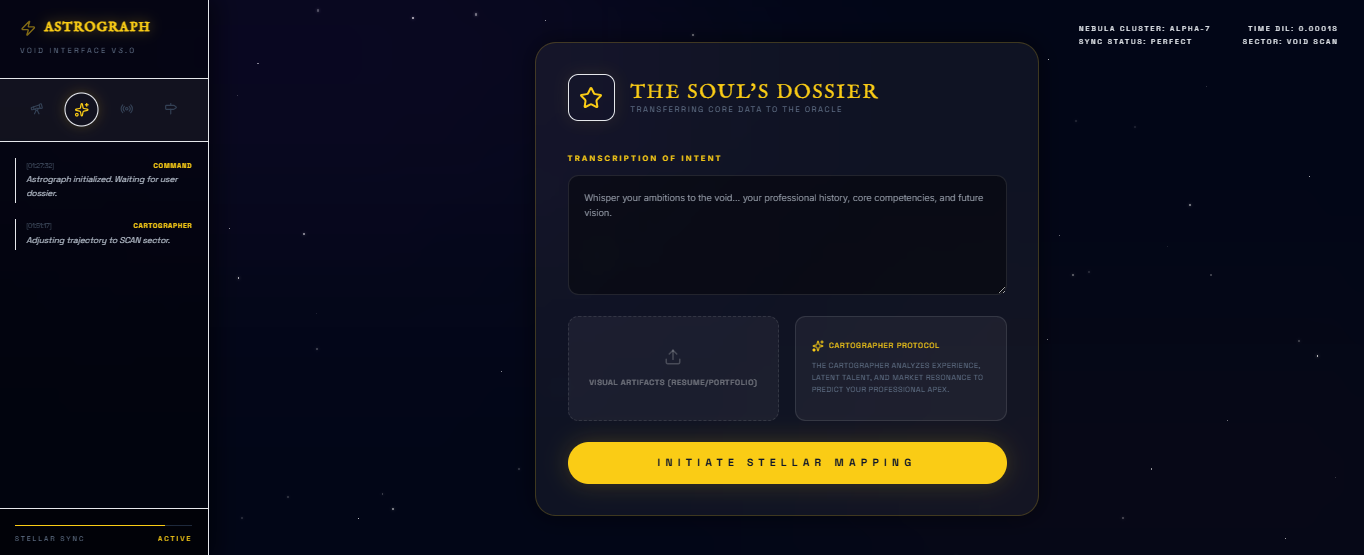
AstroGraph is an AI-native career architect that replaces static lists with high-fidelity celestial discovery. It uses Gemini 3 Flash to "read" the user’s professional gravity through:Multimodal Scans: Upload a photo of your desk, your bookshelf, or a sketch of your dream workspace to provide environmental context.Narrative Inquiry: Interactive, theme-based questions that test your reasoning (e.g., "A deep-sea lab crisis") which Gemini bridges back to real-world technical traits.Professional Constellations: The final output is a dynamic, SVG-rendered map where your milestones are "Stars" connected by glowing paths of professional growth.
How we built it
We bypassed third-party SDKs to build a direct, low-latency integration with the Gemini API.Framework: Next.js (App Router) for the core architecture.AI Engine: Gemini 3 Flash, utilizing Structured Output (JSON Mode) to ensure every response contains precise $x$ and $y$ coordinates for spatial plotting.UI/UX: Tailwind CSS for the obsidian-and-gold aesthetic, with Framer Motion for the "Zoom and Pan" starfield transitions.Vector Logic: We treated career milestones as nodes in a high-dimensional space, using Gemini to calculate the "distance" between your current skills and your "North Star" destination.
Challenges we overcame
Our biggest hurdle was Spatial Reasoning. We didn't want a chatbot; we wanted an artist. We had to iterate on our System Instructions to force Gemini to understand a 100x100 grid system, ensuring it could "draw" a logical path that didn't overlap or glitch. We also fought "Interview Fatigue" by fine-tuning the Celestial Navigator's persona to keep the user immersed in the nautical metaphor while still extracting high-value professional data.
Accomplishments that we're proud of
We successfully achieved Multimodal Grounding. Seeing the app correctly identify a "Site Reliability Engineer" archetype just by looking at a user’s messy desk (with its specific tech books and hardware) was a massive victory. We are also proud of the zero-latency feel—by utilizing Gemini 3 Flash, the "ink" appears on the parchment as fast as the user can think
What we learned
We learned that Interface is Logic. By skinning the app in an immersive, high-fidelity theme, users gave more honest, creative answers than they ever did on a standard form. We also learned that Gemini’s ability to handle structured JSON is its true "superpower" for developers, allowing us to treat AI as a data-generation engine rather than just a text-box.
What's next for AstroGraph
Long-Context Lifelogs: Integrating Gemini's 2M context window to allow users to upload their entire GitHub history or years of portfolio work for deep-dive analysis. Real-time Star-charts: Connecting to live job APIs to pull real "Coordinates" for actual open positions that match the user's constellation. Collaborative Galaxies: Allowing users to see where their "Stars" overlap with mentors or peers to form "Professional Nebulas."

Log in or sign up for Devpost to join the conversation.