Inspiration
What it does
# AstroData AI
## Inspiration
Astronomical observations contain valuable information, but turning raw telescope data into understandable evidence is difficult. Many students, citizen astronomers, and researchers must work with complex file formats, statistical methods, calibration procedures, and scientific software before they can interpret a light curve.
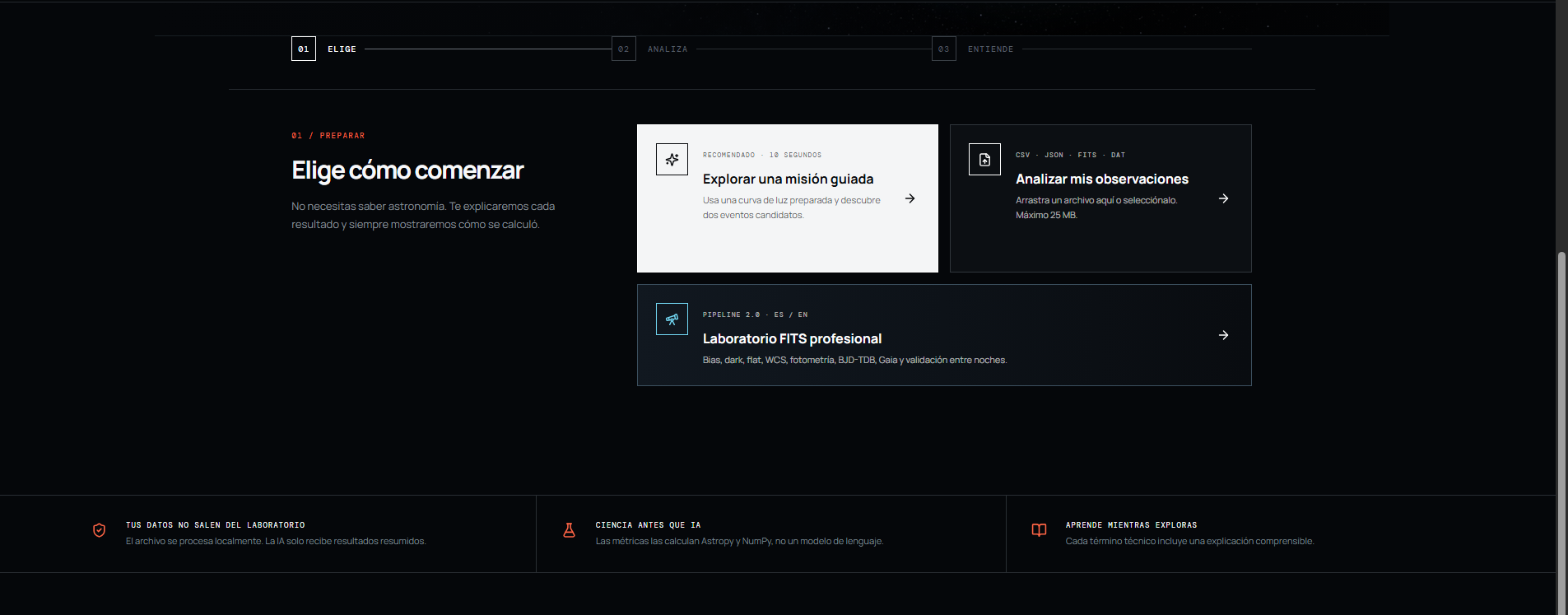
I created AstroData AI to make that process more accessible without sacrificing scientific responsibility. The goal is not to let generative AI invent discoveries, but to combine reproducible astronomical calculations with clear explanations.
## What it does
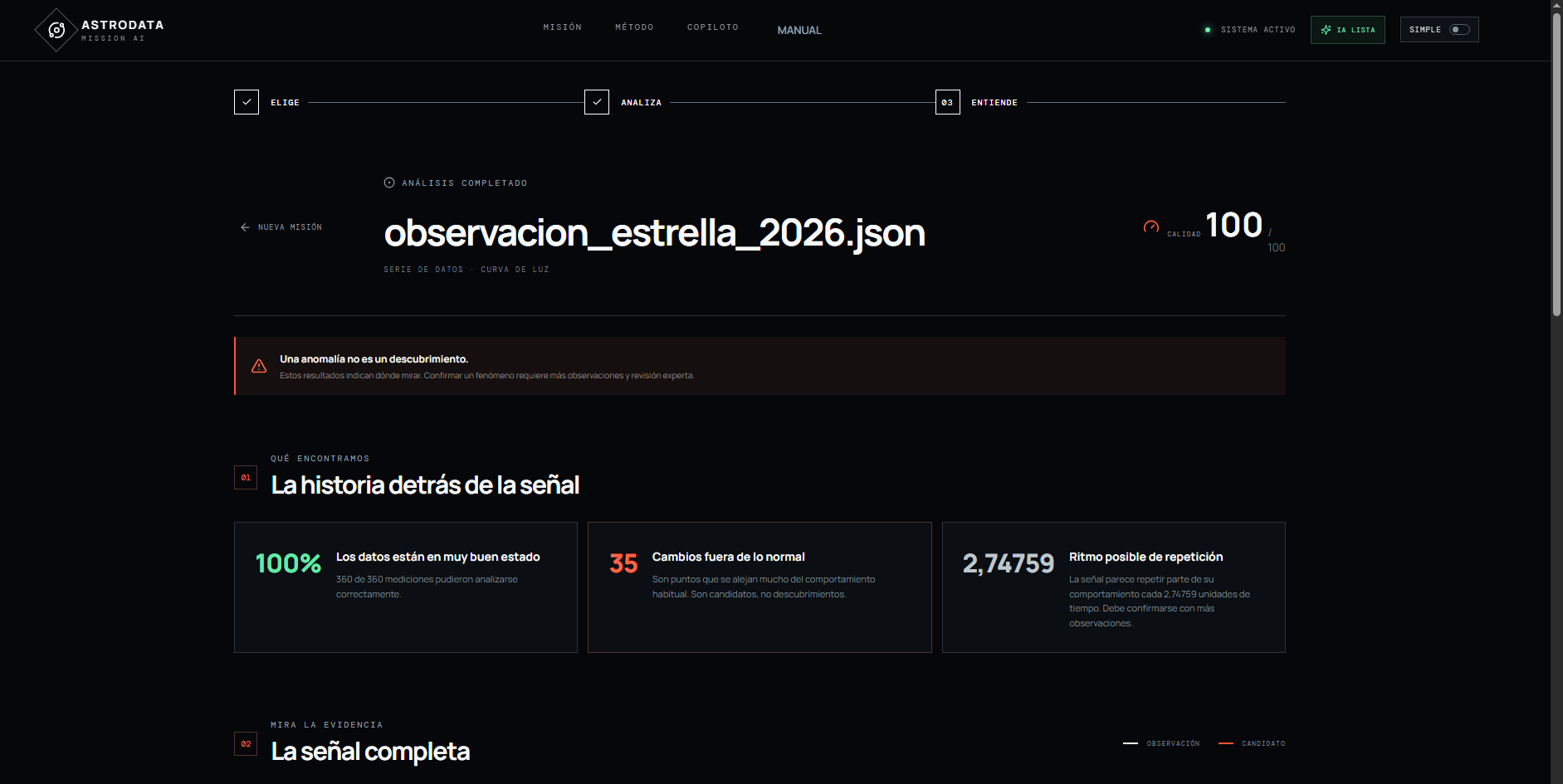
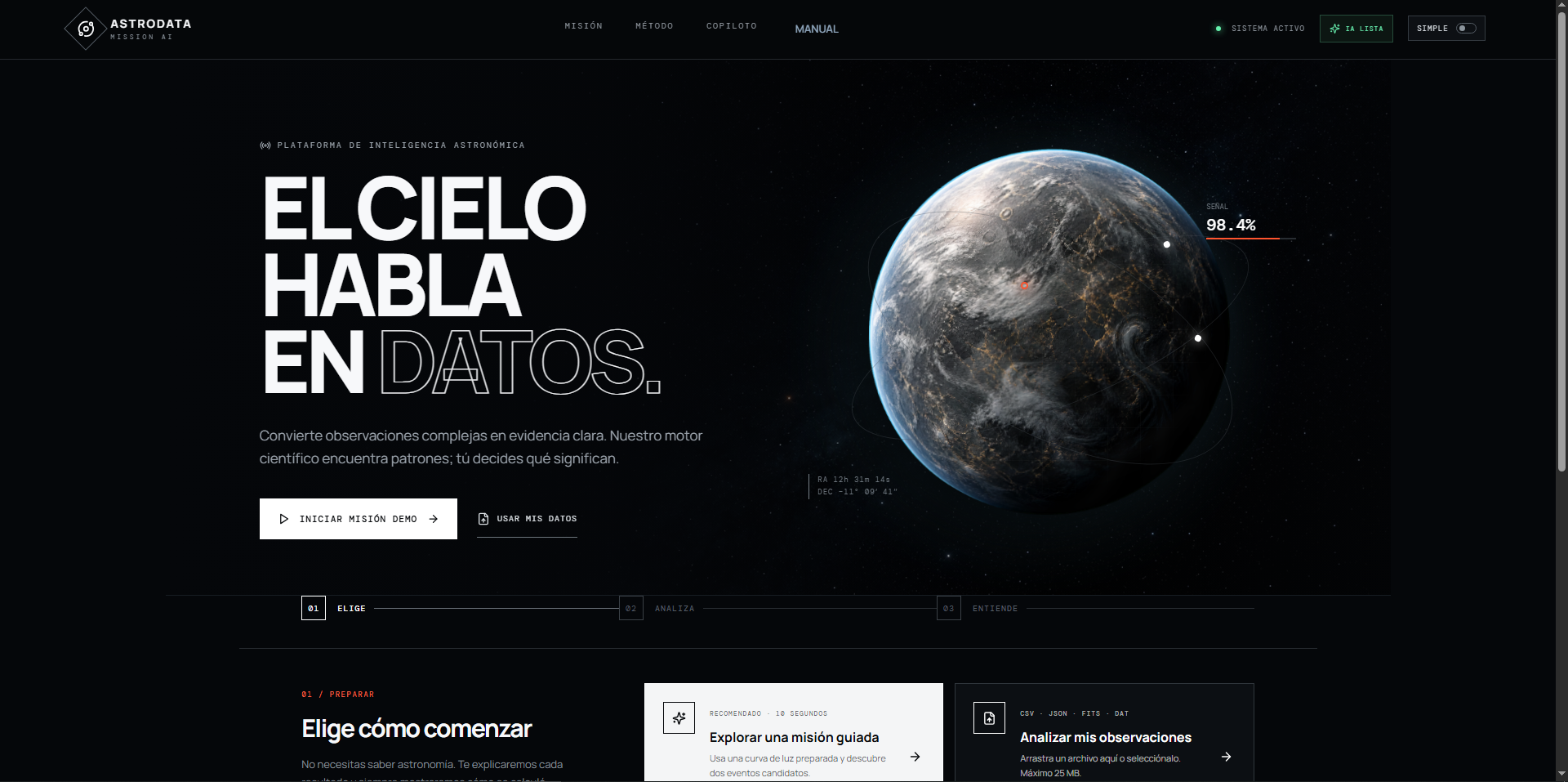
AstroData AI allows a user to upload telescope observations and follow the complete analysis through a visual, bilingual interface.
For time-series and light-curve data, the system performs:
- Schema and data-quality validation
- Missing-value and uncertainty checks
- Robust anomaly detection
- Lomb–Scargle periodicity analysis
- Box Least Squares transit detection
- Harmonic comparison and signal classification
- Phase-folded light-curve visualization
- Transit depth, duration, signal-to-noise, and event estimation
- Reproducible reports with file hashes and pipeline information
For FITS observations, the scientific workflow supports:
- Bias, dark, and flat calibration
- HDU selection
- Header and WCS inspection
- Two-dimensional star detection with Photutils
- Aperture photometry
- Uncertainty propagation
- Temporal and barycentric corrections
- Comparison-star analysis
- Astronomical catalog cross-matching
- Independent-observation validation guidance
A transit-like depth is calculated from the relative loss of light:
$$ \delta = \frac{F_{\text{out}}-F_{\text{in}}}{F_{\text{out}}} $$
The system also compares periodic models because the strongest Lomb–Scargle period is not always the physical orbital period. Box Least Squares is used to search specifically for box-shaped reductions in brightness.
## How I built it
AstroData AI uses a React and TypeScript frontend with a Python and FastAPI backend. Scientific calculations use tools such as Astropy, Photutils, NumPy, and SciPy.
The architecture deliberately separates two responsibilities:
- A deterministic scientific pipeline calculates the metrics.
- GPT-5.6 receives only a structured summary and explains the evidence in accessible language.
GPT-5.6 does not calculate anomalies or periods and does not receive the original uploaded file. Its output is validated through a structured schema and presented as an explanation, not as proof of a discovery. If the AI service is unavailable, the scientific analysis continues working.
Codex was used throughout development to help design the architecture, implement and review the frontend and backend, improve the scientific pipeline, create automated tests, diagnose integration problems, document the system, and prepare a reproducible testing path for judges. ## Challenges
One major challenge was distinguishing a statistically strong periodic signal from the correct physical interpretation. In the example dataset, Lomb–Scargle can favor a harmonic while Box Least Squares better represents the repeated transit-shaped events. Presenting both results prevents the interface from turning one statistical value into an unsupported conclusion.
Another challenge was making advanced concepts understandable without oversimplifying them. The interface separates calculated facts, interpretations, hypotheses, limitations, and recommended next actions.
FITS processing introduced additional challenges because astronomical images may contain multiple HDUs, incomplete metadata, different coordinate systems, and instrument-specific calibration requirements. The system therefore exposes processing details and validation status instead of hiding them behind a single AI answer.
## What I learned
I learned that trustworthy scientific AI requires more than connecting a model to an upload button. It requires deterministic calculations, uncertainty handling, provenance, validation rules, transparent limitations, and a clear boundary between evidence and interpretation.
I also learned that AI is most useful here as a communication layer. GPT-5.6 helps users understand the scientific results, while the reproducible pipeline remains the source of every numerical claim.
## Impact and future work
AstroData AI can help students learn astronomical data analysis, help citizen astronomers inspect observations, and help researchers perform an initial quality-controlled review before using specialized workflows.
Future work includes validating the pipeline against additional public telescope datasets, expanding catalog integrations, supporting larger observation campaigns, and comparing candidate events with independent instruments.
AstroData AI does not claim to discover a planet automatically. It identifies scientifically interesting candidates, explains why they deserve attention, and shows what must be verified next.
How we built it
Challenges we ran into
Accomplishments that we're proud of
What we learned
What's next for AstroData AI
Built With
- api
- astropy
- codex
- fastapi
- gpt-5.6
- openai
- photutils
- python
- react
- typescript


Log in or sign up for Devpost to join the conversation.