What inspired me
I’ve always been fascinated by how my biggest life events seemed to align with planetary movements. It wasn’t just coincidence—it felt like timing had a logic of its own. But astrology tools often felt either too vague or too complicated.
I wanted to build something different. A tool that would make planetary motion visible, interactive, and precise. Something that lets people explore time—past and future—and understand when things align in their lives. That’s how the idea for this app came: to turn timing into a living, accessible experience.
What it does
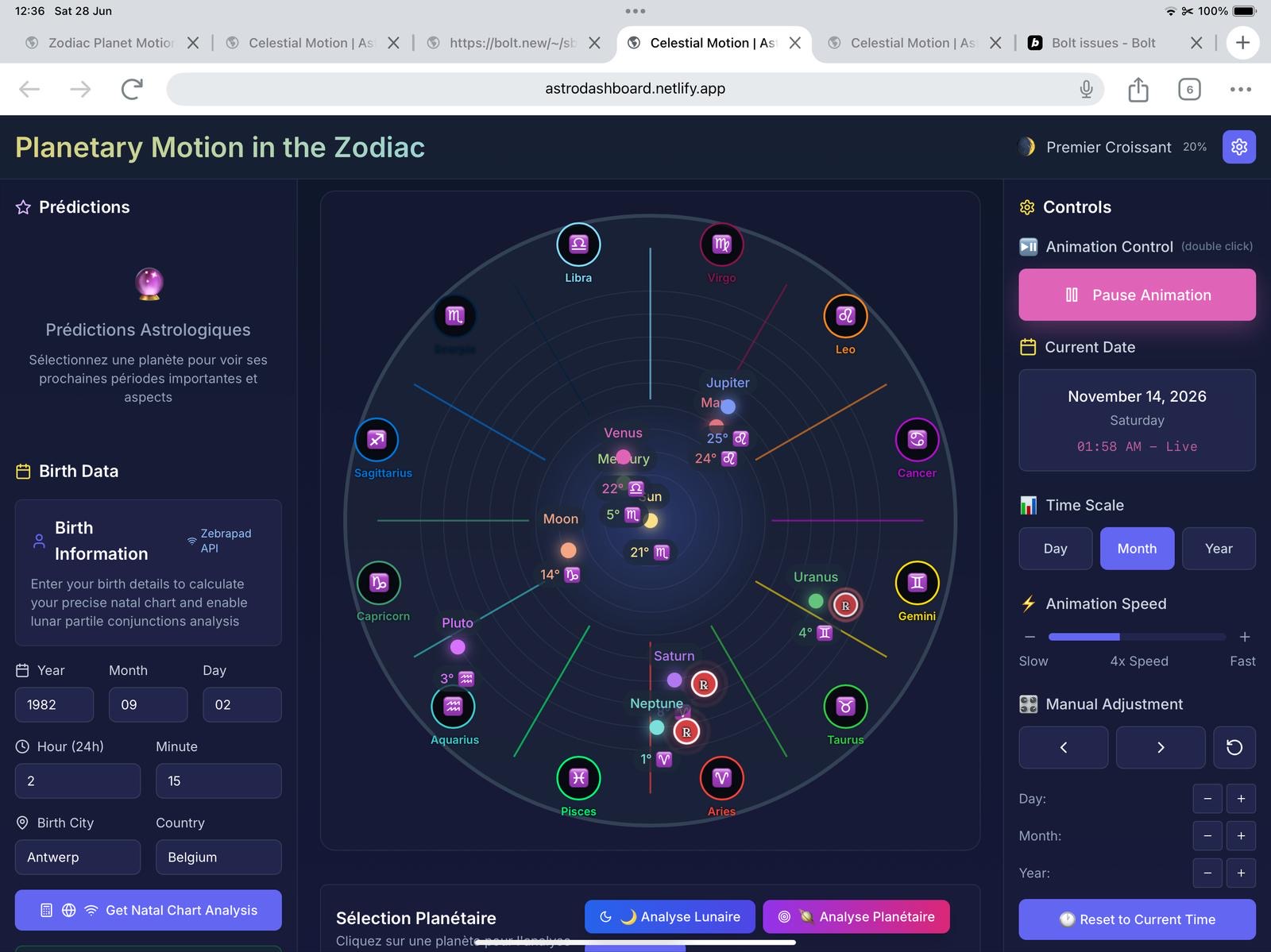
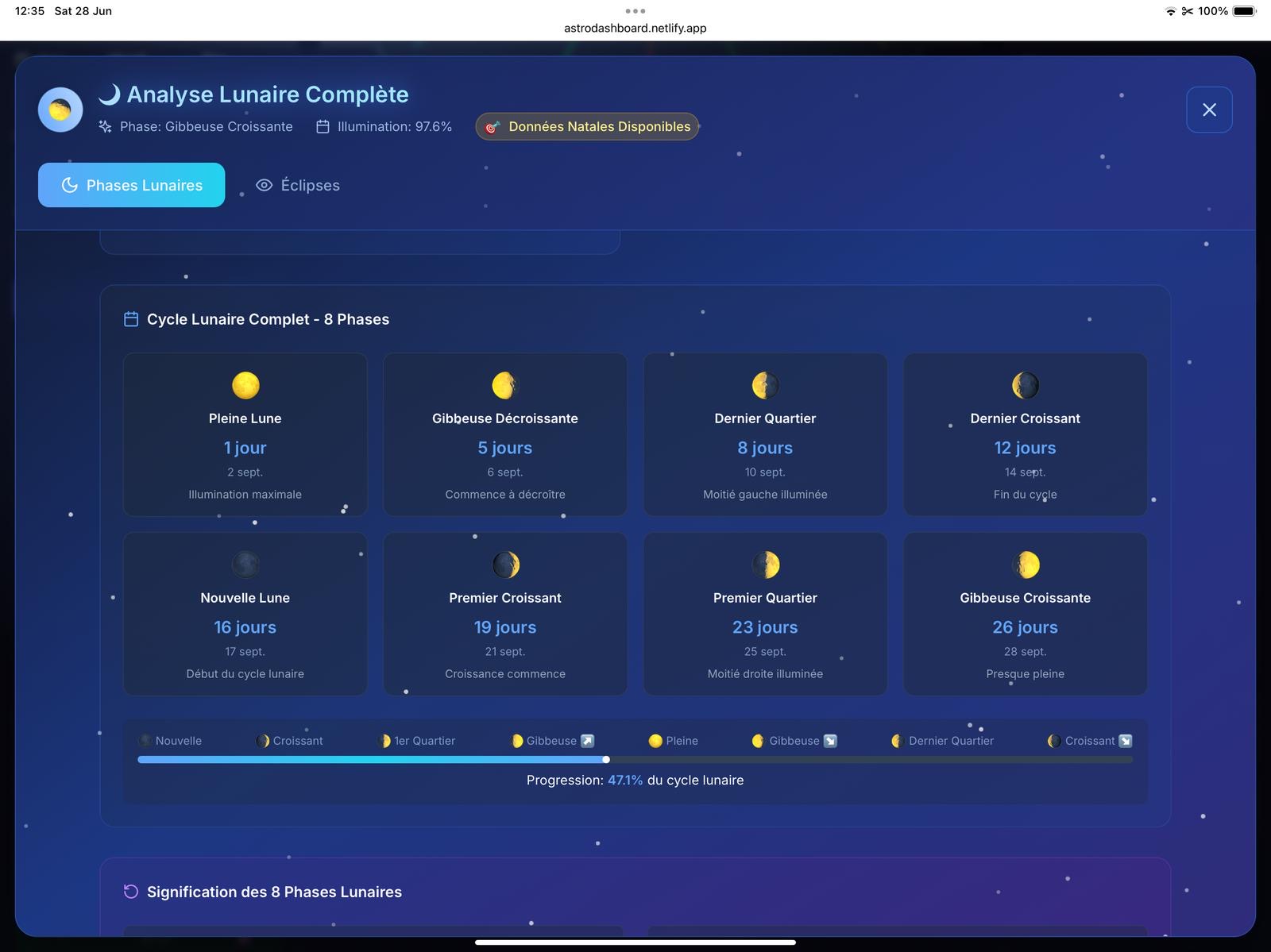
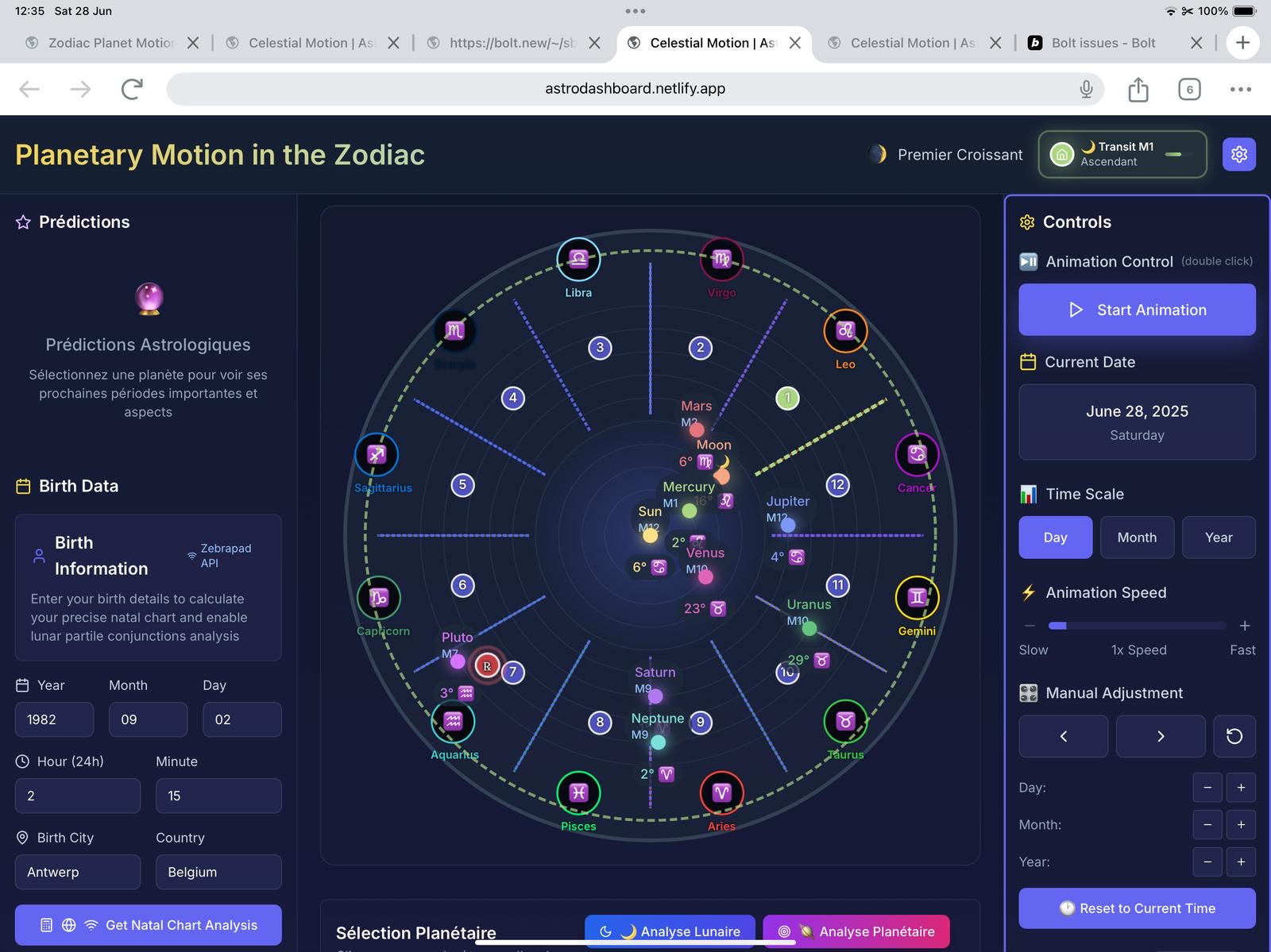
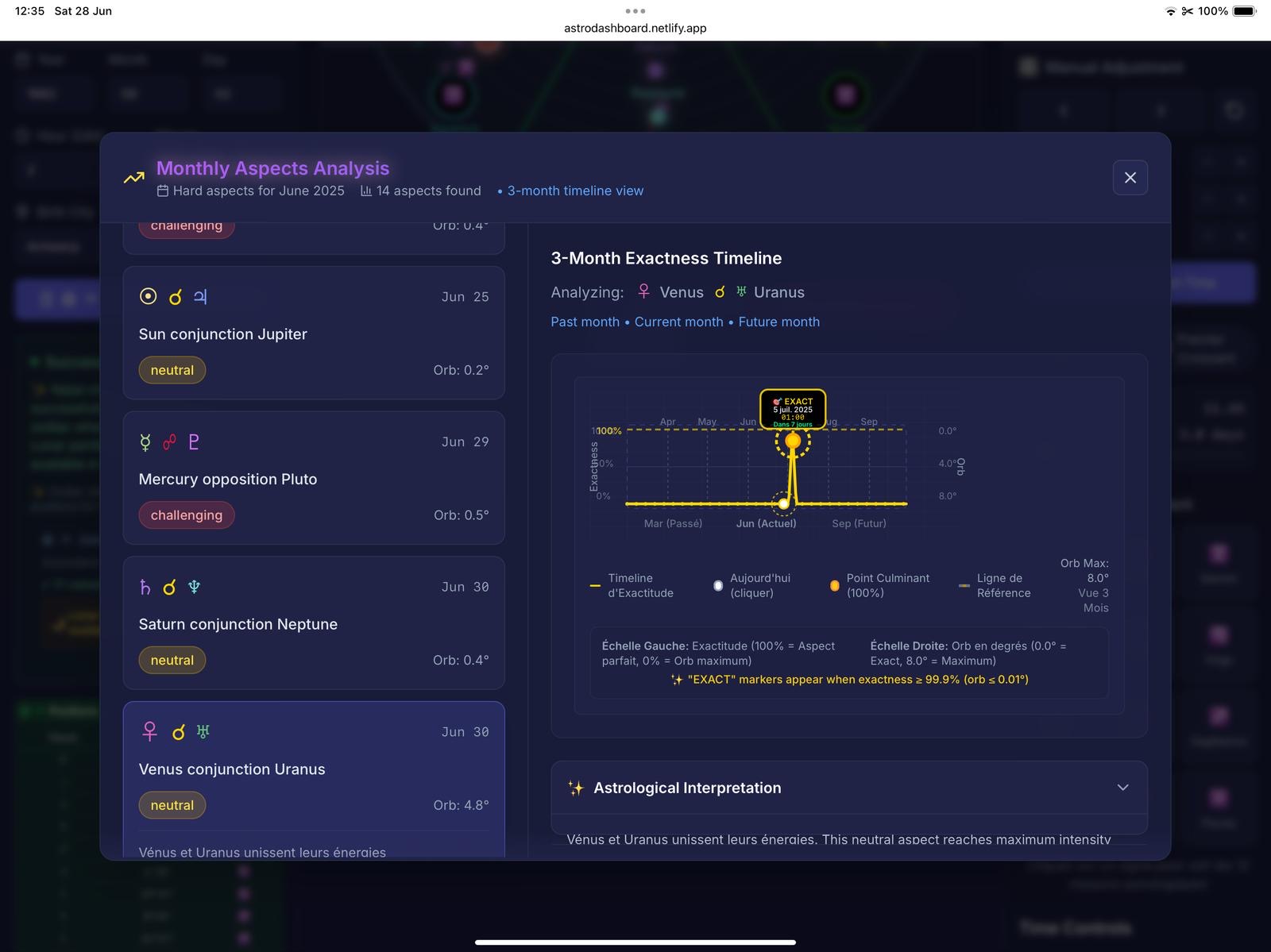
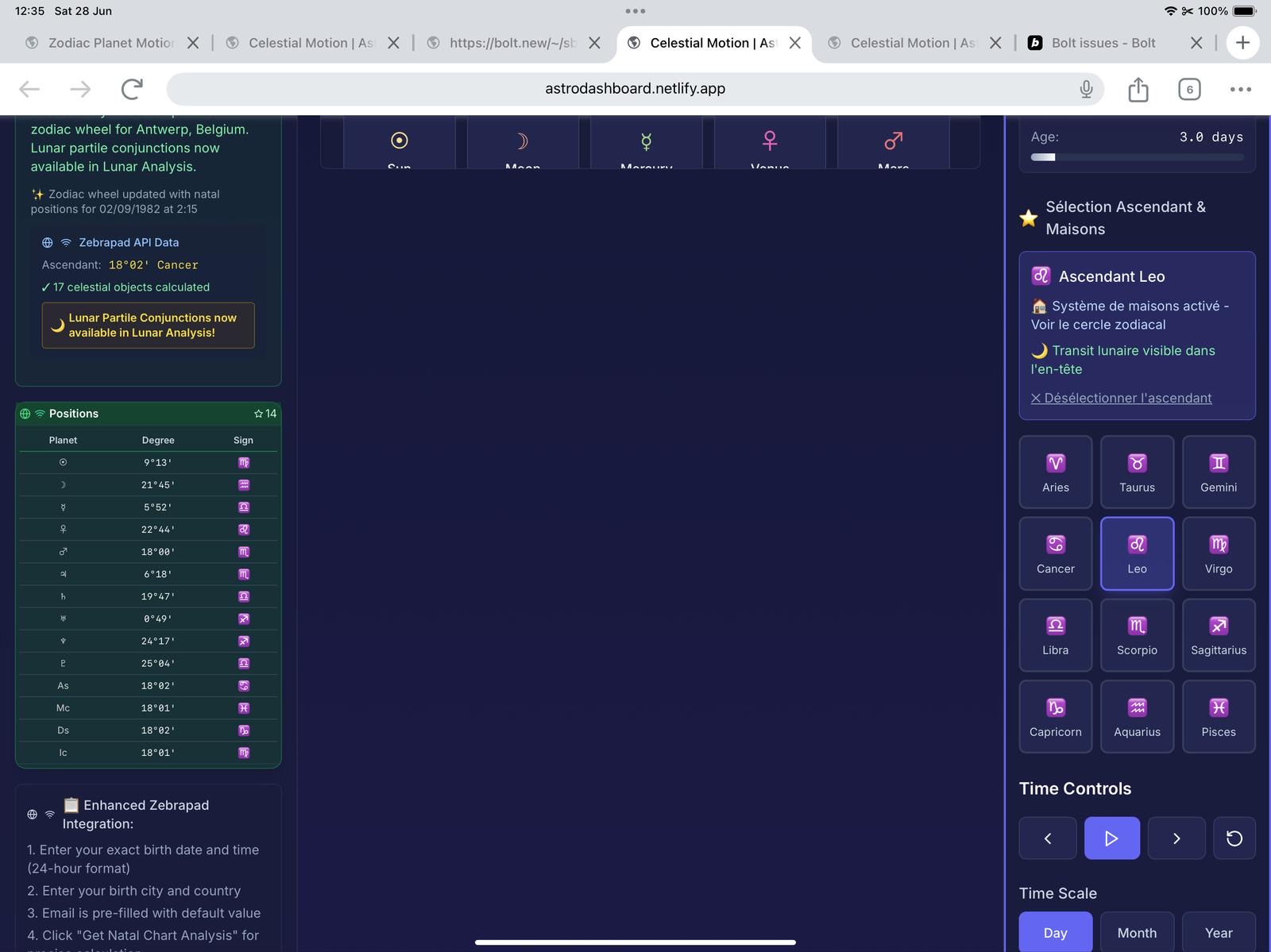
The app lets users explore planetary motion in real time. You can watch the planets move, see when they form exact aspects, and follow the Moon phases with precision.
It also allows you to travel through time, from your birth (or even before) to far into the future and instantly spot key alignments. Each tab in the interface gives you a specific insight: exact aspects, Moon transits, and house activation.
Everything is calculated on-the-go and visual, so you don’t need to interpret complex charts. It’s a dynamic astrology dashboard where you can test dates, validate timing, and navigate life with more clarity.
The app transforms astrology into something concrete: a tool for understanding when to act, reflect, or realign.
How I built it
I built this project feature by feature.
At the beginning, I used prompts to test ideas and interface logic. But I quickly realized that Bold couldn’t handle certain libraries I needed, and that some astrological calculations lacked precision, especially when it came to positions of angles, which are critical in predictive astrology.
So I wrote my own code in Python to calculate planetary positions, and mostly degrees of angles using the Swiss Ephemeris. Once my scripts were ready, I turned them into APIs.
Then I integrated those APIs directly into Bold. Bold successfully recognized the endpoints, parsed the JSON responses, and displayed exactly what I needed in the interface. It became a clean combination of custom Python logic for accuracy and Bolt for the frontend interface.
This architecture allowed me to get the best of both worlds: the precision and flexibility of backend code, and the speed and clarity of visual development.
Challenges I ran into
One of the biggest challenges was that, as the app grew, it became very heavy. Over time, each new modification or test slowed things down—sometimes to the point of crashing the system or triggering out-of-memory errors.
In several cases, I asked Bolt to generate complex features, and it ended up breaking or rewriting other parts of the app that were already working. I also encountered bugs that would repeat multiple times in a row, even after applying corrections.
Another issue was with version control and reverts. Sometimes, when I asked for a rollback, it didn’t fully restore the previous working state, which created additional layers of debugging.
Eventually, I learned to work differently. Since discovering the discussion layout, I started editing directly in the code whenever possible, instead of relying on full prompts that ask Bolt to rewrite large sections. That gave me more stability and control.
Looking ahead, I know I want to build my next apps more modularly-feature by feature, tested and locked-before combining everything into a larger system. That will help me avoid heavy loads and reduce friction when iterating.
Accomplishments that I am proud of
This is the app I had always dreamed of, something I could use myself to do astrology consults on-the-go. A tool that’s visual, animated, and accessible from anywhere. Not a desktop software like Solar Fire or Astrogold, but a modern web app that shows real-time transits, with motion and clarity.
Even though other tools exist, this one is truly mine. It reflects how I think and work with astrology. And what I’m most proud of is that, with just one well-written prompt, I was able to bring to life exactly the interface I had in mind. That still feels magical.
I’m also really happy that I managed to integrate my own APIs into Bolt. It reminded me of the power of owning your backend logic, being able to reuse the systems I’d already built, and plug them into something new. This made the app not only beautiful, but deeply functional and scalable.
This project represents a personal and technical milestone. I now have a custom astrology app that I can evolve, improve, and actually use both for myself and others.
What I learned
One of the key things I learned was how to connect my own APIs to a frontend interface. Writing the endpoints wasn’t new for me, but seeing them work inside a visual app like this, and being able to call them directly from Bolt, opened up a new level of integration and control.
I became more precise in the way I prompt, thinking more step by step, feature by feature, rather than trying to build everything at once. That made the process more stable and more strategic.
More recently, I discovered the value of the discussion-first approach. Instead of giving a single prompt to generate a full feature, I started brainstorming, testing ideas, and tweaking the code manually when needed. This hybrid workflow gave me both flexibility and precision, and saved me tokens!
It also gave me new ideas. I now see how I can scale this further, by generating content databases, building personalized logic into my backend, and animating that data on a well-structured, documented frontend. This project became a place where I could bring together my skills in data, content, and design in one living, scalable system.
What's next for Astrodashboard
The next steps are focused on having a greater responsive app and add personalization and interaction.
First, I want to align all language content to ensure clarity and consistency across the interface. Then, I’ll focus on perfecting the frontend design, making the app fully responsive on both desktop and mobile. Eventually, I aim to release it as a native mobile app as well.
I’m also planning to introduce a premium user experience, unlocking deeper insights, additional views, and saved profiles.
One major feature in development is an Astro chatbot. It will guide new users, especially those with little or no background in astrology to ask meaningful questions, explore their timing, and see the app animate live interpretations based on proven techniques.
The goal is to make the experience smart, intuitive, and personal, so that every user, no matter their level, can explore astrology in a way that feels both magical and useful.

Log in or sign up for Devpost to join the conversation.