AstroComply AI: Project Story Inspiration With the exponential rise of commercial space constellations like SpaceX's Starlink and OneWeb, Earth’s orbits are becoming increasingly crowded. Today, there are over 10,000 active satellites in orbit, with tens of thousands more planned. However, the space regulatory approval process—managed by agencies like the UN, ITU, and ESA—is stuck in the past. It relies on slow, manual evaluations of unstructured PDFs, leading to licensing bottlenecks and safety risks.
We were inspired to build AstroComply AI to bridge the gap between rapid commercial space expansion and rigorous safety oversight. Our goal was to create an autonomous, secure, and fully governed compliance control plane that accelerates space mission licensing from weeks to seconds, using UiPath as the end-to-end execution layer.
What it does AstroComply AI is an autonomous space licensing and regulatory approval platform. It automates the entire lifecycle of a satellite launch application:
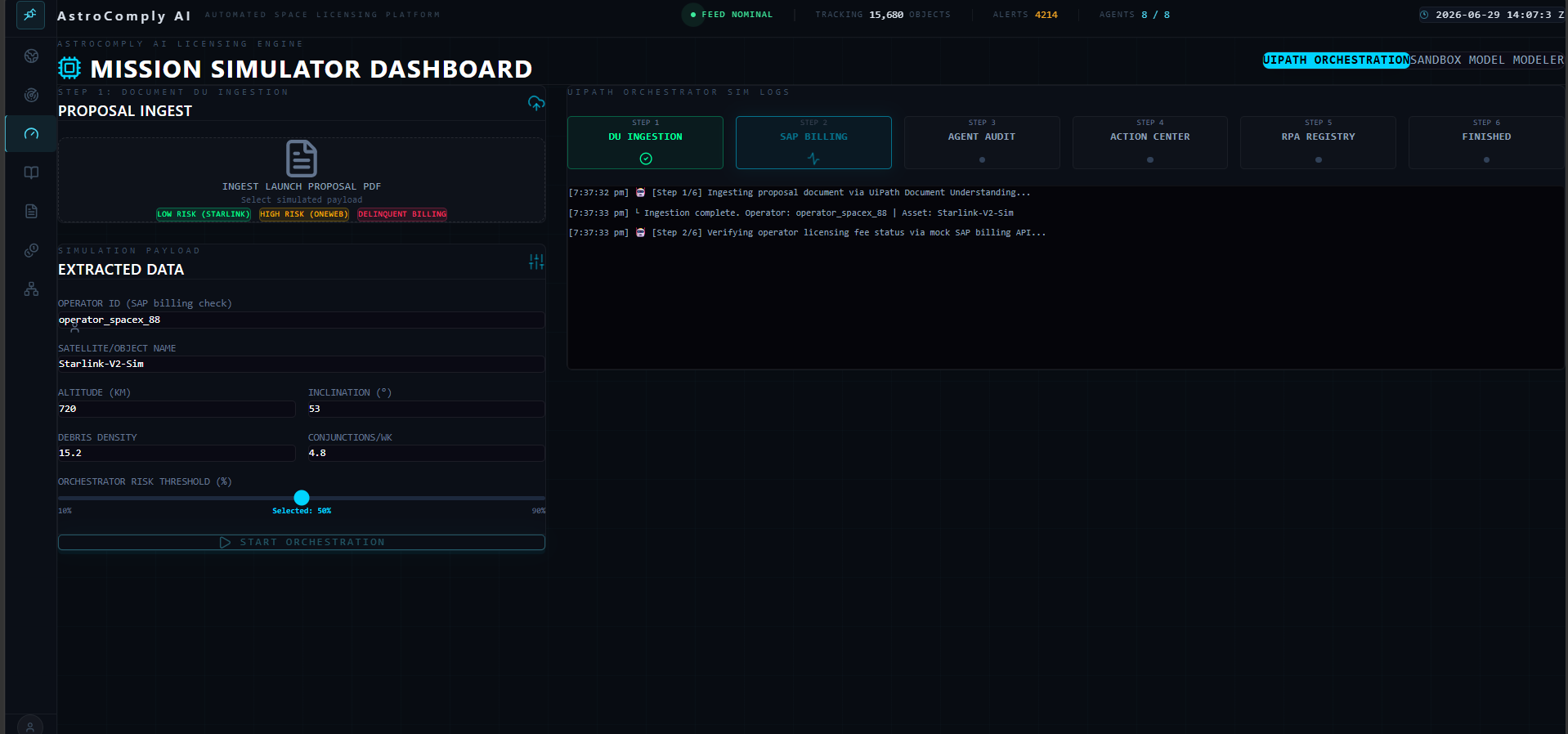
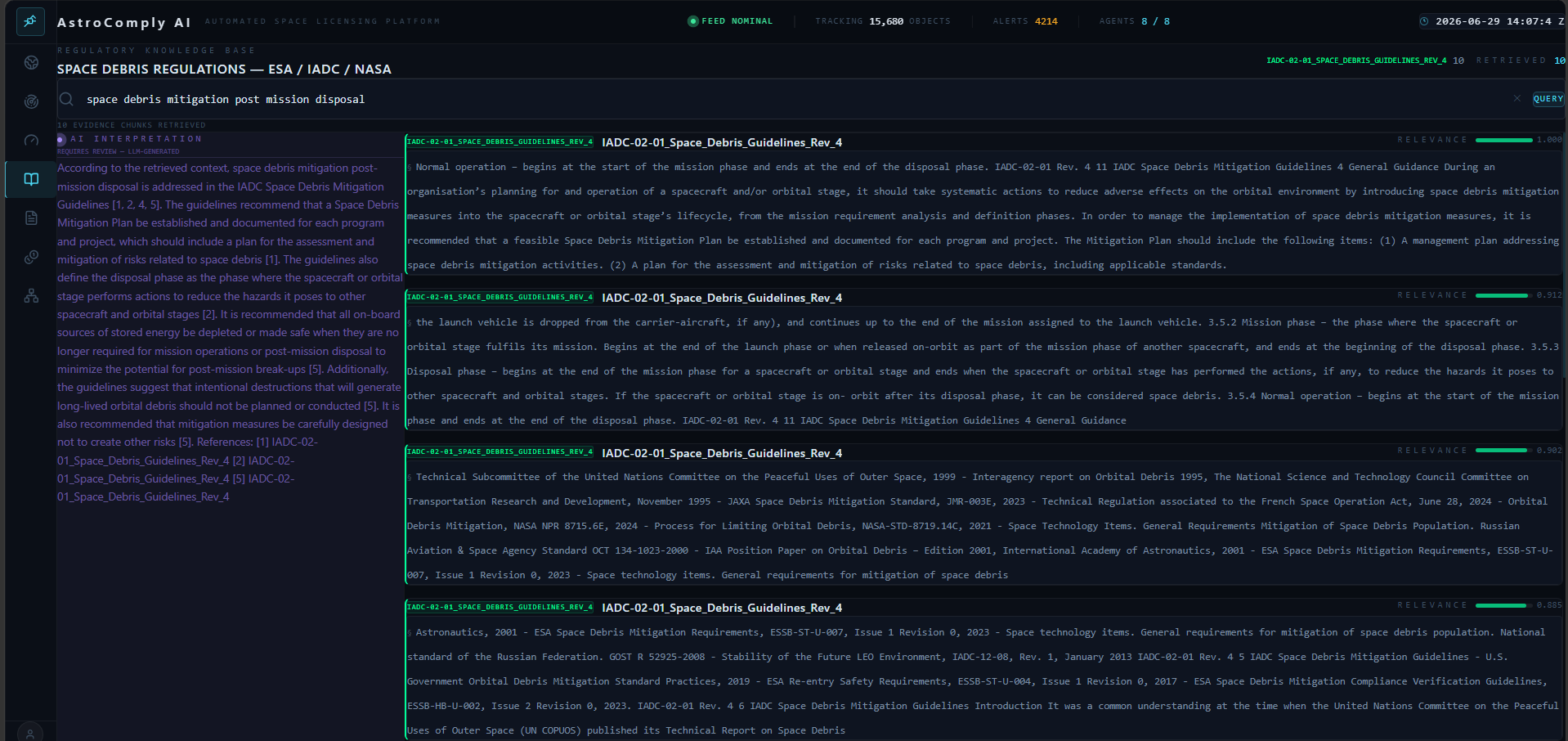
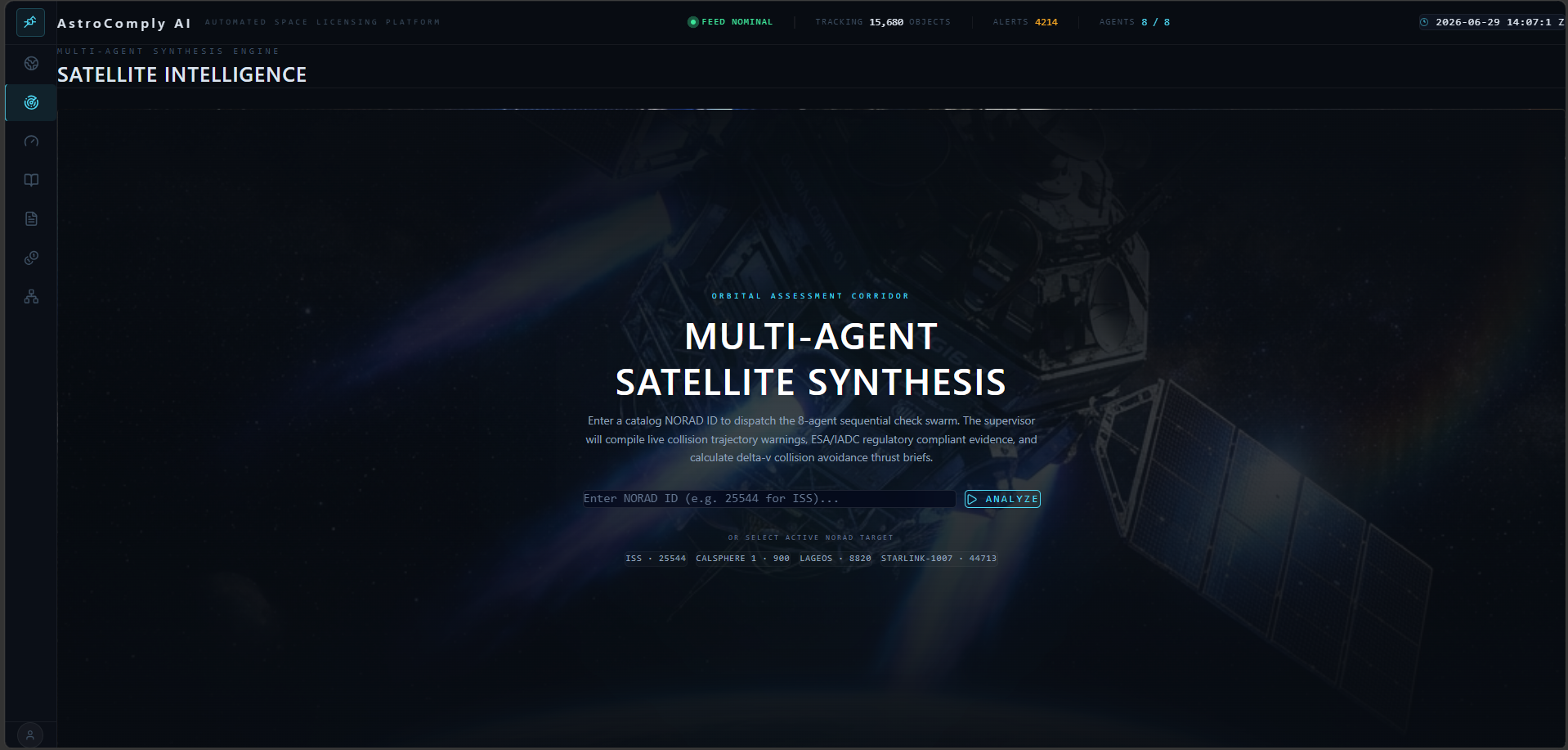
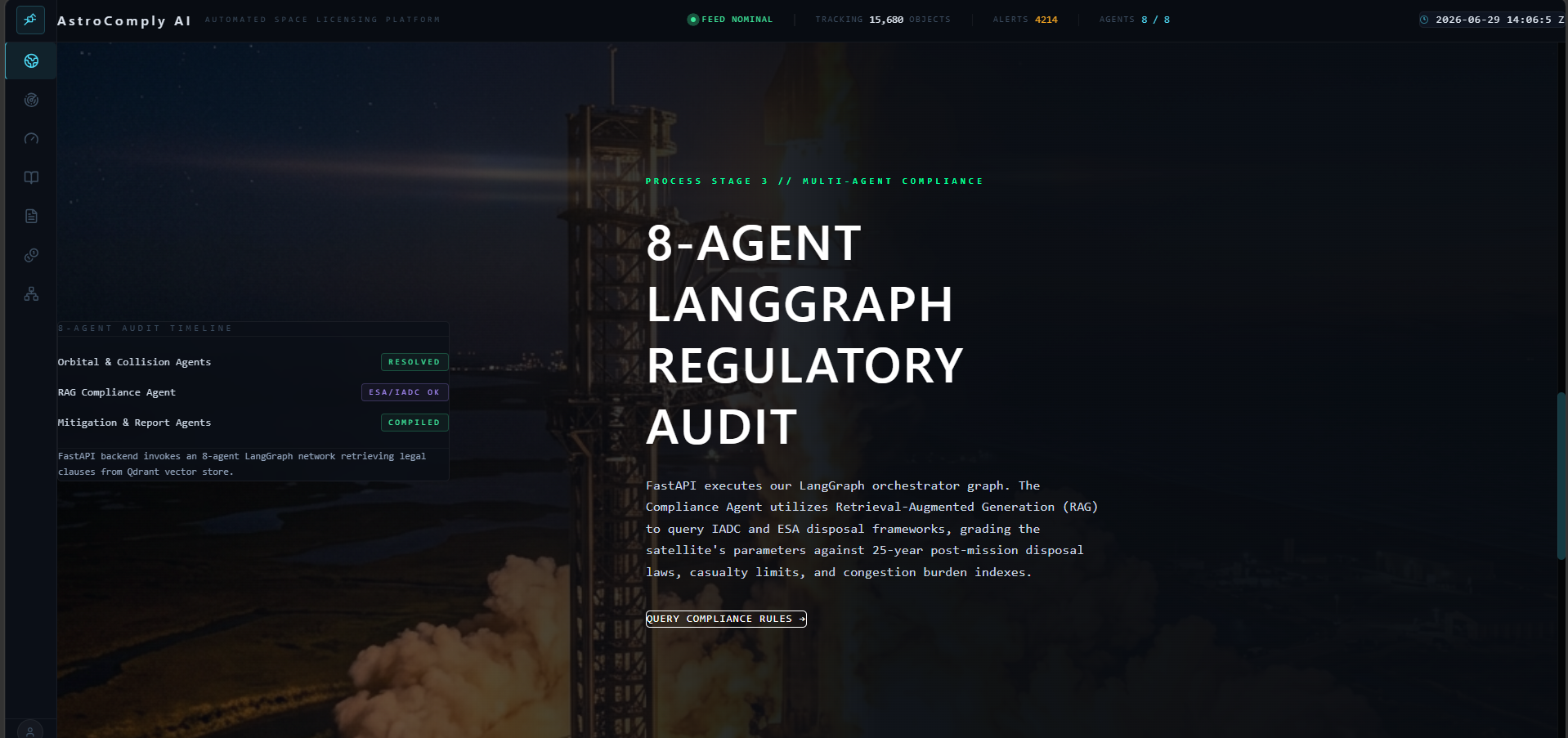
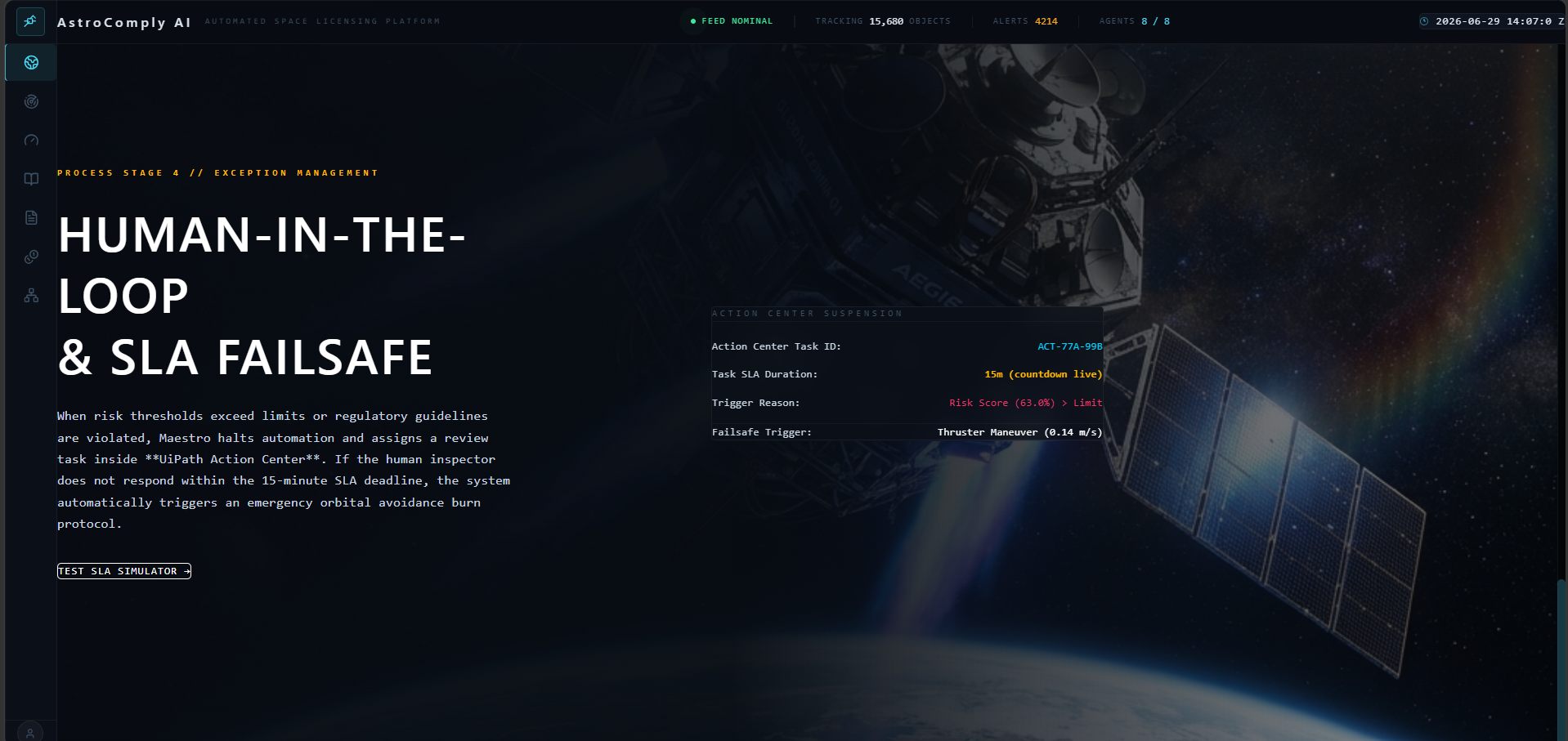
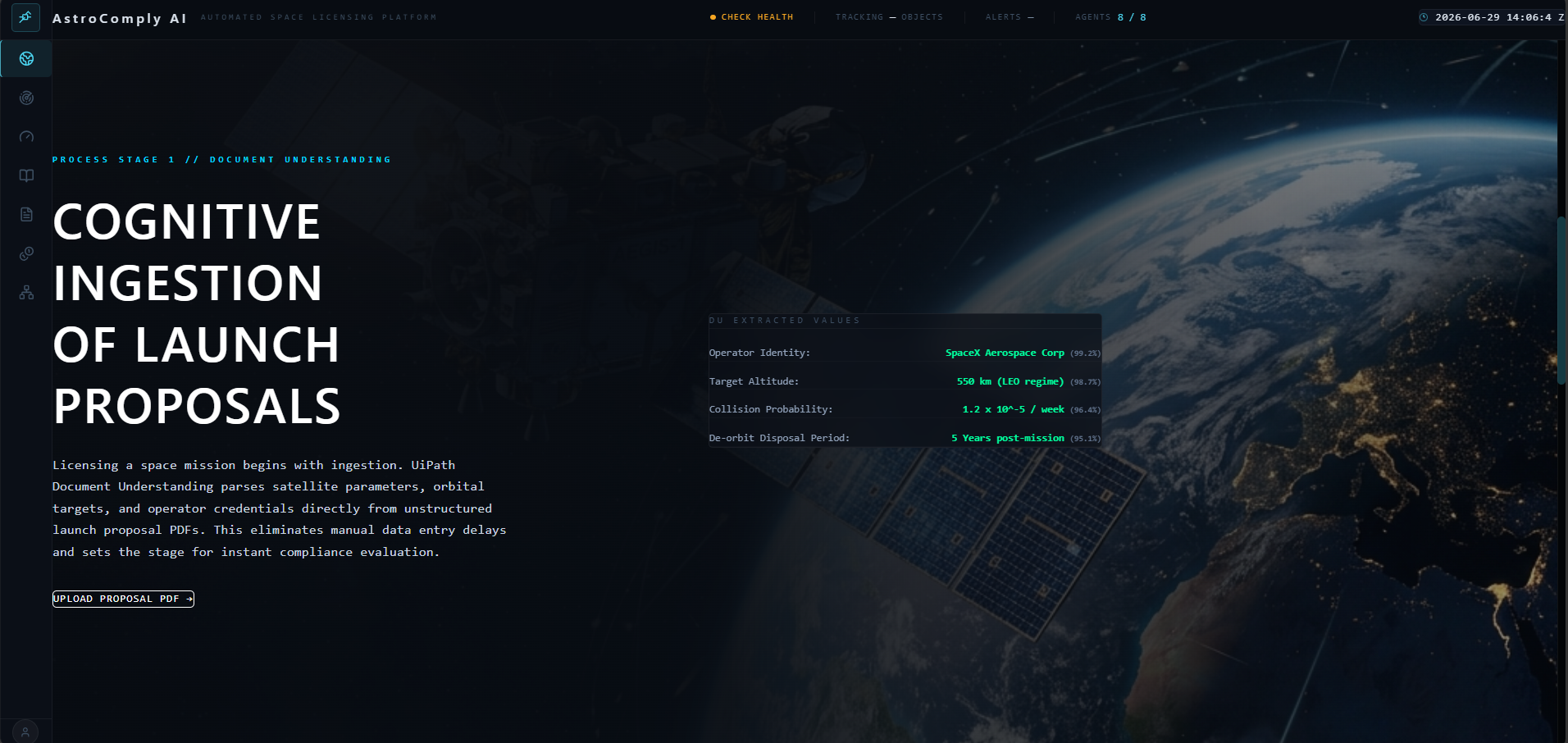
Cognitive Ingestion: Uses UiPath Document Understanding to parse unstructured launch proposal PDFs and extract target orbital parameters (Altitude, Inclination, Eccentricity, and Operator ID). Financial Verification: Automatically queries mock billing APIs to verify that operator licensing fees have been paid. Multi-Agent Compliance Auditing: Invokes an 8-agent LangGraph network. The agents perform Retrieval-Augmented Generation (RAG) against international space laws (like the ESA and IADC frameworks) stored in a Qdrant Vector Database. Collision Risk Modeling: Calculates the collision probability over a set time horizon based on the spatial density of space debris and relative velocity. It also verifies that the satellite complies with the standard 25-year post-mission de-orbit disposal rule. Human-in-the-Loop Governance: If the calculated risk score exceeds a configurable safety threshold of 50 percent or active violations are found, UiPath suspends the workflow and creates a review task in UiPath Action Center. If the 15-minute SLA is breached, an automated emergency avoidance protocol is triggered. Official Asset Registration: Once approved, a UiPath RPA bot registers the new space asset in the database. How we built it AstroComply AI is built on a modern, decoupled cloud architecture:
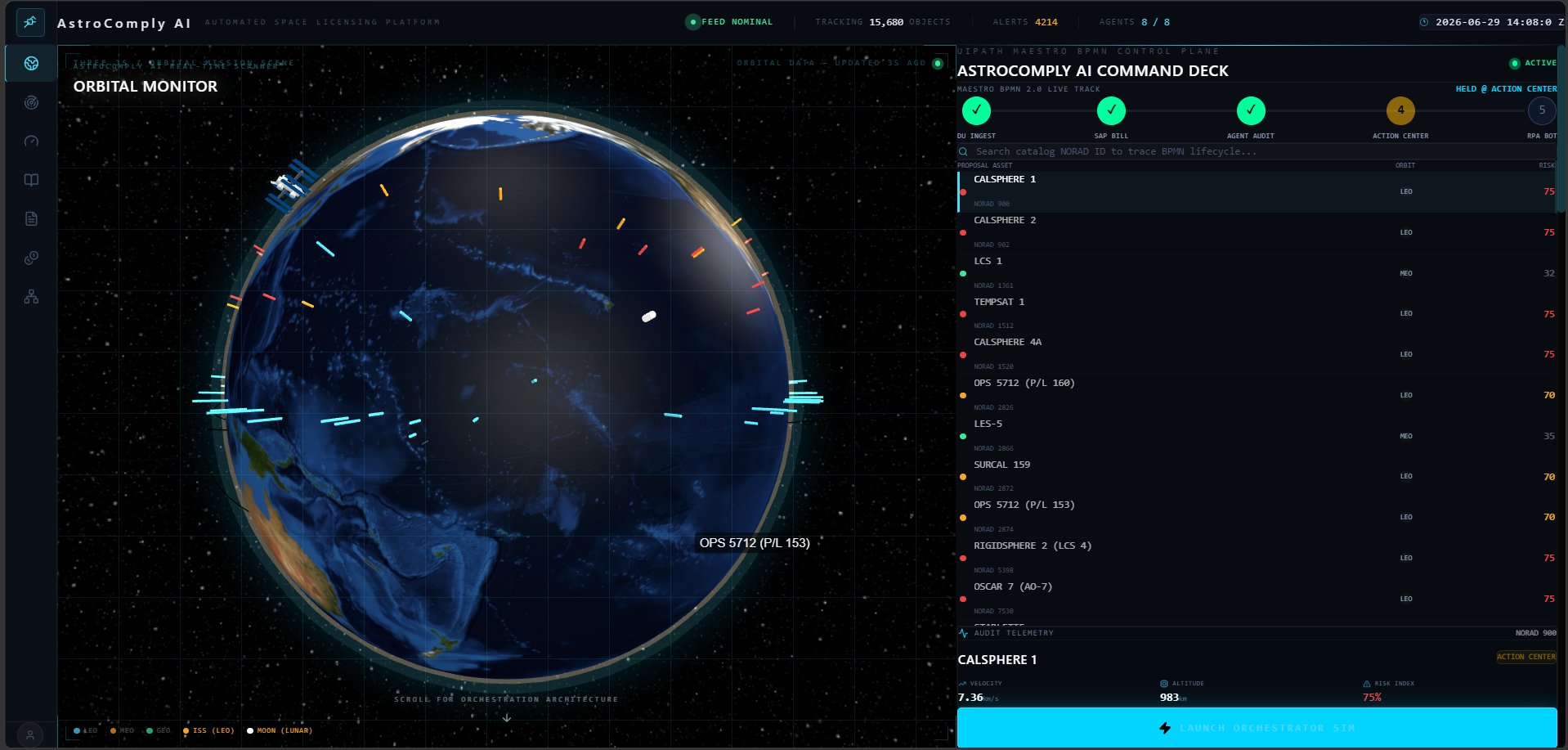
Orchestrator Control Plane: Managed natively on UiPath Automation Cloud using Maestro BPMN to design the visual process steps, Document Understanding for extraction, and Action Center for human exception reviews. Agentic Intelligence: Built using LangGraph and Groq (Llama 3.3 70B), coordinating 8 specialized agents (Collision Agent, Debris Agent, RAG Compliance Agent, etc.) to review proposals. Vector Database: Qdrant Cloud stores the embedded regulatory documents for semantic compliance matching. Relational Database: Neon Serverless PostgreSQL hosts telemetry and audit logs. Backend API: FastAPI (Python) acts as the connector between the UiPath cloud orchestrator and the LLM models. Frontend Control Deck: A Next.js 14 app hosted on Vercel displaying a WebGL 3D Globe (via Globe.gl) that renders satellite orbits and real-time compliance steps. Challenges we ran into Database Write Latency: Initially, our migration script tried to insert all 9,000+ active satellites from the CelesTrak database sequentially. Over a remote cloud connection to Neon Postgres, this resulted in thousands of round-trips taking over 45 minutes. We resolved this by limiting the seeding script to 150 core satellites to keep the 3D visualizer dynamic while optimizing the database transactions. UiPath XAML Compatibility: When we imported our desktop-built XAML workflows, the UiPath cloud compiler failed due to desktop-specific dependencies. We overcame this by recreating the process flow using native, cross-platform cloud activities in UiPath Studio Web—enabling serverless execution. Multi-Agent State Synchronization: Ensuring that the compliance and safety agents could pass structured evaluation data and flags asynchronously without losing context during a live run. Accomplishments that we're proud of End-to-End Cloud Live Sync: Successfully connected our Next.js frontend (Vercel), FastAPI backend (Render), PostgreSQL (Neon), Qdrant Cloud, and UiPath Automation Cloud. A trigger in UiPath immediately propagates data to our WebGL dashboard! Aesthetic 3D Dashboard: Built a premium, dark-mode dashboard that visualizes real-time orbits, telemetry graphs, and live BPMN status steppers. Serverless Execution: The entire UiPath orchestration runs serverless in the cloud, requiring zero local runtime configurations. What we learned How to leverage UiPath Maestro BPMN as a governance layer for autonomous LLM agents (LangGraph), ensuring AI decisions are bound by strict business rules and human checks. The mechanics of orbital analytics, including semi-major axis calculations, inclination angles, and spatial collision density calculations. What's next for AstroComply-AI Space-Track API Integration: Connect our ingestion logs to real-time space debris feeds to calculate active conjunction alerts. Multi-Nation Portals: Adapt the compliance agents to review country-specific space licensing standards (like FCC in the US and ESA in Europe) automatically based on launch location. RPA Registry Bots: Build actual RPA desktop bots that automate the login and filing processes for the United Nations Office for Outer Space Affairs (UNOOSA) registry.
Built With
- css3
- fastapi
- git
- globe.gl
- groq
- html5
- javascript
- langchain
- langgraph
- neon-postgresql
- next.js
- qdrant-cloud
- react
- render
- sqlalchemy
- tailwindcss
- three.js
- typescript
- uipath-action-center
- uipath-automation-cloud
- uipath-document-understanding
- uipath-maestro-bpmn
- vercel
- webgl


Log in or sign up for Devpost to join the conversation.