Inspiration
What it does
How we built it
Challenges we ran into
Accomplishments that we're proud of
The Problem
Astronomy is filled with extraordinary questions, but the data behind those questions can feel inaccessible to students without advanced scientific training or expensive laboratory resources. Many students hear about exoplanets, potentially habitable worlds, and the possibility of life beyond Earth without getting the opportunity to investigate the evidence themselves.
Our Idea
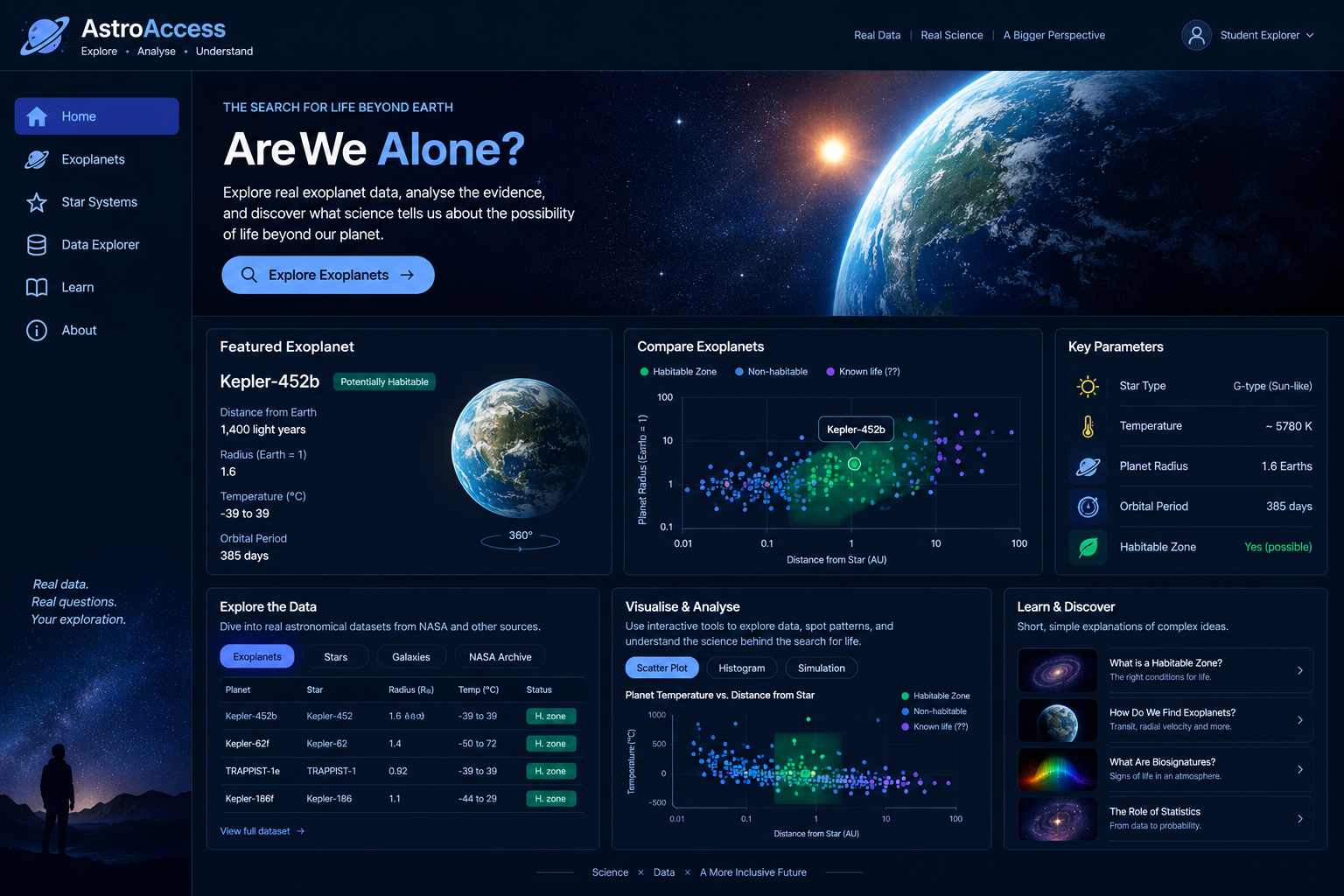
AstroAccess is an interactive educational platform designed around one of humanity's biggest questions: Are we alone?
Instead of simply presenting an answer, AstroAccess turns the question into a scientific investigation. Students can explore real astronomical data, compare exoplanets, examine properties such as orbital distance and temperature, visualize habitability concepts, and use basic statistical reasoning to understand how scientists evaluate evidence.
Why I Created It
My interest in astrophysics began with questions about how the Universe works and gradually developed into working with astronomical data and statistical analysis. That experience taught me that the most interesting part of science is often not memorizing an answer, but understanding how evidence leads us toward one.
I wanted to create something that could give other students the opportunity to investigate a real scientific question themselves.
How It Works
The proposed platform combines:
- Real public astronomical datasets
- Interactive data visualizations
- Exoplanet and stellar-property comparisons
- Basic statistical analysis
- Habitability-focused educational explanations
- Uncertainty-aware scientific reasoning
AstroAccess does not claim to detect extraterrestrial life. Instead, it teaches users how scientists distinguish evidence, probability, uncertainty, and speculation.
Challenges
One of the biggest challenges is avoiding scientific oversimplification. Habitability cannot be determined by a single number or condition. AstroAccess therefore presents scientific conclusions as evidence-based assessments rather than definitive answers.
Another challenge is accessibility: complex astronomical concepts should remain scientifically meaningful while being understandable to students encountering them for the first time.
Expected Impact
AstroAccess aims to make astronomical data more approachable for students who may not have access to advanced astronomy facilities. By turning real scientific data into an interactive investigation, the platform can encourage curiosity, quantitative thinking, data literacy, and evidence-based reasoning.
The central idea is simple:
Don't just tell students whether we are alone. Give them the tools to investigate the question.
What we learned
What's next for AstroAccess: Making the Universe Understandable Through Data
Built With
- astronomy
- astrophysics
- data-analysis
- data-visualization
- education
- exoplanets
- interactive-visualization
- nasa-data
- open
- python
- scientific-computing
- statistics

Log in or sign up for Devpost to join the conversation.