-
-
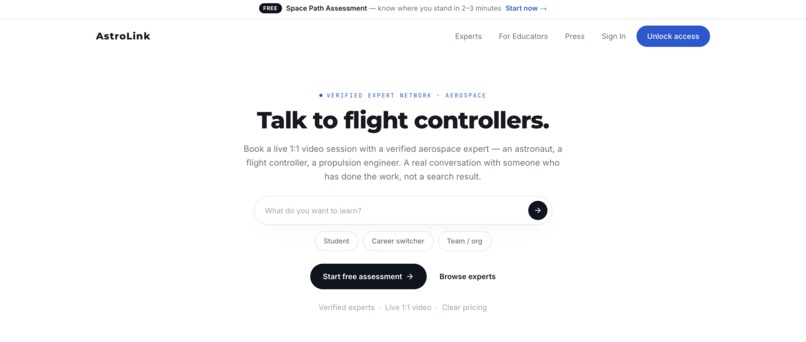
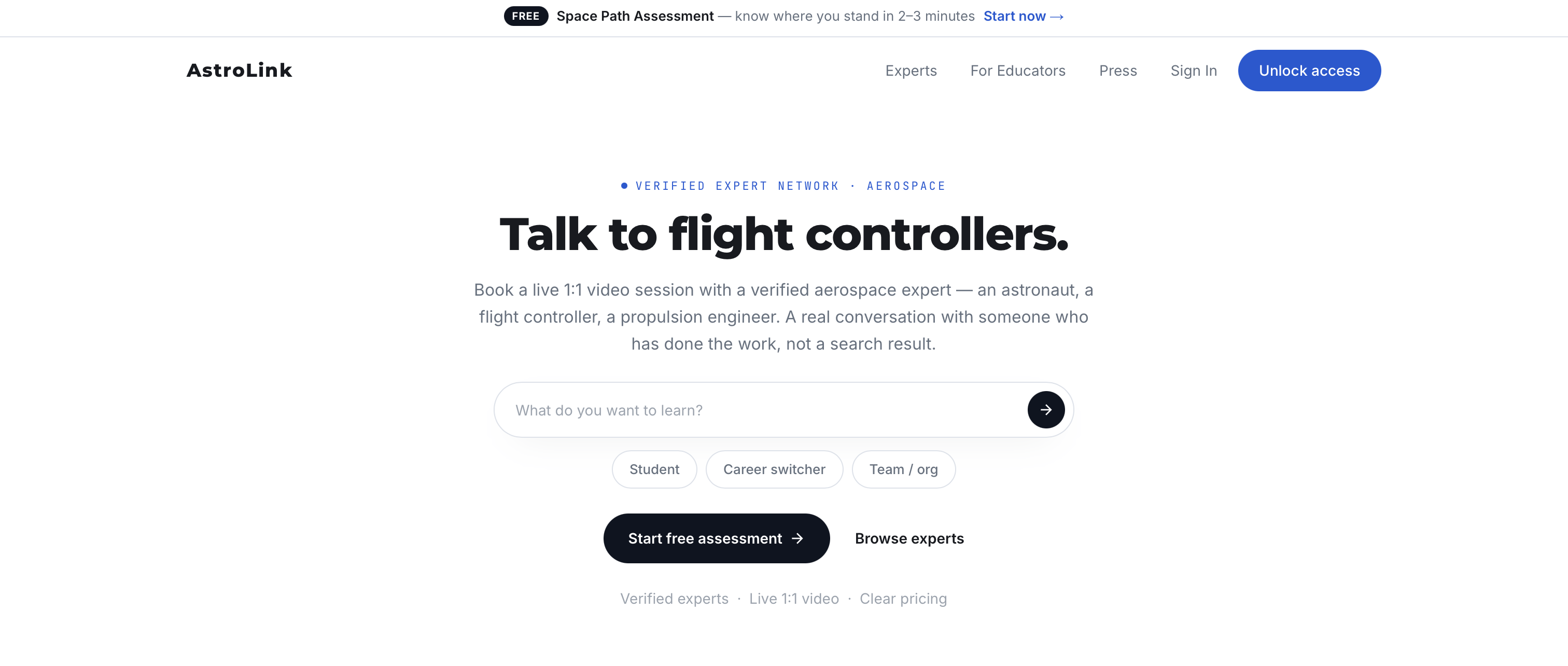
landing page
-
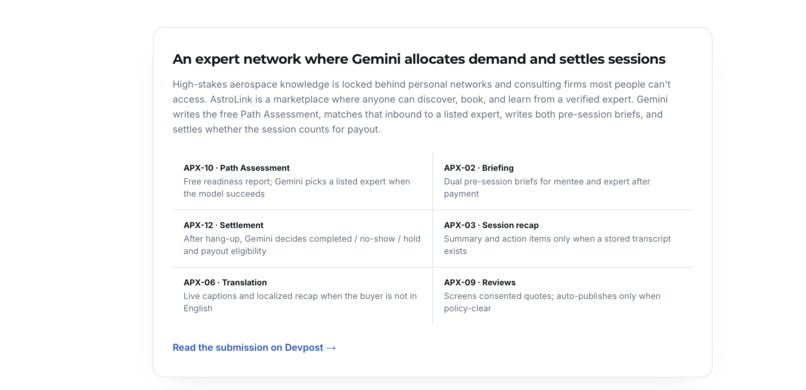
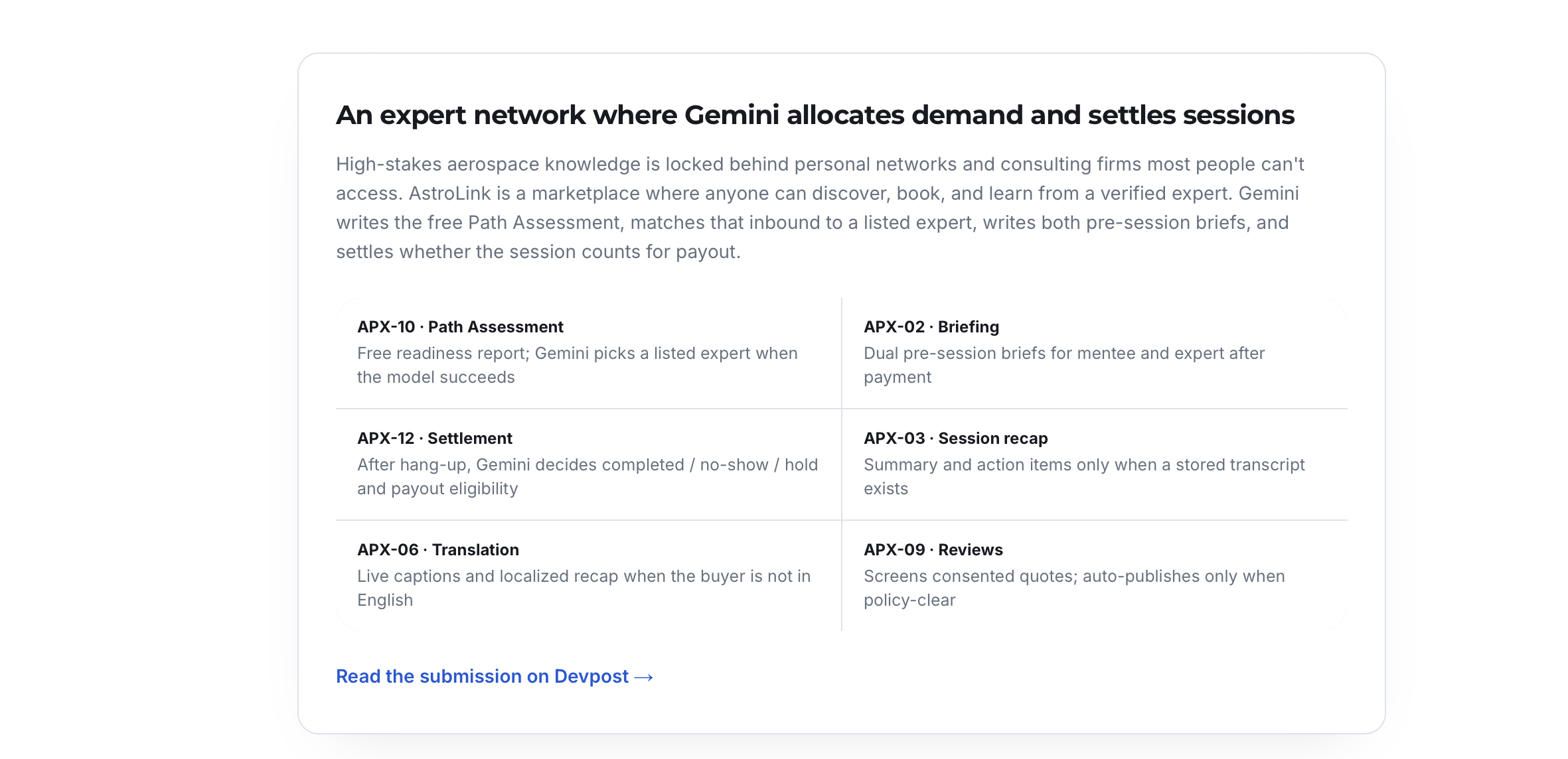
agents used
Inspiration
On May 15th, I attended the ribbon ceremony for the Skills Training Complex in Huntsville, Alabama. The Saturn V rocket at the entrance to Space Camp was the first sign this wasn't a typical event. At breakfast, a colleague arrived with an unexpected plus one: astronaut Chris Sembroski. An hour of conversation felt like twenty minutes. Later that day, Jared Isaacman — former commander of Inspiration4 and Polaris Dawn, now NASA Administrator — walked in, and I had a front-row seat. On the eight-hour drive home, one thought kept surfacing: I was incredibly lucky to be in the right place, with the right people, at the right time. And that luck had a price tag most people in the world could never afford.
When XPRIZE launched the hackathon, that realization was still sharp. I kept returning to one question: how many curious, ambitious people around the world would trade everything for an hour like the one I had that morning — and will never get it, not because of ability, but because of three structural barriers that have nothing to do with merit?
The first is geography. As an immigrant from Mexico, being in the United States has been a decisive advantage — proximity to the conferences, campuses, and corridors where the space industry actually happens. For the estimated 70,000+ active students and entrepreneurs in this sector globally, geography alone determines whether you're in the room or watching from outside it.
The second is resource allocation. Outside the United States, across Latin America, Africa, South Asia, and even much of Eastern Europe, the median household operates on $1,000–$5,000 per year in real purchasing power, leaving virtually no margin for discretionary spending beyond basic survival needs. A single international trip or professional development investment that an American household absorbs as a minor line item can represent a year or more of income for the global median household. The result is that access filters down to three groups: multinational employees whose companies cover the cost, the top 5–10% of earners in their countries, and government or NGO representatives on institutional budgets. Everyone else is priced out by design.
The third is language. Nearly half of all internet content — 49.4% — is in English, and the most influential voices in space operate almost exclusively within it. Yet 83% of the world does not speak English fluently. For a talented engineer in Lagos, a physics student in Medellín, or a young entrepreneur in Bangalore, the language barrier doesn't just make connection harder — it makes it effectively impossible with the tools that currently exist.
I went to the drawing board and looked at what Minnect, intro.co, and Cameo had each built in adjacent industries: platforms that made access to expertise transactional, scalable, and priced for real people. I asked what that model could look like purpose-built for the space sector. The result is Astro-Link — a platform connecting the next generation of explorers with the roughly 700 people who have experienced the overview effect, the profound cognitive shift, documented consistently across astronauts, that occurs when you see Earth from orbit: borderless, fragile, and whole. These are not simply credentialed figures. They are the only humans alive who carry that perspective, and right now that perspective is almost entirely inaccessible to the global majority who need it most. When the stakes are real — a career pivot, a startup that can't absorb a consulting bill, a student whose trajectory depends on one conversation — you need a human who has actually been there. That is what Astro-Link makes possible.
What It Does
Astro-Link is a marketplace built on a simple premise: the roughly 700 people who have experienced the overview effect — the permanent cognitive shift that occurs when you see Earth from orbit, borderless and whole — represent the most concentrated source of perspective, inspiration, and hard-won judgment in the space sector. Right now, access to that perspective is almost entirely determined by geography, income, and language. Astro-Link changes that by making 1:1 sessions with vetted astronauts, mission operators, and space industry experts bookable, affordable, and language-accessible to anyone on the planet with an internet connection — not just those who can afford a conference ticket or happen to be in the right room.
The platform has four core surfaces:
- Public expert directory — browse and discover vetted experts
- Candidate booking flow — AI-matched or manual session booking
- Internal compliance workspace — expert screening and approval pipeline
- Live video sessions — with AI-generated briefings and post-session recaps
How a Session Works
Discovery
Candidates land on the public /experts directory. Only experts with
compliance_status = approved and is_listed = true appear publicly.
Matching
Instead of forcing manual browsing, candidates describe their goals in plain
language. The system calls matchListedMentor(), sending the candidate's goals
and the live pool of approved experts to Gemini with a strict JSON schema
(mentor_id, match_score, match_reason). If Gemini returns an expert outside
the pool, the pool is empty, or the call fails, the system returns an explicit
failure message and routes the user to browse manually. It never fabricates a
match. This is now the default booking path.
Booking → Compliance → Payment A chain of typed backend agents validates the request, runs compliance checks, and captures payment via Stripe (immediate capture, platform-held). Experts are currently paid out manually.
Pre-Session Briefing Before the call, a Briefing Agent generates a dual-audience brief: second-person for the candidate and third-person for the expert. Both are grounded in the candidate's stated goals and optionally their Space Path Assessment. Output is schema-validated JSON, stored on the booking record.
Live Session Video runs on Daily.co. When enabled, live captions and bidirectional translation use a dedicated LLM rate-limit scope so real-time subtitle calls do not starve other AI features — directly addressing the language barrier at the session level.
Post-Session Recap A structured LLM pass turns the session into a recap for the candidate. An explicit honesty path exists: if no transcript was captured, the recap states that fact instead of inventing content.
Settlement, Review & Notification The pipeline records earnings, prompts for expert reviews, and sends notifications.
AI Backbone
Every AI step runs through a single shared LLM gateway:
- Provider-agnostic — switches between Gemini and OpenAI via environment variables; same schema and call shape throughout
- Structured output only for anything that drives product logic — no freeform text parsed with regex
- Every decision is audited — prompt hash, model, estimated cost, and
summarized output written to an
audit_logtable taggedLLM_DECISION - Rate-limited per actor, with a dedicated higher-throughput scope for live captions
- Fails honestly — explicit "the AI could not do this" paths surfaced to the user rather than silent failure or fabricated answers
- Fully E2E-stubbable (
_LLM=true) so the AI surface is testable without real model calls or cost
Agent Roster
| Agent | ID | Role |
|---|---|---|
| Booking | APX-01 | Validates booking request integrity |
| Briefing | APX-02 | Generates pre-session briefs for candidate and expert |
| Session | APX-03 | Manages live session windows |
| Compliance | APX-04 | Gates expert approval against compliance rules |
| Payment | APX-05 | Stripe capture and payment lifecycle |
| Translation | Dedicated | Live captions and translation, isolated rate-limit scope |
| Notification | APX-08 | Sends transactional notifications |
| Review | APX-09 | Post-session review collection |
| Path Assessment | APX-10 | AI-guided career assessment for candidates |
| Path Assessment Review | APX-11 | Reviews and validates assessment output |
| Settlement | APX-12 | Expert earnings recording and payout tracking |
How We Built It
It started with a simple landing page that collected emails while we figured out the product. The core development approach was to ship in small, versioned increments — roughly 50 releases across ~10 weeks — each with tests and a changelog entry, rather than one large launch. Every release was independently deployable; nothing sat in long-lived feature branches.
Phase 1 – Prove the funnel
We began with the cheapest possible signal: an early waitlist with referral
attribution and admin metrics, gated behind APP_MODE=waitlist. Once we had
clear demand, we built the core product surface and booking flow before
introducing payments.
Phase 2 – Make the session itself valuable (June 6–13) This is where the AI briefing and recap pipeline was born: post-session transcript capture, AI-generated recaps, then live bidirectional captions and translation (Daily.co + dedicated LLM agent). We deliberately deferred real money until the session experience worked, because a paid call with no value is a refund machine. Stripe went live on June 13 with immediate-capture payments, variable-duration sessions, a real refund policy, and per-user rate limits.
Phase 3 – Trust infrastructure (June–August) We added moderated reviews, a compliance gate so only approved experts are ever publicly listed, and full audit logging on every AI decision. These were not bolted on later — they were built alongside the AI features because in a paid-expertise marketplace, "why did the AI pick that person?" must be answerable from day one.
Phase 4 – Reduce friction to booking (August) We launched Path Assessment — a free AI-generated report on where a candidate stands — then connected it directly to demand: when the assessment is confident, it can recommend and book a specific expert. In the final two weeks we made matching the default booking path (August 16), replacing "browse and pick." We first shipped and validated the honest-failure behavior as its own release so the fallback story was proven before matching became the front door.
Throughout, development rotated between Grok, Google Antigravity, and Claude Code, with AI agents used heavily for code planning and implementation.
Challenges We Ran Into
The cold start problem A marketplace with no experts is a marketplace with no reason to exist. Before a single line of product code mattered, we had to convince people who have actually been to space to believe in something that didn't exist yet. Every expert on the platform required a direct conversation, a real pitch, and a leap of faith on their part. There is no automated solution to that problem — it cost time, credibility, and personal relationships to solve.
Email deliverability killed our early outreach Because we were using a new domain, almost every promotional email landed in spam or the promotions tab. Open rates were near zero — not because people weren't interested, but because they never saw the message. Automated sequences actively worked against us. We had to abandon that channel entirely and rebuild the go-to-market approach around founder-led, 1:1 outreach. That pivot cost us weeks.
Building trust infrastructure in a marketplace that trades on credibility In a platform where someone is paying to speak with a person who claims to have been to space, the compliance and verification layer isn't a nice-to-have — it's the product. Building the screening workflow, audit logging, and compliance gate in parallel with shipping features created real engineering pressure. Cutting corners here would have been easy. We didn't, because one bad actor on the expert side would have destroyed everything the supply side took months to build.
Pricing and market sensitivity We didn't know what "affordable" actually meant for our users until we talked to them directly. The same session price that felt fair to one user felt out of reach to another. Finding a price point that respects the income realities we built the product to address — while sustaining the platform — is a tension we are still actively navigating.
Accomplishments We're Proud Of
Going into this we knew we'd face the cold start problem — a marketplace with no experts is a marketplace with no reason to exist. So when we sat down with astronaut Chris Sembroski, pitched him the idea, and he agreed to be our first expert, that was a moment. From there it became a snowball effect — Dr. Remont, future astronaut Pria — and watching people who have actually been to space believe in the vision was something we didn't take lightly.
When we hosted our first session with a real customer and read her review, it confirmed everything. One conversation genuinely changed her perspective. That's the overview effect reaching someone who never would have had access to it otherwise — and that hit home.
With no advertising budget, just word of mouth and constant shipping, we built an early waitlist of active users in under 40 days. It's not the number we're chasing — it's what it proved: people want this, and with a real go-to-market strategy, the momentum is there.
We also pitched two community colleges and walked away with serious conversations about pilot programs. Forty days in, with a product still being built, we weren't showing up with a pitch deck and a dream. We were showing up with something real — and that changes the conversation entirely.
But the accomplishment we're most proud of is simpler than any of that. When we tell people the story of why this started, their eyes light up. It resonates because it's not a story about someone out of reach — it's the everyday person who got lucky enough to be in the right room, and built something so that room doesn't have to be closed to everyone else. You don't have to be part of the gatekept community anymore. That's what we're building, and seeing people feel that — that's what makes us proud.
What We Learned
Students are the core user — and they need a different product shape The majority of our early users are students. Our only paying customer so far was a graduate student who booked a session with Chris Sembroski specifically to discuss her philosophical dissertation. That told us two things: students extract the highest value from these conversations — career clarity, research direction, real perspective — not just fan access. And traditional platforms like Cameo and intro.co lean toward celebrity experiences. We are building the opposite: high-signal, preparation-heavy, outcome-oriented sessions.
This insight is already changing the product. We are moving toward shorter 15-minute minimum blocks. The AI does the heavy lifting before the call — dual briefings that tell both sides exactly who the other person is and what they care about — so the live time starts with substance instead of ice-breaking. After the call, transcripts and actionable next steps (something Chris himself emphasized) give the student a durable artifact, not just a memory.
Automated outreach failed. Founder-led sales worked. Because we were using a new domain, almost every promotional email landed in spam or the promotions tab. Open rates were near zero — not because people weren't interested, but because they never saw the message. The moment we switched to personal, founder-led 1:1 outreach, conversations started. Users told us the price felt fair or too high, which features they wanted, and when they would be ready to book. That direct feedback has been more valuable than any dashboard metric.
Zero-dollar go-to-market still produced signal We have spent nothing on advertising and still closed our first sale. That forced clarity on two fronts: who the ideal early customer actually is, and what organic channels already generate engagement. It also revealed a second growth lever we were initially hesitant to use — our experts' own audiences. We can now help experts run campaigns to their existing communities, creating more meaningful 1:1 sessions while compensating them for their time and reach. The free Space Path Assessment was built from this realization: a low-friction entry point that converts into a paid session with far better context on both sides.
Institutional and community capital is the path to scale and access A conversation with Pinnacle Bank highlighted something important: many local and regional banks already reinvest in their communities. Their current budget cycle was closed, but the signal was clear — there is appetite for sponsored credits that give public schools, underfunded programs, and top-performing students access to the platform. This model becomes even more powerful internationally. In markets where median household income makes individual paid sessions difficult, financial institutions and sponsors can buy bulk credits so educational organizations can offer the service at low or no cost to students. The same insight that started with a local North Carolina bank now points toward a scalable access strategy for Latin America and other regions.
What's Next for Astro-Link
The most consistent thing we hear from users after a session is a version of the same question: "Okay — how do I actually get into this industry?"
That question is the next problem we're building for. Astro-Link's natural evolution is becoming the talent bridge for the space sector — connecting candidates who have already demonstrated genuine curiosity and received expert guidance with recruiters and founders who are actively looking for that exact kind of person. After a session, an AI agent delivers tailored follow-up resources: relevant coursework, skill pathways, and introductions matched to where the candidate wants to go. For companies, it's a higher-signal pipeline than anything a job board provides. For the candidate, it's momentum — not just inspiration.
But the reason this matters beyond product logic comes back to the three barriers. The talent bridge doesn't just serve users who are already well-positioned. If a candidate in Medellín has a 30-minute conversation with an astronaut and that conversation surfaces an opportunity, a program, or an introduction they would never have found otherwise — that is the mission extended into a career outcome. Geography, income, and language got them to the session. The platform gets them to what comes next.
This moves Astro-Link from a single conversation into an ongoing career-acceleration engine for the space sector — one where the people most historically excluded from the industry have the clearest path forward.
The community college conversations we've already started are the first institutional expression of this. Students at those institutions don't need to be told the space industry is exciting. They need a door. That's what we're building.


Log in or sign up for Devpost to join the conversation.