-
-
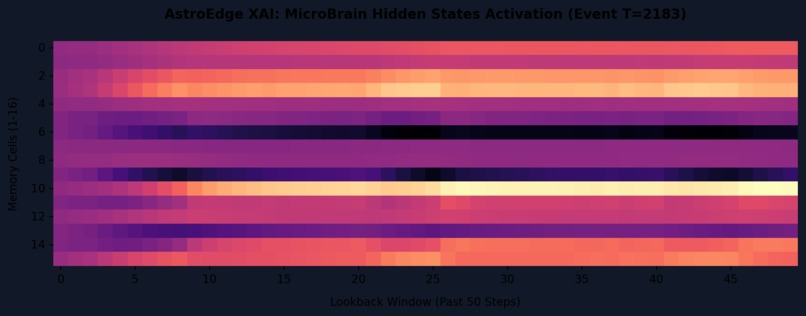
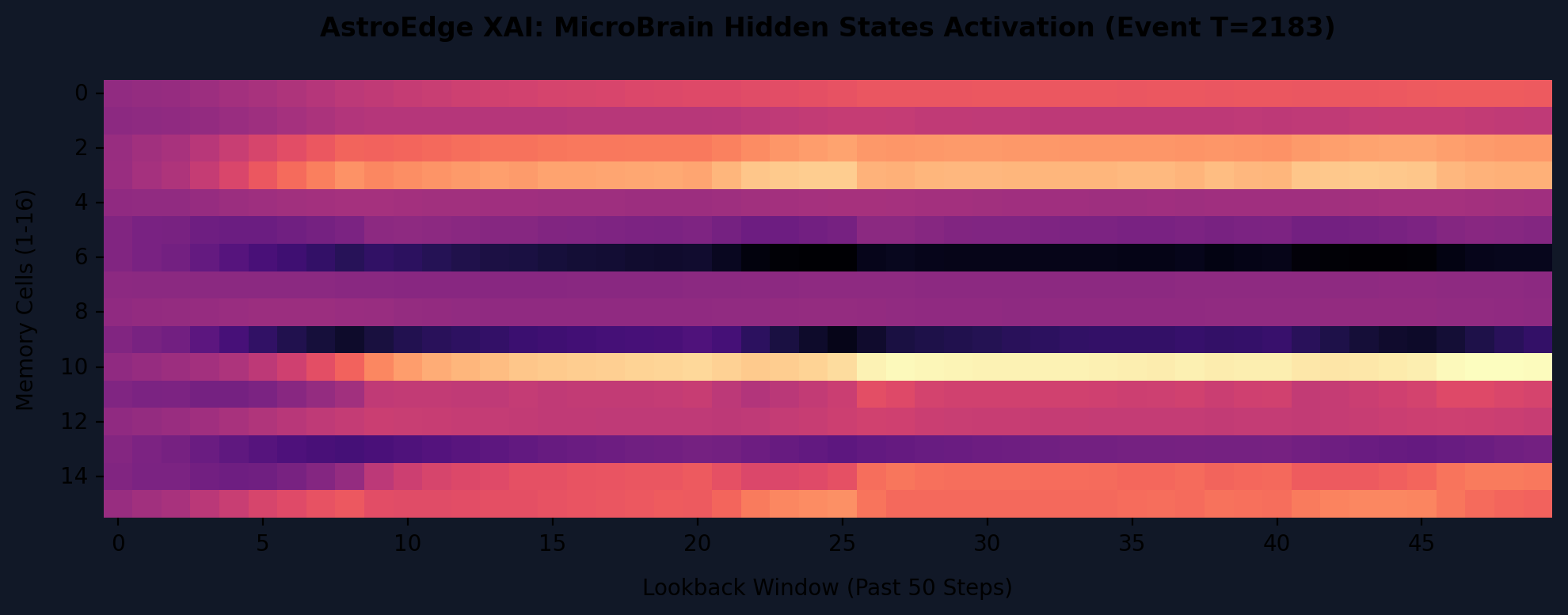
Heatmap of first true positive error
-
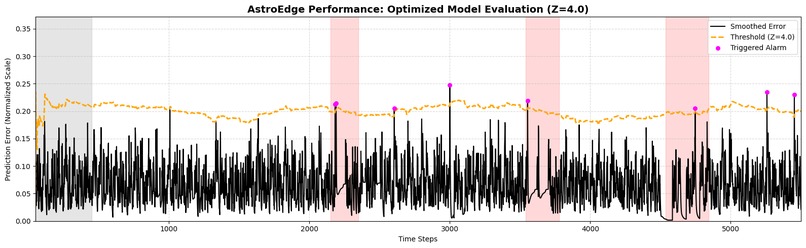
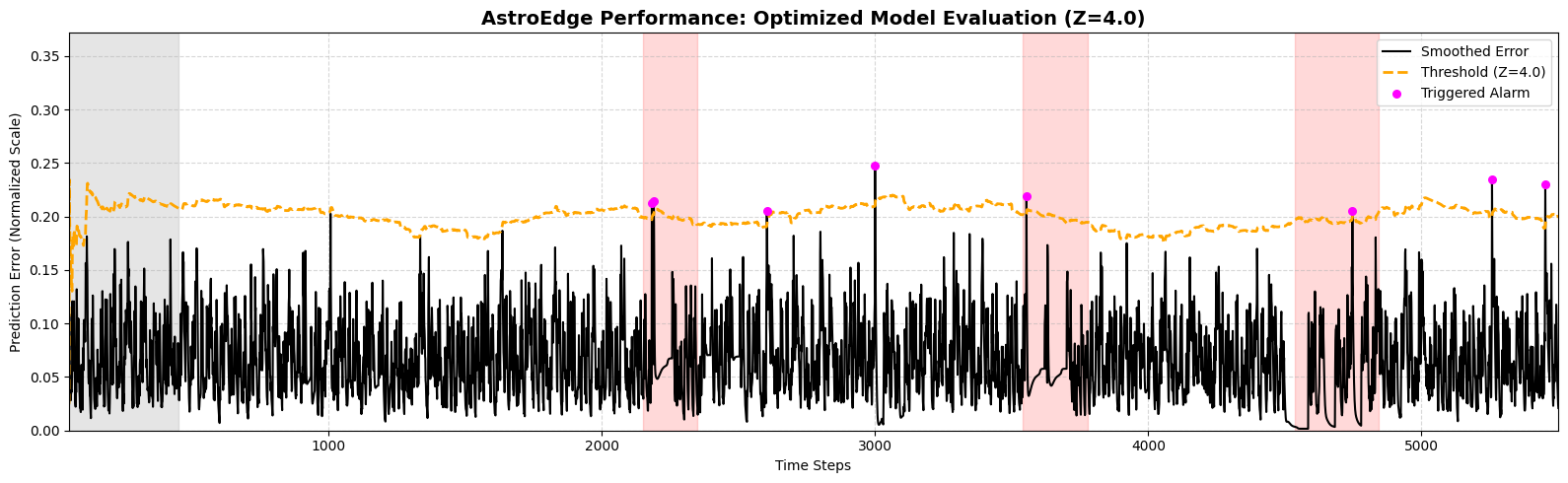
test set result
-
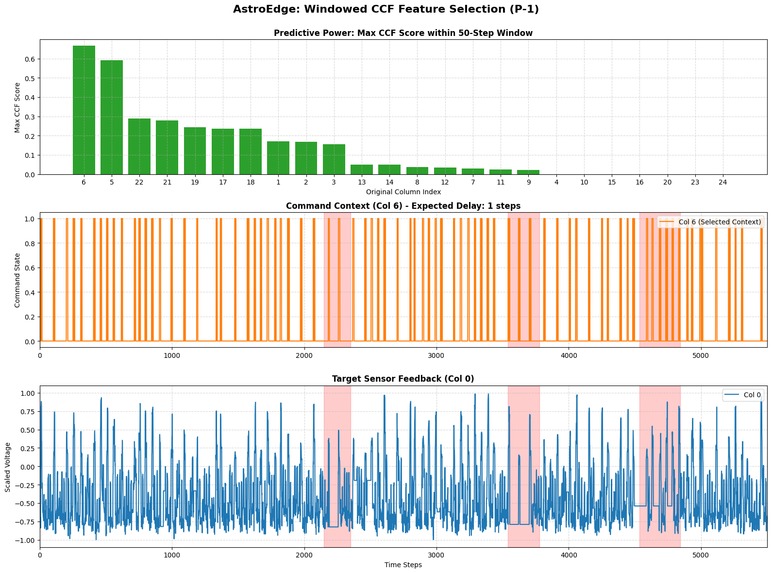
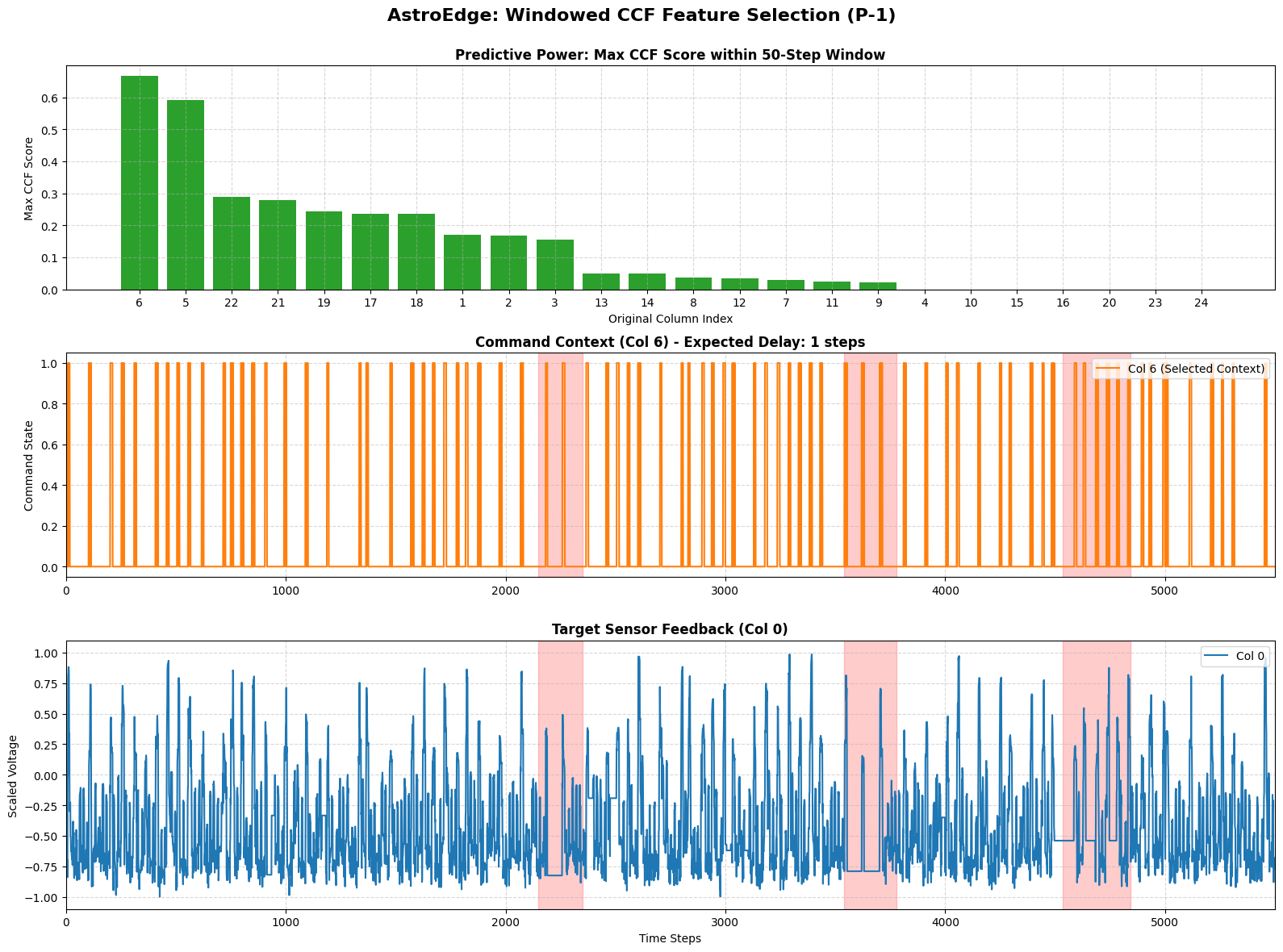
Feature selection
AstroEdge: Adaptive Context Downlink for Deep Space Rovers
Less noise, more science. Smart telemetry triage at the edge of space.
💡 Inspiration
Space exploration has a hidden, critical bottleneck: Bandwidth Starvation. Deep space rovers, like NASA’s Curiosity, operate in incredibly noisy radiation environments. A random cosmic ray can cause a momentary voltage spike, causing the rover's rigid, hard-coded safety system to panic.
When this happens, the rover triggers an alarm and fires a standard, unhelpful snippet of diagnostic data back to Earth. Because this initial data lacks context, Earth-based engineers (or AI like Telemanom) cannot safely rule out a false alarm. They are forced to request extended data logs. This multi-day "ping-pong" delay across the Deep Space Network actively steals precious transmission bandwidth from real scientific discoveries. We realized that in space, bandwidth is science. Wasting it on false alarms is unacceptable.
⚙️ What it does
AstroEdge is an ultra-lightweight, edge-deployed AI "MicroBrain" designed to act as a triage doctor directly on the spacecraft.
Instead of treating every safety alarm equally, AstroEdge dynamically adjusts the size of the telemetry downlink. If our model predicts that an anomaly is just expected background noise, it aggressively shrinks the data window to save bandwidth. If it detects a true, unpredictable failure, it expands the window, proactively packaging the complete causal dataset into the very first transmission. We eliminate the secondary "ping-pong" data request, optimize bandwidth, and return the Deep Space Network to its true purpose.
🛠️ How we built it
We built AstroEdge focusing on extreme efficiency and transparency, using Python, TensorFlow, and React:
- Dataset & Feature Engineering: We utilized real NASA Curiosity Rover telemetry data. To make the model lightweight enough for edge hardware, we couldn't use all 25 sensor variables. We ran a Windowed Cross-Correlation Function (CCF) analysis to find the strongest mathematical link to our target variable (Column 0). Column 6 emerged as the dominant causal trigger with a 0.66 predictive score and a 1-step physical delay. We stripped away the rest.
- The MicroBrain (LSTM): We engineered a highly compressed, single-layer Long Short-Term Memory (LSTM) network. Because telemetry is a time-series problem, the LSTM's internal memory allows it to understand the physical causality behind a spike, rather than just reacting to the immediate value.
- Dynamic Thresholding: We threw away static safety limits. AstroEdge calculates prediction error and uses Exponential Smoothing to create a rolling baseline. An anomaly is only flagged when the error breaches a dynamic Z-Score threshold, adapting to real-time noise:
- Prediction Error: $$e_t=|y_t-\hat{y}_t|$$
- Dynamic Threshold: $$\tau_t=\mu_t+z\cdot\sigma_t$$
- The Web Dashboard: We built a React frontend to visualize the live telemetry streams, the dynamic payload sizing, and our XAI heatmaps.
🚧 Challenges we ran into
- The Compute Barrier: Traditional flight software must adhere to strict, deterministic guidelines (like NASA's "Power of 10" rules). We had to overcome the sheer size of modern AI. We solved this by keeping the architecture to a single layer and designing it to be exported as a micro-JSON payload via TensorFlow.js.
- Trusting the "Black Box": Aerospace engineers rightfully distrust non-deterministic algorithms in life-or-death scenarios. To solve this, we built an Explainable AI (XAI) pipeline. By rendering high-contrast heatmaps (
mako_rvia Seaborn) of the LSTM's internal hidden states, we can explicitly point out which memory cell is tracking the failure, turning our black box into a transparent, evidence-based glass box. - The Simulation Gap: While our offline accuracy was incredible, we realized we currently lack a live Real-Time Operating System (RTOS) environment to test how our dynamic telemetry adjustments interact with actual memory buffers and network queuing.
🏆 Accomplishments that we're proud of
- Achieving a 99.40% F1-Score (100% Recall, 98.81% Precision) at $z=4.0$. AstroEdge successfully captured every true anomaly without being fooled by operational noise.
- Successfully implementing the XAI Heatmap generation without needing to retrain the model, pulling internal weights dynamically to prove our model's logic.
- Bridging the gap between a pure data-science machine learning task and a highly practical aerospace systems engineering solution.
🧠 What we learned
We learned that building AI for space is fundamentally different from building AI for Earth. You cannot just throw more compute or deeper layers at a problem. Every byte of memory and every cycle of processing power is a massive luxury. We learned how to prioritize mathematical correlation (CCF) over blind feature-feeding, and how to design systems that prioritize bandwidth preservation above all else.
🚀 What's next for AstroEdge
Our next major milestone is Real-World Validation. We plan to move beyond offline datasets and execute Hardware-in-the-Loop (HITL) testing to simulate actual flight software schedulers. Ultimately, AstroEdge is a blueprint for the future of autonomous spaceflight: moving from passive anomaly detection to active federated learning, where constellations of satellites can share lightweight anomaly signatures on-orbit.

Log in or sign up for Devpost to join the conversation.