-
-
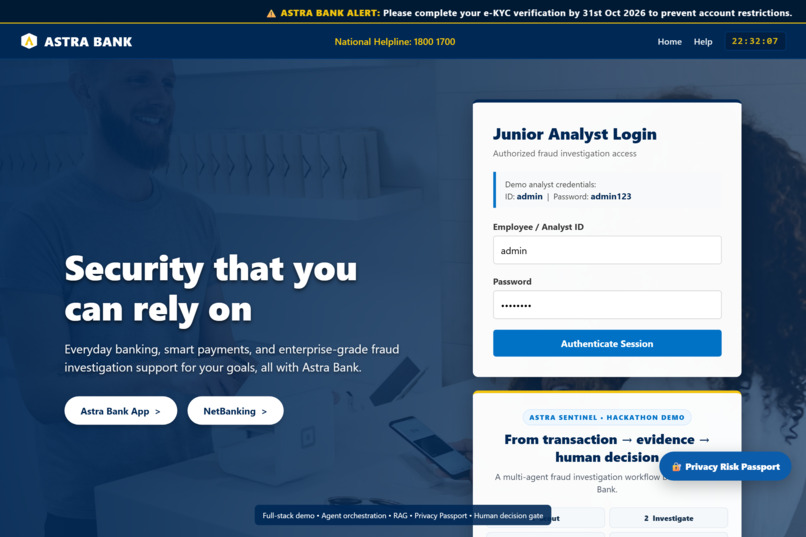
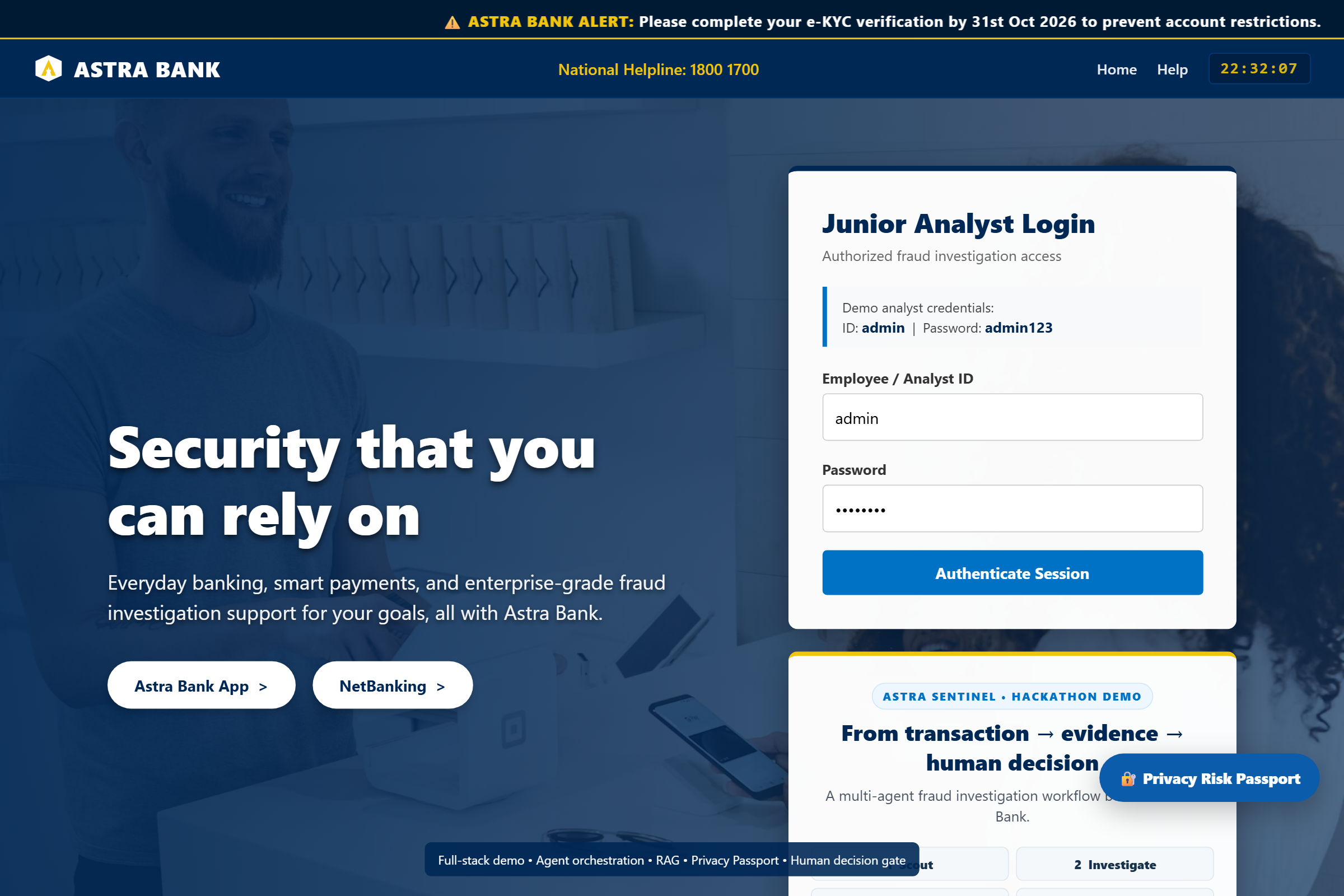
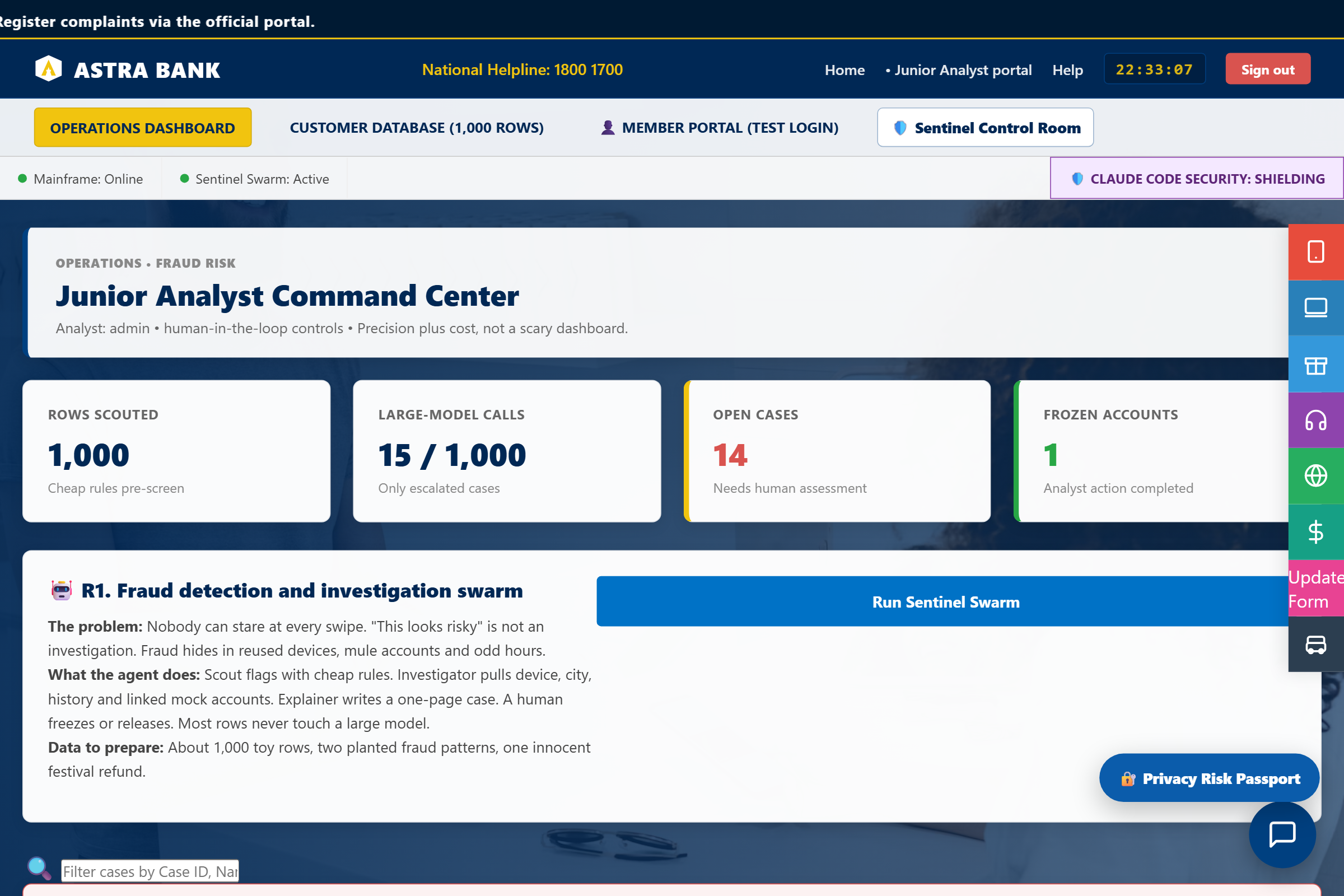
Astra Bank's secure banking interface introduces its digital banking experience and the Sentinel Swarm fraud investigation system.
-
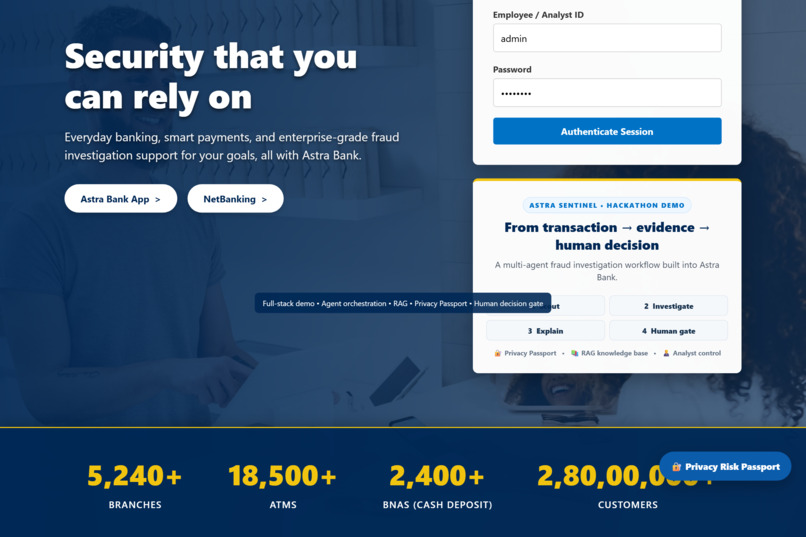
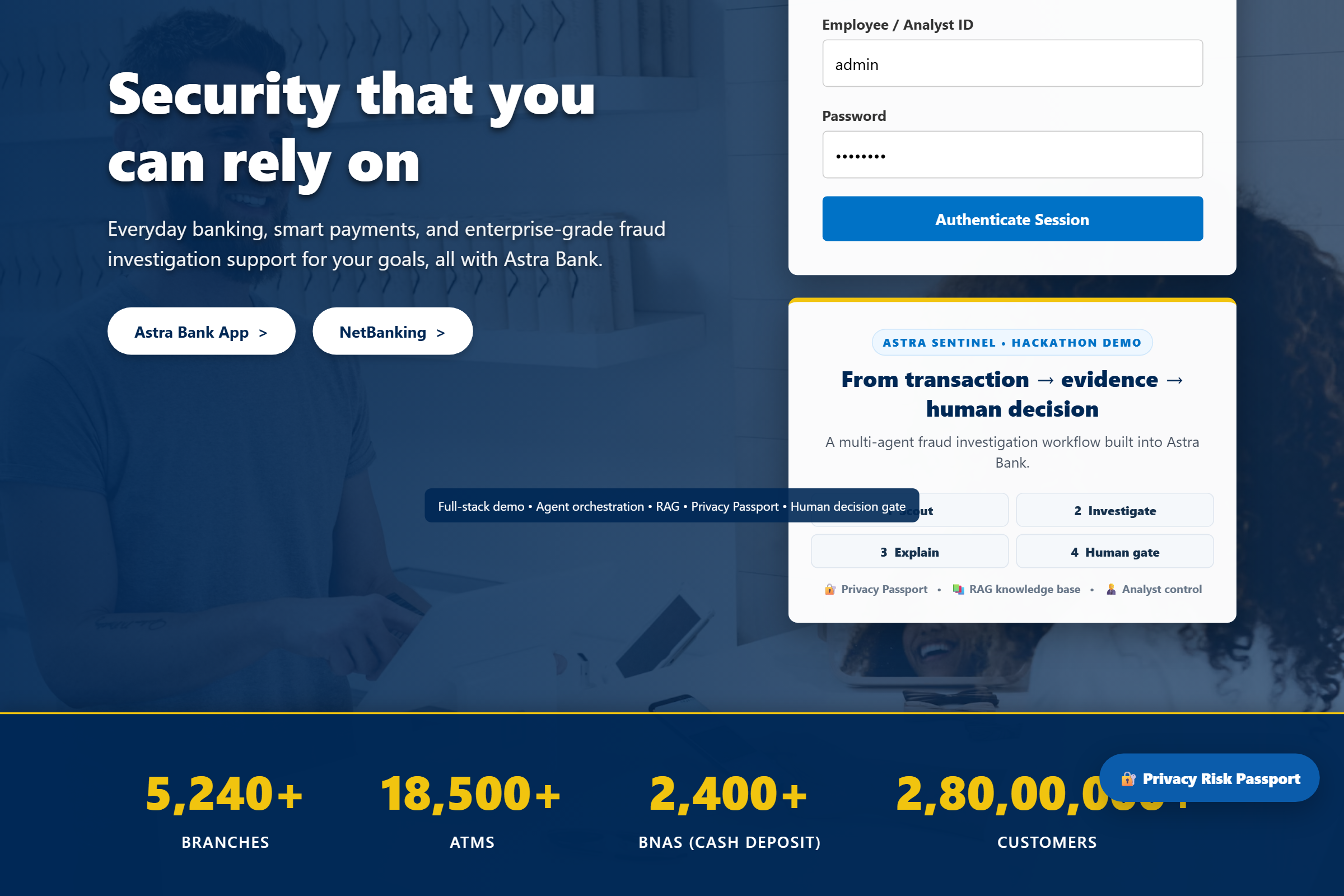
Astra Bank serves over 2.8 crore customers across 5,240+ branches with enterprise fraud protection.
-
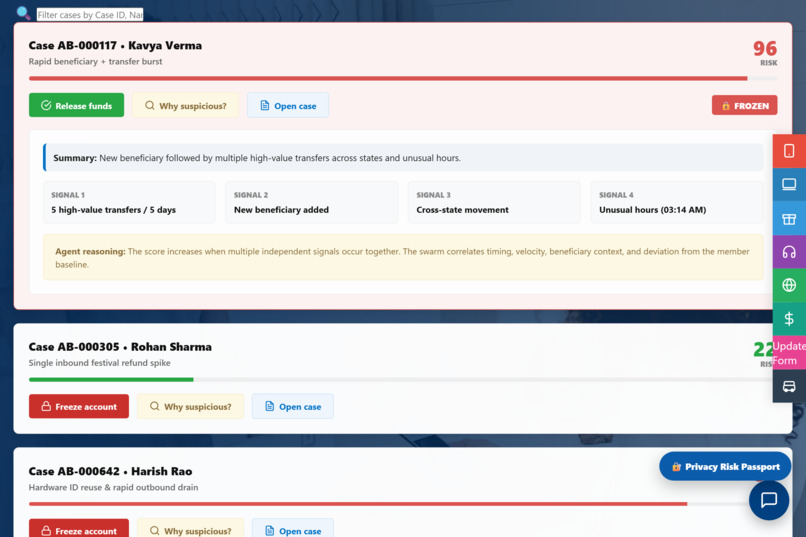
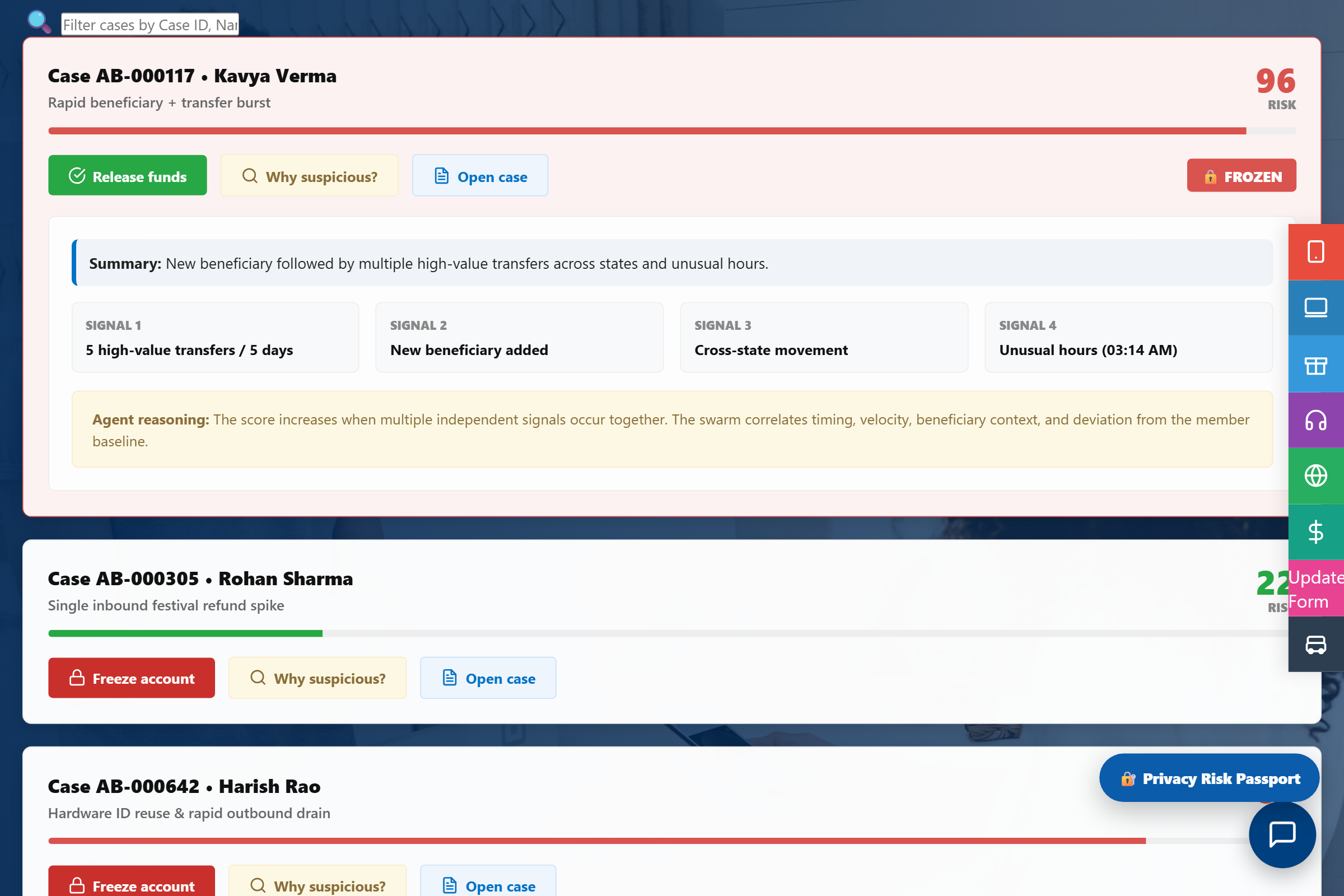
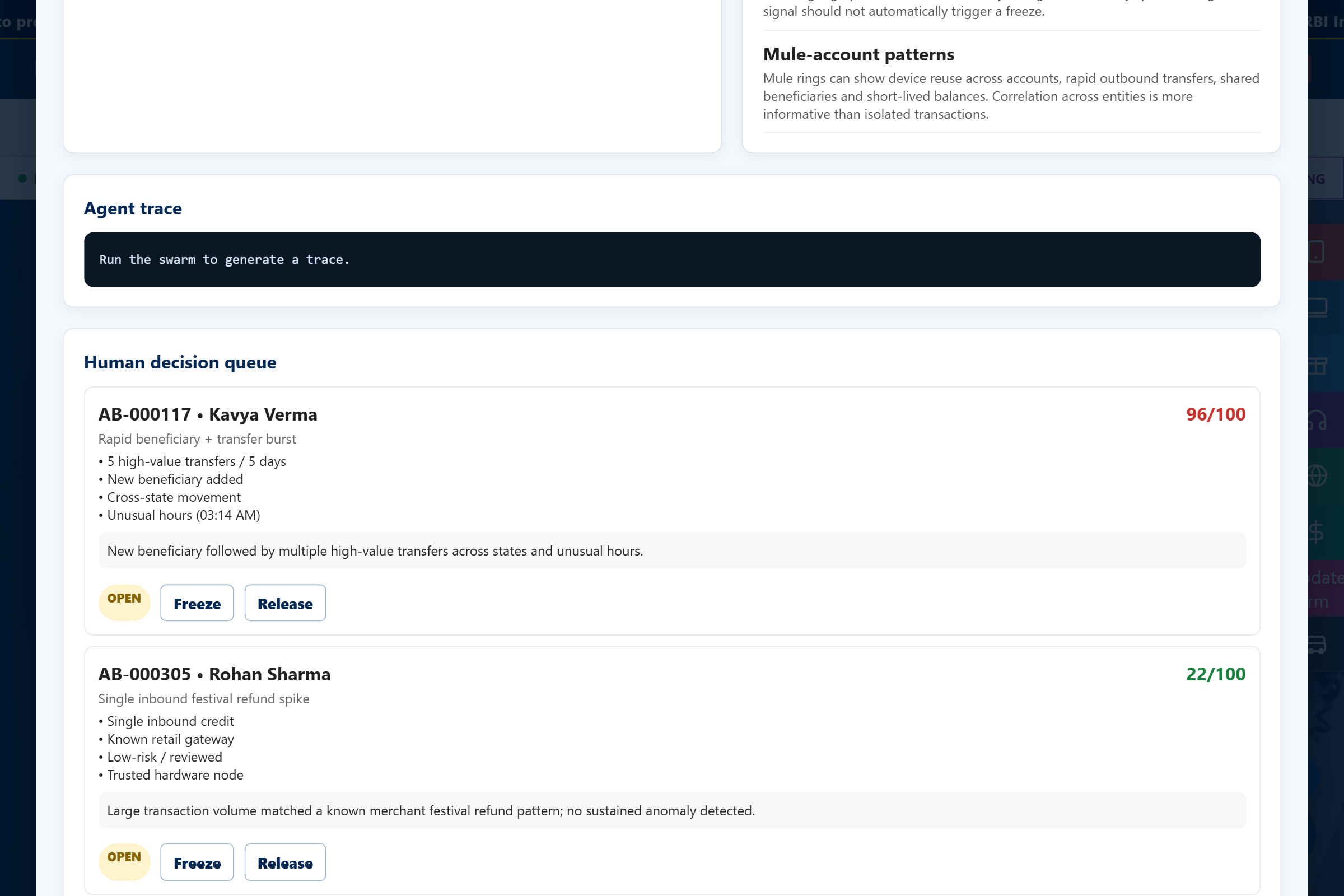
Fraud risk cases detailing high-value transfers, new beneficiaries, and cross-state activity flags.
-
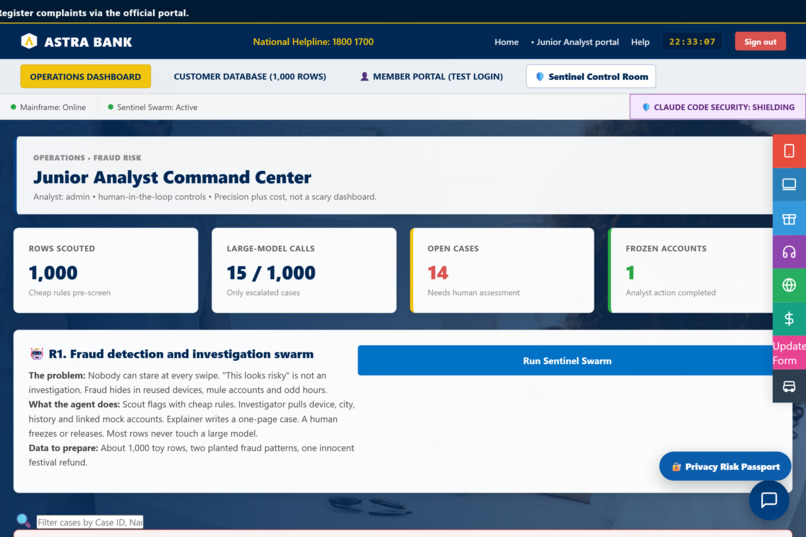
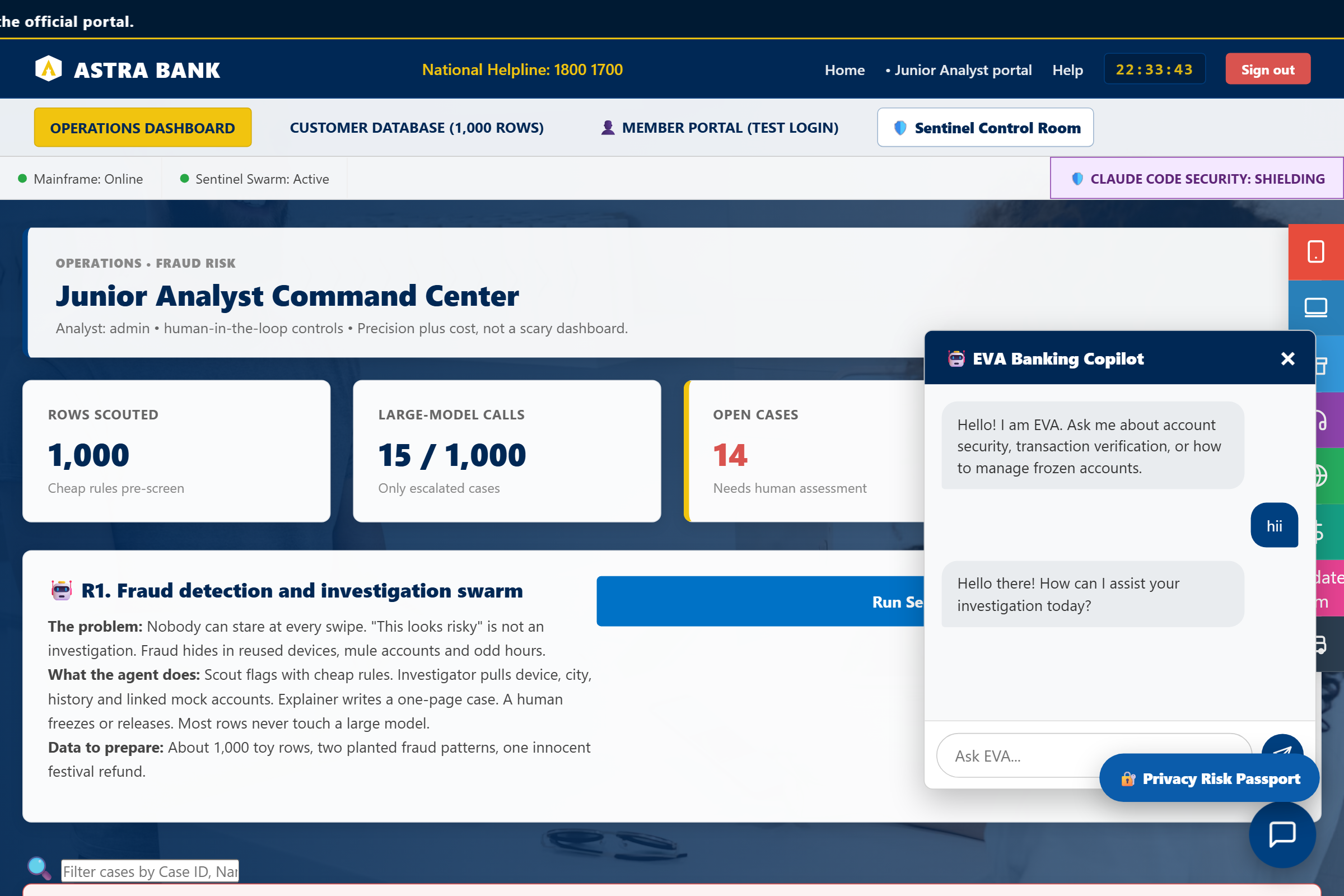
The Sentinel Command Center monitors transactions, highlight suspicious activity, tracks open cases, and supports human-led fraud decisions.
-
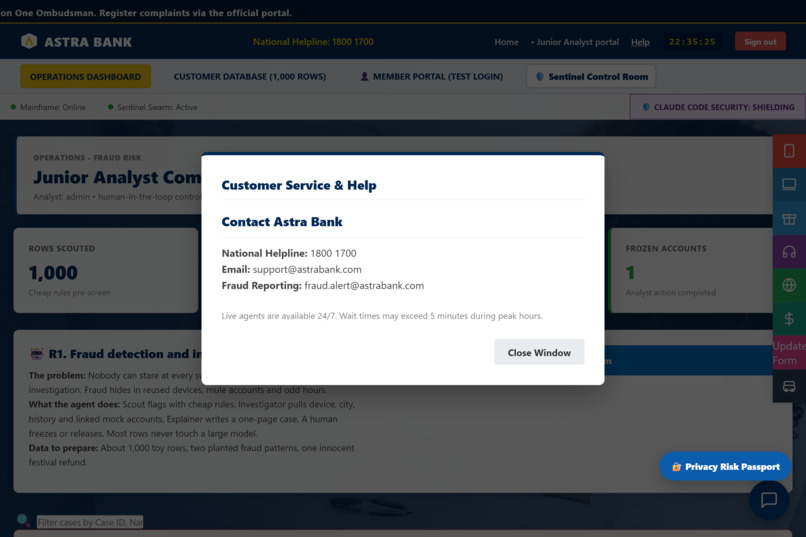
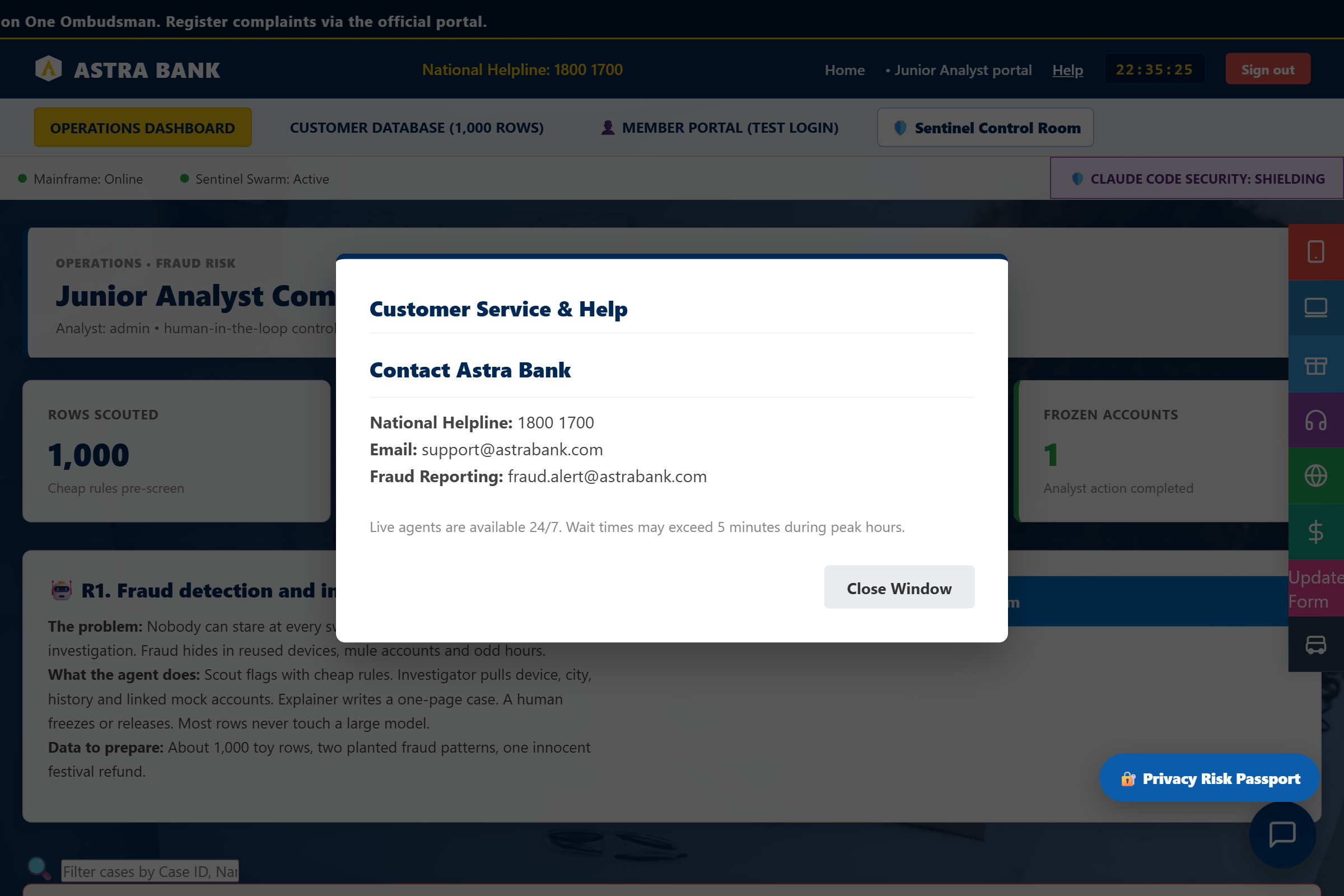
Customer Service & Help pop-up displaying Astra Bank's national helpline, support email, and fraud reporting contacts.
-
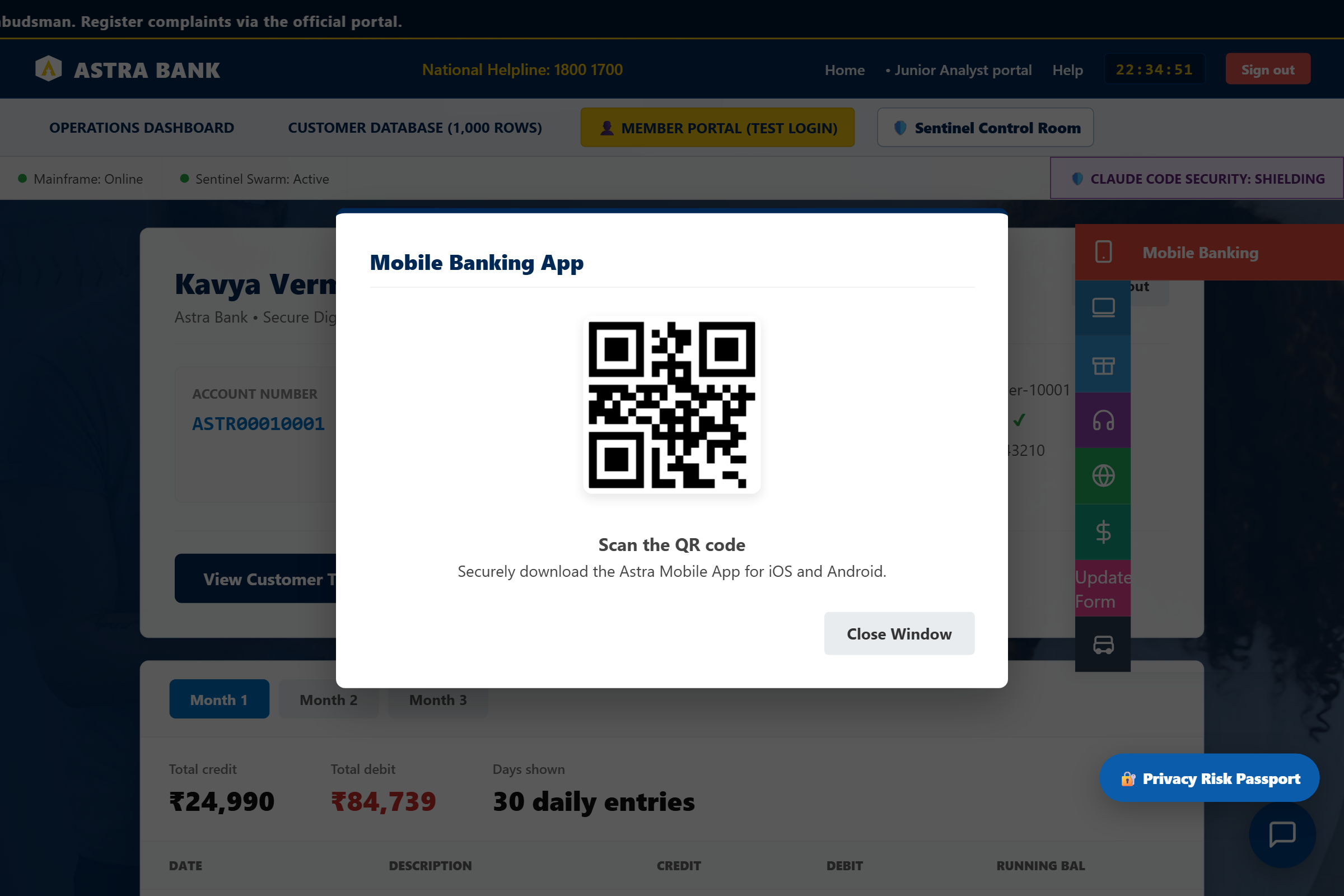
Mobile Banking App pop-up displaying a QR code for secure app download on iOS and Android.
-
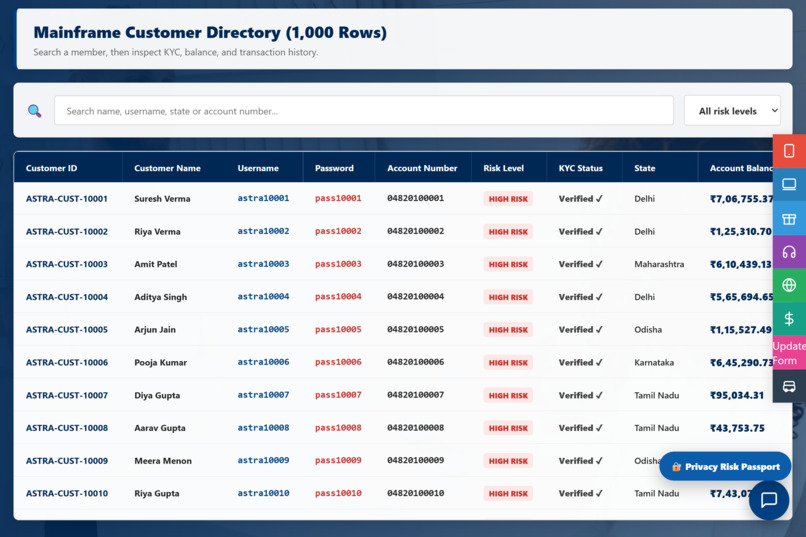
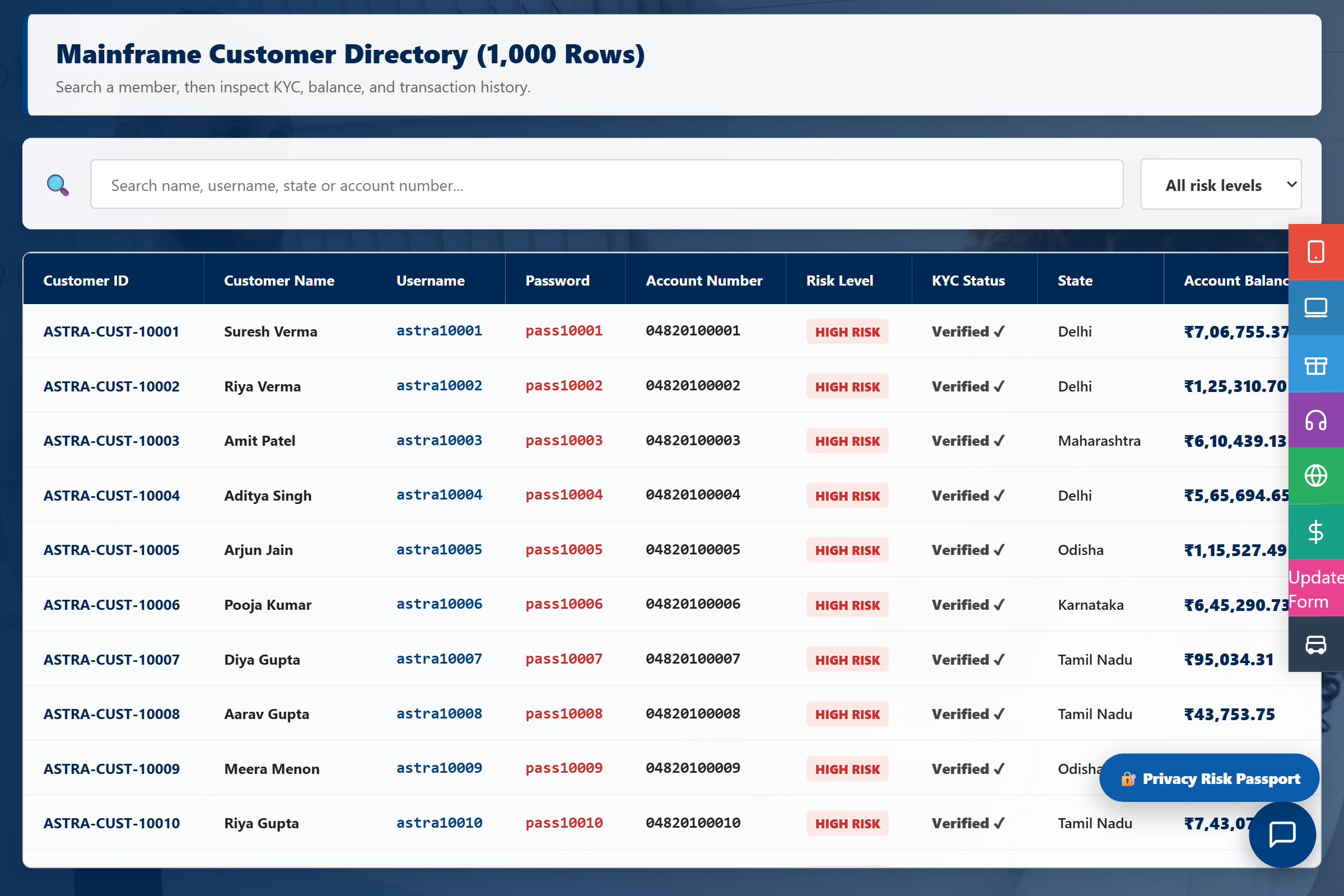
Mainframe Customer Directory managing 1,000 member profiles, risk scores, and account balances
-
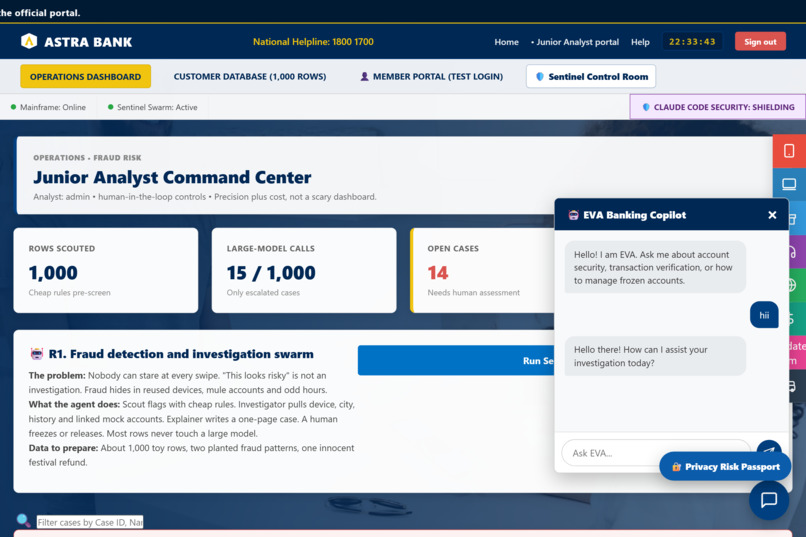
EVA Banking Copilot assistant helping analysts with security, transaction checks, and account controls.
-
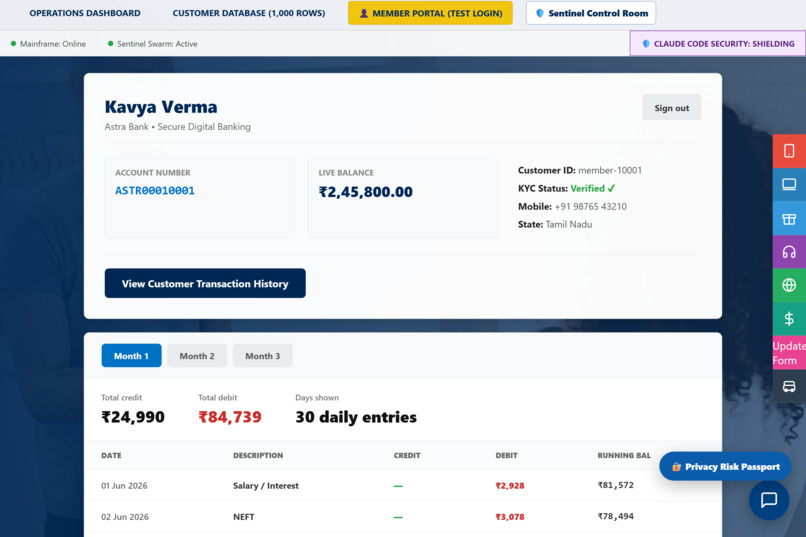
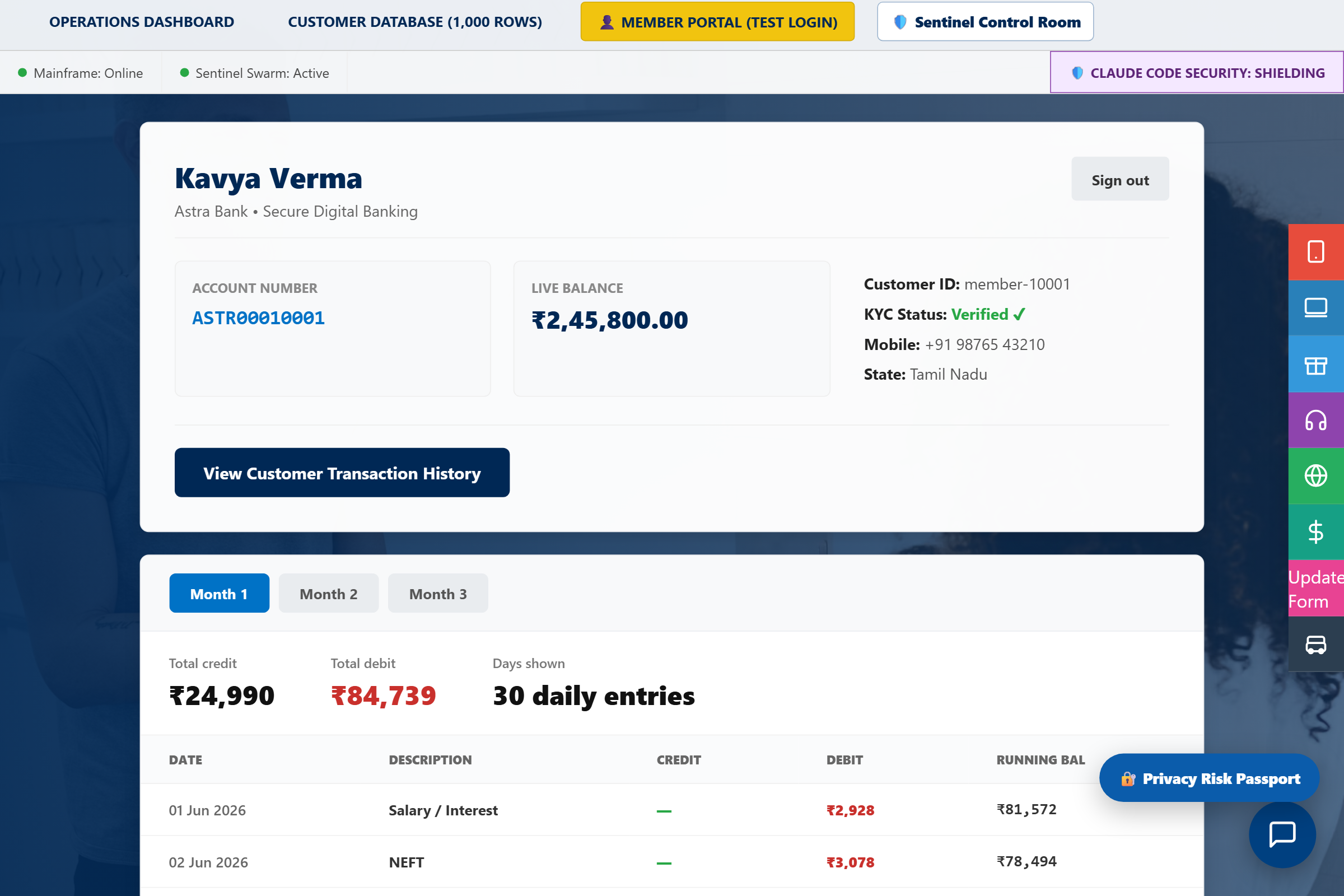
Member Portal view displaying customer account details, monthly balance overview, and transaction history.
-
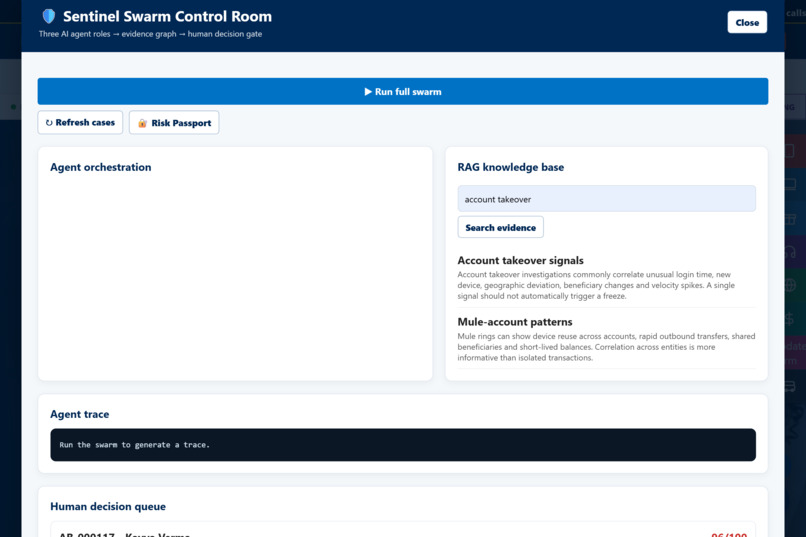
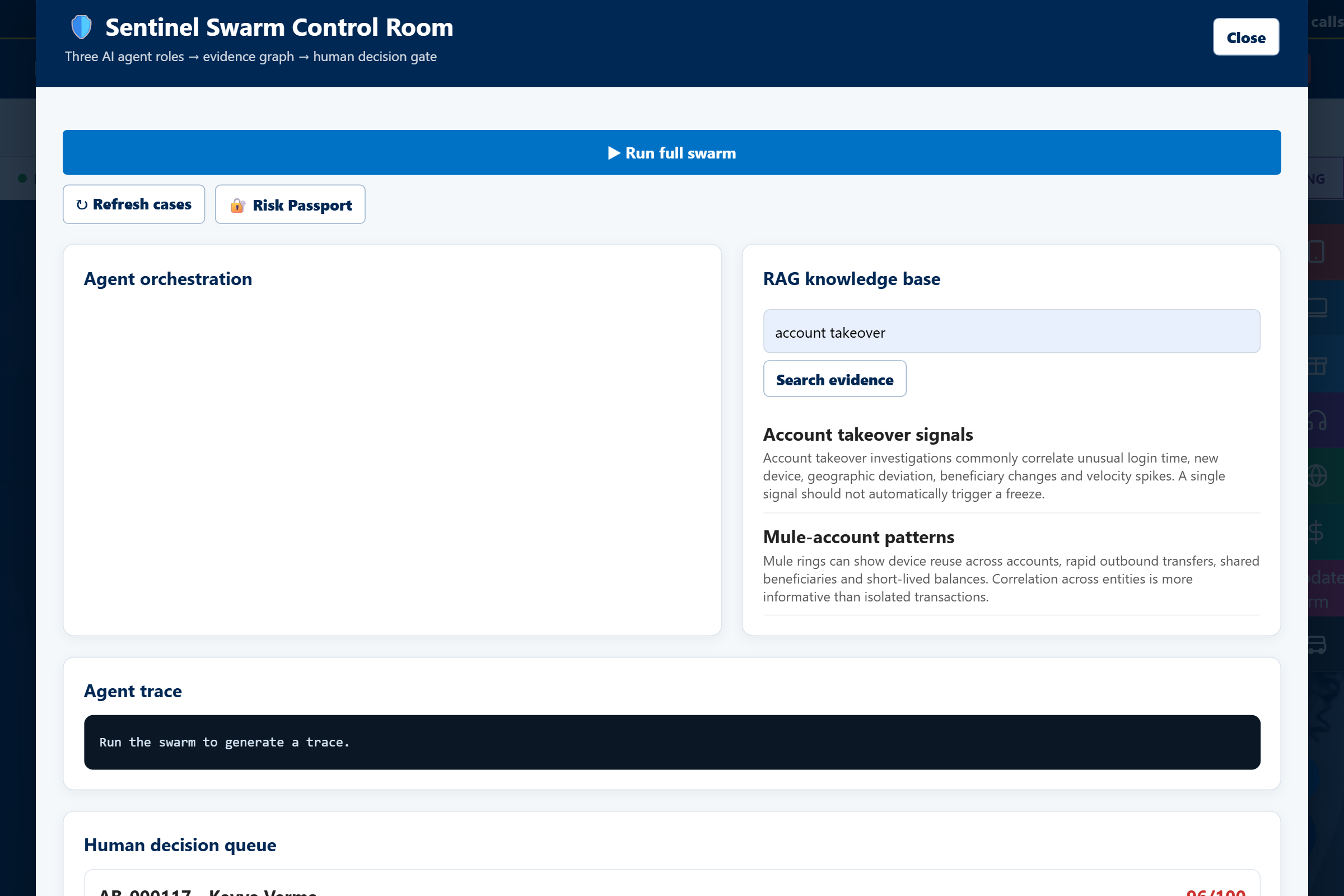
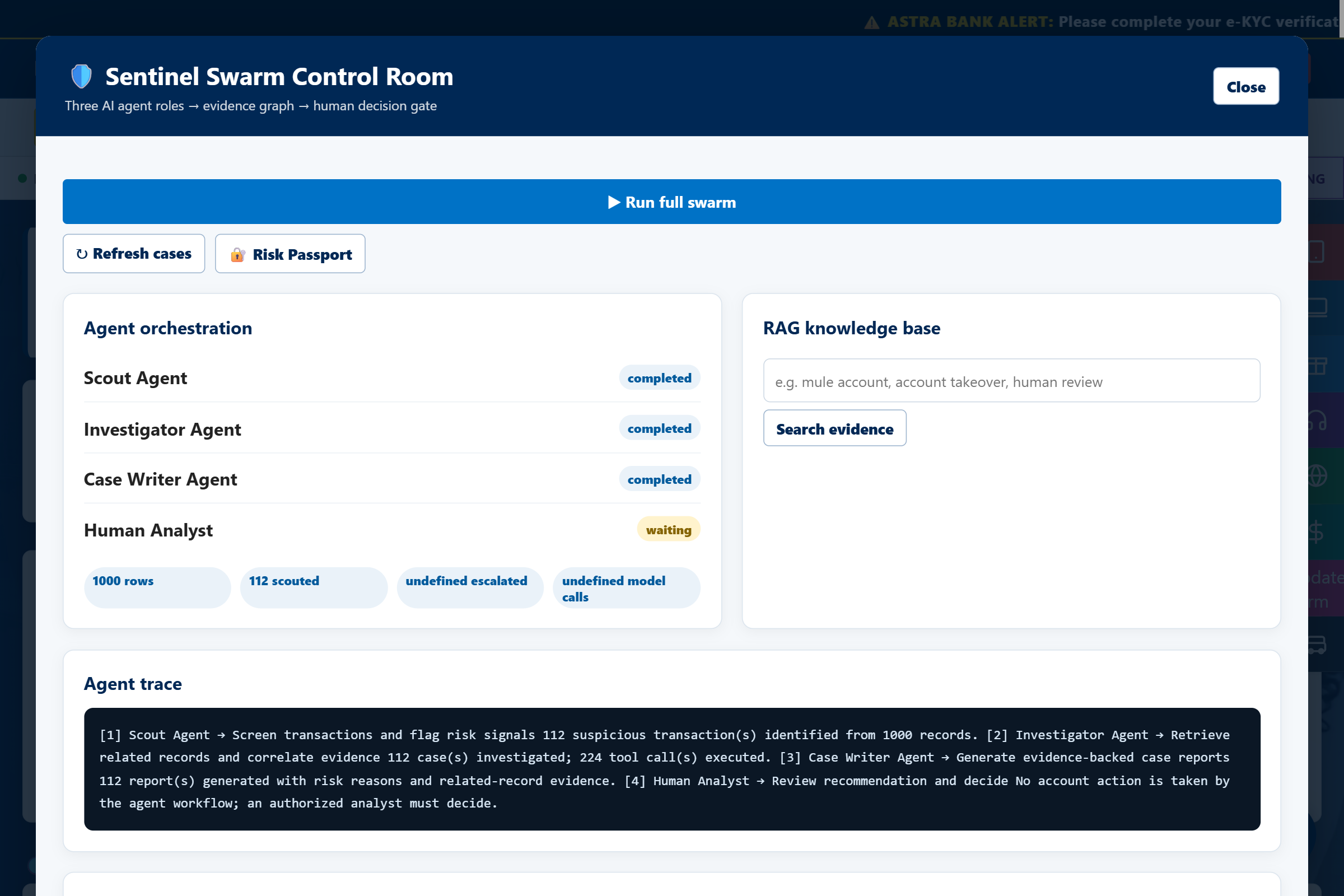
Sentinel Swarm Control Room highlighting agent orchestration, RAG knowledge base, and decision queues.
-
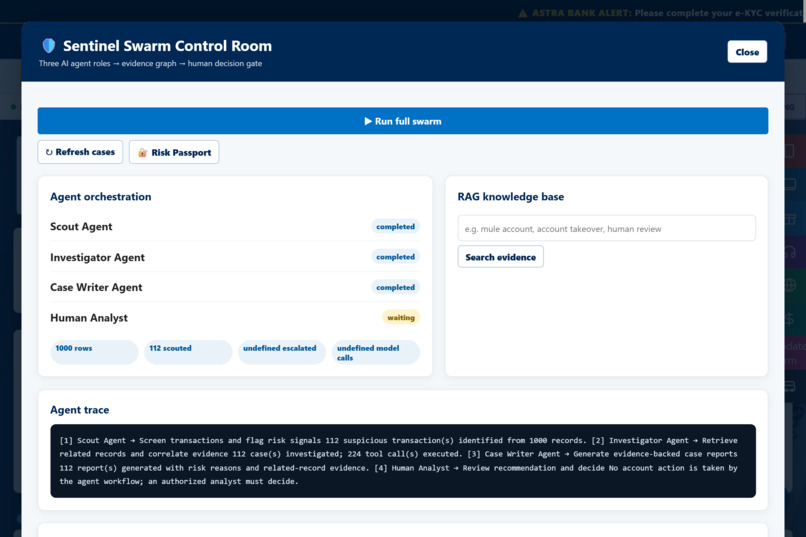
Running a full swarm simulation inside the Sentinel Control Room to flag suspicious transactions and generate automated case reports
-
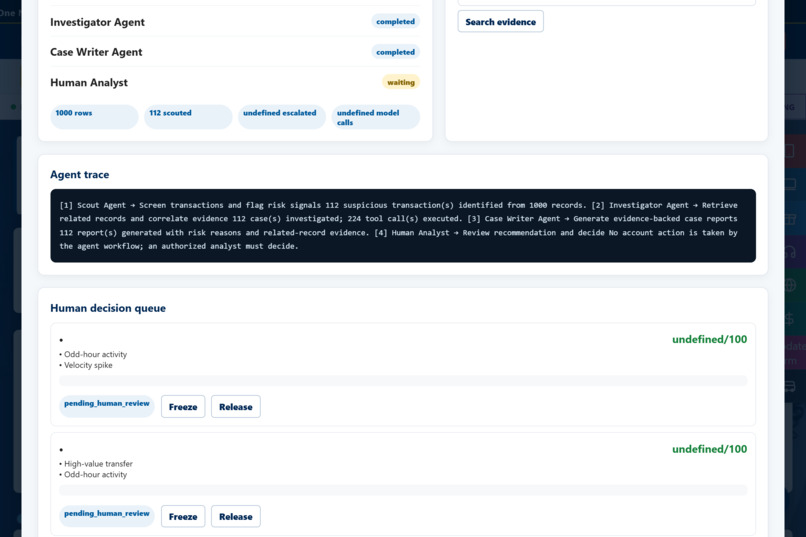
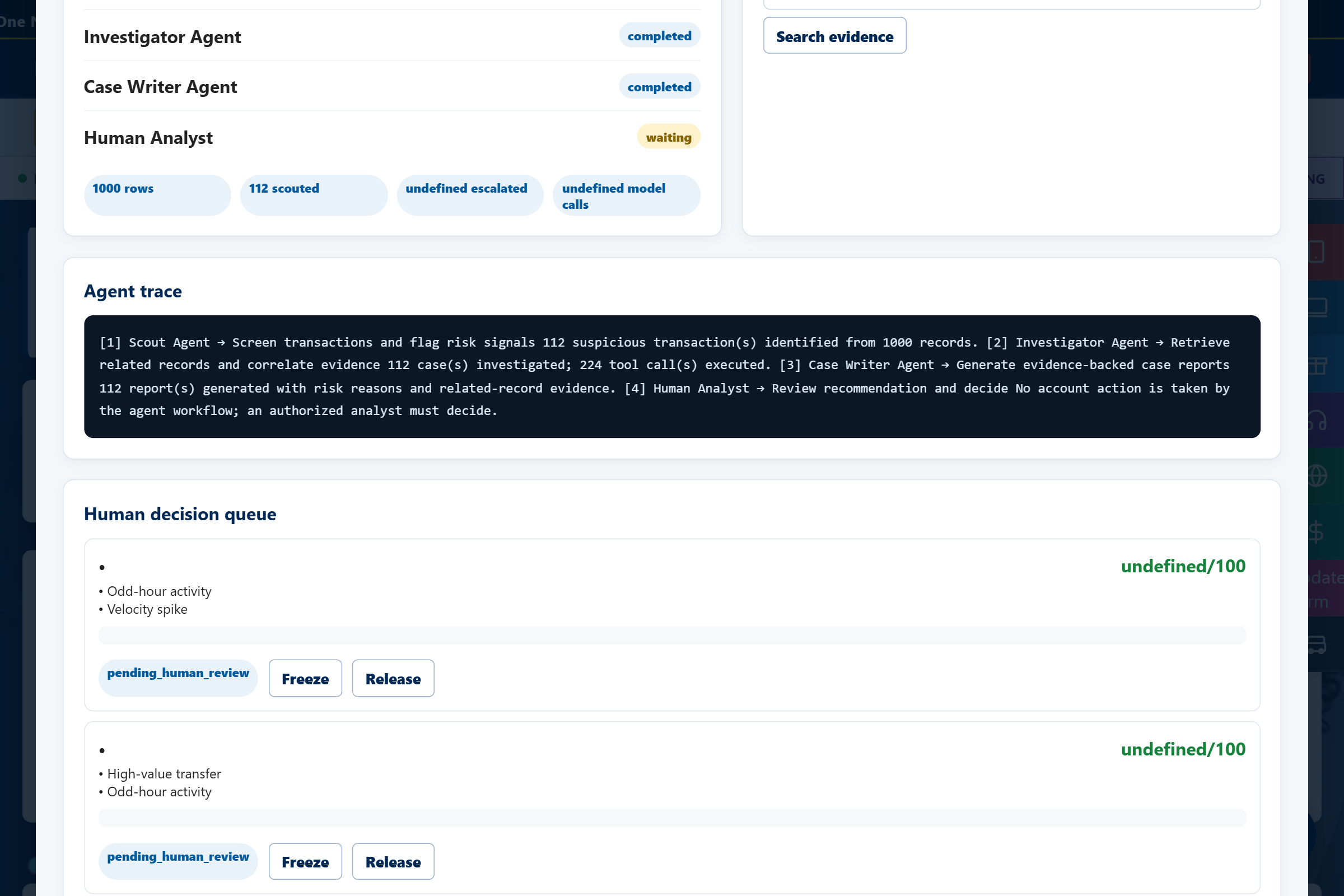
Reviewing odd-hour activity and velocity spikes in the Sentinel dashboard to decide real-time account freeze and release actions.
-
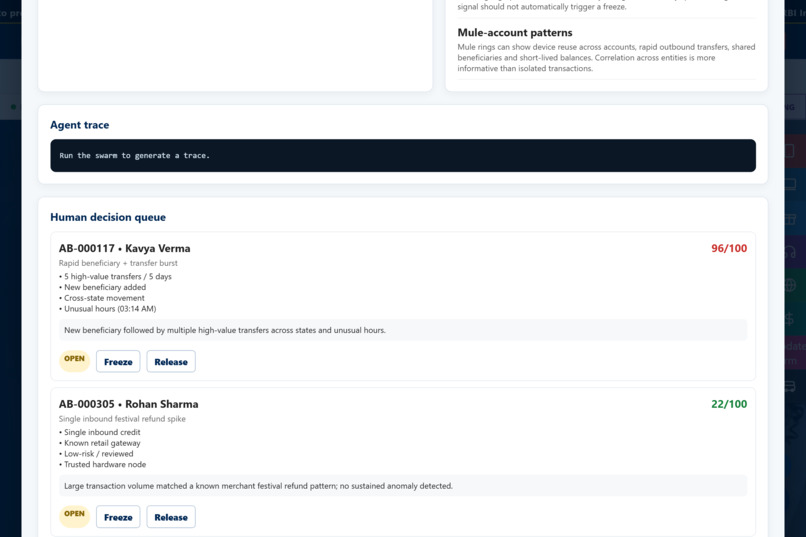
Human decision queue evaluating high-risk alerts like rapid beneficiary updates and transfer bursts.
-
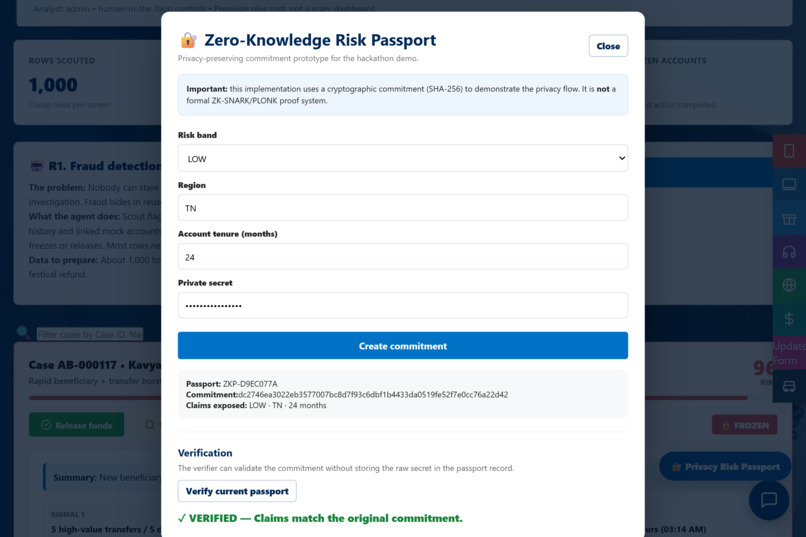
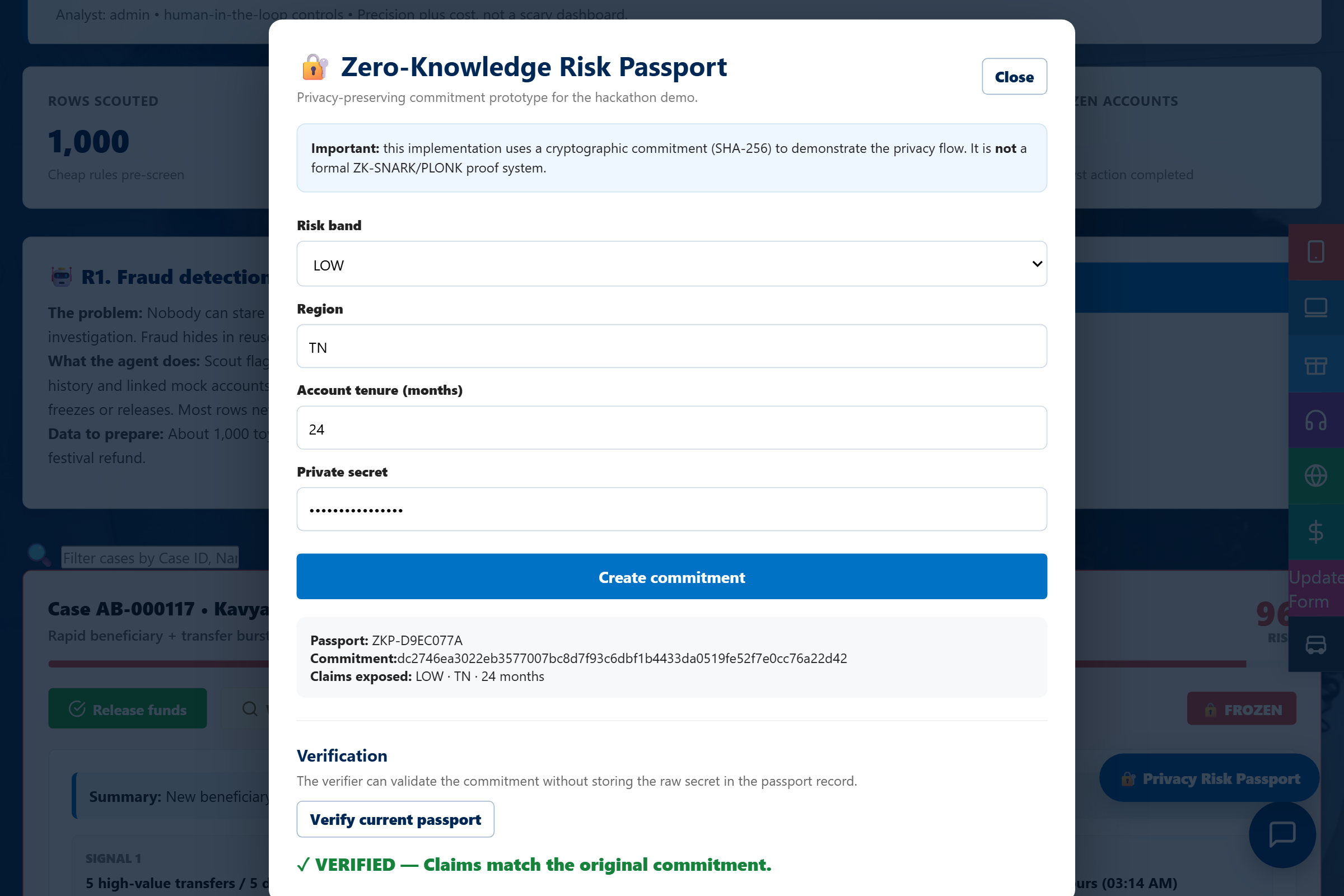
Zero-Knowledge Risk Passport verification showing cryptographic commitment validation for privacy-preserving claims.
Astra Bank Sentinel Swarm: Intelligent Fraud Detection and Privacy-Preserving Banking
Inspiration
Digital banking has made financial services faster and more accessible, but it has also created new challenges in fraud detection, account security, and customer privacy. Suspicious transactions can occur within seconds, and investigating them often requires connecting multiple signals, understanding transaction patterns, and distinguishing genuine customers from potential attackers.
Traditional fraud detection systems often rely on predefined rules or risk scores. While these approaches are useful, a suspicious score alone may not explain why a transaction is risky or provide investigators with enough context to make an informed decision.
We wanted to explore a better approach: What if multiple specialized AI agents could work together to investigate suspicious banking activity, explain their findings, and keep a human analyst in control of critical decisions?
This idea inspired Astra Bank Sentinel Swarm, a smart digital banking prototype that combines agent-based fraud investigation, human oversight, and a privacy-focused identity verification concept called the Zero-Knowledge Risk Passport.
Our goal was to demonstrate how banking security could become more intelligent, explainable, and privacy-conscious without losing sight of the customer experience.
What it does
Astra Bank Sentinel Swarm is a digital banking and fraud investigation prototype that brings customer banking features and an AI-assisted security workflow into one platform.* Cost-Efficiency Impact: The Scout Agent acts as a vital cost-containment layer. By filtering out roughly 85% of standard, low-risk transaction traffic using lightweight local heuristics, it ensures our higher-compute, LLM-powered Investigator Agent is only called for complex anomalies. *
1. Digital Banking Experience
The customer-facing interface demonstrates common digital banking features, including:
- Customer account information and banking dashboard.
- Card and fixed deposit information.
- Transaction history and account activity.
- KYC-related information.
- Astra Assist, a banking support interface.
- Freeze notifications and account-security interactions.
The prototype uses synthetic customer and transaction data to demonstrate the workflow without exposing real customer information.
2. Sentinel Swarm: Multi-Agent Fraud Investigation
The Sentinel Swarm workflow divides fraud investigation into specialized roles rather than asking one AI model to perform every task.
Scout Agent — Initial Screening
The Scout Agent performs lightweight, rule-based screening of transaction records to identify activity that may require further investigation. It helps filter large volumes of transactions before more expensive analysis is used.
Investigator Agent — Risk Analysis
The Investigator Agent examines suspicious activity in greater context. Signals can include rapid transaction bursts, new beneficiaries, unusual transaction timing, device-related anomalies, location changes, and deviations from expected account activity.
Case Writer Agent — Evidence Summary
The Case Writer Agent turns investigation findings into a concise case summary. It helps explain which signals were detected and why a transaction or account may deserve further review.
Human Analyst — Final Decision
The workflow keeps a human analyst in control of critical actions. The analyst reviews the evidence and decides whether an account or transaction should be escalated, restricted, frozen, or released according to the applicable policy.
3. Suspicious Activity Scenarios
The prototype demonstrates how different patterns can be assessed, such as:
- A rapid series of transfers involving a new beneficiary.
- Unusual transaction timing combined with a device or location anomaly.
- A benign transaction pattern, such as a legitimate refund, that should not automatically be treated as fraud.
Considering multiple signals helps illustrate why context matters: one unusual transaction does not necessarily mean an account has been compromised.
4. Zero-Knowledge Risk Passport
The Zero-Knowledge Risk Passport explores how a customer might prove that specific banking or identity requirements have been met without revealing unnecessary personal information.
Example claims include:
- KYC Verified.
- Identity Verified.
- Risk Policy Eligible.
- No Active Freeze.
- Stable Account Activity.
Instead of displaying every underlying detail, the concept focuses on communicating whether a particular requirement is satisfied. This illustrates the potential for privacy-preserving verification in digital banking, financial eligibility checks, and identity workflows.
Important implementation detail: The current prototype demonstrates a local cryptographic hash or commitment-based concept. It does not yet implement a complete zero-knowledge proof protocol. A production version would require a properly designed proof system and independent security testing.
How I built it
We built Astra Bank Sentinel Swarm as a self-contained web prototype using HTML, CSS, and JavaScript. The application combines a digital banking interface, simulated fraud-investigation workflows, synthetic transaction data, and a conceptual privacy-verification feature.
Core implementation
- Frontend: HTML, CSS, and JavaScript for the banking dashboard, transaction views, interface interactions, and investigation presentation.
- Synthetic data: Simulated customer records and transaction activity for demonstrating normal and suspicious patterns without using real customer data.
- Fraud screening: Rule-based checks to identify transactions that may need additional scrutiny.
- Agent workflow: Separate Scout, Investigator, and Case Writer roles to illustrate screening, contextual analysis, and case summarization.
- Human oversight: An analyst review stage that keeps critical account decisions under human control.
- Risk Passport concept: A local hash or commitment-based demonstration of how verification claims might be represented while reducing the need to display underlying data.
Investigation workflow
- Transaction records enter the initial screening stage.
- The Scout Agent identifies potentially suspicious activity.
- The Investigator Agent examines relevant signals and patterns.
- The Case Writer Agent prepares a readable explanation of the findings.
- A human analyst reviews the evidence before deciding on an appropriate response.
This modular design makes the investigation process easier to understand and provides a foundation for future improvements, such as more advanced anomaly detection, secure backend services, and stronger privacy-preserving verification.
The prototype is a demonstration of the proposed workflow, not a production banking service. Its simulated data and local implementation are intended to show the concept rather than provide live financial security.
Challenges I ran into
One of our main challenges was balancing fraud detection with the risk of false positives. A transaction can be unusual without being fraudulent, so treating every anomaly as proof of wrongdoing could disrupt legitimate customers. This motivated us to consider multiple signals and include a human review stage.
Another challenge was organizing the investigation into distinct agent responsibilities. Screening, deeper investigation, and report writing serve different purposes, and keeping those roles separate helped us design a clearer workflow.
We also had to consider explainability. Identifying suspicious activity is only part of the problem; investigators need to understand what triggered an alert and which evidence supports it. The Case Writer role was designed to make the results easier to review.
Privacy presented a separate challenge. A system should not need to reveal every customer detail simply to establish that a requirement has been met. The Zero-Knowledge Risk Passport helped us explore this principle, while also making clear that a hash or commitment alone is not equivalent to a complete zero-knowledge proof. I also had to tackle data silo challenges during contextual analysis. Fraud looks at transaction behavior (amounts, frequencies), while cybersecurity looks at system telemetry (device IDs, network anomalies). We trained the Investigator Agent to bridge this gap, analyzing financial patterns alongside device security signals simultaneously to form a single, unified risk assessment.
Finally, we had to distinguish a working prototype from a production-ready security platform. A real banking deployment would require secure server-side authentication and authorization, protected databases, encrypted communications, audit logging, secure key management, robust fraud models, and extensive security testing. These remain important areas for future development.
Accomplishments that I am proud of
We are proud of bringing several related ideas together in one coherent banking-security prototype.
- A multi-agent investigation concept: We divided the workflow into specialized screening, investigation, and case-writing responsibilities.
- A human-in-the-loop approach: We designed the workflow so that important account actions are reviewed by a human rather than treated as automatic consequences of an AI-generated risk assessment.
- Context-aware fraud scenarios: We explored how combinations of transaction timing, transfer velocity, beneficiary changes, device signals, and location changes can help identify activity that deserves investigation.
- A customer-facing banking interface: We combined security concepts with a digital banking experience instead of presenting fraud detection as an isolated backend feature.
- A privacy-focused verification concept: We introduced the Zero-Knowledge Risk Passport to explore selective disclosure and the possibility of verifying claims without unnecessarily exposing personal information.
- A modular foundation: The separation of agent responsibilities creates a foundation for future testing, improvements, and integration with stronger security infrastructure.
Most importantly, we learned to think about banking security as more than detecting suspicious transactions. It also involves producing understandable evidence, protecting customer privacy, and making responsible decisions.
What I learned
Building Astra Bank Sentinel Swarm helped us understand that effective fraud investigation requires more than a single risk score. Transaction context, multiple signals, and clear explanations can all contribute to a more useful review process.
We learned that specialized agents can make a complex workflow easier to organize, but their outputs still need validation. AI-generated explanations should be supported by evidence, and high-impact decisions should include appropriate oversight.
We also learned the importance of distinguishing fraud detection from cybersecurity. Fraud detection focuses on identifying potentially unauthorized or deceptive financial activity, while cybersecurity protects the systems, identities, data, and infrastructure that make banking possible. A complete solution needs both.
The Zero-Knowledge Risk Passport taught us another important lesson: privacy-preserving verification requires more than hashing information. A cryptographic commitment, a hash, and a formal zero-knowledge proof have different properties. A genuine zero-knowledge implementation needs a suitable protocol, correct verification logic, careful handling of secrets, and independent review.
Finally, we learned that a prototype can demonstrate an idea without claiming to solve every production challenge. Being transparent about what is implemented, what is simulated, and what still needs to be built is an essential part of responsible security engineering.
What's next for Astra Bank Sentinel Swarm
Our next goal is to evolve Astra Bank Sentinel Swarm from a concept demonstration into a more robust, testable, and privacy-conscious platform.
1. Stronger Fraud Detection
We plan to explore anomaly-detection models, more realistic transaction patterns, improved risk scoring, and systematic evaluation using labeled synthetic datasets. We also want to measure false positives, false negatives, and investigation quality.
2. More Explainable Investigations
We want to improve the evidence trail for each alert, showing which signals contributed to the risk assessment and how the final case summary relates to the underlying transaction data.
3. A Real Zero-Knowledge Risk Passport
We aim to investigate a well-established zero-knowledge proof protocol that can verify selected claims without disclosing the underlying personal information. This would require careful protocol selection, soundness and privacy testing, secure key management, and independent cryptographic review.
4. Production-Grade Cybersecurity
Future versions would need a secure backend, strong authentication and authorization, encrypted communications, protected data storage, tamper-resistant audit logs, secure secrets management, and a defined incident-response process. Security testing and threat modeling would be integral to this stage.
5. Better Human Oversight
We plan to develop an analyst console with case prioritization, evidence timelines, review notes, escalation paths, and a clear record of decisions. Account restrictions would follow explicit policies and appropriate authorization rather than relying solely on an automated model.
6. End-to-End Testing and Evaluation
We want to test the system against a wider range of normal and suspicious scenarios, including account takeover attempts, rapid transfers, unusual beneficiary activity, and legitimate transactions that resemble fraud. This would help us evaluate both detection quality and the impact on genuine customers.
Our long-term vision is to build a banking-security platform that combines intelligent investigation, explainable decisions, human accountability, and privacy-preserving verification—helping make digital banking safer without treating customer privacy as an afterthought.
Astra Bank Sentinel Swarm combines multi-agent fraud investigation, human-reviewed security decisions, and a privacy-first identity verification concept for safer digital banking.
Astra Bank Sentinel Swarm is a digital banking security prototype that uses specialized AI-agent roles to screen transactions, investigate suspicious patterns, and summarize evidence for human review. It also introduces the Zero-Knowledge Risk Passport, a concept for verifying selected banking claims while minimizing unnecessary disclosure of customer information. Built with HTML, CSS, JavaScript, and synthetic data, the project explores explainable fraud investigation, cybersecurity, and privacy-conscious banking.
Built With
- aiagents
- anomalydetection
- artificialintelligence
- banking
- cost-optimization
- cross-telemetry
- cybersecurity
- dataanalytics
- explainableai
- financialsecurity
- fintech
- frauddetection
- fraudprevention
- generativeai
- humanintheloop
- intelligentautomation
- kyc
- llm
- machine-learning
- multiagentsystems
- rag
- response-automation
- riskanalysis
- transactionmonitoring
- webdevelopment


Log in or sign up for Devpost to join the conversation.