Inspiration
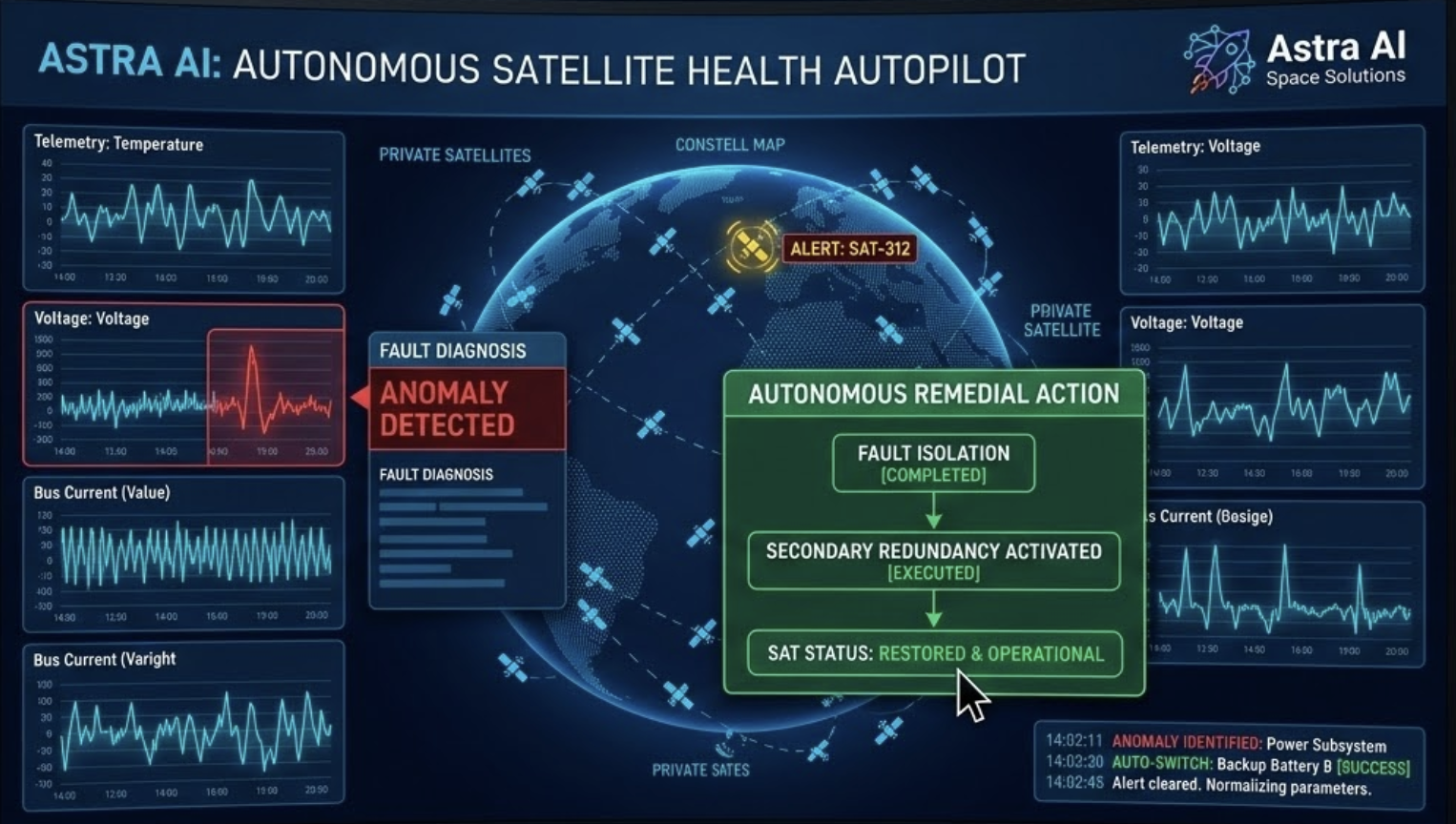
Space systems are mission-critical, but the software used to build, maintain, and operate them still depends heavily on manual development and deployment workflows. We started Astra AI with the idea of making satellite health monitoring more intelligent through anomaly detection, predictive analysis, and real-time fleet visibility.
While building the project, we identified a second challenge: even a powerful AI-driven application is only useful when its software can be reliably tested, secured, deployed, and monitored. This led us to explore the problem behind "Life After Code" - what happens after developers write the code?
For this hackathon, we are extending Astra AI into an agentic DevSecOps workflow that can help move mission-critical software from development towards production with much less manual effort.
What We Built
Astra AI is an AI-powered satellite health monitoring and predictive intelligence platform focused on anomaly detection, Remaining Useful Life (RUL) forecasting, and fleet monitoring.
For this hackathon, we are building an additional "agentic software delivery layer" around the Astra AI application. The goal is to use GitLab's agentic capabilities to automate important stages of the software lifecycle after code is written.
Our workflow is designed around:
"Plan → Create → Verify → Secure → Package → Release → Configure → Monitor → Govern"
The agents can analyse development changes, trigger validation and testing workflows, identify issues, assist with remediation, perform security and quality checks, and prepare the application for deployment and monitoring.
The result is not simply another AI chatbot. The objective is to demonstrate an AI-driven workflow that can actually perform meaningful software-engineering and DevSecOps tasks.
How We Built It
The original Astra AI application was developed as a modern web application using React, TypeScript, Vite, Tailwind CSS, and shadcn/ui, with Supabase components included in the project architecture.
For the hackathon extension, we are integrating the application with GitLab's agentic development and CI/CD capabilities. The new layer connects software-development events with automated validation, security, deployment, and monitoring workflows.
The architecture separates the core Astra AI application from the agentic delivery layer, allowing the agents to operate across the software lifecycle without changing the underlying purpose of the satellite-health platform.
What We Learned
The biggest learning was that AI-assisted coding is only one part of modern software development. The larger opportunity is to automate the entire journey from a code change to a reliable production system.
We learned how agentic workflows can coordinate multiple software-engineering tasks, how automated validation can reduce repetitive manual work, and how CI/CD, security, monitoring, and governance can become part of an intelligent workflow rather than isolated tools.
We also learned that autonomy must be balanced with reliability. For mission-critical applications, an agent should not simply act quickly; it should validate its decisions, surface evidence, and provide appropriate human oversight when required.
Challenges We Faced
The main challenge was designing an agentic workflow that performs real actions rather than simply generating recommendations.
Another challenge was balancing autonomy with safety. A satellite-related software platform is a high-stakes environment, so automated testing, security validation, controlled deployment, and human approval become especially important.
We also had to integrate the existing Astra AI application with a new software-delivery workflow without losing the simplicity and usability of the original platform.
Future Vision
Our long-term vision is to make Astra AI more than a satellite health monitoring platform. We want it to become a reliable autonomous engineering layer for mission-critical space software — helping teams move from development to production faster while improving software quality, security, observability, and operational reliability.
Built With
- css
- react
- shadcn/ui
- supabase
- tailwind
- typescript
- vite

Log in or sign up for Devpost to join the conversation.