Inspiration
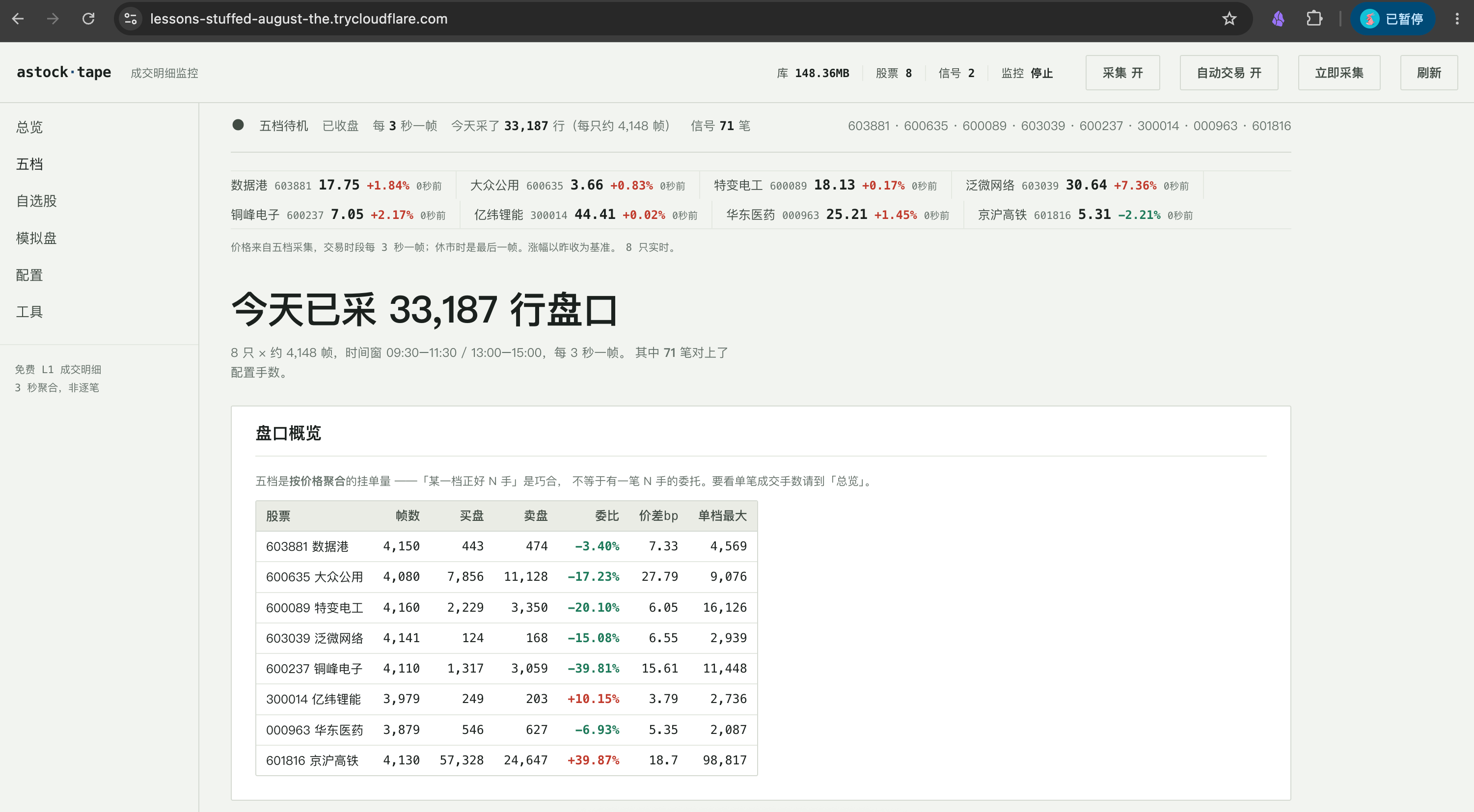
A-share retail traders only get free Level-1 data, and it has a dirty secret: the "tick-by-tick" feed is not tick-by-tick at all — the exchange/vendor aggregates everything into ~3-second windows. Inside one window you can't tell whether 666 lots were a single institutional order or 200 retail fills.
Traders in China read integer lot counts as signals ("XXX", "YYY" — the so-called 盘口暗号). But no free tool lets you capture, search, and alert on them. And because free sources only serve the latest trading day, a day you don't capture is a day that is gone forever.
So I built astock: a zero-dependency, runs-on-a-laptop pipeline that captures the feed before it evaporates, indexes it by lot size, and taps you on the shoulder the moment a XXX-lot buy prints.
What it does
Capture — polls Level-2-style order-book snapshots every 3 s and pulls
incremental trade details by sequence cursor every 15 s during market hours,
plus 4 scheduled daily jobs (morning full backfill, afternoon increment,
daily-bar backfill, feature snapshot).
Search — find every print with lot count ∈ {XX, YY, XXX,YYY, …}, or
≥ a threshold, by amount, by side, by natural-language query
(astock ask "今天 XXX 手的买单").
Alert — a rule engine (lots_in / lots_gte / amount_gte / shares_in /
shares_gte) with per-rule cooldowns, macOS/terminal/webhook notifications.
Research — daily feature snapshots with T+1 / T+5 forward-return labels
$r_{T+1} = P_{T+1}/P_T - 1$, an event-study module, and a paper-trading
engine with pool-based capital allocation.
How we built it
Pure Python standard library — no pip, no npm. The web UI is
http.server.ThreadingHTTPServer serving a single hand-written HTML file;
storage is SQLite; scheduling is an in-process thread pinned by a cross-process
singleton lock in the database (so the launchd daemon and the web server can
never run the same job twice).
The trickiest architectural seam: the paper-trading logic layer is plain
JavaScript, built by tools/build_sim.py into a single file, and the Python
scheduler drives it through a Node subprocess — one source of truth for both
backtest and live simulation.
Security: HMAC-signed session cookies, constant-time comparison, per-IP login rate limiting, Origin-based CSRF checks, and a default bind to 127.0.0.1.
Challenges we ran into
The 3-second window. A "XXX-lot trade" may be an aggregate. We tag every
record with a confidence level — confirmed_single only when the source
reports the window contained exactly $n=1$ trades — and never let the rule
engine overclaim.
Perishability. Miss a day and it's unrecoverable. Every scheduled slot is
persisted in schedule_runs; a run only "counts" if executed after its
planned time, so a 00:33 manual catch-up can never silently cancel the real
15:40 job (that exact bug once made one slot fire 15+ times in a day).
Time-of-day vs. calendar. Comparing start_time < slot_time as wall-clock
times breaks the day after a long-running process crosses midnight — the
fix is date-aware comparison, learned the hard way.
Two writers, one truth. The same lot-size config once lived under two key
names; divergence caused duplicate alerts. Now normalization at load time
keeps a single authoritative schema with legacy aliases synced.
Accomplishments that we're proud of
- 1,756 unit tests, all green** — in a project with zero third-party deps.
- 20,815 trade records re-captured in 92 s during a live recovery drill.
- Weeks of unattended 3-second polling with order-book frame counts reconciled against the vendor's own sequence numbers.
- A UI honest about epistemics: "no data yet" and "no matches" are rendered as different states, because they are different statements.
What we learned
Snapshots and increments have opposite failure modes: a missed order-book frame is gone forever (poll tightly), while trade details are cursor-based (poll lazily, lose nothing). More generally: in a data tool, "we never got it" and "we got it and it matched nothing" must never share a code path — most silent-failure bugs are exactly that confusion.
What's next for astock
- Real Level-2 (Shenzhen order-by-order feed) to resolve the 3-second ambiguity for good.
- Failover across the four free quote sources when one is rate-limited.
- Pattern mining over lot-count sequences, not just single prints.
- A proper public release with a one-command installer.
