-
-
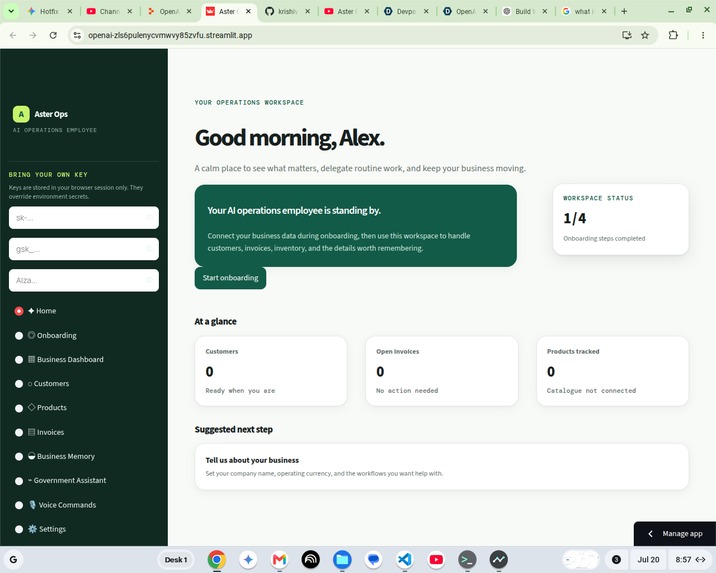
Home screen
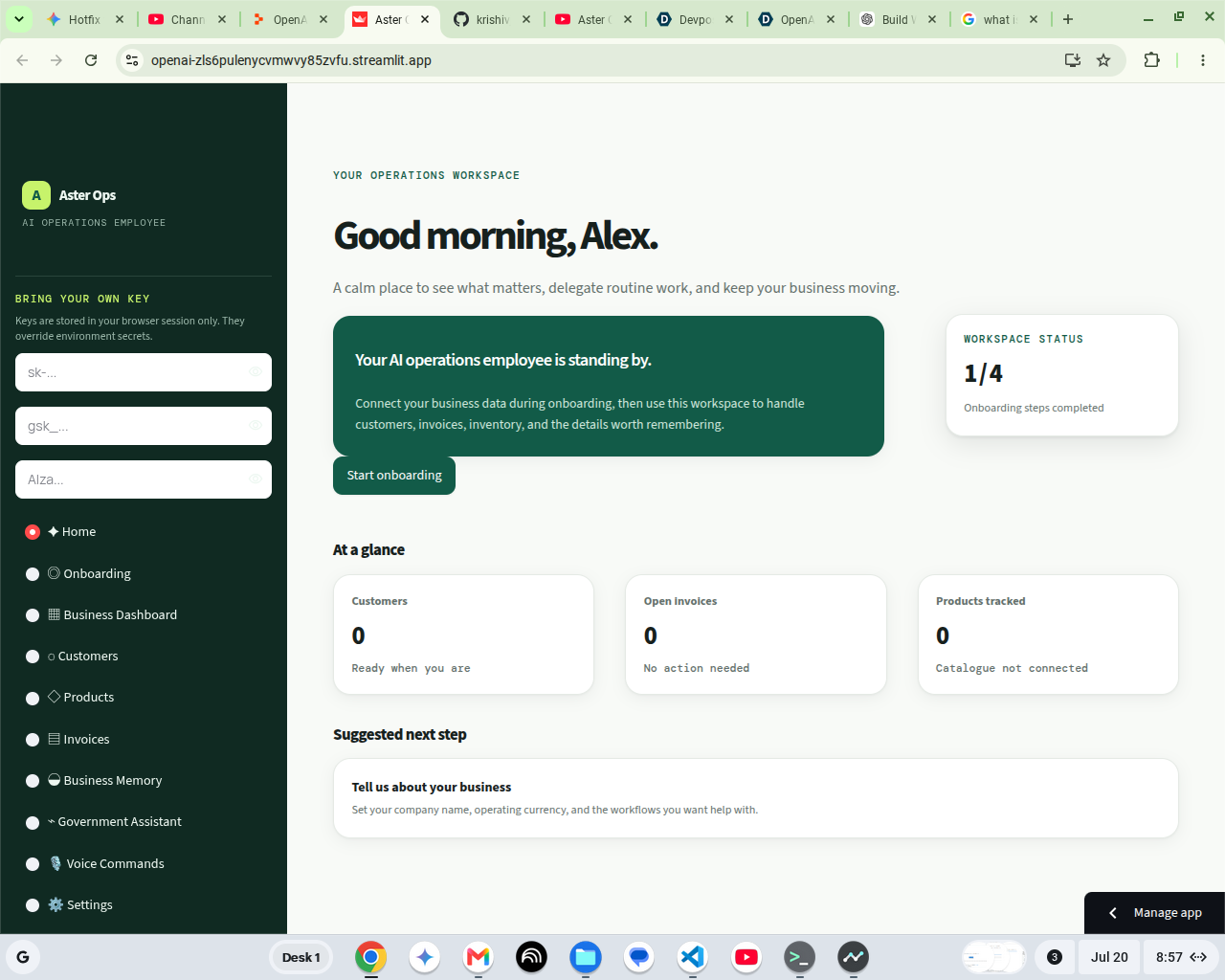
Inspiration
Small businesses drown in manual back-office noise—shuffling chaotic PDF invoices, managing fragmented customer records, and wrestling with rigid ERP sheets instead of focusing on growth. That daily friction inspired Aster Ops: an autonomous, AI-driven operations employee designed to handle back-office overhead entirely through natural language and voice commands.
What it does
Aster Ops acts as a digital operations workspace that replaces traditional manual spreadsheets and clunky interfaces. It features intelligent onboarding and document extraction, a real-time database-backed business dashboard, a flexible customer and product catalog, automated invoice tracking, durable business-scoped memory (RAG) for company preferences, and an administrative government assistant for regulatory compliance guidance in both English and Hinglish.
How we built it
Built specifically for OpenAI Build Week, we engineered a modular Python architecture combining Streamlit for a fast, responsive user interface, SQLAlchemy 2.x for robust relational persistence, and Alembic for schema migrations. Crucially, we collaborated heavily with OpenAI Codex and GPT-5.6 to design our core backend structure, implement fuzzy CSV header mapping, wire up the OpenAI Responses API, and build structured output validation loops.
Challenges we ran into
Balancing asynchronous file-parsing pipelines with a clean frontend layout inside Streamlit presented several state-management hurdles—especially when mapping extracted invoice rows safely before committing them to the database. Codex significantly accelerated our workflow by helping us rapidly debug these edge cases and streamline our ingestion logic.
Accomplishments that we're proud of
- Delivering a fully functional, end-to-end AI workspace rather than just a simple chat wrapper.
- Implementing dual-language support (English and Hinglish voice inputs) to make regional business operations truly effortless.
- Seamlessly integrating structured AI responses with a real-time financial tracking database.
What we learned
We gained deep practical insights into designing agentic tool-calling loops, handling messy unstructured documents gracefully, and leveraging OpenAI Codex to accelerate full-stack Python development under tight hackathon timelines.
What's next for Aster Ops
- Expanding our automated document processing engine to support multi-page tax filings and receipt reconciliation.
- Deepening multi-agent delegation so multiple specialized AI employees can collaborate on back-office operations simultaneously.
Built With
- alembic
- api
- bot
- codex
- dotenv
- gemini
- gpt-5.6
- groq
- openai
- postgresql
- pydantic
- python
- sqlalchemy
- sqlite
- streamlit
- telegram

Log in or sign up for Devpost to join the conversation.