-
-
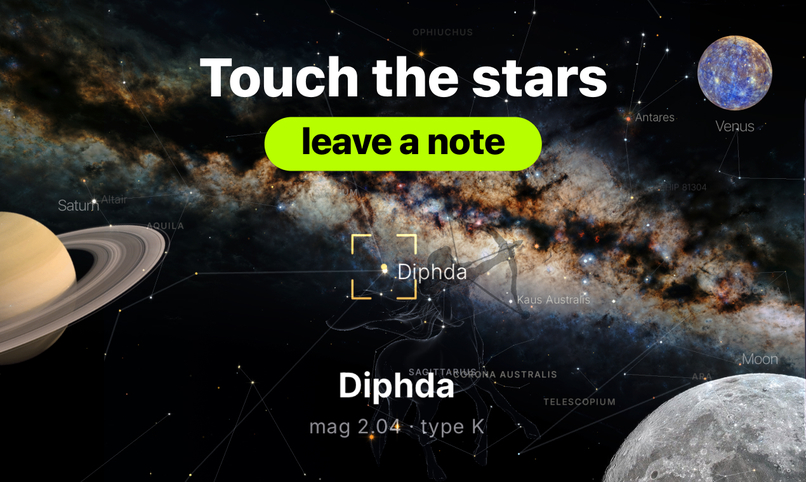
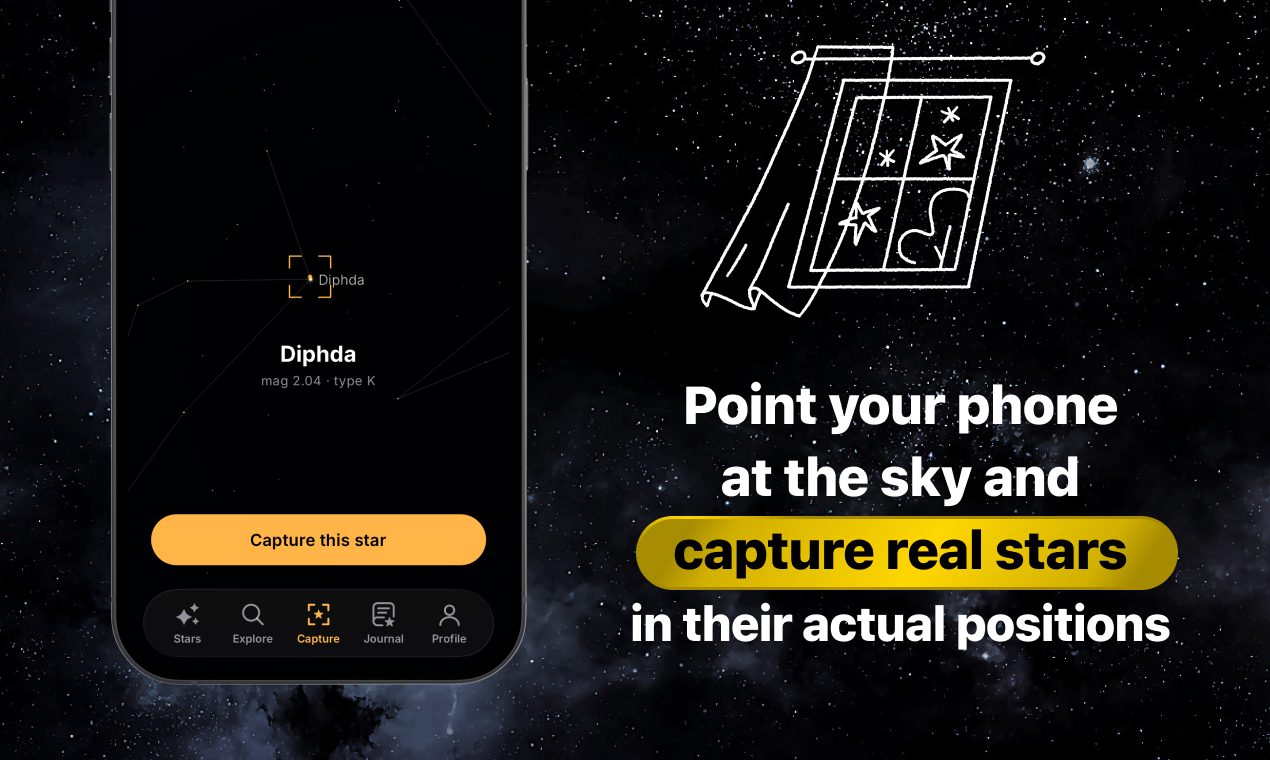
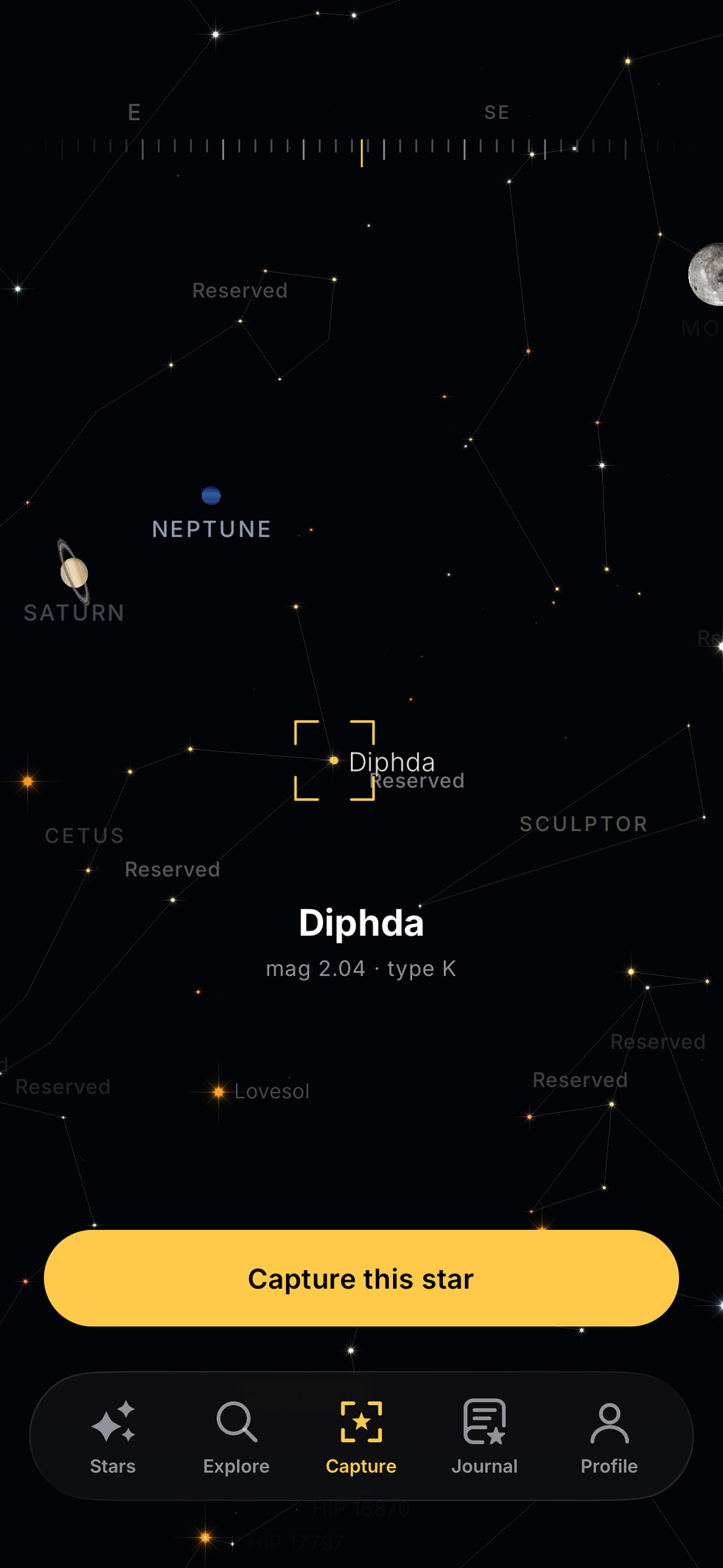
Tap any star to open it. Diphda, magnitude 2.04, type K, in the same sky as Saturn, Venus, the Moon and the constellation lines.
-
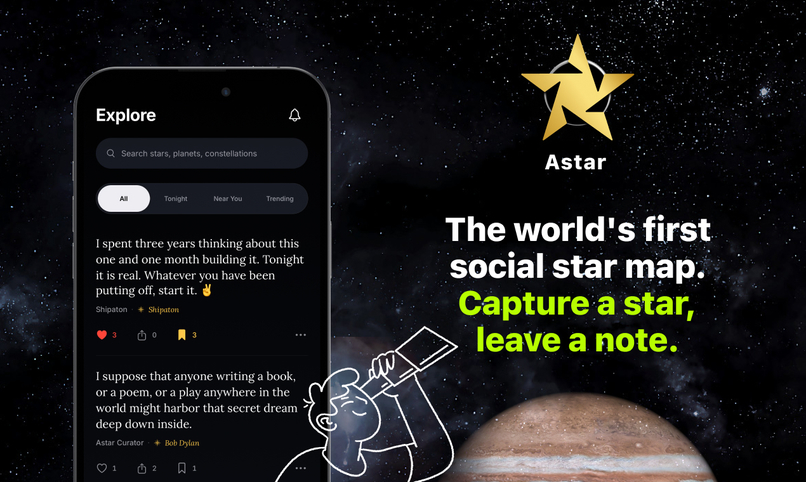
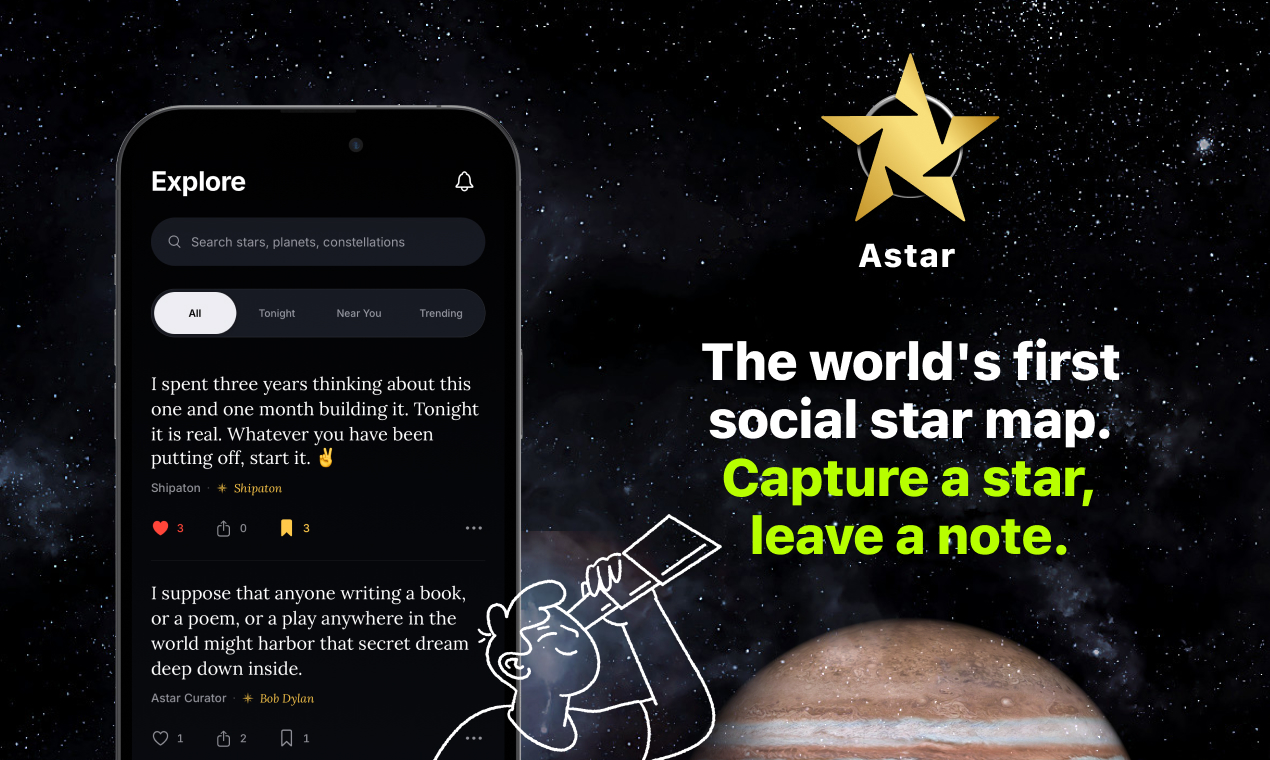
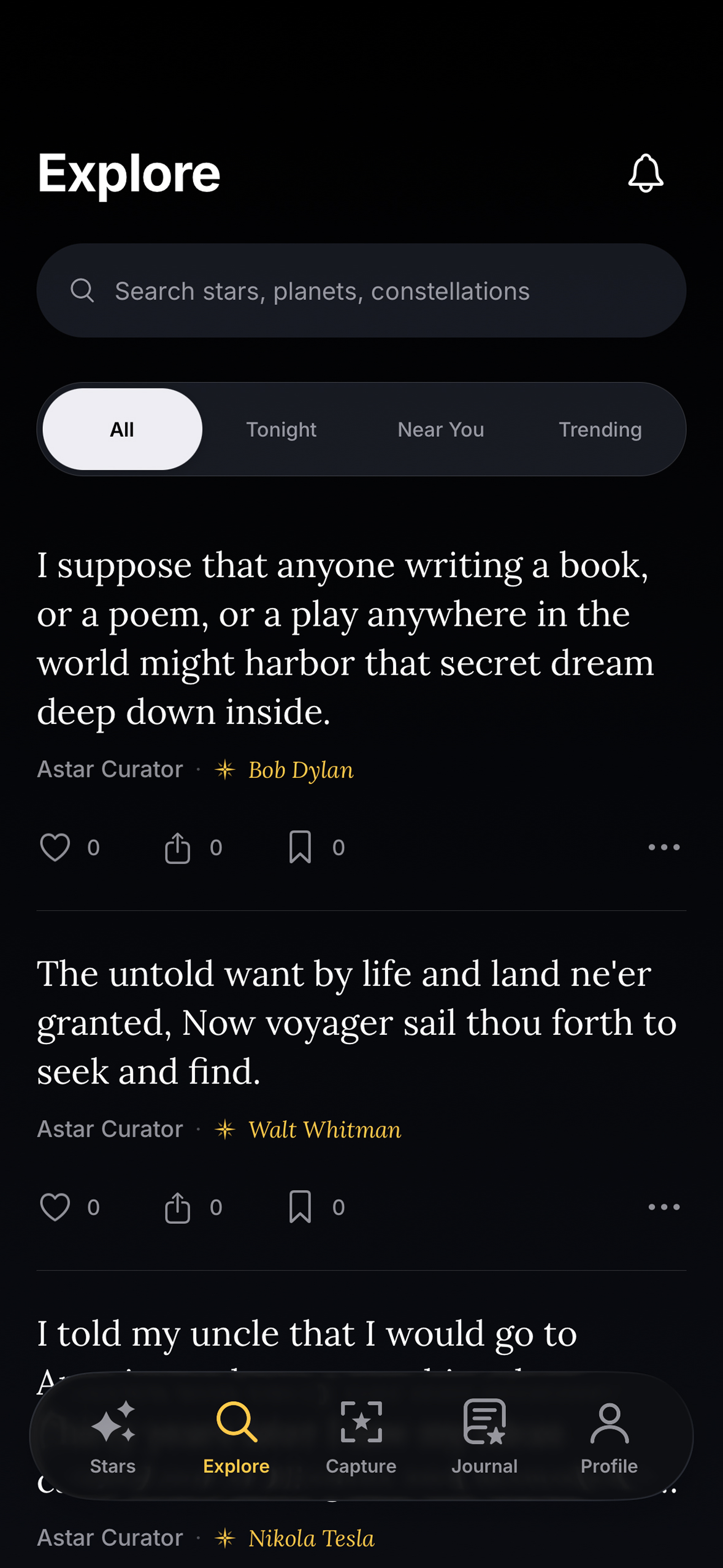
Explore is the public feed. Every note sits on a real star someone tapped, filtered by All, Tonight, Near You or Trending.
-
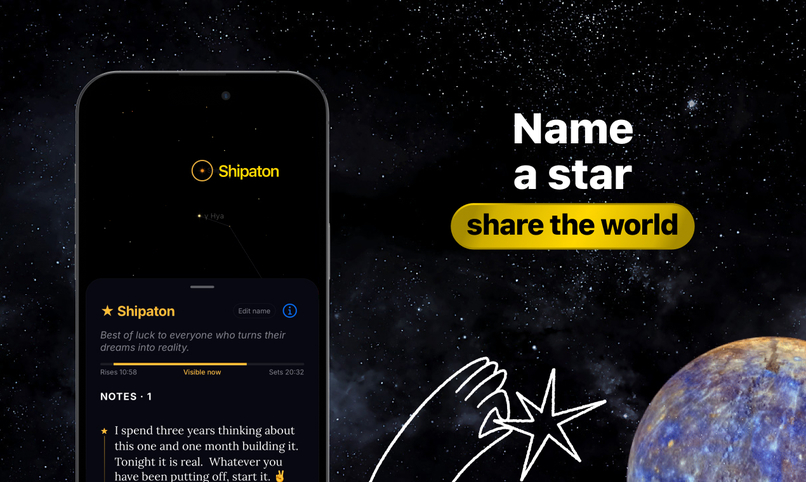
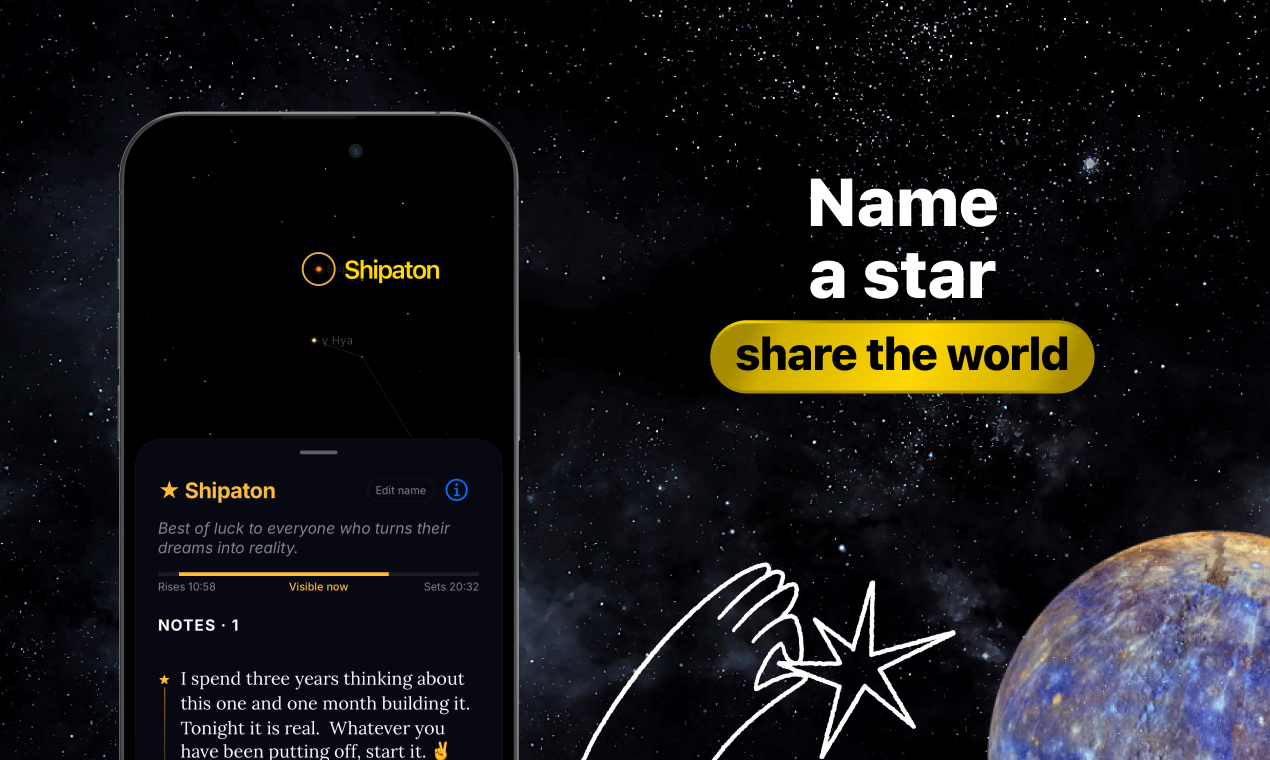
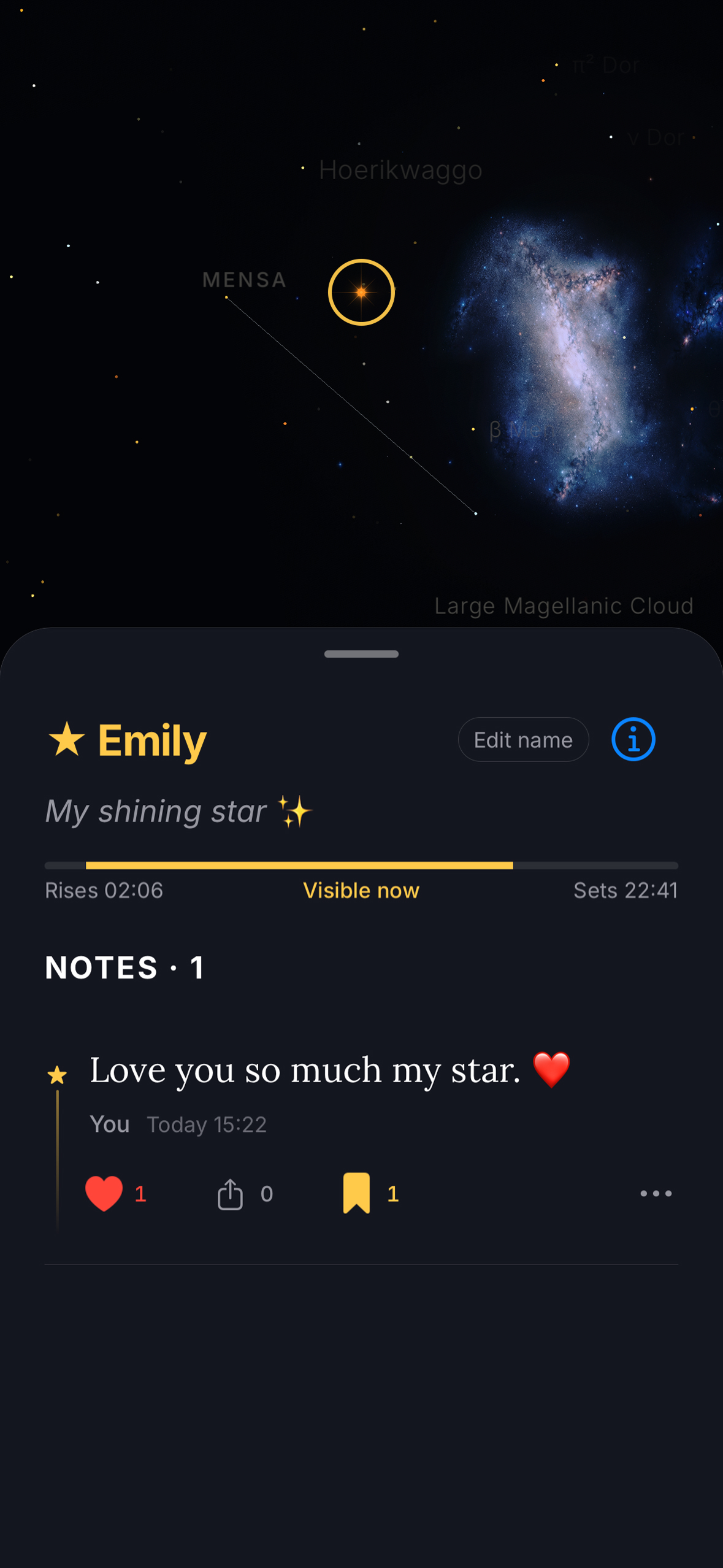
Naming a star is a lease, not a deed. This one is named Shipaton for a month, carrying a note and its own rise and set times.
-
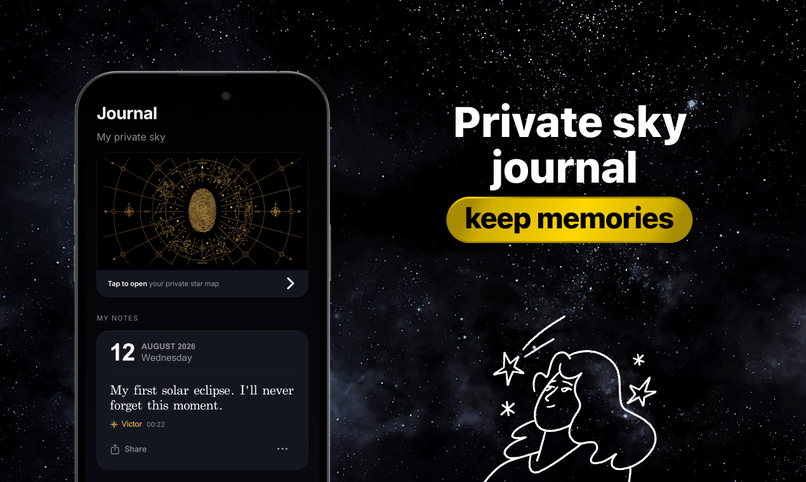
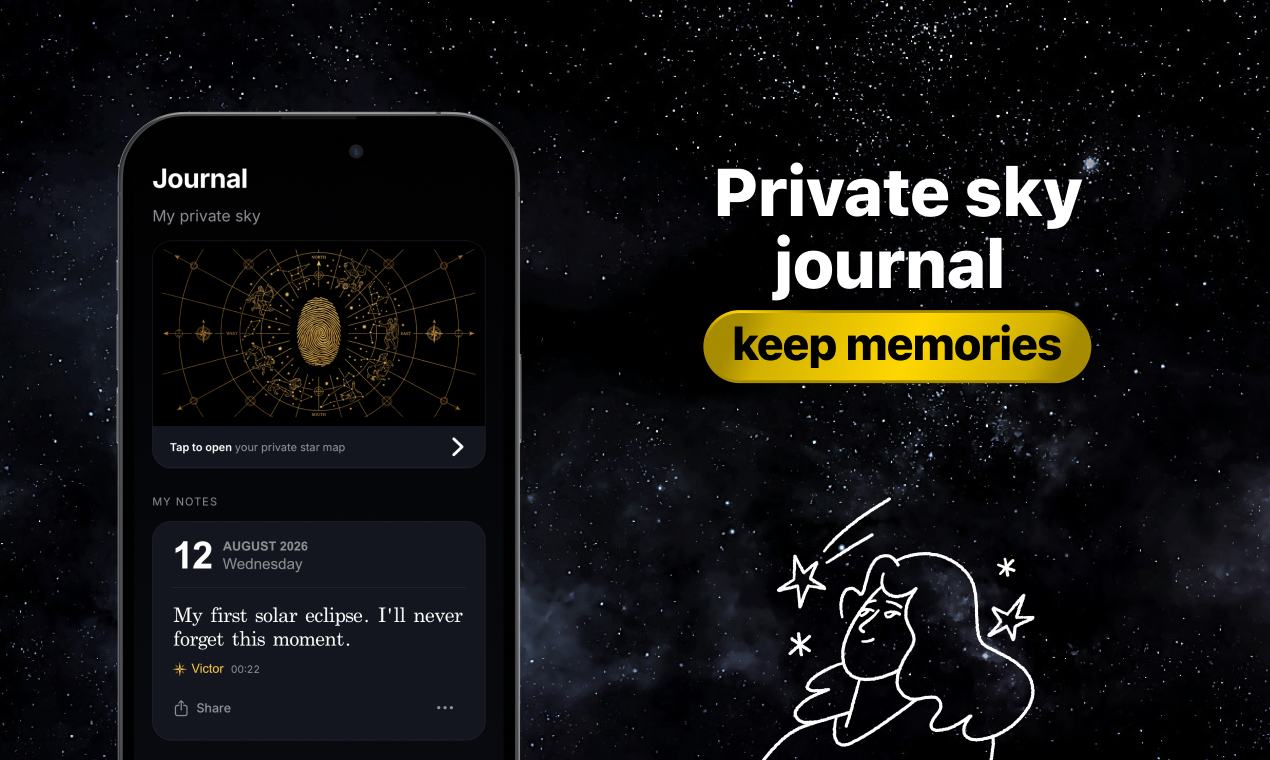
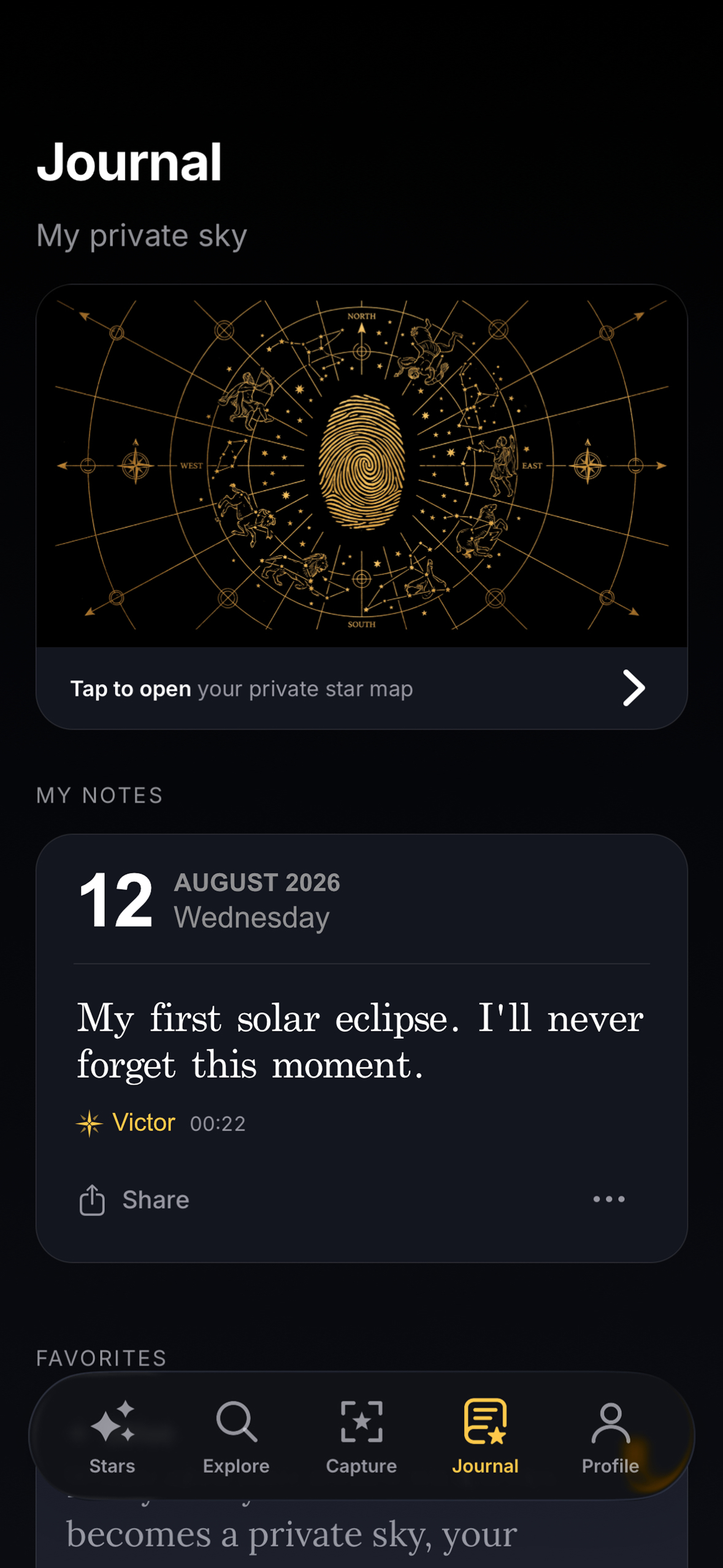
Journal is your private sky. Your own notes, on your own stars, on a map nobody else can see.
-
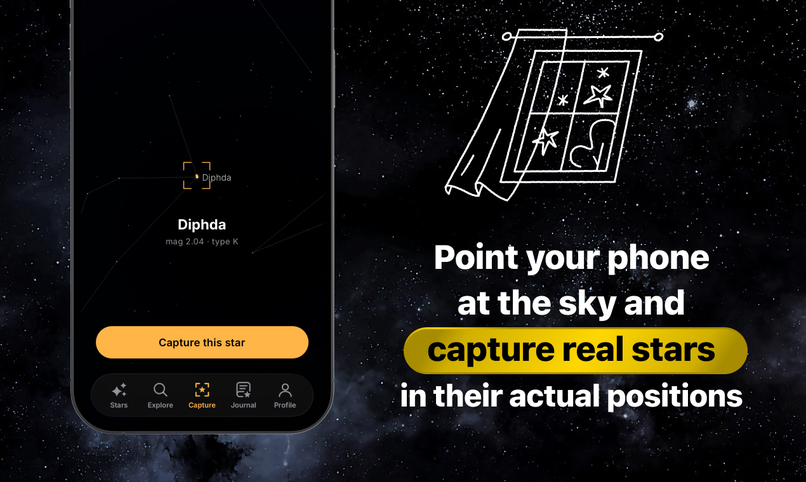
Point the phone at the sky and capture the star it is aimed at, in its real position for your location and the minute you look.
-
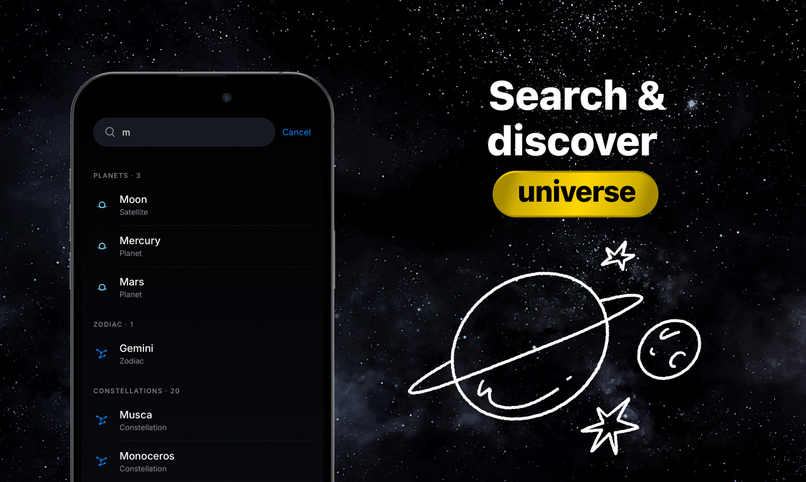
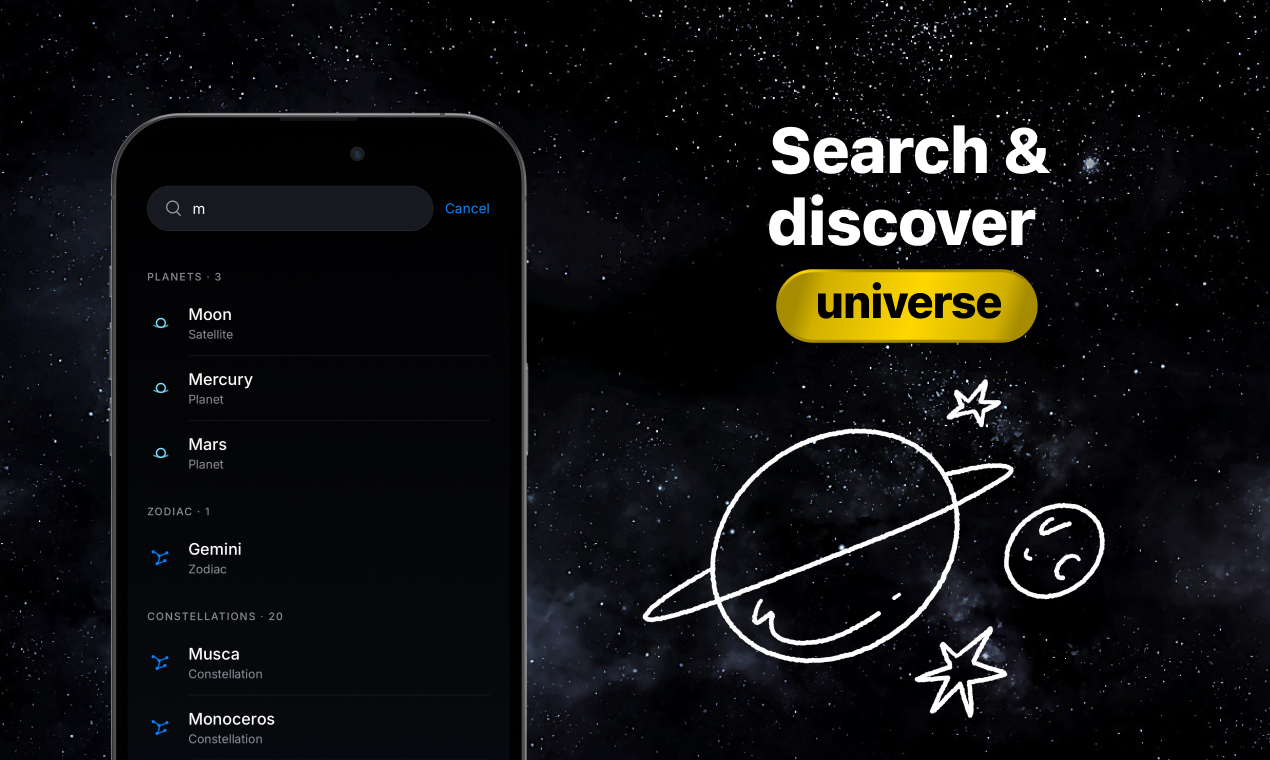
Search 953,396 stars plus planets, constellations and the Moon. One typed letter already resolves Moon, Mercury, Mars and Musca.
-
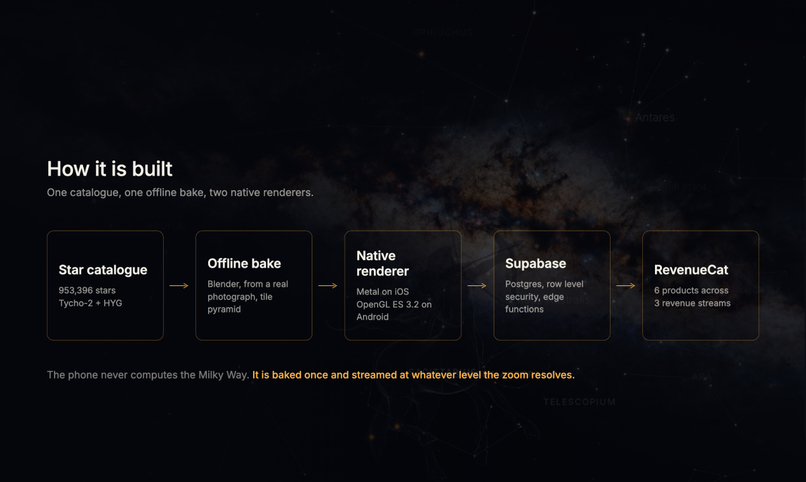
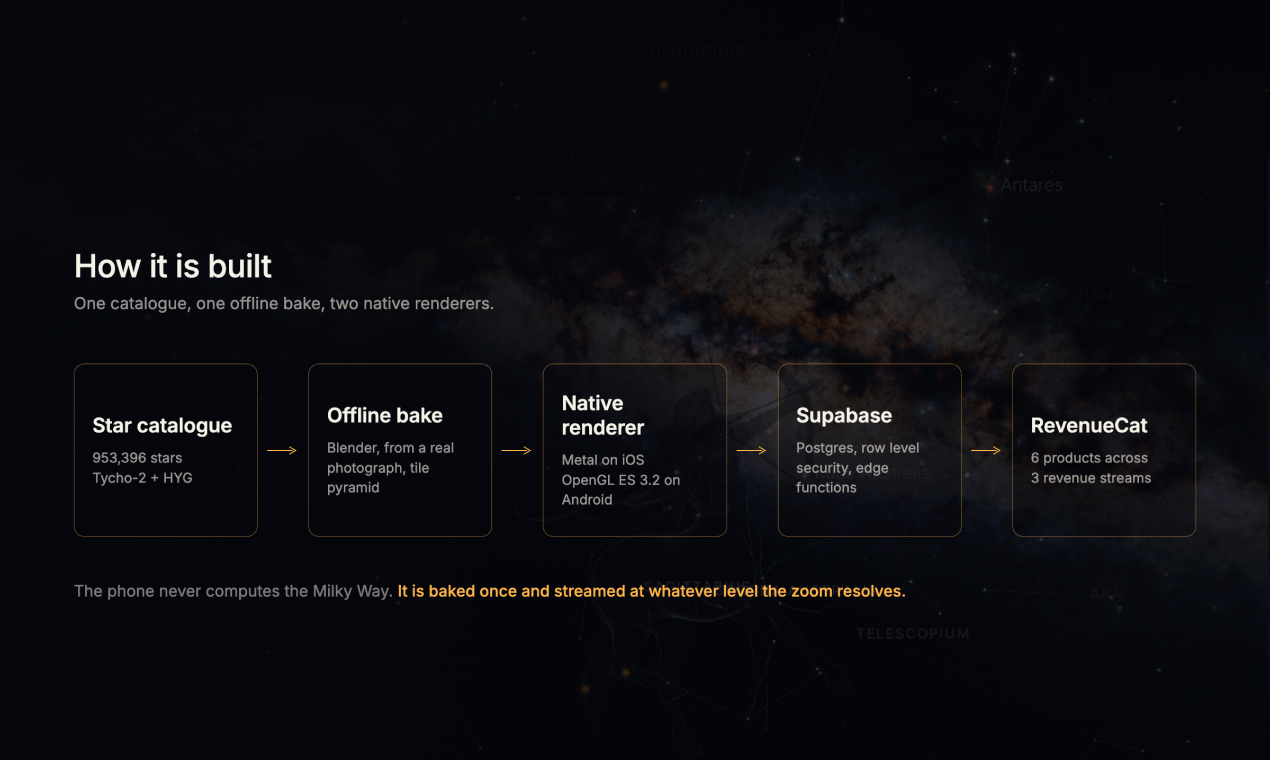
One catalogue, one offline Blender bake, two native renderers, Supabase, and RevenueCat carrying six products across three streams.
-
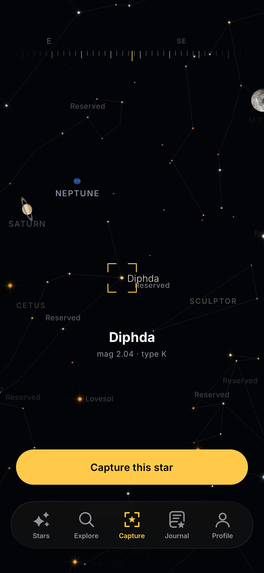
Capture real time stars
-
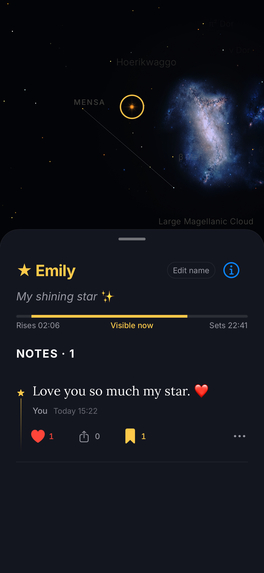
Name the Stars
-
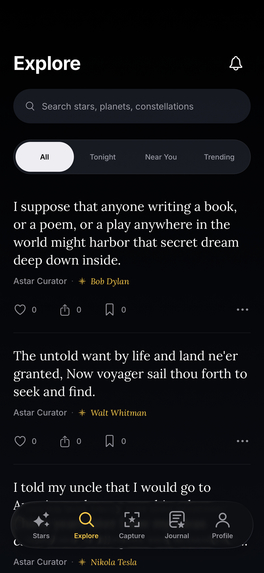
Read the notes left on the stars
-
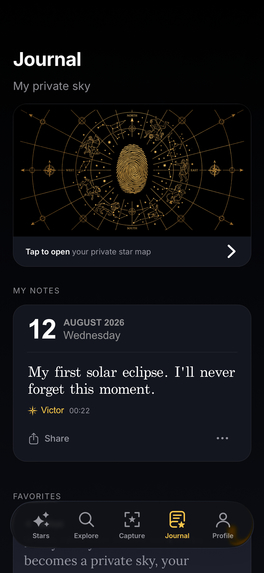
Add your own personal notes to the Private Star Map.
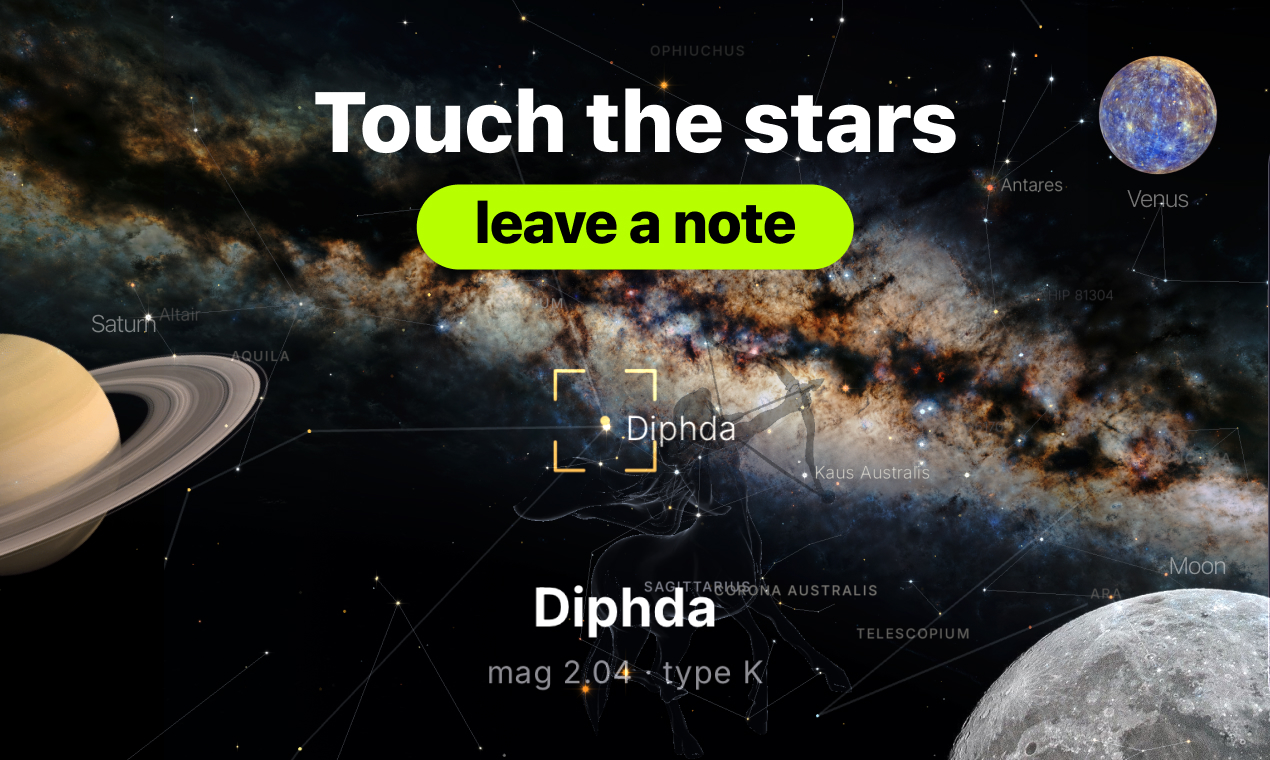
Astar
A star map you can write on.
Astar shows you the real sky above you, right now. Tap any star and leave a note on it. Read what strangers left on theirs. Give a star a name for a month. Keep a private sky of your own. Free on iOS and Android, featuring a star map that works offline.
💡 Inspiration
I used to lie on my back and look at the stars and imagine writing on the sky. Not a message to one person. Something anyone could look up and find.
I first pitched this in 2022, as a 3D sky you could fly through. It took me three more years to understand that flying through it is just a screensaver. Leaving something behind is the part that matters.
One rule came out of that, and everything difficult in this project comes from it: the star you tap has to really be above you, right now, from exactly where you are standing. If it is not, none of it means anything.
🌌 What it does
A real sky. Every star is where it actually is tonight, for your location and this minute, along with the constellations, the planets, the Moon and the Sun.
Tap a star, leave a note. Notes do not stay forever. The sky is a place, not an archive.
Name a star. For a month at a time, not forever.
Explore. A moderated public feed of what other people wrote.
Journal. Your own private sky, that only you can see.
No signal needed. The best skies are usually where the phone signal is worst, so the map never asks for one.
🔨 How I built it
The app is React Native, with a renderer written by hand for each platform so the sky can draw almost a million stars without stuttering. The Milky Way is not drawn by the phone at all. I rendered it once, offline, from a real photograph, and the app streams pieces of it as you zoom in.
All of it was built with AI assistance, from the first line of code to the store listing. I want to be plain about that, because it is the only reason this exists. A real sky, a moderated social layer and a working store business used to mean a team and a few years of runway.
🥵 Challenges I ran into
I kept measuring my own tools instead of my app. The phone was overheating, so I spent days timing things, and the numbers made no sense. An empty black screen scored worse than the full sky. It turned out the tool I was measuring with cost more than the thing I was measuring. Once I stopped timing frames and simply asked the phone how hot it was getting, the answer was obvious within a minute.
I built the Milky Way three times before admitting I was wrong. Every version passed my own quality checks and still looked like grey fog. The real Milky Way is not a smooth glow, it is thousands of stars too faint to pick out one by one, and nothing I painted could fake that. So I took a real photograph of the sky and carefully removed every star from it, then grew my own star catalogue from 25,713 to 953,396 so that the real stars would outnumber the painted ones everywhere you look.
The two hardest problems were not code at all. I built the App Store name around the phrase "name a star", then checked Apple's own search data and found that almost nobody types it. And I built a proper tutorial for new users, looked at it, and deleted it. Then I fixed it and deleted it again. A card floating over the sky just gets in the way of the sky.
💰 How it makes money
Naming a star is a lease, not a deed.
If a name is permanent, the good ones are gone in a week and what is left is a registry that is dead by design. A name that expires can be renewed by whoever still cares, or taken by someone who cares more. The sky keeps moving.
| Stream | What it is for | Price |
|---|---|---|
| Premium subscription | People who live in the sky rather than visit it | $7.99 / month, $49.99 / year |
| Star naming | A name on one specific star, for a month. Purchases stack | $19.99, or $14.99 with Premium |
| Note extension | Keeping one note alive past its lifetime | $0.99 and $1.99 |
Star names sold in Astar are not recognised by the International Astronomical Union. The app says so at the moment you buy, and there is no certificate pretending otherwise. I would rather sell a smaller thing that is true.
🎨 Design notes
Tapping a star always frames it the same way. Wherever you tap it from, the camera lands the star in the same place above the note card. Two different screens framing the same star differently was worse than either one on its own.
Anything floating over the sky is glass. A solid card sitting on the star field always looked wrong, however carefully it was styled.
🏆 Accomplishments
- A sky that draws 953,396 real stars smoothly on both iPhone and Android.
- 3,102 tests.
- A moderated public feed and a store listing in 24 languages, shipped by one person.
📝 What I learned
A big dataset is a heat problem, not a storage problem. Putting almost a million stars on a phone is not a question of whether the data fits. It is a question of how much of the processor you can spend every frame before the phone gets hot and slows itself down.
The device will tell you the truth, if you ask it properly. Almost every performance idea I felt sure about turned out to be wrong the moment I measured it on real hardware.
Making it better usually meant taking something away. Every time I tried to make something clearer by adding a layer, an explanation, a card or a hint, it got worse.
If you are not writing the code yourself, you have to check every single step. A small mistake you accept early does not stay small. It settles into the foundation, and the bug it causes three weeks later is far harder to trace back than it would have been to catch on the spot. Reviewing is not extra work on top of building this way. It is the work.
🚀 What is next for Astar
More languages inside the app, photos and video in notes, and the wider social layer that the moderation work already supports.
Built With
- apple-signin
- astronomy-engine
- blender
- claude
- eas
- expo.io
- google-signin
- kotlin
- metal
- opengl
- python
- react-native
- revenuecat
- sentry
- supabase
- swift
- typescript

Log in or sign up for Devpost to join the conversation.