-
-
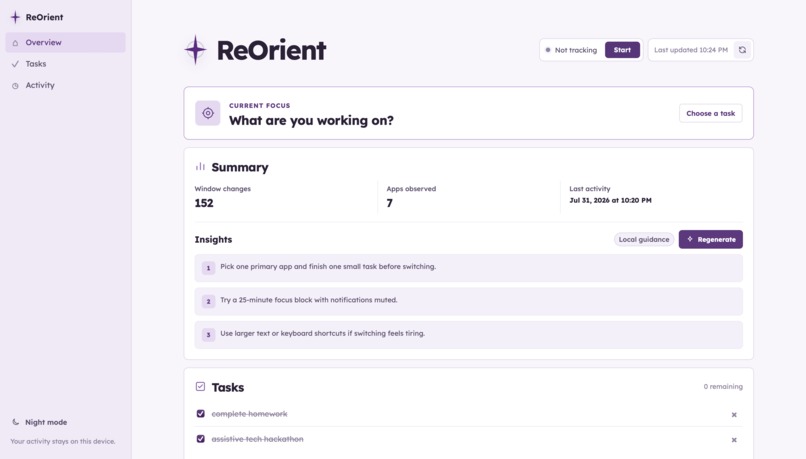
Memory Insights + Task Tracker
-
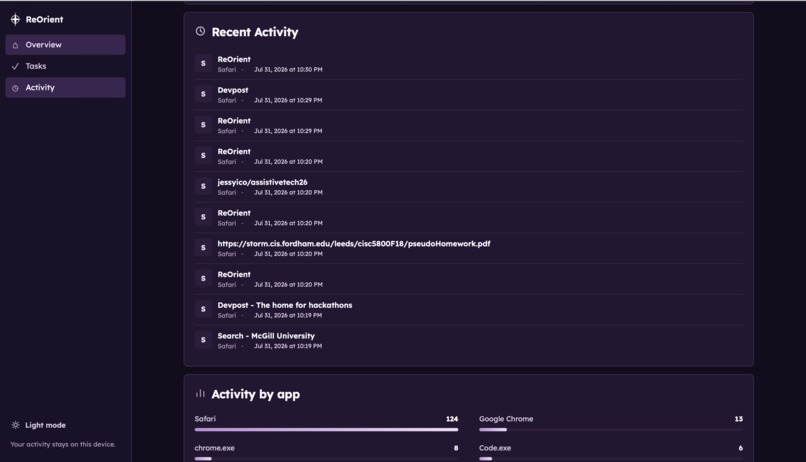
Activity Memory
Inspiration
Millions of people with ADHD, memory impairments, traumatic brain injuries, and other cognitive disabilities struggle to regain focus after interruptions. Even a brief distraction can make it difficult to remember what they were doing, forcing them to reconstruct their workflow from scratch. We wanted to create a tool that reduces this cognitive burden and makes digital work more accessible by helping users confidently return to where they left off.
What it does
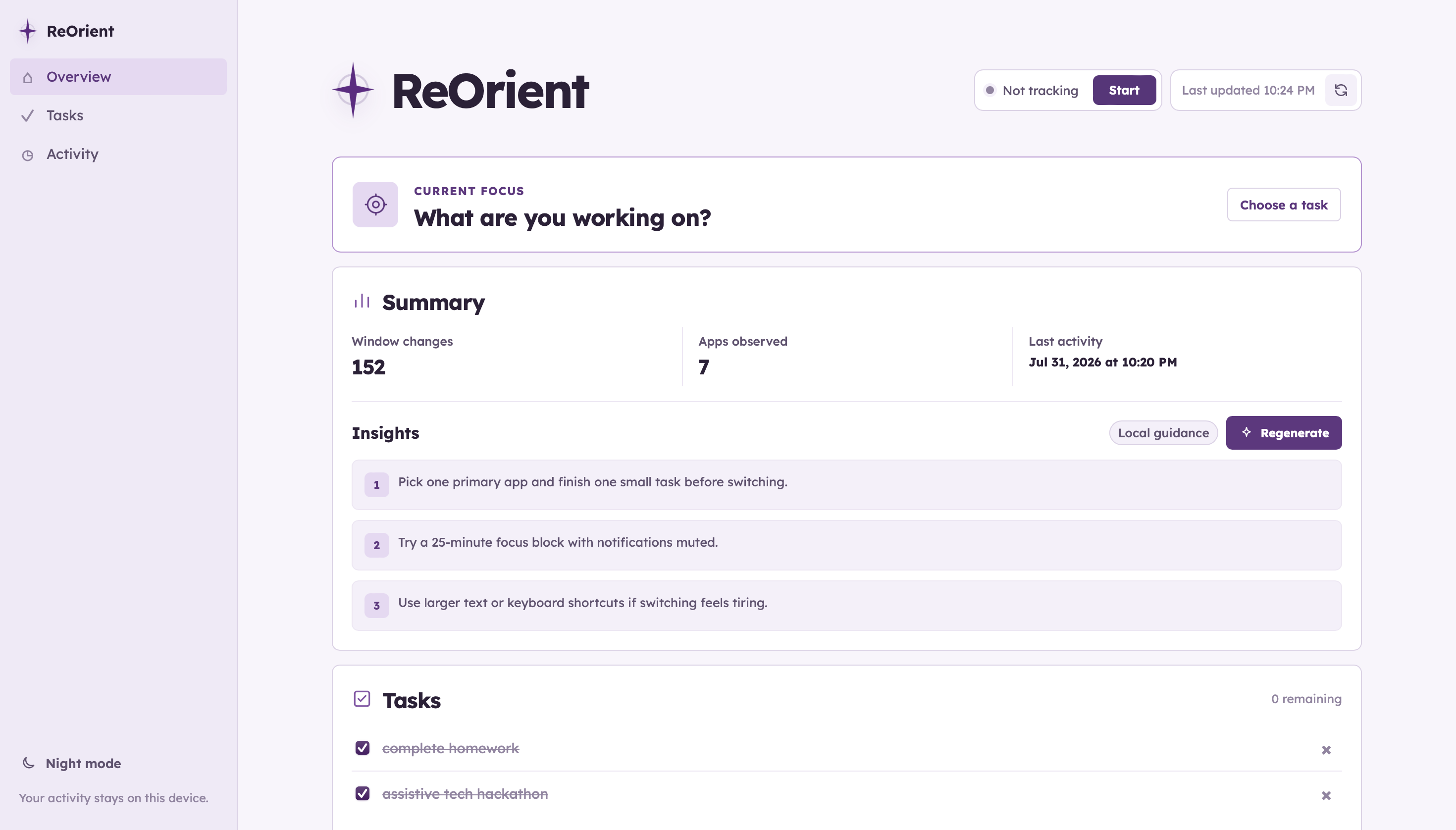
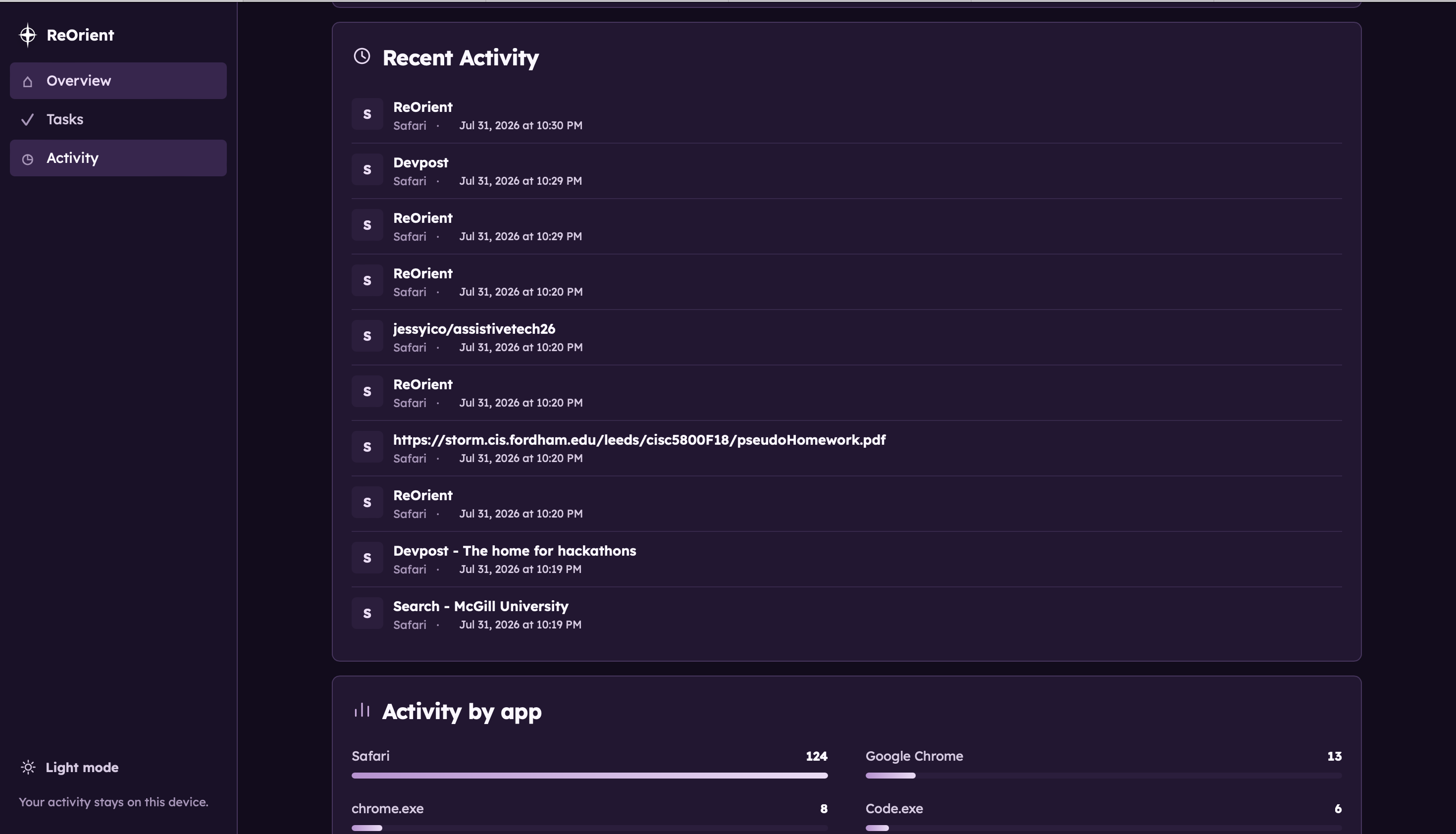
ReOrient is a desktop assistant that automatically captures lightweight context about a user's work, including open applications, documents, and browser tabs. It can generate an AI-powered summary of what the user was working on, highlight their recent progress, and suggest the next step, allowing them to quickly resume their workflow without relying on memory alone. It creates a history of active applications and also has a goal tracker built in.
How we built it
We built ReOrient using Python, FastAPI, and SQLite to securely store desktop activity history locally. Our cross-platform activity tracker captures active applications and browser context across both macOS and Windows. Gemini analyzes this activity to generate concise, actionable summaries that help users quickly recover from interruptions. An intuitive React dashboard presents recent activity, context summaries, task suggestions, and focus insights in an accessible, easy-to-navigate interface.
Challenges we ran into
One of our biggest challenges was balancing usefulness with privacy. We wanted to collect enough context to generate meaningful summaries while avoiding unnecessary or sensitive information. We also had to ensure the application remained lightweight and responsive while continuously tracking activity in the background.
Accomplishments that we're proud of
We're proud of building a solution that addresses an often-overlooked area of accessibility: cognitive accessibility. ReOrient goes beyond simply recording activity by using AI to provide meaningful context that helps users recover from interruptions. We're also proud that the application is lightweight, privacy-conscious, and designed with real-world usability in mind.
What we learned
This project taught us the importance of designing technology around people's needs rather than the technology itself. We gained experience integrating desktop activity tracking, local data storage, and AI summarization while learning how thoughtful design decisions can make accessibility tools both practical and trustworthy.
What's next for ReOrient
We plan to expand ReOrient with smarter context awareness, personalized summaries, and support for more applications and browsers. Future versions could integrate calendars, task managers, and productivity tools to provide richer context while maintaining strong privacy protections. Ultimately, we hope ReOrient becomes a reliable accessibility companion that helps people with cognitive disabilities work more independently and confidently.

Log in or sign up for Devpost to join the conversation.