🔬 Silicon YOLO
We froze a neural network into silicon. YOLOv10n's weights become hard-wired, multiplier-less logic — ~0.2 W, ~$2/chip, up to ~200 FPS object detection that beats edge GPUs on energy by ~26× — co-designed by two AI agents orchestrated by a human-in-the-loop.
A fixed-weight YOLO object-detection chip for the Digilent Genesys 2 / Xilinx Kintex-7 XC7K325T. Instead of fetching weights from DRAM, every weight is baked into the fabric as CSD / constant-coefficient multipliers (0-DSP) — INT8 (INT4 for tolerant layers), 640×640, 80-class COCO. The model never changes, so the silicon doesn't need a general MAC array, a weight bus, or off-chip memory.
| 🎯 Target | ⚡ Throughput | 🔌 Power | 🧮 DSPs | 📦 LUTs | 🎓 Accuracy |
|---|---|---|---|---|---|
| FPGA — Kintex-7 XC7K325T | ~51 FPS @ 200 MHz | ~3.2 W | 0 | ~38K (11.7%) | 37.62 mAP50-95 |
| ASIC — 28 nm (est.) | up to ~200 FPS @ ~800 MHz | ~0.2–0.8 W | 0 | logic-only | 37.62 mAP50-95 |
💡 Inspiration
Most edge-AI accelerators spend the majority of their power and area moving weights around — DRAM fetches, weight buses, big general-purpose MAC arrays. But for a fixed function — "detect these 80 COCO classes, forever" — the weights never change. So why pay to move them? Bake them into the silicon. A constant weight isn't a multiply at all; it collapses into a handful of shifts and adds (canonical-signed-digit arithmetic). That removes the DSP array, the weight memory traffic, and most of the power.
⚡ What it does
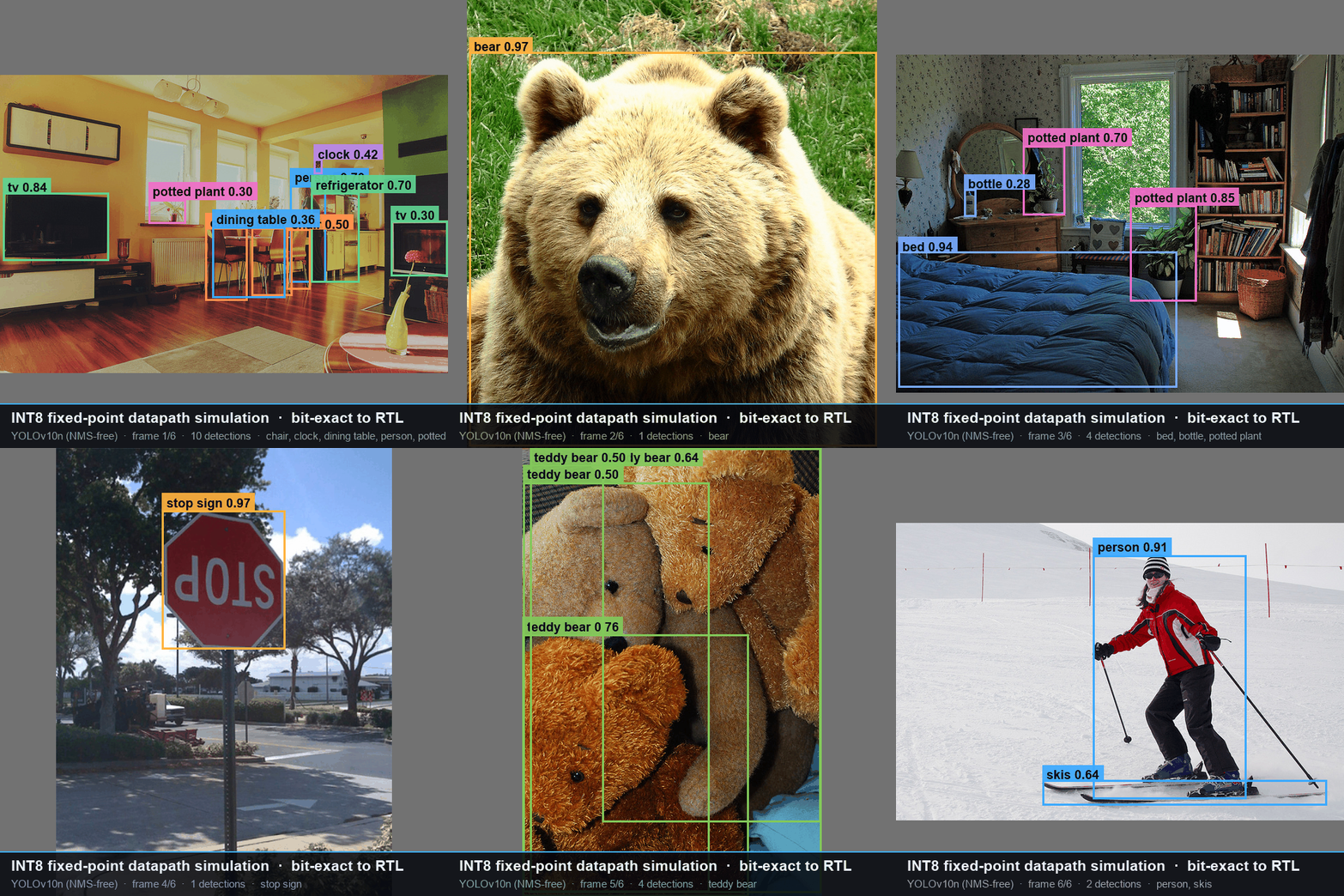
- Runs YOLOv10n (NMS-free) at 640×640, 80-class COCO entirely on-chip — no DRAM weight traffic.
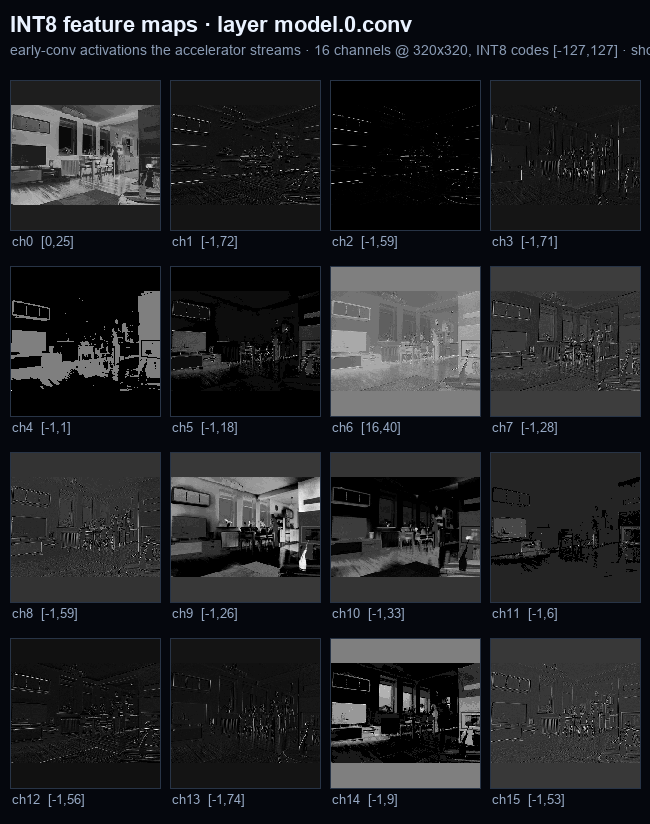
- 0 DSP blocks. Every conv weight is a CSD constant-coefficient multiplier + on-chip weight ROM.
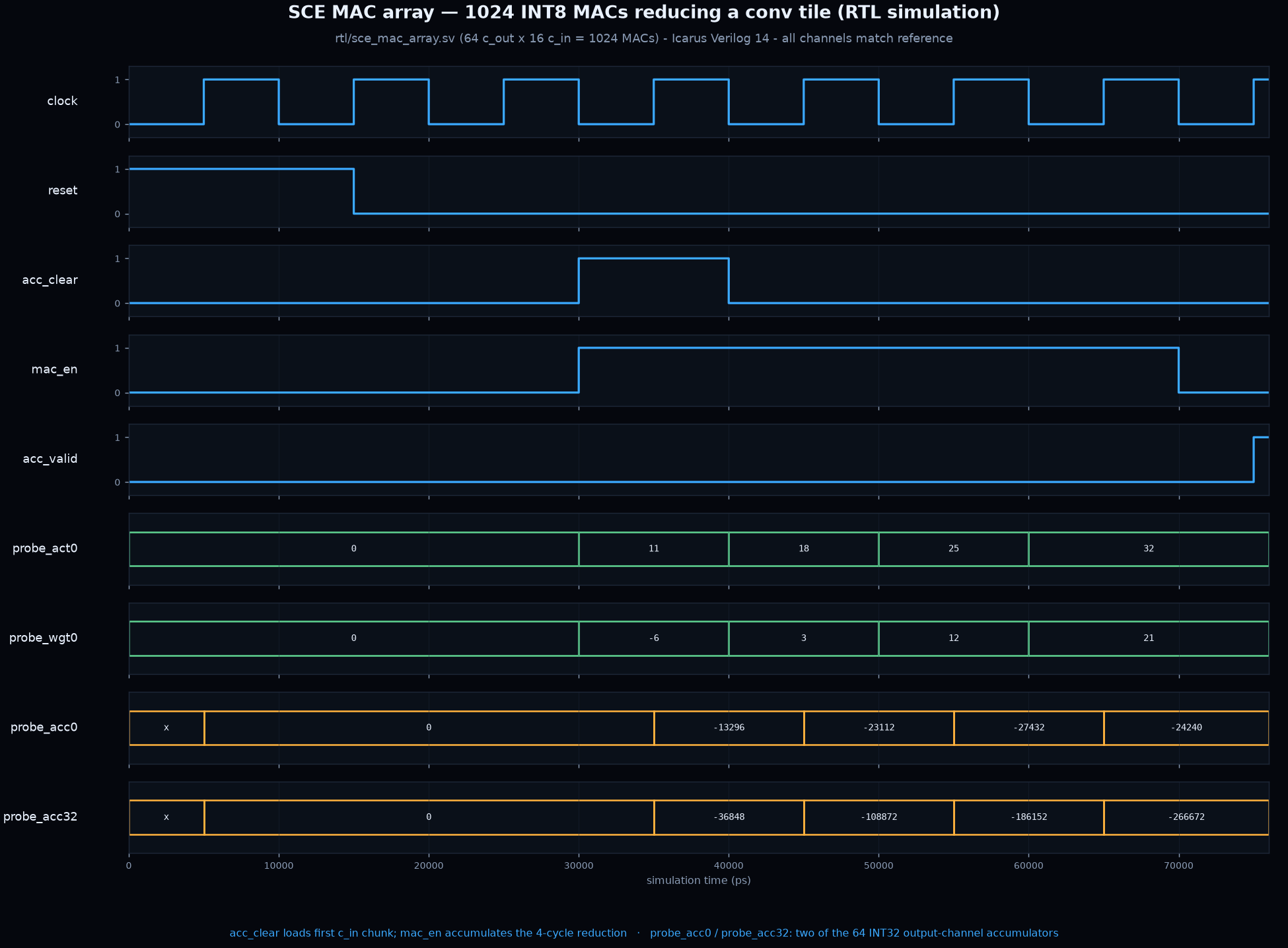
- Folded INT8 pipeline of 1024 CSD MACs, per-channel weight scales (INT4 for tolerant layers).
- NMS-free head deletes an entire hardware block vs. classic YOLO accelerators.
- Fits ~11.7 % of a Kintex-7 at ~51 FPS / ~3.2 W — and as a 28 nm ASIC runs up to ~200 FPS @ ~800 MHz at ~0.2–0.8 W (the real product).
- Near-lossless: FP32 37.94 → INT8 37.62 mAP50-95 (−0.32 pt).
📐 Architecture & specs
| Target board | Digilent Genesys 2 — Xilinx Kintex-7 XC7K325T |
| Model | YOLOv10n (NMS-free), COCO 80-class |
| Input | 640×640 RGB |
| Precision | INT8 datapath, per-channel weight scales; INT4 for tolerant layers |
| Compute | 1024 CSD constant-coefficient MACs, folded dataflow, 0 DSPs |
| Weights | Frozen in on-chip ROM (.mem/.coe), baked as multiplier-less logic |
| LUTs | ~38K (11.7 % of XC7K325T) |
| BRAM | ~483 (57.5 %) |
| Throughput | ~51 FPS @ 200 MHz (FPGA) up to ~200 FPS @ ~800 MHz (28 nm ASIC) |
| Power | ~3.2 W on FPGA ~0.2 W (200 MHz) – ~0.8 W (800 MHz) as a 28 nm ASIC |
| Accuracy | FP32 37.94 → INT8 PTQ 37.62 mAP50-95 (−0.32) |
📊 Results & verification
- Accuracy: INT8 post-training quantization is essentially lossless (−0.32 pt) and above the original YOLOv8-n baseline.
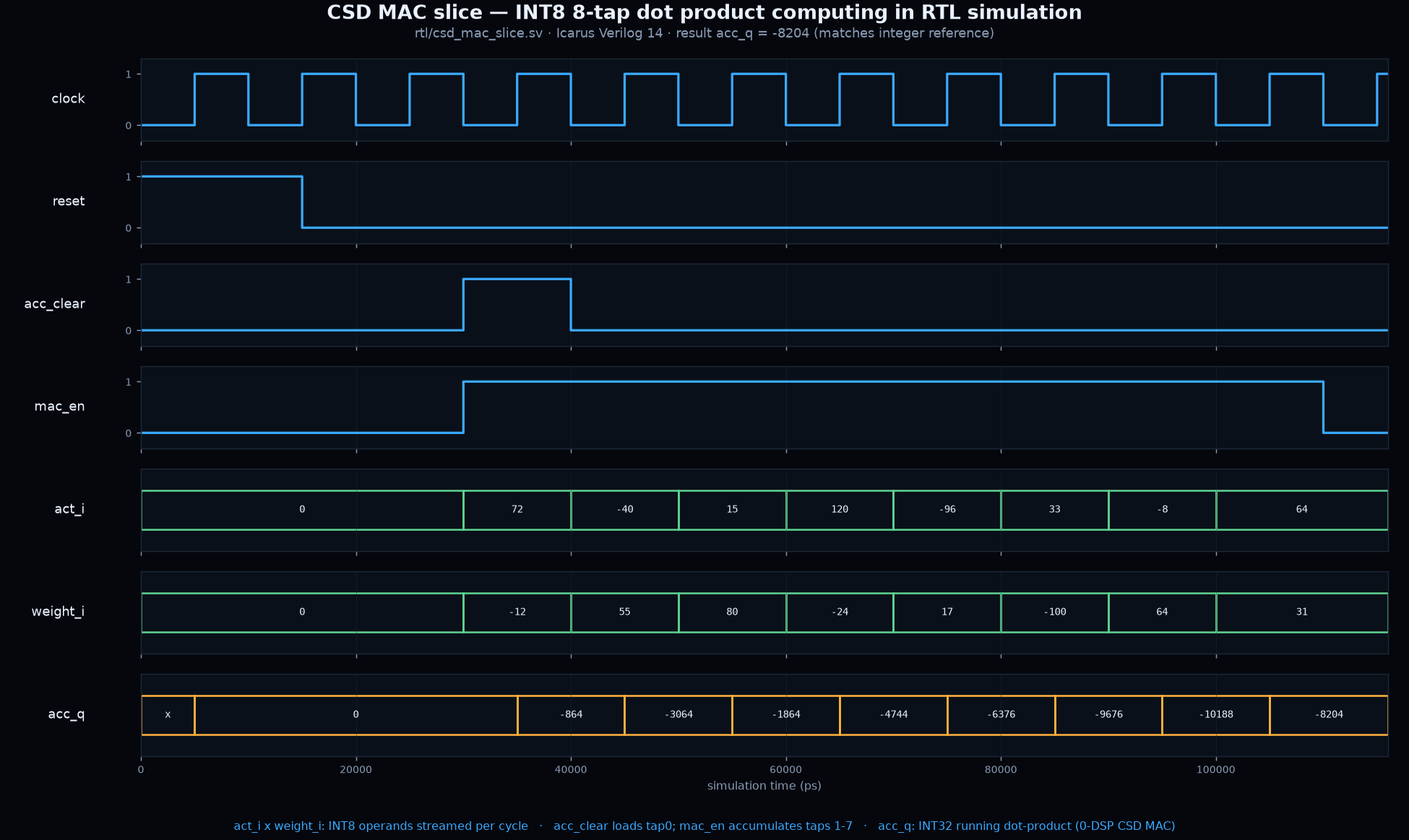
- RTL proven bit-exact: 4/4 datapath unit testbenches PASS under Icarus Verilog, checked against golden vectors (the CSD MAC slice and 1024-MAC array reproduce the integer reference exactly).
- Honest caveat: the top-level testbench reports INCONCLUSIVE (the detection-output decoder is still stubbed
// TODO) — we report that rather than a false PASS. Per-block datapath correctness is proven. Seertl_tb/SIM_SHOWCASE.md.
💸 Cost & efficiency
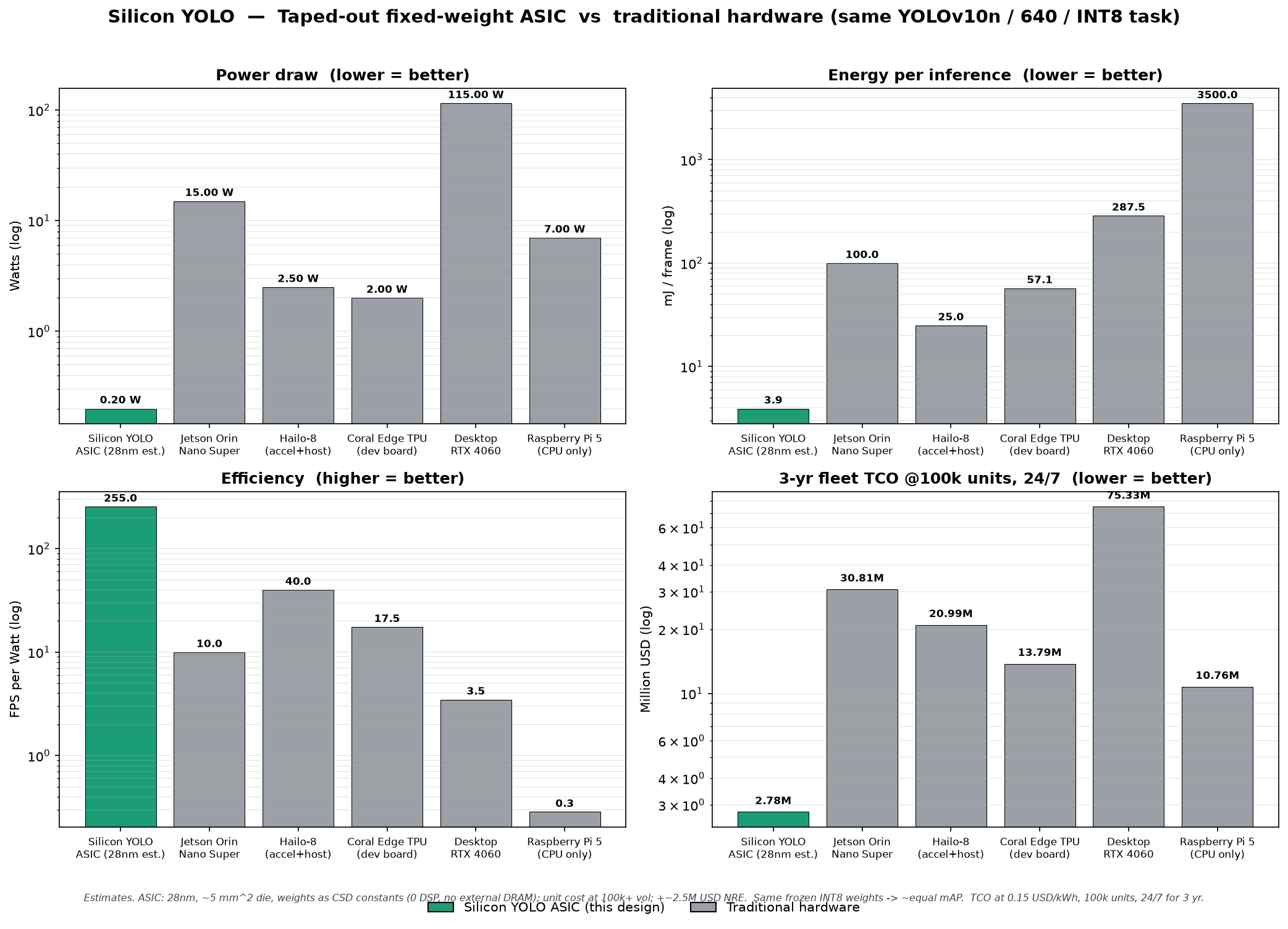
The FPGA is the prototype; the fixed-weight 28 nm ASIC is the product. Against today's edge options it wins decisively on energy and lifetime cost:
⏱️ Two operating points, same efficiency. The datapath is logic-only (0 DSP — every weight is CSD shift-add), so the same netlist closes timing far faster off FPGA fabric. The Kintex-7 is a 28 nm part, so this is a same-node fabric-overhead win (~3–4×): the ASIC reaches up to ~800 MHz → ~200 FPS. Throughput and power both scale ~linearly with clock, so efficiency stays ~constant at ~255 FPS/W — run ~800 MHz / ~200 FPS / ~0.8 W for max throughput, or ~200 MHz / ~51 FPS / ~0.2 W milliwatt-class for battery/always-on. The cost table below uses the low-power point (the headline product mode).
| Platform | Type | Power | FPS @640 INT8 | mAP50-95 | Unit cost (@100k) | NRE |
|---|---|---|---|---|---|---|
| Silicon YOLO ASIC (28nm est.) | Fixed-weight ASIC | 200 mW | 51 | 37.6 | $2 | $2.5M |
| Jetson Orin Nano Super | Edge GPU SoC | 15 W | 150 | 37.3 | $249 | -- |
| Hailo-8 (accel+host) | NN accelerator | 2 W | 100 | 37.0 | $200 | -- |
| Coral Edge TPU (dev board) | NN accelerator | 2 W | 35 | 36.0 | $130 | -- |
| Desktop RTX 4060 | Desktop GPU | 115 W | 400 | 37.4 | $300 | -- |
| Raspberry Pi 5 (CPU only) | CPU SBC | 7 W | 2 | 37.3 | $80 | -- |
- ~26× better energy/frame than a Jetson Orin Nano; ~73× vs. a desktop RTX 4060.
- ~$2/chip at 100k volume; break-even vs. Jetson at ~10,100 units.
- ~11× lower 3-year fleet TCO at 100k units, 24/7.
Full methodology and tables:
docs/COST_COMPARISON.md.
🛠️ How we built it — two AI agents, one human-in-the-loop
The whole project was orchestrated by Simular Sai (a computer-use agent) driving two coding/EDA agents in parallel in a single window:
- Track A — model & verification (Claude Code): baseline → INT8 PTQ → weight freeze → hardware handoff (
hw_graph.json, per-layer.mem/.coeROMs,quant_scales.json) → golden vectors. - Track B — chip design (Cognichip): spec capture → micro-architecture → PPA → SystemVerilog RTL (layer scheduler, requant unit, SiLU LUT, unified weight ROM, CSD MACs).
The handoff contract: Track B is gated — no RTL until Track A freezes the weights and ships the op-graph, quant scales, and golden vectors. Sai enforced that gate, babysat the runs, and recovered the build when it broke.
The pivot that made it work: we first tried to compress YOLOv8-n via structured
channel pruning + retraining — it worked but recovered accuracy painfully slowly
(~32 mAP after 8 epochs; ~50 needed). So we dropped pruning entirely and switched to
pretrained YOLOv10n → PTQ → freeze: smaller, more accurate, NMS-free, and no training.
The lesson: for a fixed-weight chip, a stronger pretrained model you never touch beats a
weaker one you spend a week pruning. (Full prior-attempt log: docs/PRIOR_ATTEMPT_YOLOV8N.md.)
🏆 Accomplishments
- Near-lossless INT8 (37.94 → 37.62) with zero retraining, on a frozen pretrained model.
- A genuinely multiplier-less, DSP-free accelerator that fits a real board at ~51 FPS.
- Bit-exact RTL datapath, verified against golden vectors with open-source tooling.
- Two autonomous AI agents driven to a working hardware handoff, kept honest by a human-in-the-loop.
📚 What we learned
- For fixed-function inference, pick a strong pretrained model and quantize — don't prune-and-retrain a weaker one.
- Constant weights are nearly free in hardware (CSD shift-add), which is what kills the DSP array.
- Enforce the handoff contract and verify with golden vectors — it's what catches silent failures.
🚀 What's next
- Finish the top-level detection-output decoder so the full-chip TB reaches a true PASS.
- Vivado synthesis/implementation on the XC7K325T to confirm PPA and timing closure.
- INT4 for tolerant layers; path from FPGA prototype to 28 nm tapeout.
🧰 Built with
PyTorch · Ultralytics YOLOv10n · INT8 PTQ · SystemVerilog · Icarus Verilog / OSS CAD Suite · Vivado (xsim) · CSD / constant-coefficient arithmetic · Claude Code · Cognichip · Simular Sai · matplotlib · HyperFrames
Silicon YOLO · UC Berkeley AI Hackathon 2026 (Cal Hacks) · co-designed by Claude Code + Cognichip, orchestrated by Simular Sai.
Built With
- claude-code
- cognichip
- digilent-genesys-2(kintex-7-xc7k325t)
- int8/csd-multiplier-less-arithmetic
- pycocotools
- python
- pytorch(cuda)
- rtl
- simulang
- simular(hyperframes)
- simular(sai)
- systemverilog
- torch-pruning
- verilog
- xilinx-vivado
- yolov10n


Log in or sign up for Devpost to join the conversation.