AssetRouter-AI
Inspiration
As blockchain ecosystems have expanded, managing digital assets has become increasingly fragmented. Users may hold assets across multiple chains while having different objectives such as improving yield, reducing risk, maintaining liquidity, or finding a more efficient way to move an asset.
The difficulty is not simply finding available protocols. The user also needs to determine whether an opportunity actually fits their objective, understand the associated liquidity and execution conditions, and then identify a practical route for reaching that opportunity.
We built AssetRouter-AI to address this decision-making problem.
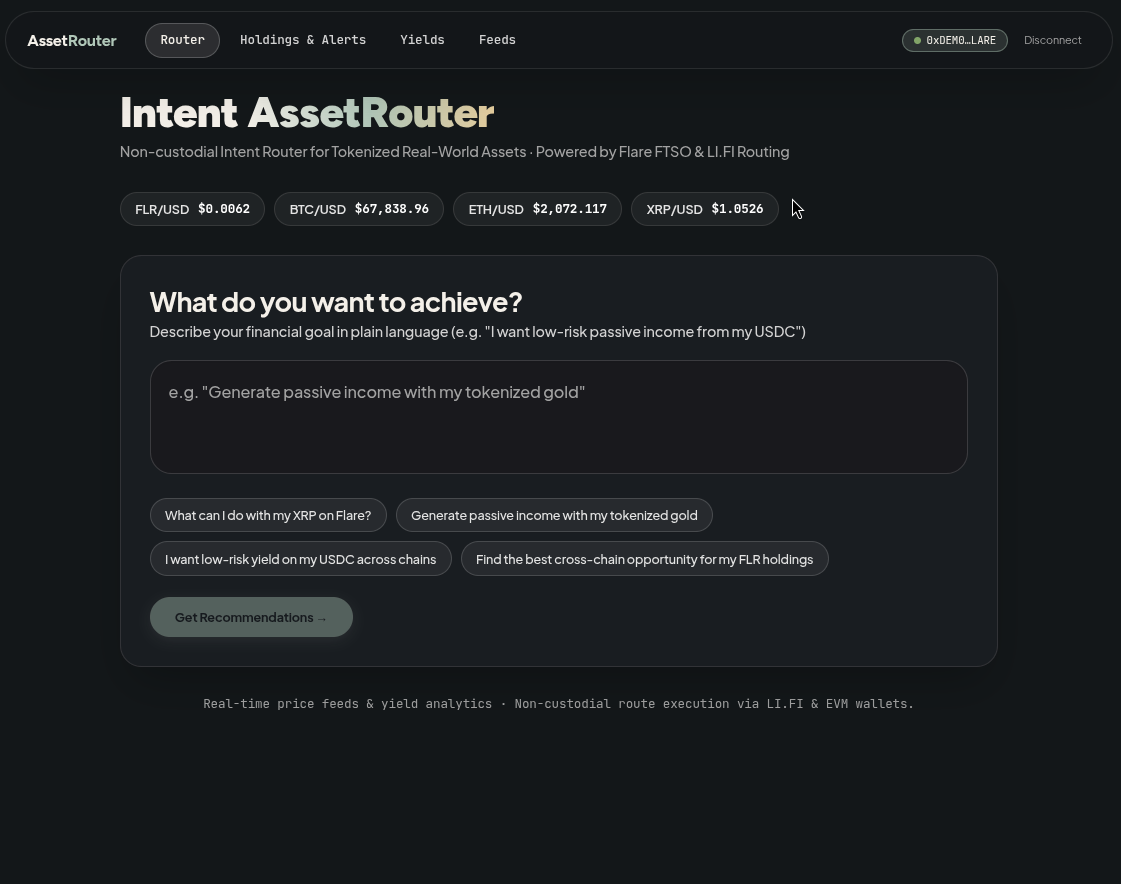
Instead of requiring users to manually select an asset, protocol, chain, bridge, and transaction path, AssetRouter allows them to describe their objective in natural language. The system interprets that objective, combines it with portfolio and market context, discovers relevant opportunities, evaluates them against the user's requirements, and produces an explainable route that can subsequently be executed through the connected wallet.
For example, a user can describe a requirement such as:
"I want at least 8% yield on my USDC while keeping the risk low."
The system converts this request into structured requirements and uses those requirements when evaluating available opportunities rather than simply returning the pool with the highest advertised APY.
What it does
AssetRouter-AI provides an intent-driven interface for discovering and acting on opportunities across blockchain ecosystems.
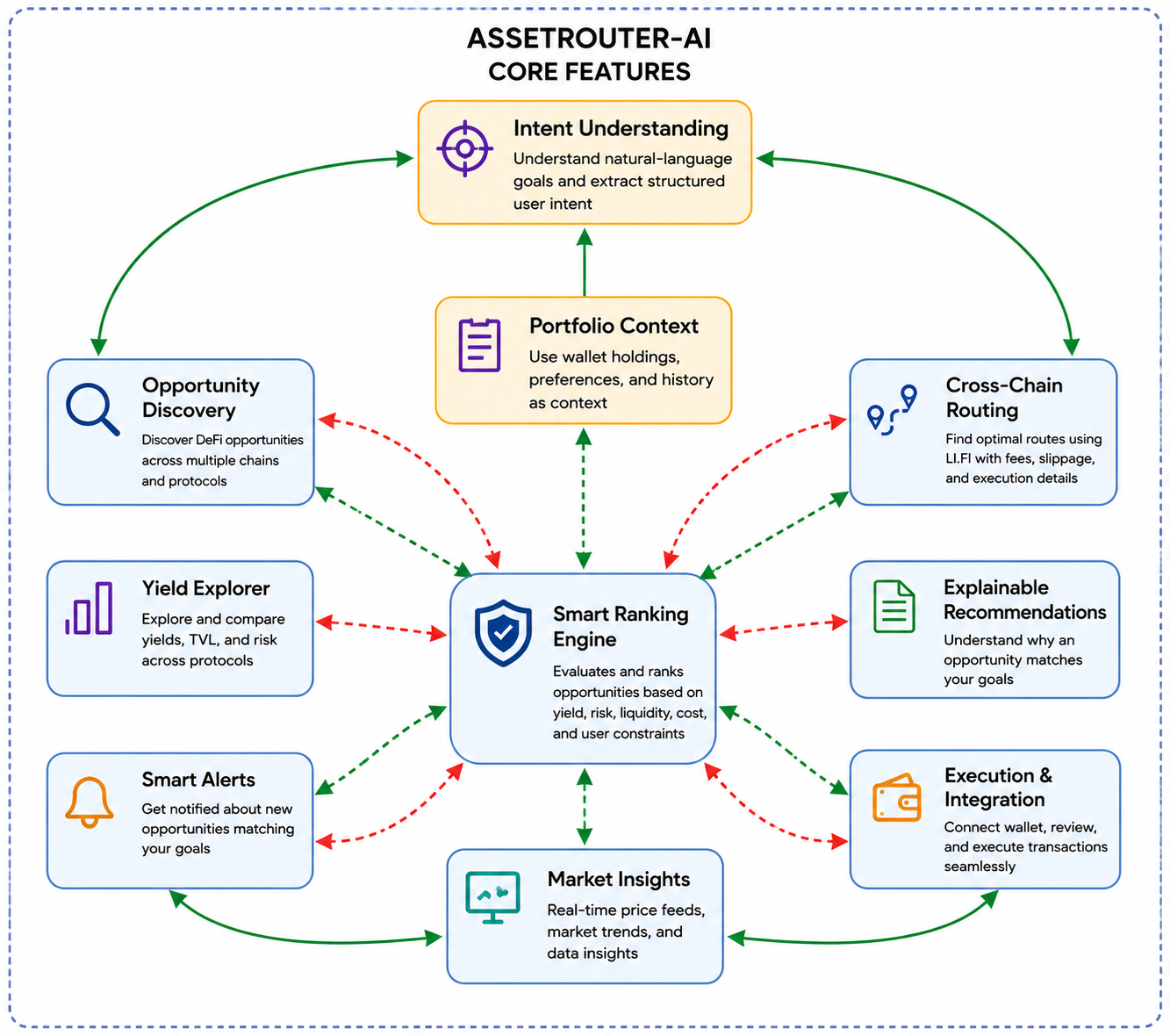
The platform combines natural-language intent understanding, portfolio context, market data, yield discovery, deterministic opportunity ranking, and cross-chain routing into a single workflow.
Core capabilities
| Capability | Description |
|---|---|
| Natural-Language Intent | Users describe their financial objective without manually configuring multiple parameters. |
| Goal Profile Extraction | The natural-language request is converted into structured requirements such as asset, target APY, risk tolerance, preferred chain, and cost preferences. |
| Opportunity Discovery | Yield and liquidity opportunities are collected from supported data sources. |
| Goal-Aware Ranking | Opportunities are evaluated against the user's requirements rather than being ranked purely by APY. |
| Explainable Recommendations | Each recommendation provides evidence explaining why it satisfies the user's requirements. |
| Portfolio Context | Existing holdings can be used to identify positions that may benefit from a different opportunity. |
| Smart Opportunity Alerts | New opportunities are surfaced when they materially improve upon the user's existing position while satisfying their saved requirements. |
| Cross-Chain Routing | LI.FI is used to identify bridge and swap routes required to reach the selected destination. |
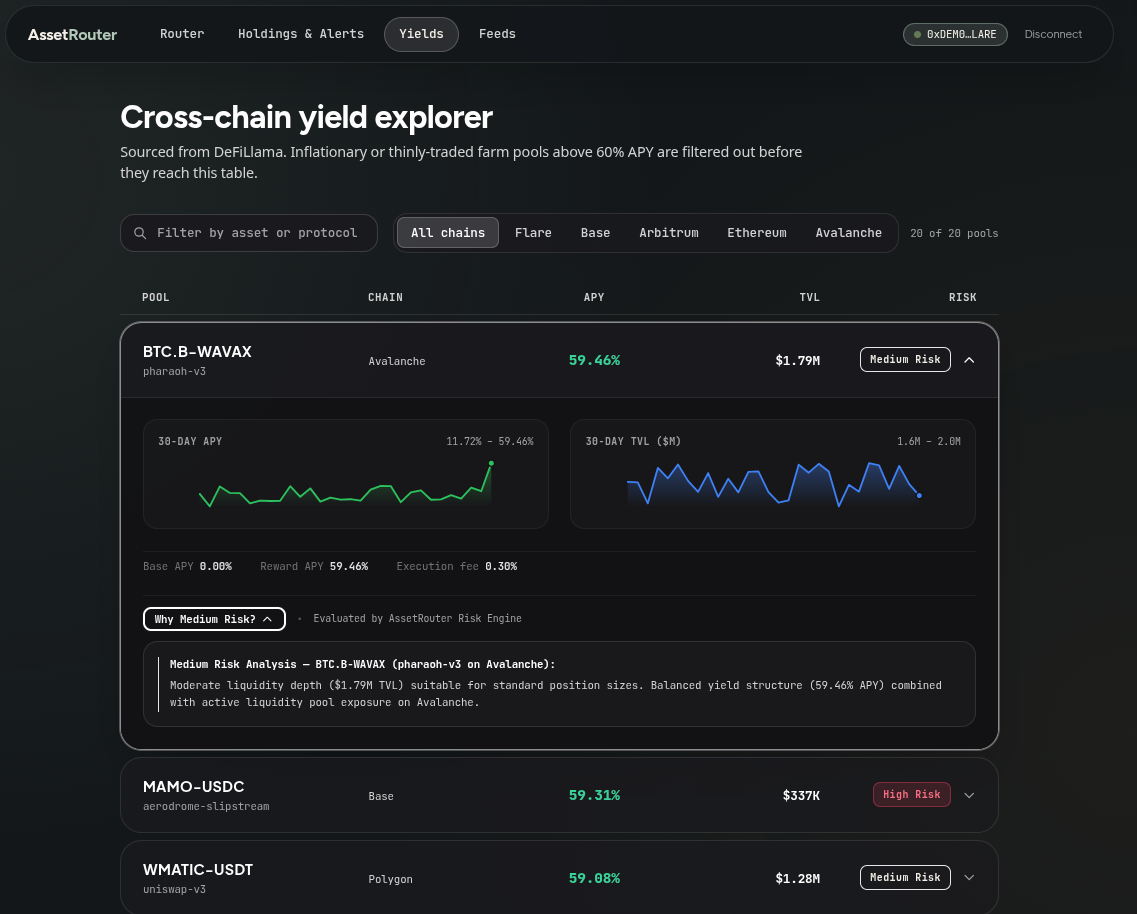
| Yield Explorer | Users can independently explore available yield opportunities across supported chains and protocols. |
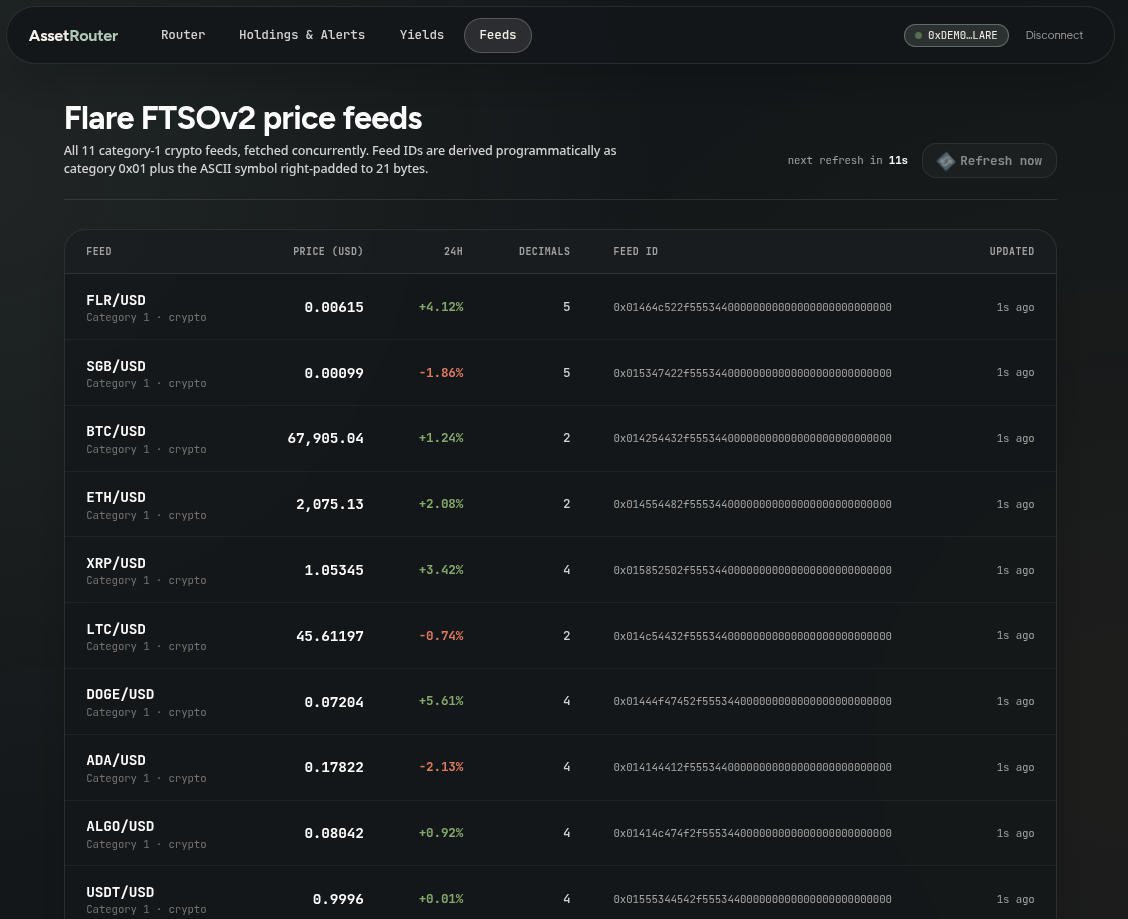
| Market Feed Explorer | Users can inspect the underlying market feeds used by the platform. |
How we built it
AssetRouter is implemented as a modular application where the AI layer interprets the user's request, while deterministic backend logic performs the numerical evaluation and ranking.
Architecture
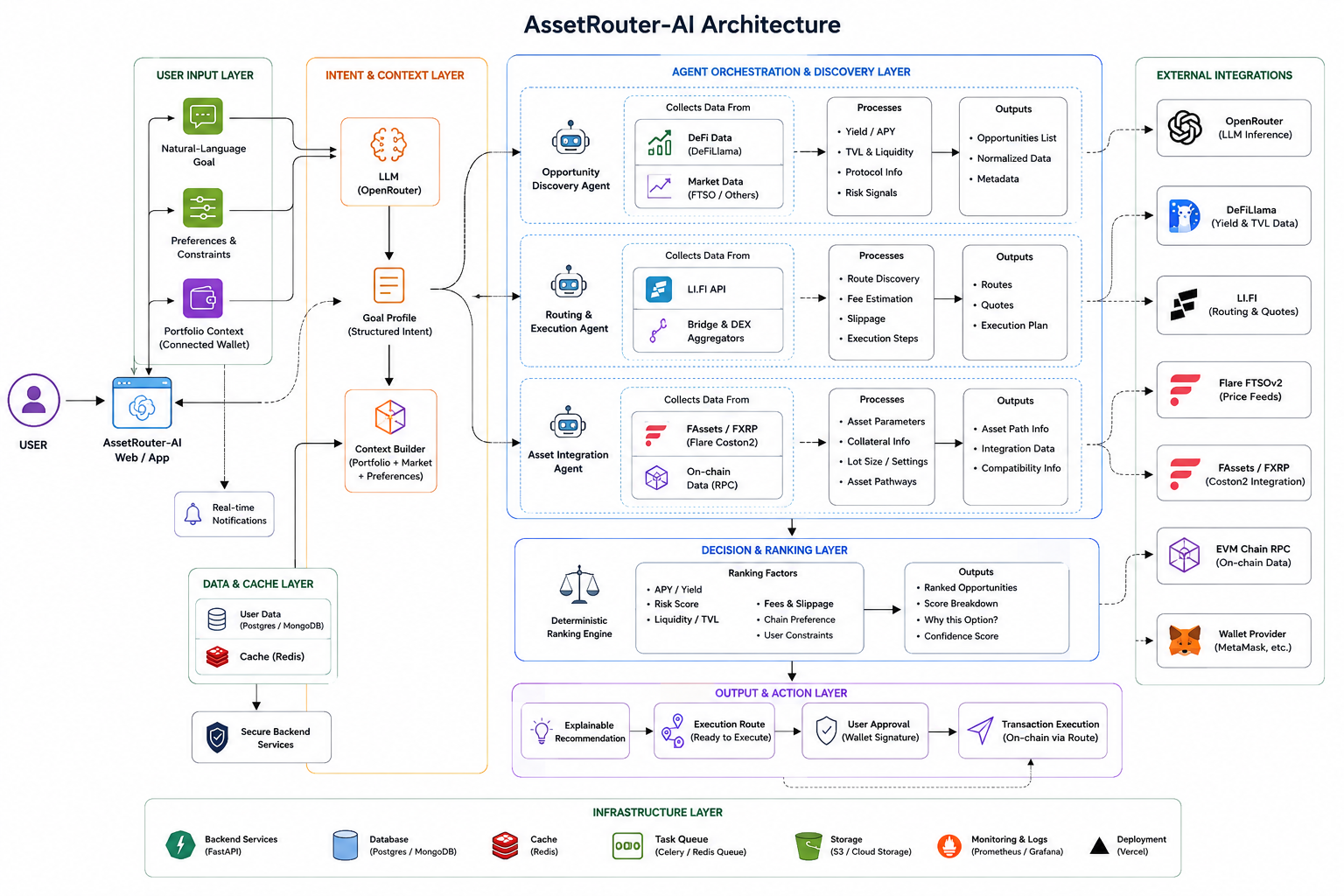
The architecture begins with a natural-language goal and passes it through several independent layers.
The LLM is responsible primarily for interpreting the user's language and extracting the relevant requirements. These requirements are then combined with wallet holdings, market information and asset-specific integrations.
The resulting opportunity set is evaluated using deterministic backend logic. This separation is important because numerical decisions such as APY comparison, constraint matching and ranking should not depend on an LLM generating or inventing numerical values.
The final stage produces an explainable recommendation and, where appropriate, an executable route.
User Flow
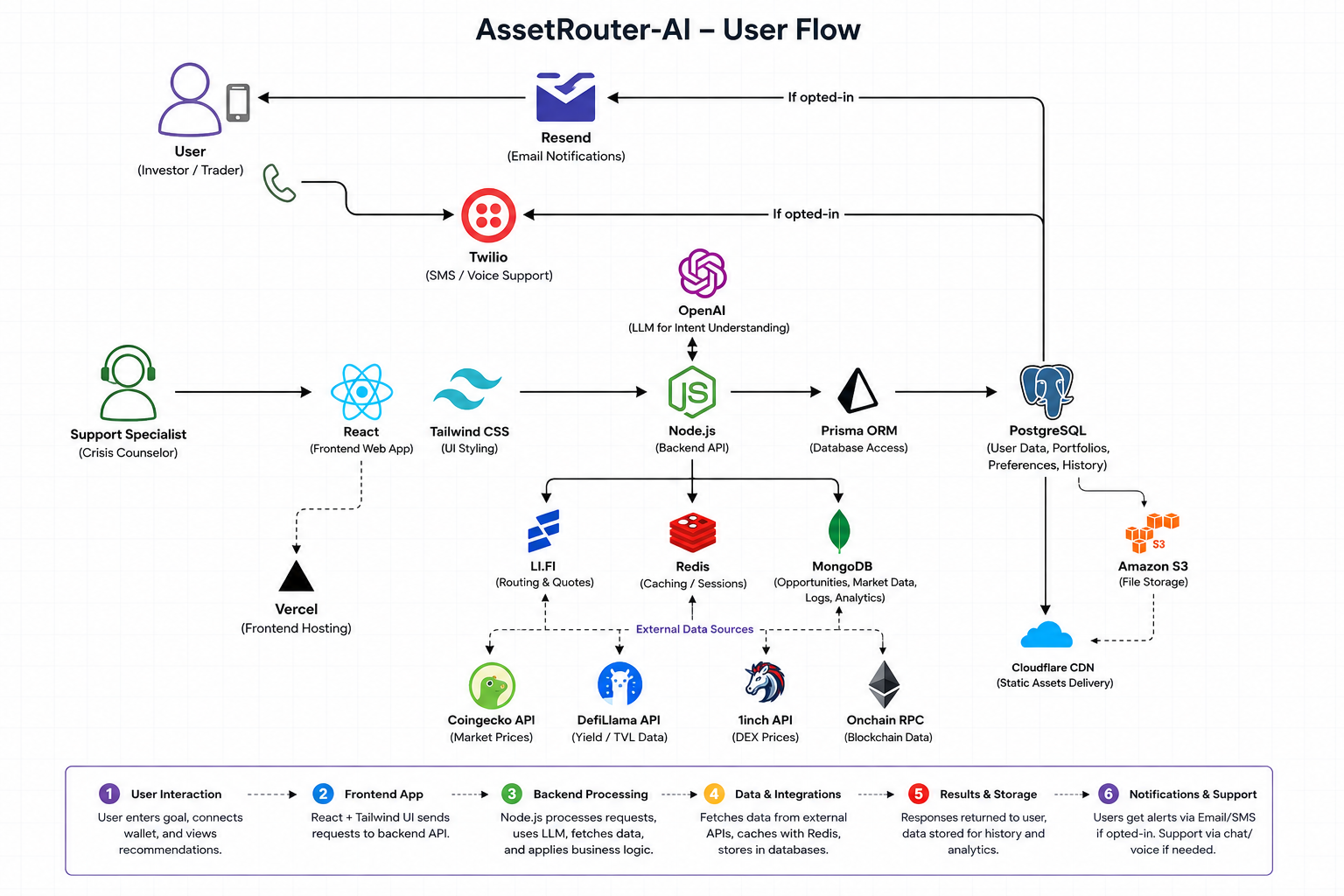
The complete user interaction can be understood as five stages:
1. User Input
The user interacts with AssetRouter through the application or, in a future integration, through a wallet, DeFi application or fintech interface.
Instead of navigating through several protocol-specific interfaces, the user describes the outcome they are looking for.
2. AssetRouter API
The request is passed to the AssetRouter backend, which coordinates intent processing, market information, opportunity discovery and routing services.
3. Goal Understanding
The natural-language request is interpreted into a structured Goal Profile.
For example:
| User statement | Extracted requirement |
|---|---|
| "At least 8% yield" | Target APY = 8% |
| "Keep it low risk" | Risk tolerance = Low |
| "Use my USDC" | Asset = USDC |
| "Prefer Flare" | Preferred chain = Flare |
Only constraints explicitly present in the user's request are used as hard requirements.
4. Opportunity Evaluation
The system gathers relevant opportunities and evaluates them against the Goal Profile.
The ranking considers factors such as:
- APY relative to the user's target
- Risk classification
- Liquidity / TVL
- Preferred chain
- Execution costs
- Asset compatibility
- Available routing paths
This prevents the system from simply selecting the highest advertised APY when that opportunity may violate other requirements.
5. Route / Action
The selected opportunity is presented together with the reasoning behind the recommendation and the route required to reach it.
Where cross-chain movement is required, LI.FI provides the underlying bridge and swap route. The connected wallet remains responsible for user authorization and transaction approval.
Technology Stack
| Layer | Technology | Role |
|---|---|---|
| Frontend | Next.js + TypeScript | Application and interactive dashboards |
| UI | React + Tailwind CSS | Interface and reusable components |
| Backend | Python + FastAPI | API layer and application logic |
| AI | OpenRouter | Natural-language intent interpretation |
| Routing | LI.FI | Cross-chain bridge and swap route discovery |
| Market / Yield Data | DeFiLlama | Yield, APY and TVL information |
| Oracle Integration | Flare FTSOv2 | Live asset pricing |
| FAssets | Flare FAssets / Coston2 | XRP/FTestXRP asset pathway |
| Wallet | MetaMask / EVM Wallets | Wallet connection and transaction authorization |
| Deployment | Vercel | Application deployment |
External APIs and Integrations
| Integration | How AssetRouter uses it |
|---|---|
| OpenRouter | Converts natural-language financial goals into structured intent information. |
| LI.FI | Discovers cross-chain bridge and swap routes for reaching a selected opportunity. |
| DeFiLlama | Supplies yield, APY and TVL information for opportunity discovery. |
| Flare FTSOv2 | Provides live asset price information used for valuation and market context. |
| Flare FAssets / Coston2 | Provides the XRP → FTestXRP pathway for XRP-related requests in the supported test environment. |
| Wallet Providers | Provide portfolio context and allow users to authorize transactions. |
Key Product Features
Goal-Aware Recommendations
A major design decision was to move away from ranking opportunities exclusively according to their headline APY.
Consider two opportunities:
| Opportunity A | Opportunity B | |
|---|---|---|
| APY | 12% | 8.4% |
| Risk | High | Low |
| TVL | $300K | $2.4M |
| User target | 8% | 8% |
| User risk preference | Low | Low |
A basic yield aggregator could prioritize Opportunity A.
AssetRouter instead recognizes that Opportunity B better satisfies the user's complete requirement.
The recommendation therefore includes evidence such as:
- Meets the user's APY target
- Matches the selected risk preference
- Has sufficient liquidity
- Matches the preferred chain
- Has an available execution path
This makes the recommendation explainable rather than presenting an unexplained score.
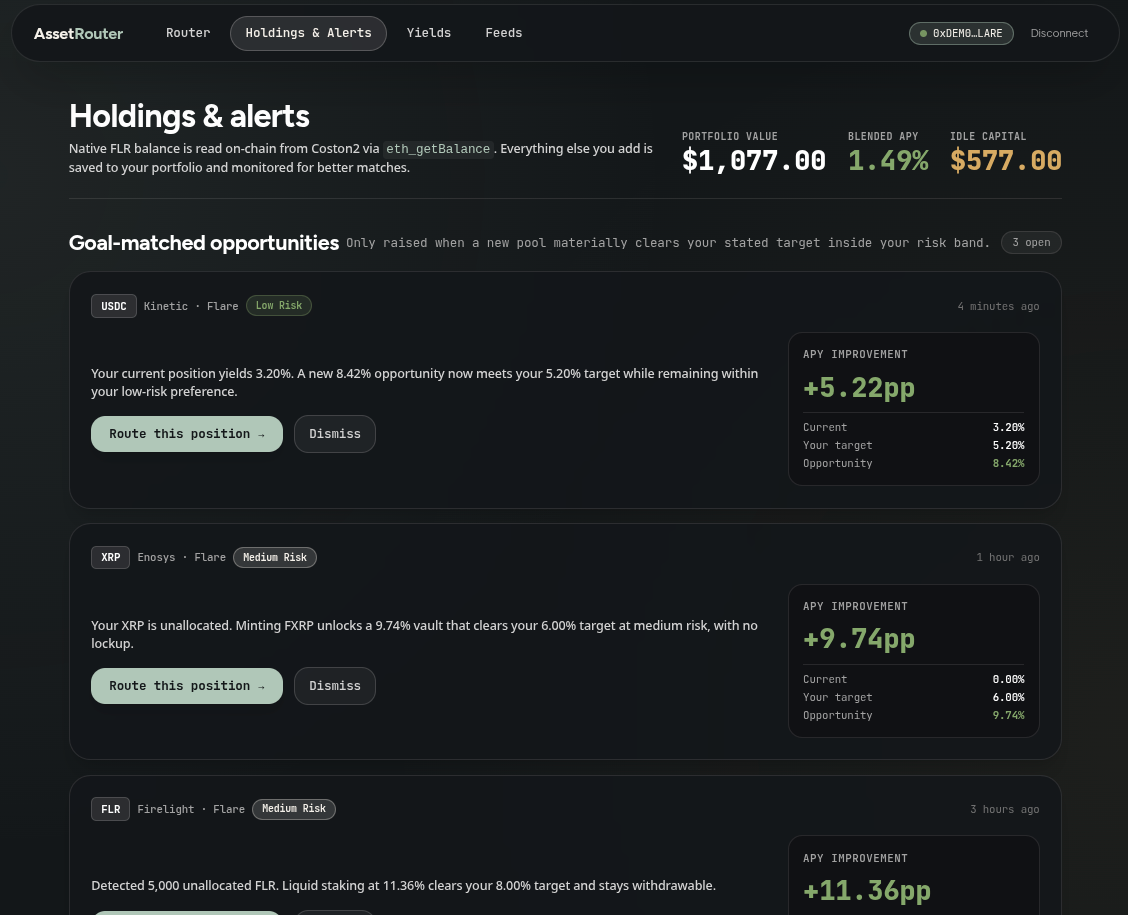
Holdings & Smart Opportunity Alerts
The Holdings & Alerts page extends the same goal-aware logic to assets the user already owns.
AssetRouter can identify positions that are currently idle or earning below the user's target and compare them against newly discovered opportunities.
For example, an alert may identify that a user's USDC currently earns 3.2%, while a newly available opportunity offers 8.42% and still falls within the user's low-risk preference.
The important part is that the alert is not triggered merely because the APY is higher. It is evaluated against the user's previously established requirements.
Route this position
When the user selects "Route this position →", AssetRouter carries the context of that opportunity back into the routing interface.
The system:
- Identifies the selected holding and destination opportunity.
- Constructs the corresponding natural-language routing intent.
- Opens the AI routing workflow with the intent pre-filled.
- Runs the routing engine using that context.
- Presents the relevant route and execution steps through LI.FI.
This creates a continuous flow between portfolio monitoring, opportunity discovery and execution rather than treating them as separate pages.
Yield Explorer
The Yield Explorer provides a broader view of available opportunities across supported chains and protocols.
Users can filter opportunities by factors such as:
- Asset
- Protocol
- Chain
- APY
- TVL
- Risk
Individual opportunities can be expanded to inspect additional information, including historical APY and TVL data and the factors contributing to the platform's risk assessment.
This page is primarily the discovery layer of the product. Users can explore the opportunity landscape independently, while the Intent Router uses similar underlying information to determine which opportunities are appropriate for a specific goal.
Flare FTSOv2 Integration
Flare's FTSOv2 infrastructure is integrated as a live market-data source rather than being treated as the entire product.
The Feeds page exposes the available price feeds and their current values, including assets such as:
- FLR/USD
- BTC/USD
- ETH/USD
- XRP/USD
- LTC/USD
- DOGE/USD
- ADA/USD
- ALGO/USD
- USDT/USD
- USDC/USD
These feeds provide the pricing context used by the application for portfolio valuation and asset-related calculations.
Challenges We Ran Into
Separating AI interpretation from financial evaluation
One of the biggest technical challenges was deciding how much responsibility should be given to the LLM.
An LLM is well suited to understanding natural language, but allowing it to independently calculate rankings or fabricate market values would make the recommendation system difficult to trust.
We therefore separated the system into two responsibilities.
LLM layer:
- Understands the user's language
- Extracts the user's requirements
- Produces structured intent information
- Helps generate human-readable explanations
Deterministic backend:
- Validates constraints
- Processes numerical values
- Compares opportunities
- Calculates ranking scores
- Generates evidence from actual data
This architecture gives us the flexibility of natural-language interaction without making the numerical decision process dependent on probabilistic output.
Integrating multiple data sources
Yield data, market feeds, wallet information and cross-chain routes all have different data structures and update patterns.
Building a common internal representation for opportunities allowed the ranking system to evaluate information from different sources consistently.
Connecting discovery with execution
Finding a good opportunity is only useful if the user can actually reach it.
Connecting opportunity recommendations to LI.FI routing required us to preserve the context of the user's asset, destination and objective all the way through to the execution stage.
Accomplishments We're Proud Of
We were able to build a working end-to-end prototype that connects several normally separate parts of the Web3 experience.
The main accomplishments include:
- Natural-language financial goal interpretation
- Structured Goal Profile extraction
- Deterministic opportunity ranking
- Evidence-backed recommendations
- Portfolio-aware opportunity monitoring
- Goal-matched Smart Opportunity Alerts
- Direct transition from alerts into the routing workflow
- Cross-chain route discovery through LI.FI
- Yield discovery through DeFiLlama
- Live market data through FTSOv2
- XRP/FAssets integration through the Flare test environment
- A modular architecture that allows additional chains, protocols and data providers to be integrated without redesigning the core decision engine
What We Learned
The project changed our perspective on where the complexity in Web3 actually exists.
The infrastructure required to move an asset already exists across bridges, DEX aggregators, lending protocols, yield platforms and blockchain networks. The harder problem for an end user is determining which combination of those services actually makes sense for their specific objective.
We also learned that AI does not necessarily need to be the component making every decision. In our implementation, its strongest role is understanding ambiguous human requirements and translating them into structured information that conventional software can evaluate reliably.
Another important lesson was the value of keeping discovery, evaluation and execution separate. A user should be able to explore the available opportunity landscape, understand why a particular opportunity matches their requirements, and then move into execution without losing the context of their original objective.
What's Next for AssetRouter-AI
End-to-End Testnet Execution
The next step is completing the full execution lifecycle on supported testnets:
User Goal
   ↓
Goal Profile
   ↓
Opportunity
   ↓
Route
   ↓
Wallet Approval
   ↓
Testnet Transaction
   ↓
Confirmation
   ↓
Updated Portfolio
This will allow us to validate the complete transition from recommendation to on-chain execution.
More Comprehensive Risk Evaluation
Future versions can incorporate additional signals such as:
- APY volatility
- TVL changes
- Liquidity depth
- Protocol history
- Smart-contract risk
- Impermanent-loss exposure
- Bridge risk
- Gas-cost estimation
This would allow AssetRouter to optimize for risk-adjusted outcomes rather than treating APY as the primary measure of opportunity quality.
Portfolio-Level Optimization
The current system primarily evaluates individual positions and opportunities. A natural extension is portfolio-level optimization.
Instead of asking:
"Where should I move this USDC?"
a user could ask:
"How should I allocate my portfolio to achieve my target yield while staying within my risk tolerance?"
The system could then evaluate multiple positions and opportunities simultaneously.
Expanded Ecosystem Support
The modular integration layer makes it possible to add additional chains, protocols, lending markets, DEXs, staking systems and asset representations without changing the fundamental intent-processing workflow.
AssetRouter as Infrastructure
Longer term, the same decision engine could be exposed through an API for wallets, DeFi applications and fintech products.
A third-party application could provide its user's objective to AssetRouter and receive back a structured set of suitable opportunities and execution routes.
This would allow AssetRouter to operate as a decision and routing layer between users and the increasingly fragmented infrastructure underneath Web3.
Closing
AssetRouter-AI brings together natural-language intent, portfolio context, market information, opportunity discovery and cross-chain execution into a single workflow.
The goal is to reduce the amount of manual decision-making required from users while keeping the underlying evaluation transparent and deterministic.
Rather than requiring users to understand every protocol and routing option available across different ecosystems, AssetRouter allows them to begin with the outcome they want and progressively translates that objective into a practical, explainable path toward achieving it.
Built With
- fastapi
- flare
- nextjs
- supabase


Log in or sign up for Devpost to join the conversation.