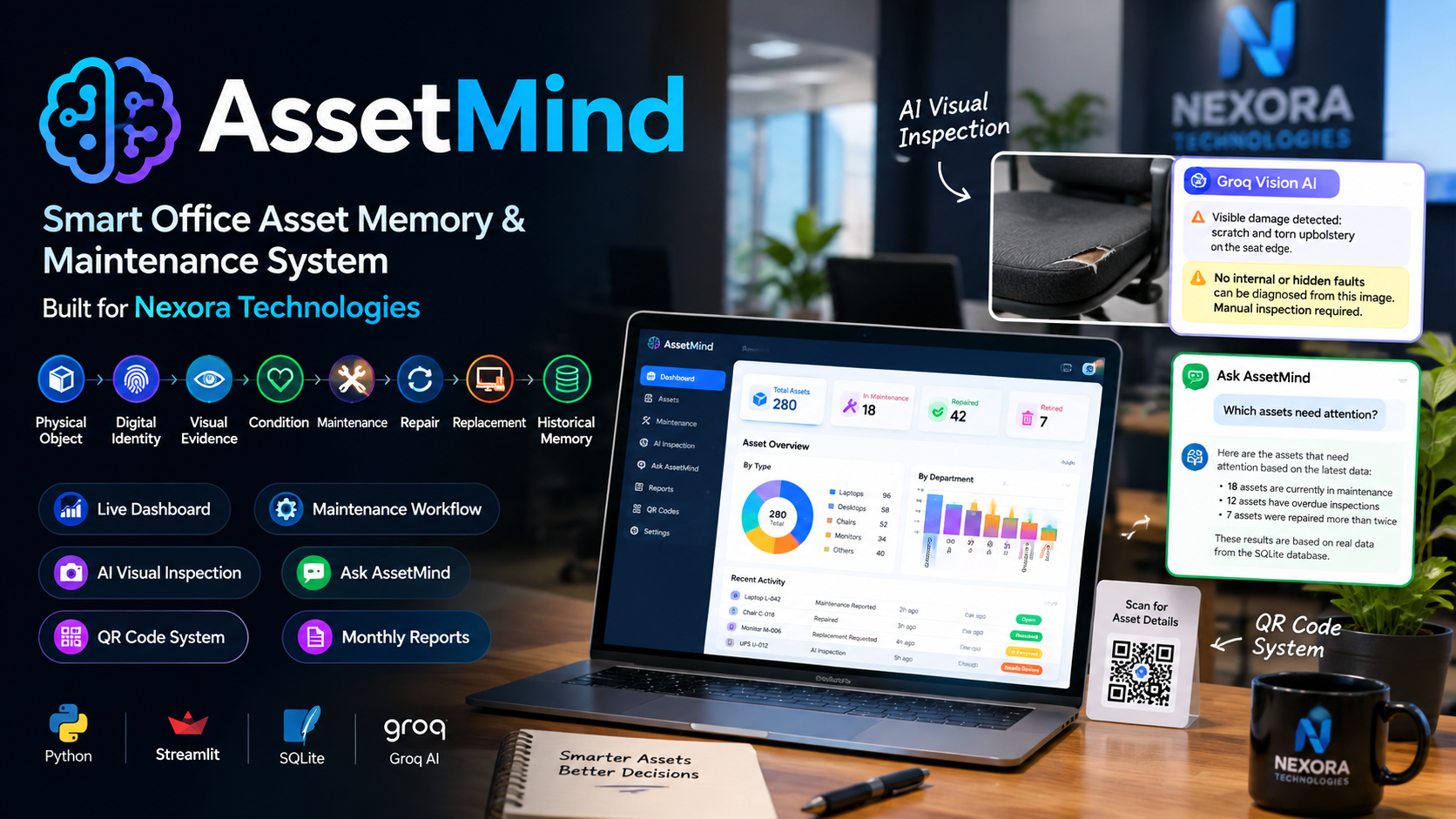
Inspiration
Physical office assets have a memory problem.
A laptop gets repaired, a chair is damaged, a monitor is replaced, or a UPS develops an issue — but the history of what happened often disappears into conversations, spreadsheets, or informal reports. Months later, nobody remembers how many times an asset was repaired, what condition it was previously in, or whether replacing it would make more sense.
We wanted to build a system where every physical asset has a permanent digital memory.
That idea became AssetMind, a digital memory and lifecycle system built for Nexora Technologies, a fictional software company with approximately 280 assets across 6 departments and 8 office locations.
The core concept is simple:
Physical Object → Digital Identity → Visual Evidence → Condition → Maintenance → Repair → Replacement → Historical Memory
Nothing is deleted. Even retired assets remain in the system and can be linked to their replacements, creating a complete lifecycle and replacement chain.
What it does
AssetMind provides a complete lifecycle system for physical office assets.
Live Dashboard
Provides real-time visibility into the organization's asset fleet through metrics, charts, and condition summaries.
Full Asset Profiles
Every asset has a permanent database-backed identity and timeline containing events from registration through maintenance, repair, replacement, and retirement.
Maintenance Workflow
Employees can report an issue, which moves through a structured workflow:
Report → Review → Repair/Replace → Resolve
Every status change is permanently recorded.
AI Visual Inspection
Users can upload a photo of a damaged asset and have a Groq vision model analyze what is visually observable.
The system is deliberately designed not to diagnose hidden or internal faults.
For example, it will not claim that a laptop's power supply is damaged simply because something looks wrong in a photograph. Instead, uncertain or non-visible problems are flagged for manual inspection.
Low-confidence results are also automatically overridden to "Manual inspection required" as a hard safety layer.
Ask AssetMind
Users can ask questions in natural language, such as:
- "Which assets need attention?"
- "How many laptops are currently under maintenance?"
- "Which department has the most damaged assets?"
The AI does not directly access the database or generate SQL.
Instead, questions are mapped to a predefined set of safe Python database functions. Those functions query the real SQLite database, calculate the actual numbers, and only then does Groq turn those results into a natural-language response.
This prevents the assistant from inventing statistics.
QR Code System
Every asset receives a unique QR code that can be generated, downloaded, scanned, and used to instantly access its asset profile.
Monthly Reports
AssetMind generates CSV and PDF reports containing fleet statistics and an AI-written executive summary.
The summary is generated only from statistics already calculated by Python, rather than allowing the AI to invent numbers.
Replacement Chain
When an asset reaches the end of its useful life, it is retired rather than deleted.
The retired asset remains permanently available in the database and can be linked to its replacement, preserving the complete lifecycle history.
How we built it
AssetMind is implemented as a single Streamlit application rather than a collection of separate frontend/backend services.
The core stack includes:
- Python — application logic and business rules
- Streamlit — application interface
- SQLite + SQLAlchemy — persistent asset and lifecycle data
- Groq API — AI-powered vision inspection and natural-language analysis
- Plotly — interactive dashboard visualizations
- OpenCV + Pillow — image processing
- qrcode — QR code generation
- ReportLab — PDF report generation
- Pandas — reporting and data processing
The codebase is modularized into areas such as:
database/ → services/ → ai/ → components/ → utils/
This keeps database operations, business logic, AI functionality, and UI components separated.
Two distinct AI capabilities are used:
- Vision AI for visual asset inspection
- Text AI for natural-language database questions and report summaries
The system uses models including openai/gpt-oss-120b and qwen/qwen3.8-27b through Groq.
Challenges we ran into
The biggest challenge was not making the AI produce impressive responses.
It was making sure the AI didn't claim things it could not actually know.
A photograph can show visible damage, but it cannot reliably reveal every internal hardware problem. We therefore designed the visual inspection workflow around this limitation.
The system:
- Restricts the vision model to visually observable evidence
- Explicitly prevents claims about hidden/internal faults
- Treats uncertain cases as requiring manual inspection
- Applies post-processing rules to override unsafe or low-confidence outputs
We faced a similar challenge with natural-language database queries.
Allowing an LLM to freely generate SQL could lead to incorrect queries, hallucinated data, or unsafe database access. Instead, we created a controlled layer of predefined database functions.
The AI can interpret the question, but Python retrieves the facts.
The AI then explains those facts.
This separation was one of the most important architectural decisions in the project.
Accomplishments that we're proud of
We are proud that AssetMind goes beyond simply adding an AI chatbot to an inventory application.
We built a system where AI is constrained by verifiable data and explicit safety boundaries.
Some of the key accomplishments include:
- Built a complete asset lifecycle system covering registration to retirement
- Created permanent historical timelines for every asset
- Implemented repair, maintenance, replacement, and retirement workflows
- Added AI-powered visual inspection with explicit uncertainty handling
- Prevented the vision model from making unsupported internal-fault diagnoses
- Built a natural-language database assistant without giving the LLM direct database access
- Connected AI responses to real SQLite data through predefined functions
- Added QR-based asset identification
- Generated CSV and PDF monthly reports
- Implemented replacement-chain tracking
- Created a modular Python/Streamlit architecture
- Designed the system around AI-assisted decision support rather than autonomous decision-making
Most importantly, we built AssetMind around a principle:
The AI can assist with decisions, but it should never replace evidence, data, or human judgment.
What we learned
We learned that building reliable AI systems is often more about constraints and architecture than model capability.
A powerful model does not automatically make an application trustworthy.
We learned to separate:
What the AI can interpret → What Python can verify → What the system is allowed to conclude.
We also learned that AI safety can be implemented as an engineering feature rather than simply a prompt instruction.
For example, telling a vision model "don't diagnose internal damage" is useful, but adding deterministic post-processing that forces uncertain results into manual inspection provides an additional layer of protection.
Similarly, instead of asking an LLM to calculate database statistics, we let Python perform the calculations and use the LLM only to explain verified results.
This made us think about AI less as an autonomous decision-maker and more as a controlled interface between users and reliable systems.
What's next for AssetMind
The current version focuses on physical office assets, but the architecture can be extended significantly.
Future versions could include:
- Mobile-first asset scanning
- Automatic asset registration using computer vision
- OCR for serial numbers and asset labels
- Predictive maintenance based on historical failures
- Maintenance cost and replacement-cost analysis
- Role-based access control
- Multi-company and multi-tenant support
- Cloud database deployment
- Automated maintenance reminders
- Technician assignment and workload tracking
- Asset depreciation and financial tracking
- Integration with procurement and HR systems
- More advanced lifecycle analytics
- Historical trend analysis for repair-vs-replacement decisions
The long-term vision is to make AssetMind a digital memory layer for the physical workplace — where every physical object has an identity, every important event is recorded, and AI helps people understand the history without inventing what the data does not contain.
Built With
- artificial-intelligence
- data-engineering
- groq
- machine-learning
- opencv
- pandas
- python
- reportlab
- sqlalchemy
- sqlite
- streamlit


Log in or sign up for Devpost to join the conversation.