-
-
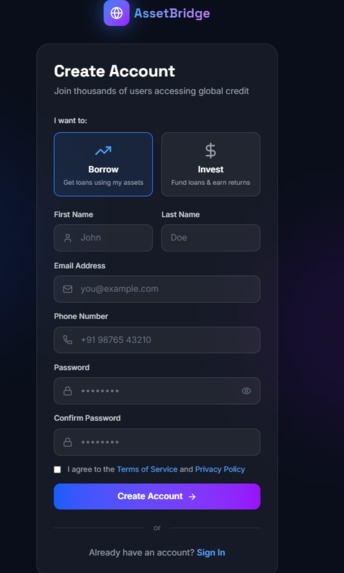
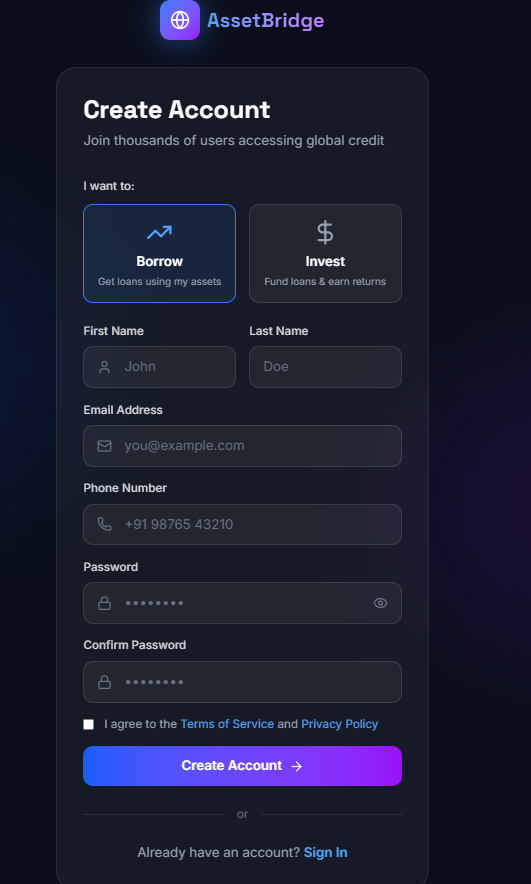
Registration page
-
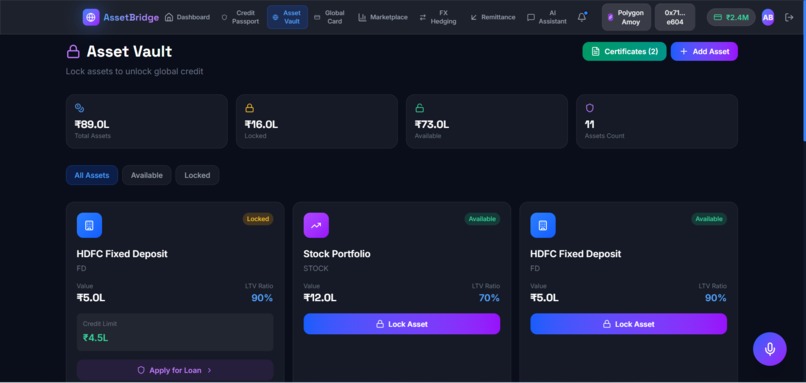
Asset Vault
-
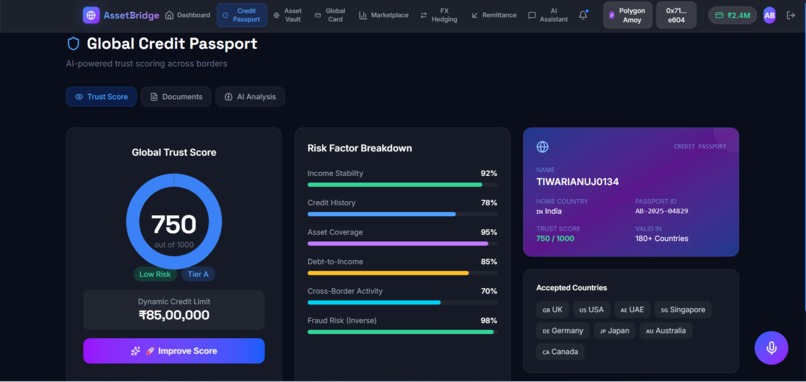
Credit passport page
Inspiration
Every year, over 250 million people cross borders — and instantly lose their financial identity. A professional with ₹5,000,000 in gold and a flawless repayment history in Mumbai becomes statistically indistinguishable from a high-risk borrower in London. The system resets them to zero. This is not a liquidity problem. It is a trust portability failure. Modern technology allows messages to travel globally in milliseconds. Capital does not. Financial reputation does not. Collateral does not. We asked: If information is borderless, why is trust geofenced? We discovered that trillions in legally owned assets — gold, deposits, real estate — remain economically underutilized because global underwriting systems cannot verify or model cross-border collateral risk in real time. AssetBridge was born from a simple thesis: Separate asset custody from credit liquidity. Make trust mathematically portable.
What it does
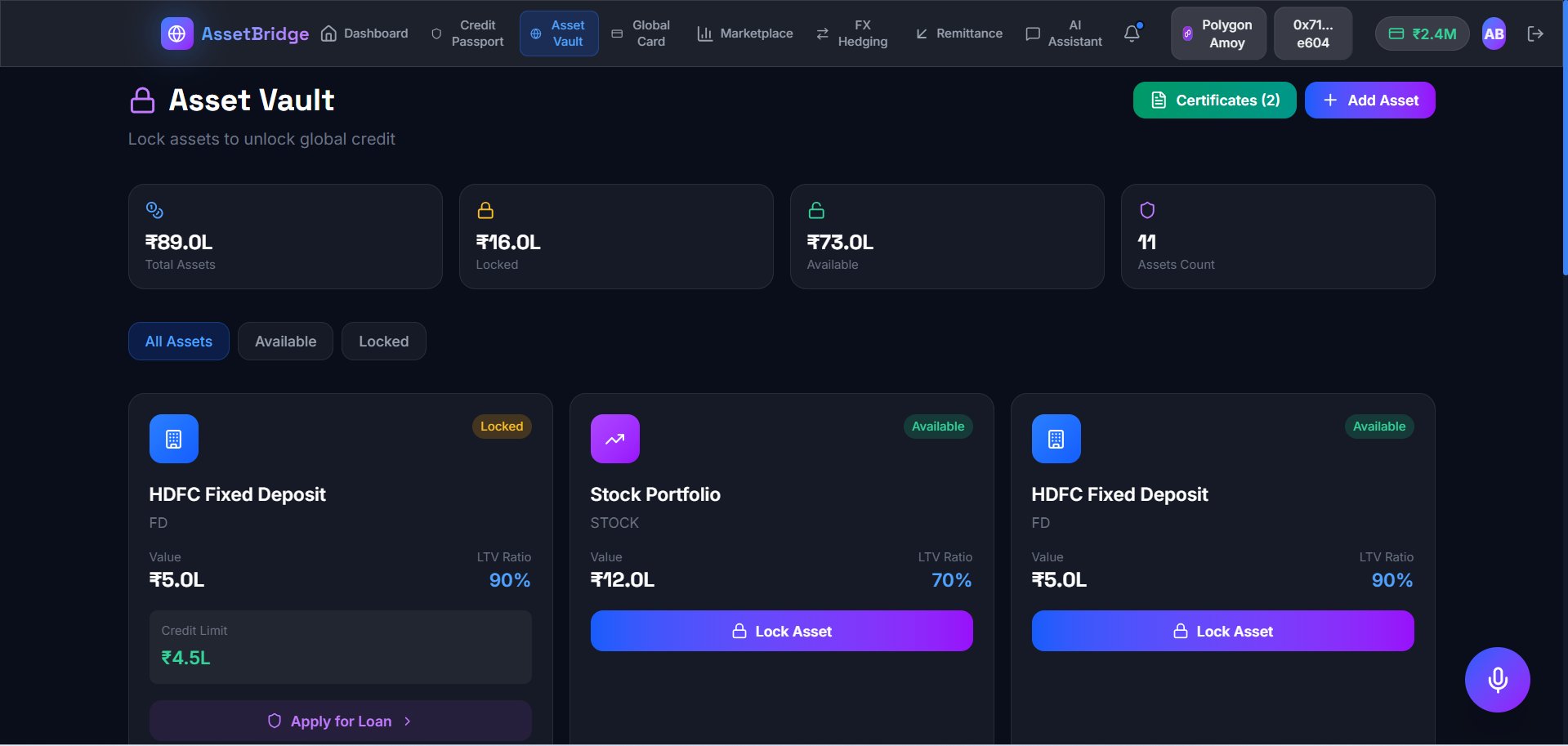
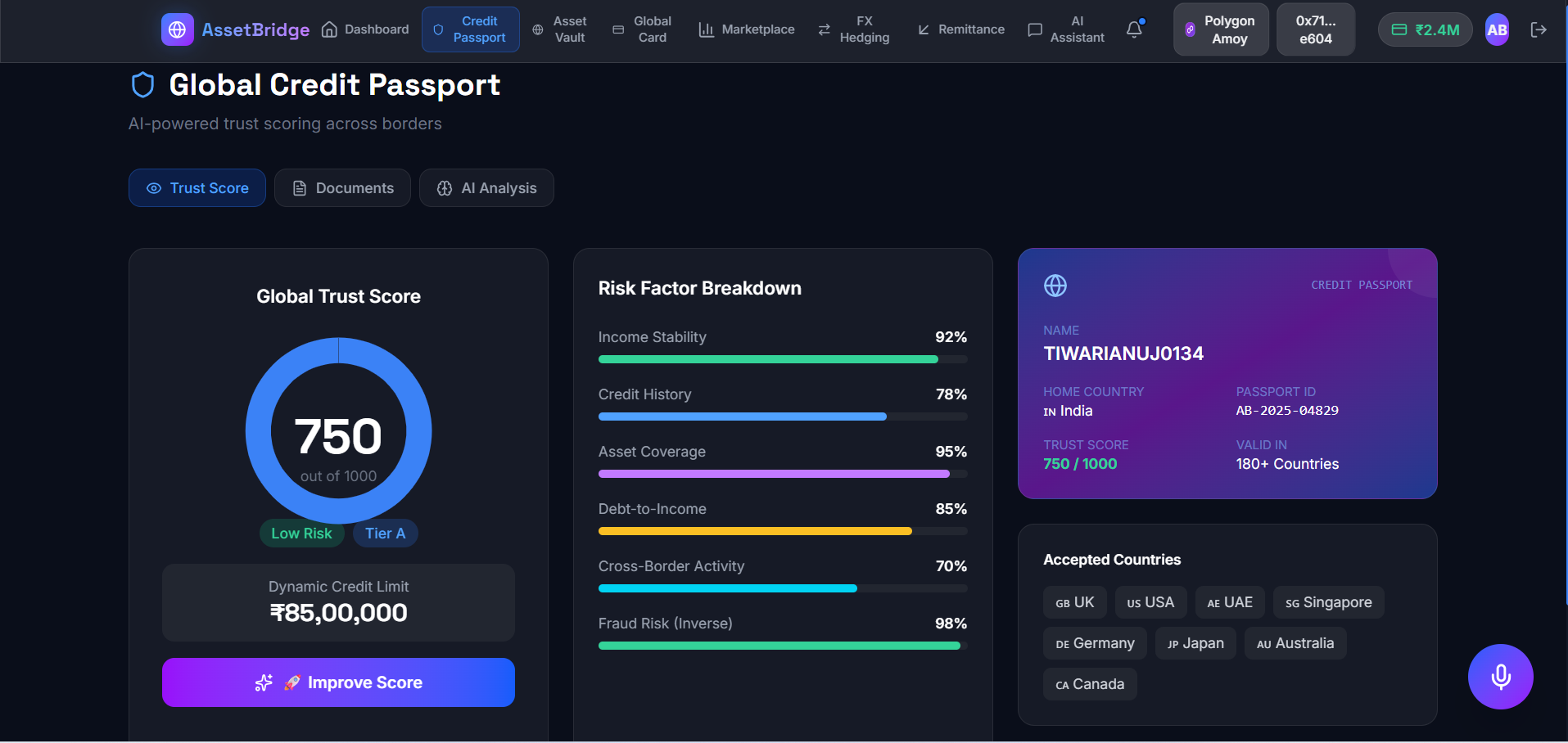
AssetBridge is a Programmable Global Credit Infrastructure. It serves as a decentralized "Layer 2" for banking, allowing users to tokenize domestic assets and unlock global credit without selling them. Key capabilities include: The AI Credit Passport: Our risk engine ingests financial documents and uses OpenAI to generate a deterministic, explainable "Global Trust Score," replacing archaic credit bureaus. Zero-Liquidation Liquidity: Users lock physical assets (Gold/FD) in our vault. We tokenize this lien on the Polygon Blockchain, proving ownership mathematically without moving the asset. P2P Global Marketplace: International investors can view these "AI-Verified" & "Blockchain-Secured" loan requests and fund them instantly, creating a borderless flow of capital. Algorithmic Risk Shield: The system continuously monitors Live Market Rates (Gold/FX). If currency volatility hits a threshold, our smart contracts trigger auto-hedging protocols to protect both borrower and lender.
How we built it
We architected AssetBridge not as an app, but as a Financial Protocol using a robust MERN + Web3 stack:
The Core (Backend): Node.js & Express (TypeScript) handling the complex Double-Entry Ledger system for simulated money movement and loan lifecycle management (UNDER_REVIEW → LISTED → ACTIVE). The Brain (AI): Integrated OpenAI GPT-4 via a custom context-aware agent. It doesn't just "chat"; it performs underwriting, analyzing bank statements to calculate Default Probability and generating Explainability Graphs for the UI. The Trust Layer (Blockchain): Used Wagmi & RainbowKit to connect wallets. We deploy Smart Contracts on Polygon Amoy to mint "Collateral NFTs" that serve as immutable proof of the locked asset. The Experience (Frontend): React + Vite with Tailwind CSS & Framer Motion to create a "Glassmorphism" UI that feels like an institutional banking terminal. Real-Time Data: Integrated external Oracles (ExchangeRate-API) to fetch live Gold and Forex rates, ensuring our LTV calculations are always market-accurate.
Challenges we ran into
The "Oracle" Problem: Feeding real-world data (Gold prices) into our risk engine without latency was tough. We solved this by building a caching layer for market data to ensure the UI remains snappy while keeping data fresh. Bridging Web2 & Web3: Creating a seamless UX where a non-crypto user can lock an asset (Web2 DB) and receive a proof (Web3 NFT) was complex. We abstracted the complexity so the user just sees "Success," while the backend handles the cryptographic heavy lifting. Simulating Institutional Logic: Building a P2P marketplace required robust state management. Ensuring a loan doesn't get "Double Funded" or stuck in "Pending" required writing a strict state-machine for the Loan Model.
Accomplishments that we're proud of
60 Seconds vs 60 Days: We successfully compressed the traditional cross-border underwriting process (which takes months) into a sub-minute AI-driven flow. The "Digital Lien" Certificate: We generate a dynamic, legally plausible PDF certificate for every locked asset, stamped with a cryptographic hash. It feels tangible and secure. JARVIS Voice Integration: We successfully implemented a context-aware Voice CFO. You can literally talk to the app ("Lock 50k Gold"), and it executes the financial command. It feels like the future. End-to-End Automation: From Registration to Asset Locking to Investor Funding to Virtual Card Issuance—the entire loop works without human intervention.
What we learned
Trust is just Data: Financial trust isn't about knowing a person; it's about verifying their history. AI is better at this than humans. Collateral is the Universal Language: Currencies fluctuate, but Gold is Gold in Mumbai and Manhattan. Tokenizing collateral is the key to solving cross-border friction. UX is Security: In Fintech, if the UI glitches, the user loses trust. Polishing the "Glassmorphism" interface was as important as writing the backend logic.
What's next for AssetBridge
Mainnet Launch: Deploying our Collateral Contracts on Polygon Mainnet. Custody Partnerships: Integrating APIs with real-world Gold Vaults (like Brinks or MMTC-PAMP) so the "Lock" isn't just digital, but physically enforceable. Institutional API: Releasing an SDK for Neobanks to use our "Cross-Border Credit Score" for their own customers. AssetBridge Protocol: Moving from a centralized platform to a DAO-governed protocol where the community decides LTV rates and Risk Parameters.
Built With
- amoy
- css
- ethers.js
- exchangerate-api
- express.js
- farmer
- hardhet
- lucide
- mongodb
- motion
- node.js
- pdfkit
- polygon
- react
- recharts
- tailwind
- testnet
- typescript
- vite
- wagmi

Log in or sign up for Devpost to join the conversation.