-
-
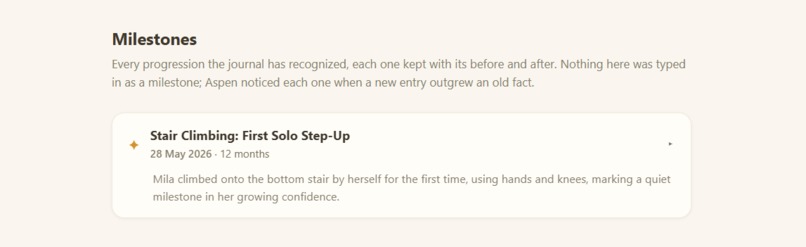
Milestone Record
-
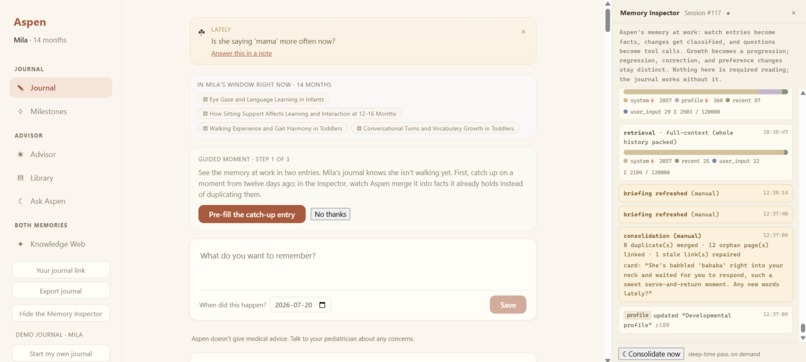
Main Page of Demo
-
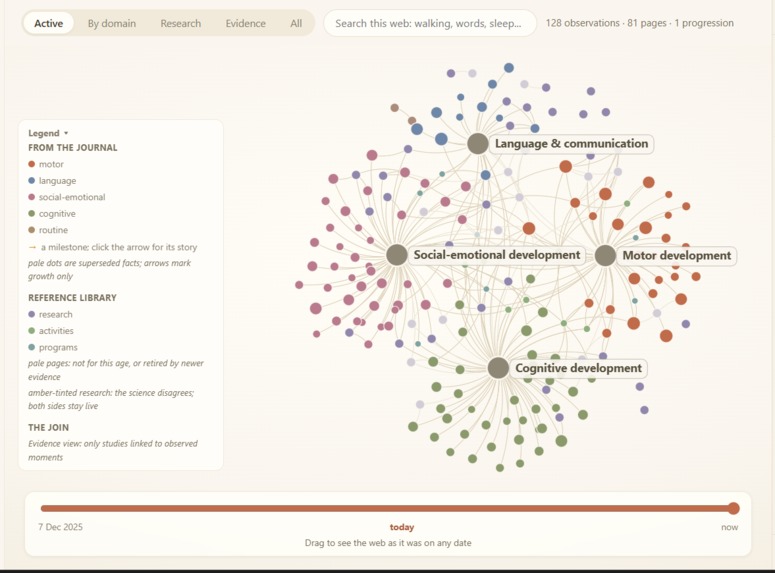
Knowledge Web
-
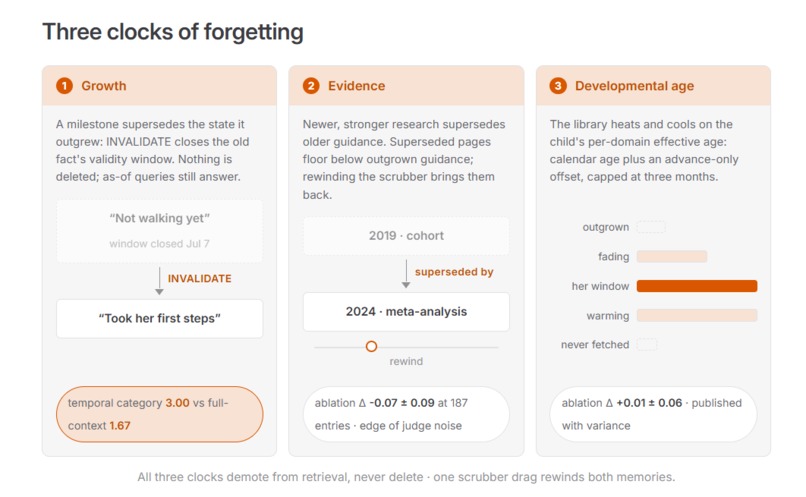
Forgetting Modalities
-
Benchmarks Summary
-
Four-Way Baselines and Benchmarks
Inspiration
Parenting tools usually know either the child or the research. A CHI 2026 study found that parents often gradually abandon baby tracking as children grow and identified milestone-timed guidance as an unmet need.
Aspen closes that gap with a journal-fed child record and a living research record. It tracks what changed, why, and what deserves limited context now.
What it does
Parents journal in ordinary language. Aspen preserves each entry and records both when an extracted fact was true and when it was learned. Parents can backdate, add superseding corrections, and reconstruct earlier states.
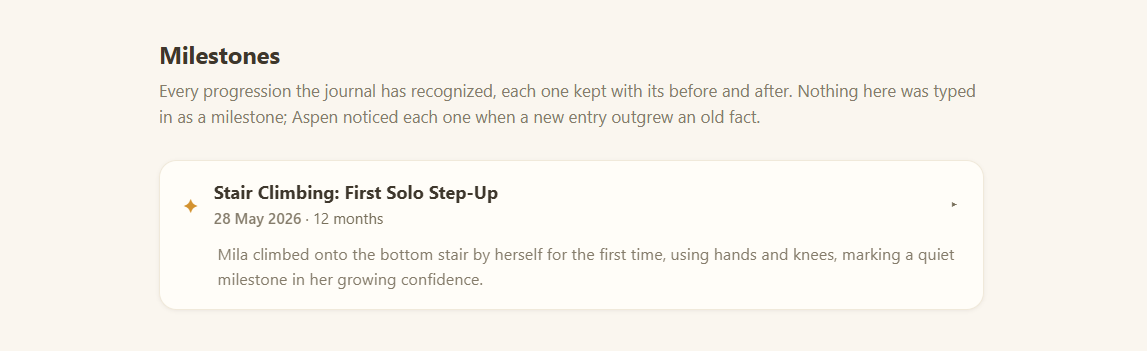
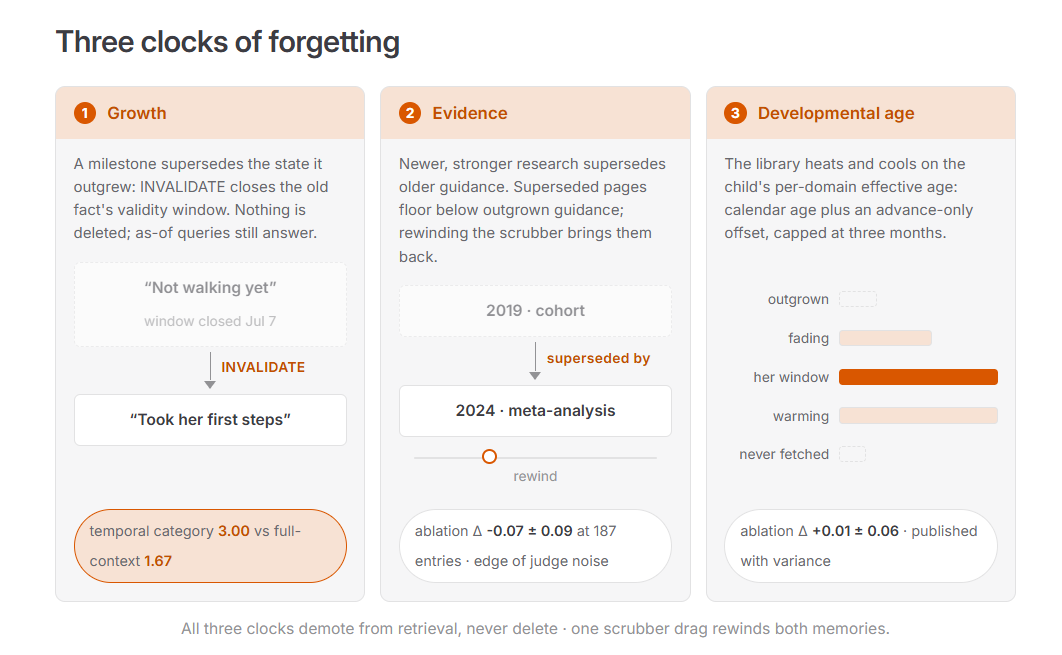
When a fact changes, Aspen classifies the reason as developmental progression, skill regression, error correction, or preference change. Only progression creates a milestone. For example, "not walking yet" can become the history behind "first steps" without treating the earlier fact as an error.
The research record searches OpenAlex, rejects poor matches, creates parent-readable Library pages, grades evidence, and checks claims against source abstracts. New guidance can supersede, refine, or contest an existing page. Unsupported topics can enter a persisted reading list.
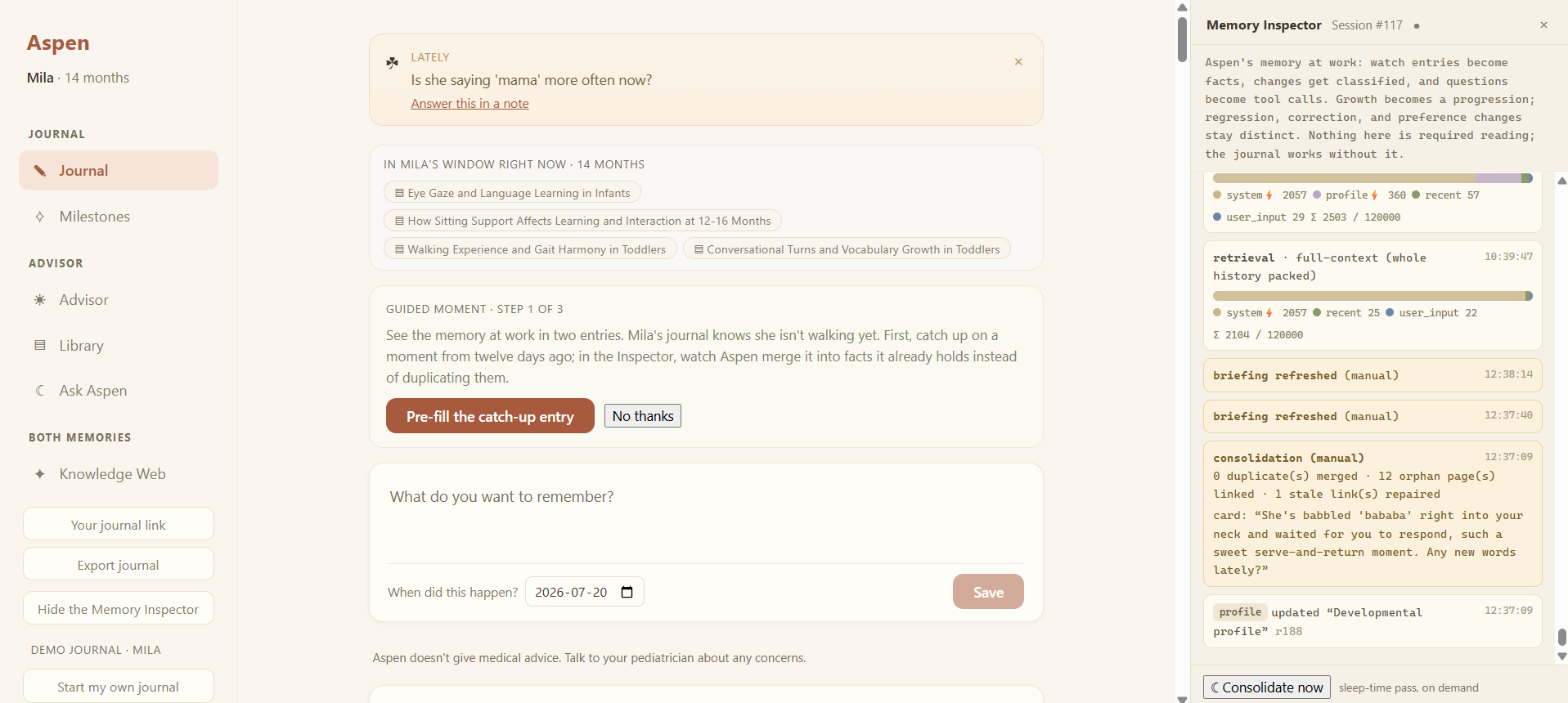
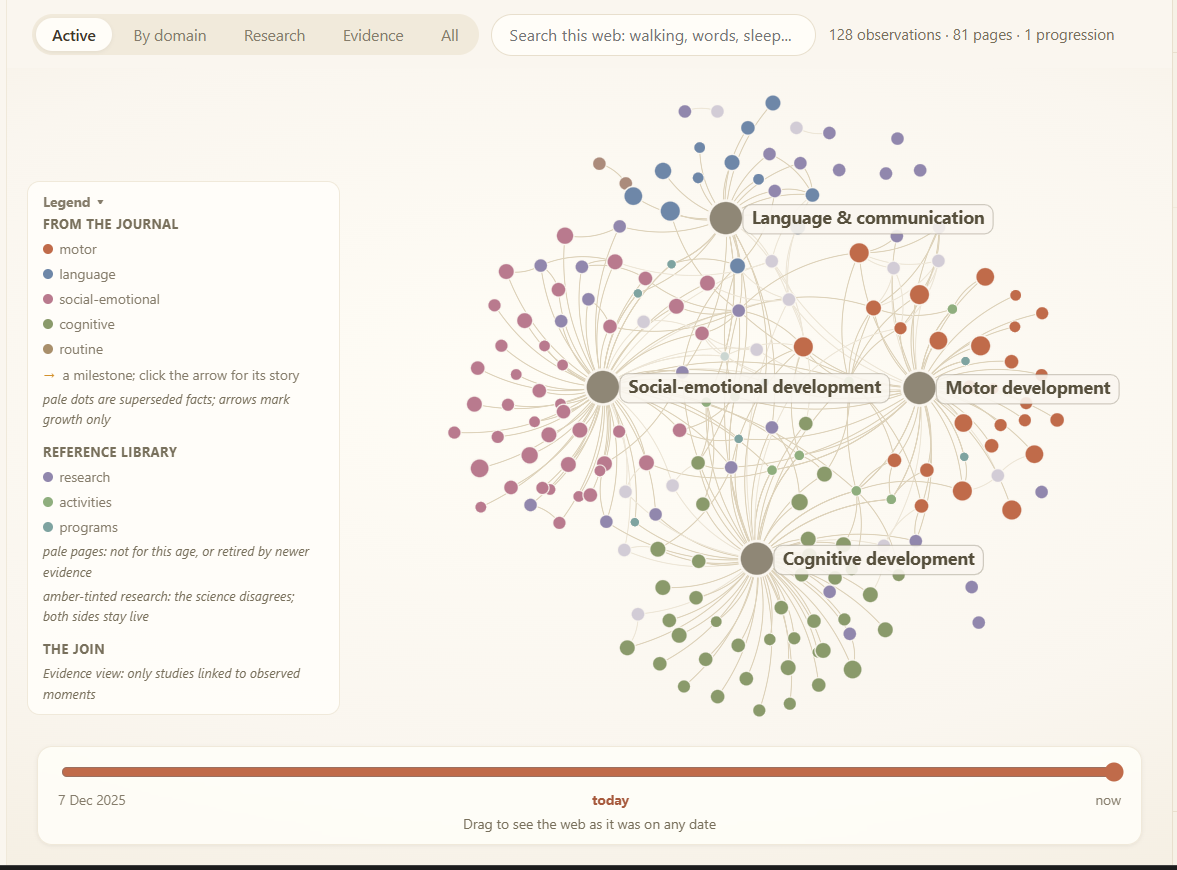
The Advisor joins both records with citations to studies, dated journal moments, and family preferences. The Knowledge Web and time scrubber make the history inspectable.
Aspen forgets on three clocks:
- Growth: outgrown facts cool into history.
- Evidence: superseded research is heavily demoted but stays auditable.
- Developmental age: outgrown guidance fades while upcoming guidance warms.
History is demoted, never destructively deleted.
How we built it
Aspen was built from scratch during the submission window as a TypeScript monorepo with a domain-agnostic memory engine, an Express server, and a React interface. Child-development policy stays outside the engine, so its memory machinery is not tied to one child or domain.
Retrieval combines BM25, pgvector similarity, graph expansion, reciprocal-rank fusion, evidence and time weighting, Qwen reranking, query-aware allocation, and token-budget packing. The Inspector displays the candidates, rankings, tool calls, citations, and packed context.
Qwen Cloud handles answers, extraction, classification, synthesis, reranking, verification, and embeddings through qwen-plus, qwen-flash, qwen-max, and text-embedding-v4. Five record tools are also available through MCP.
The demo runs on Alibaba Cloud ECS in Singapore with Postgres 16 and pgvector as its durable store. Each demo explorer receives an isolated fork of Mila's synthetic record.
The full architecture, the benchmarks, and a judge guide are documented at aspen-memory-ai-agent.com/docs.
Challenges we ran into
Literature search was noisy. A screen-time query returned a PFAS toxicology paper, while a sleep-training query found a deep-learning survey. I added a relevance gate and rejection ledger.
One early Library page exceeded its source abstract, and another response claimed a reading-list write that never happened. Aspen now checks source claims, citations, dates, reading-list actions, safety language, and record searches in code.
Accomplishments that we're proud of
I'm proud that Aspen can be inspected rather than taken on faith. Citations resolve to the study pages and dated journal entries behind its answers, the Inspector exposes retrieval and tool activity, and null evaluation results are published alongside the wins.
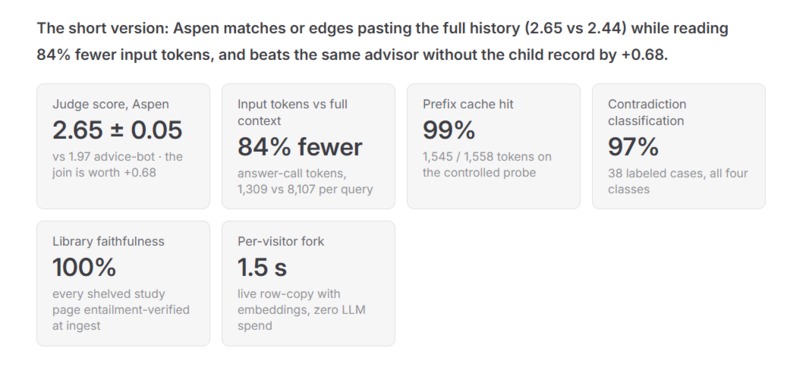
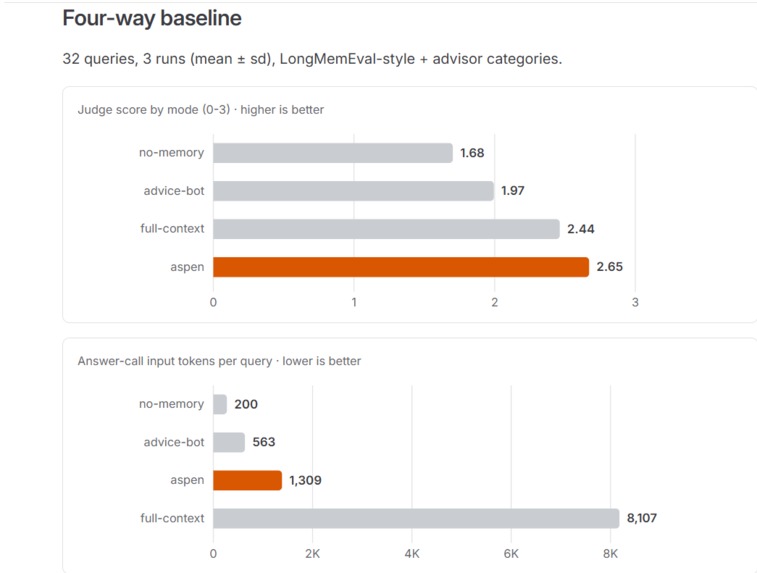
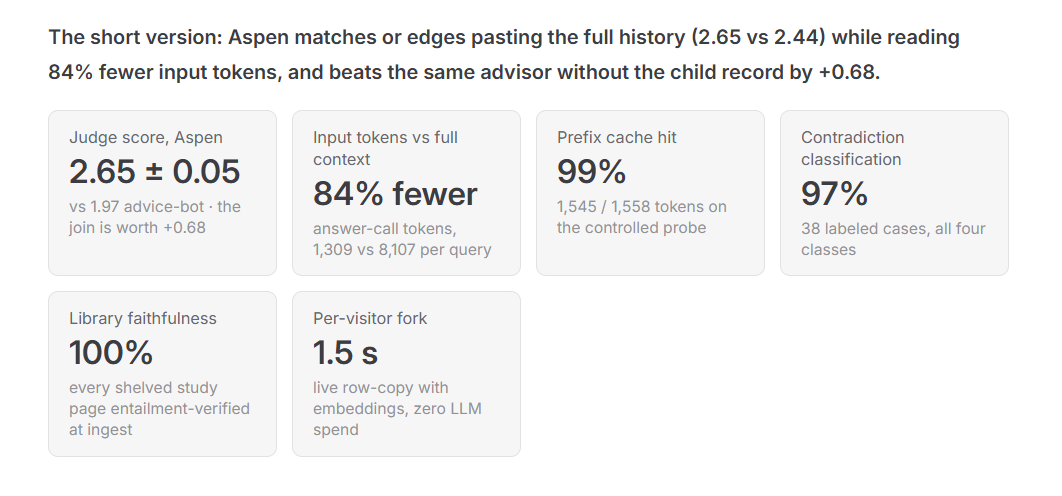
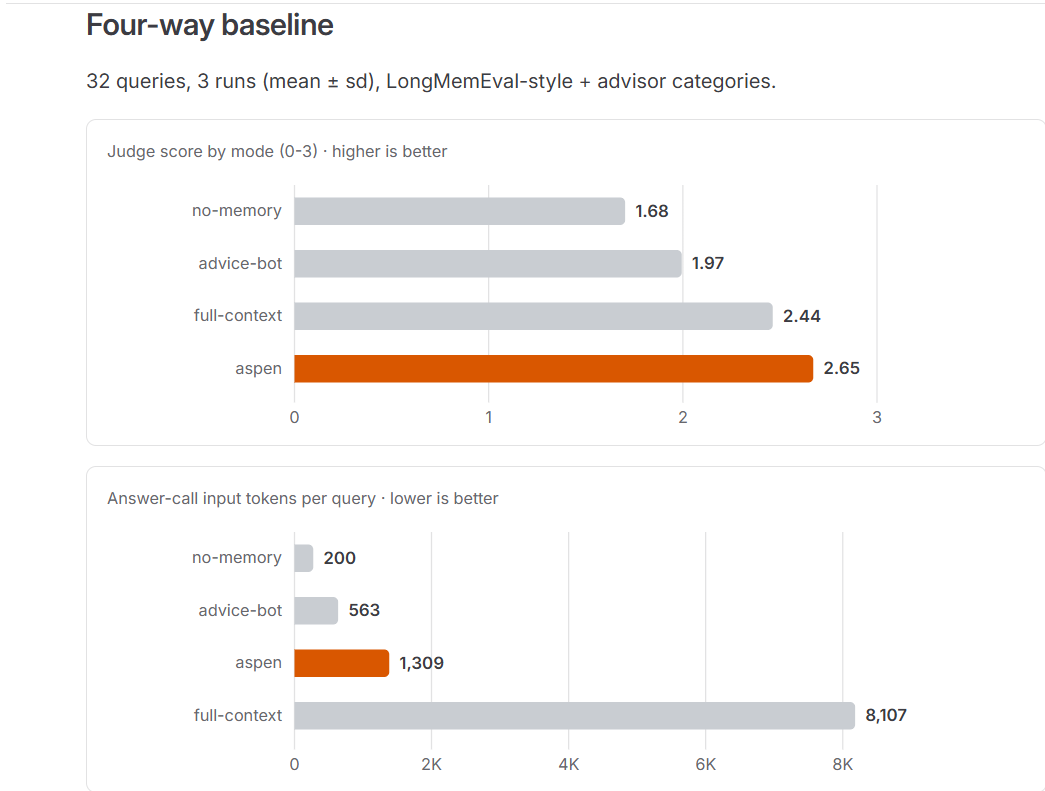
Across three runs on our tuned 32-query development set, Aspen used 84% fewer answer-call input tokens than full history (1,309 vs. 8,107) while matching or edging its judged quality (2.65 vs. 2.44). It also beat the same answerer given the full research library but no child record by +0.68 (2.65 vs. 1.97): the measured value of knowing the child. The change classifier correctly labeled 37 of 38 changes across all four types. Every shelved study page has passed a separate qwen-max claim check against its source abstract.
The answer comparison used a mode-blinded qwen-max judge on a tuned, not held-out set. These are project-specific results, not universal benchmark claims.
What we learned
I expected retrieval to be the hardest part. The harder problem was interpreting change: "not walking yet" becoming "first steps" is growth, while losing a skill needs a completely different response. I also learned that prompts cannot guarantee actions. When Aspen said it had added a topic to the reading list without calling the tool, I enforced that promise in code.
What's next for Aspen
The public demo follows a completely fictional family. Before Aspen is ready for real families, it needs accounts, caregiver invitations, managed storage, clear export and deletion controls, and independent background jobs for each family. Those foundations come before a wider release.
Built With
- alibaba-cloud
- alibaba-cloud-ecs
- dashscope-api
- express.js
- model-context-protocol-(mcp)
- node.js
- openalex
- openalex-api
- pgvector
- postgresql
- qwen-cloud
- react
- typescript
- vite


Log in or sign up for Devpost to join the conversation.