Inspiration
GeneCodex was born from a direct need. It started as a conversation with a real geneticist, who researches rare genetic diseases. Her daily work, like that of many scientists, involved spending hours manually gathering and cross-referencing data for a single genetic variant from a dozen different, complex, and disconnected web tools. I was inspired to build a tool that would automate this tedious process, not as a generic data viewer, but as a personalized assistant designed to fit her specific workflow and answer her specific questions. The goal was to give her back her most valuable asset: time to focus on discovery.
What it does
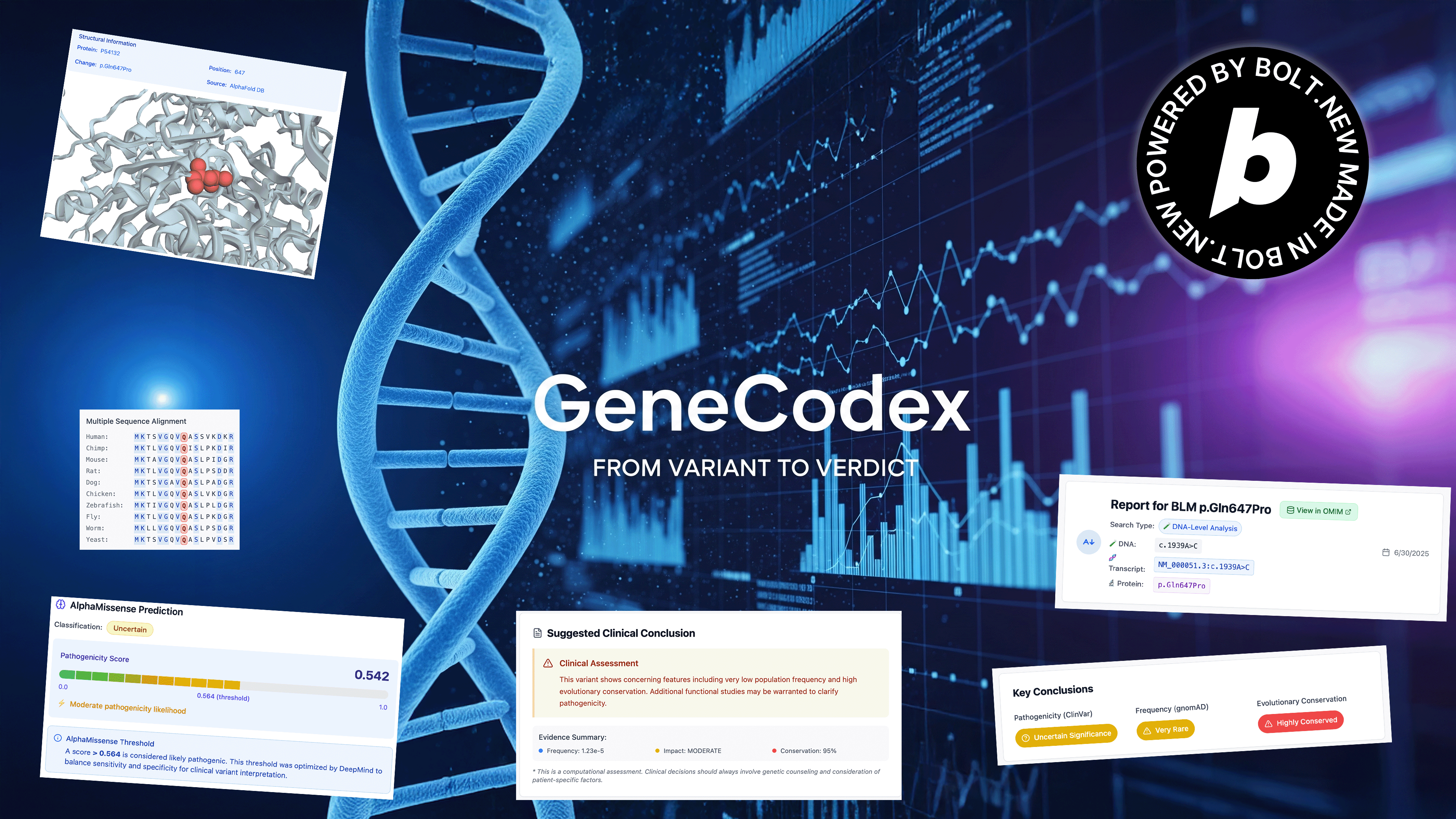
GeneCodex is an intelligent, all-in-one web platform that transforms the analysis of genetic variants. A user can input a variant in multiple formats (at the DNA or protein level, or with a specific transcript ID), and with a single click, GeneCodex orchestrates a complex series of tasks:
- It queries major clinical and population databases like ClinVar and gnomAD.
- It gets state-of-the-art functional predictions from Ensembl VEP.
- It integrates cutting-edge AI pathogenicity scores from AlphaMissense.
- It performs an evolutionary conservation analysis by querying BLAST and running an alignment with Clustal Omega.
- It provides an interactive 3D structural visualization of the protein from the AlphaFold DB, highlighting the exact location of the mutation.
The result is a single, unified, and interactive report that synthesizes all this information, allowing a researcher to assess the potential impact of a variant in seconds, not hours.
How we built it
GeneCodex was built iteratively in a unique, conversational development process. The entire application was scaffolded, debugged, and refactored through a partnership between a human developer and an AI assistant.
The tech stack includes:
- IDE & Environment: StackBlitz, using its web container technology.
- Frontend: A modern web framework, likely React with TypeScript, built with Vite.
- Deployment: Continuous deployment to Netlify.
- Backend & Database: Supabase for user authentication and storing search history.
- Core APIs: We integrated a suite of professional bioinformatics APIs, including Ensembl VEP, NCBI E-utils (for ClinVar & BLAST), gnomAD, UniProt, AlphaFold DB, and the Google Generative Language API (for the AI assistant).
- 3D Visualization: The interactive viewer is built using the
3Dmol.jslibrary.
Challenges we ran into
The biggest challenge was bridging the gap between multiple complex systems. We ran into a classic, frustrating series of bugs while trying to integrate the Gemini API key. This led us down a deep rabbit hole of debugging ECONNREFUSED errors, only to discover the root cause was a fundamental misunderstanding of how environment variables work in a containerized web environment (backend process.env vs. frontend import.meta.env.VITE_...). Solving this required a complete refactoring of the API call logic but taught us an invaluable lesson about full-stack development. Another challenge was correctly formatting the dynamic links to external databases like gnomAD and ClinVar, forcing us to learn the specific data identifiers (like VCV IDs) they require.
Accomplishments that we're proud of
We are incredibly proud of creating a tool that solves a real-world problem for a specific, expert user. Our biggest accomplishment is the successful synthesis of data from over five different, complex bioinformatics APIs into a single, clean, and intuitive user interface. We are also proud of the resilience shown during the debugging process, turning major roadblocks into deep learning experiences. Finally, we're proud to have built a tool that already incorporates state-of-the-art AI models like AlphaMissense, putting it at the forefront of modern genetic analysis tools.
What we learned
This project has been a masterclass in modern, AI-assisted development. We learned that the most powerful applications come from a deep understanding of a specific user's pain points. We learned, through trial and error, the critical differences between frontend and backend environments in the cloud. Most importantly, we learned that the true power of AI in development isn't just generating code, but acting as a collaborative partner in a complex problem-solving and debugging dialogue.
What's next for GeneCodex
The vision for GeneCodex is to evolve from a data analysis tool into a true research platform. Our immediate roadmap, based directly on user feedback from the geneticist, includes:
- Batch Analysis: Allowing users to upload a file with hundreds of variants and receive a summary table of results. *DONE
- Enhanced Collaboration: Implementing the ability to share a unique, permanent link to a specific report with colleagues.
- Advanced 3D Visualization: Superimposing the mutant protein structure with the wild-type structure for direct visual comparison.
- New Analysis Modules: Building a new module to specifically predict the outcome of splicing variants using specialized tools like SpliceAI.
Built With
- 3dmol.js`
- alphafold-db`
- alphamissense`
- ensembl-vep-api`
- gemini-api`
- gnomad-api`
- ncbi-blast-api`
- netlify`
- react`
- stackblitz`
- supabase`
- test
- typescript`
- vite`

Log in or sign up for Devpost to join the conversation.