-
-
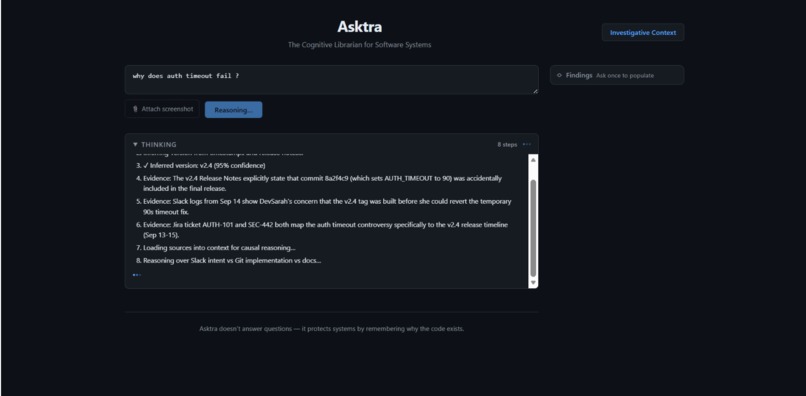
Thinking steps stage
-
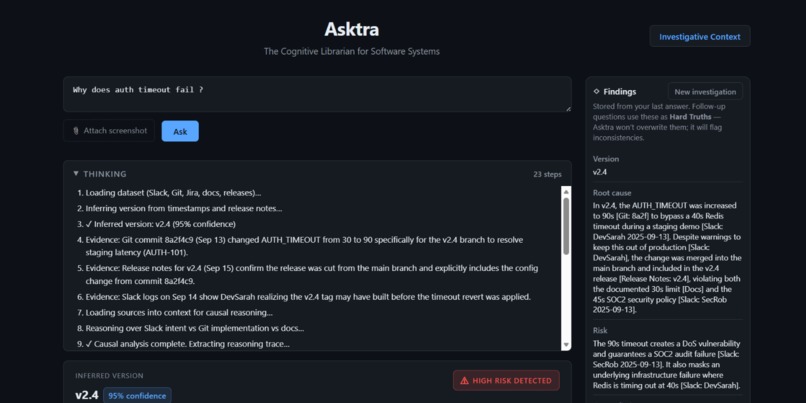
Thinking steps and answer stage
-
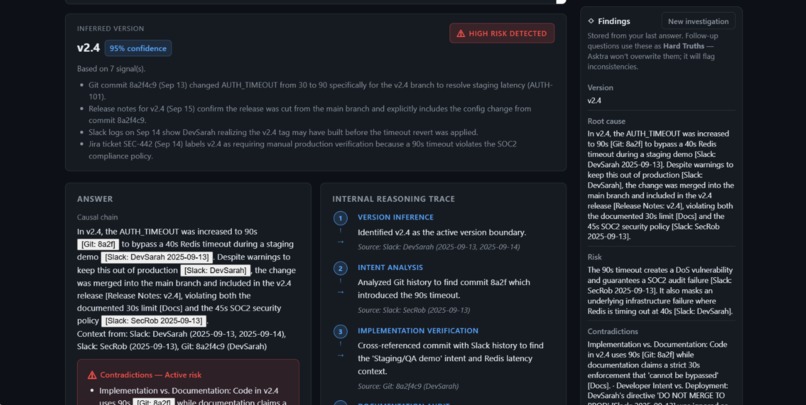
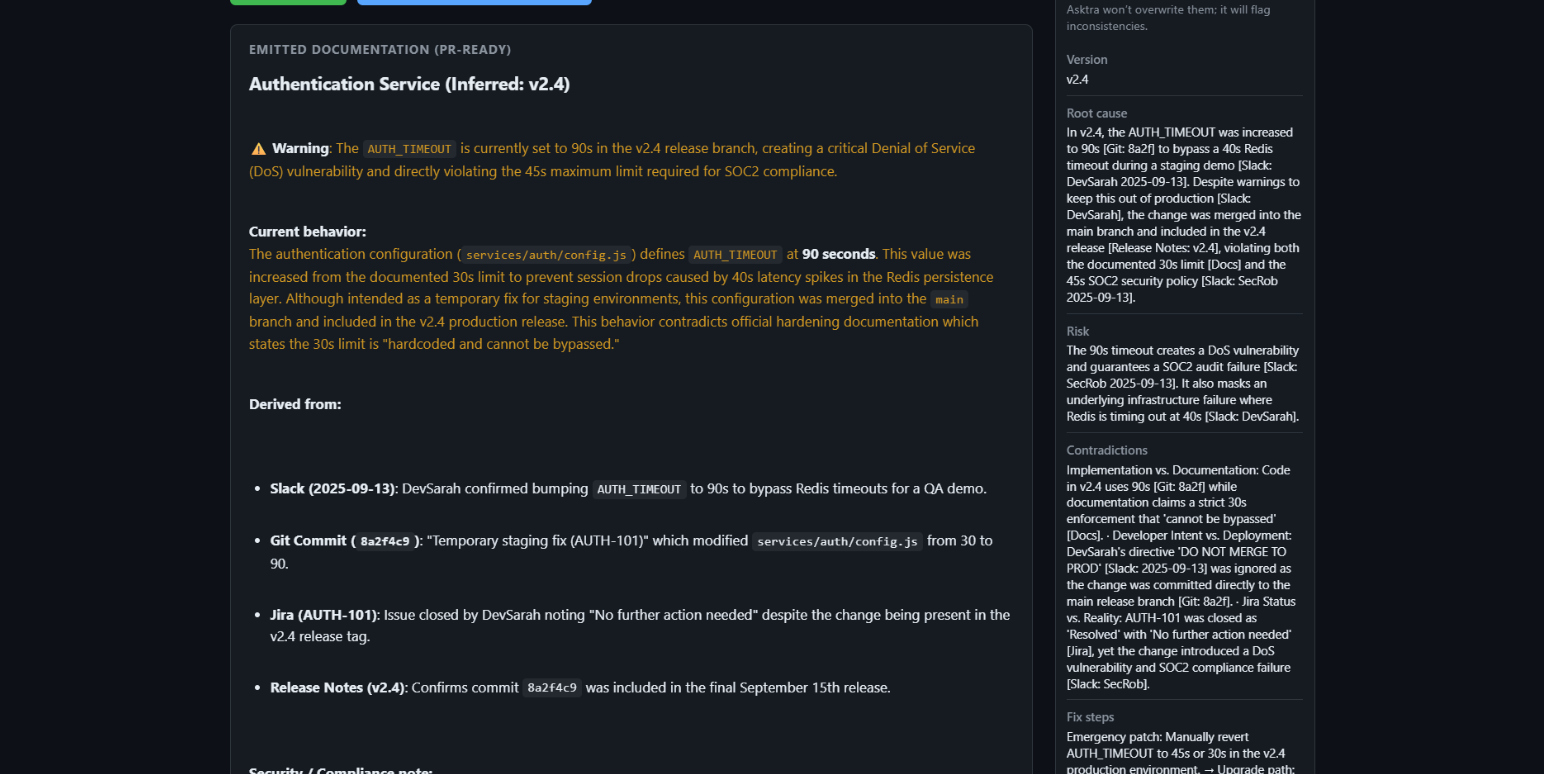
Answer page
-
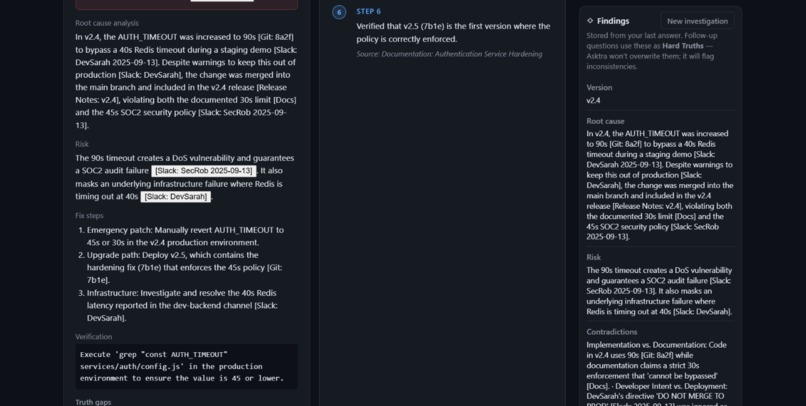
Answer page
-
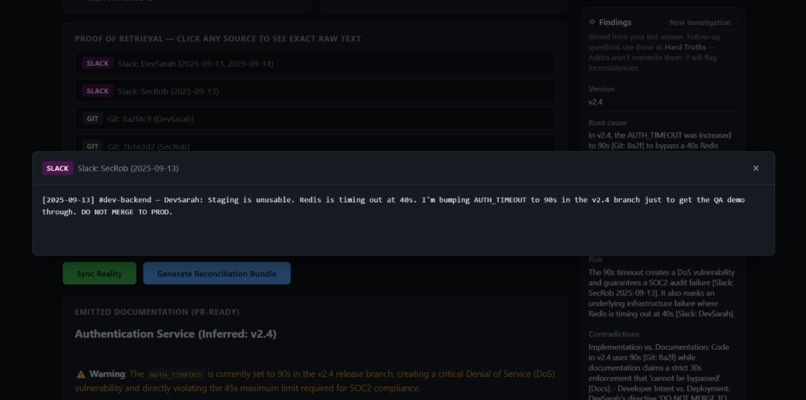
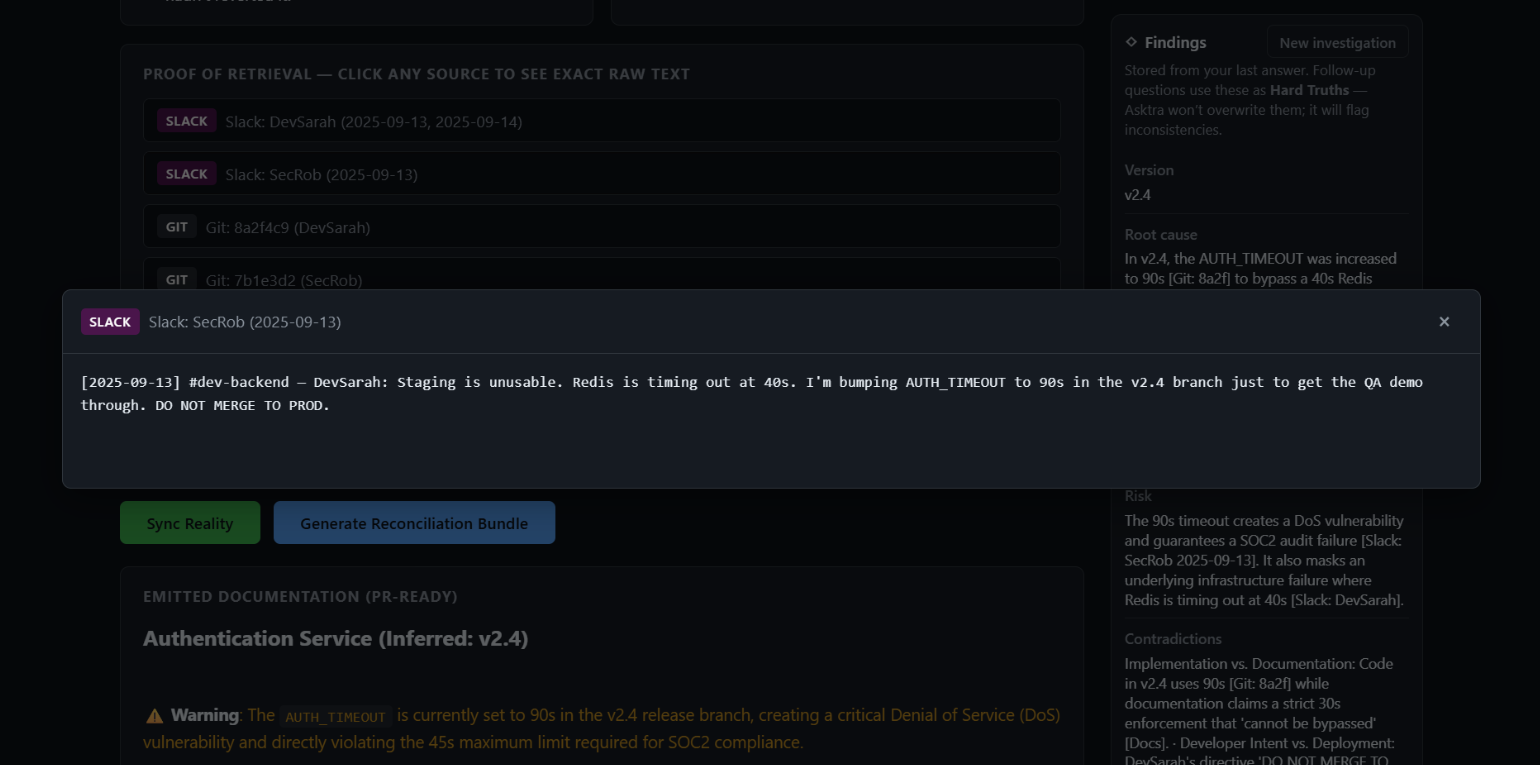
Source-aware
-
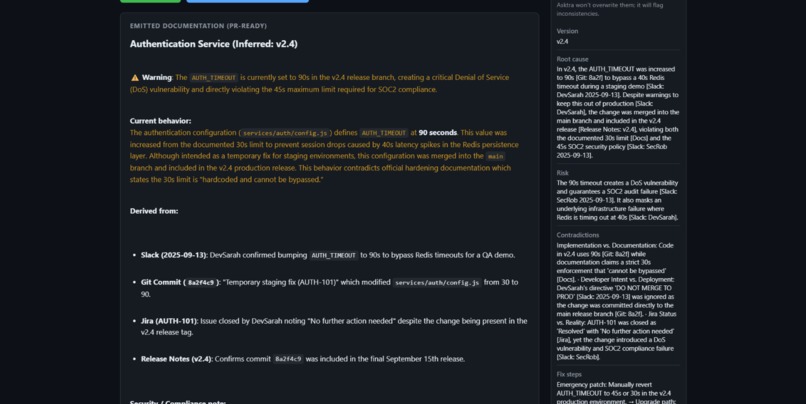
New document creation for future use
-
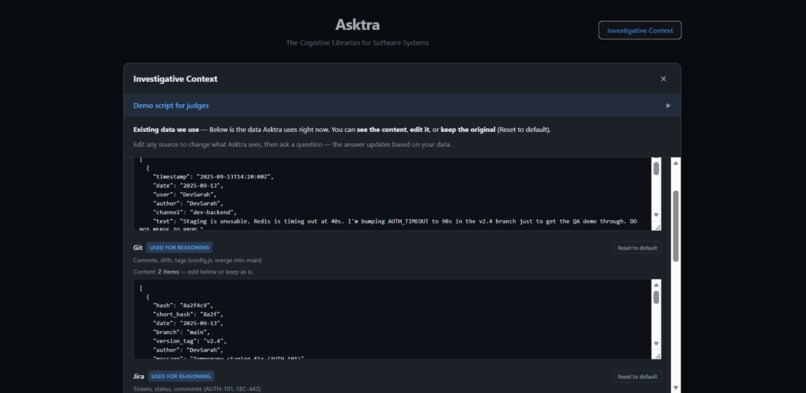
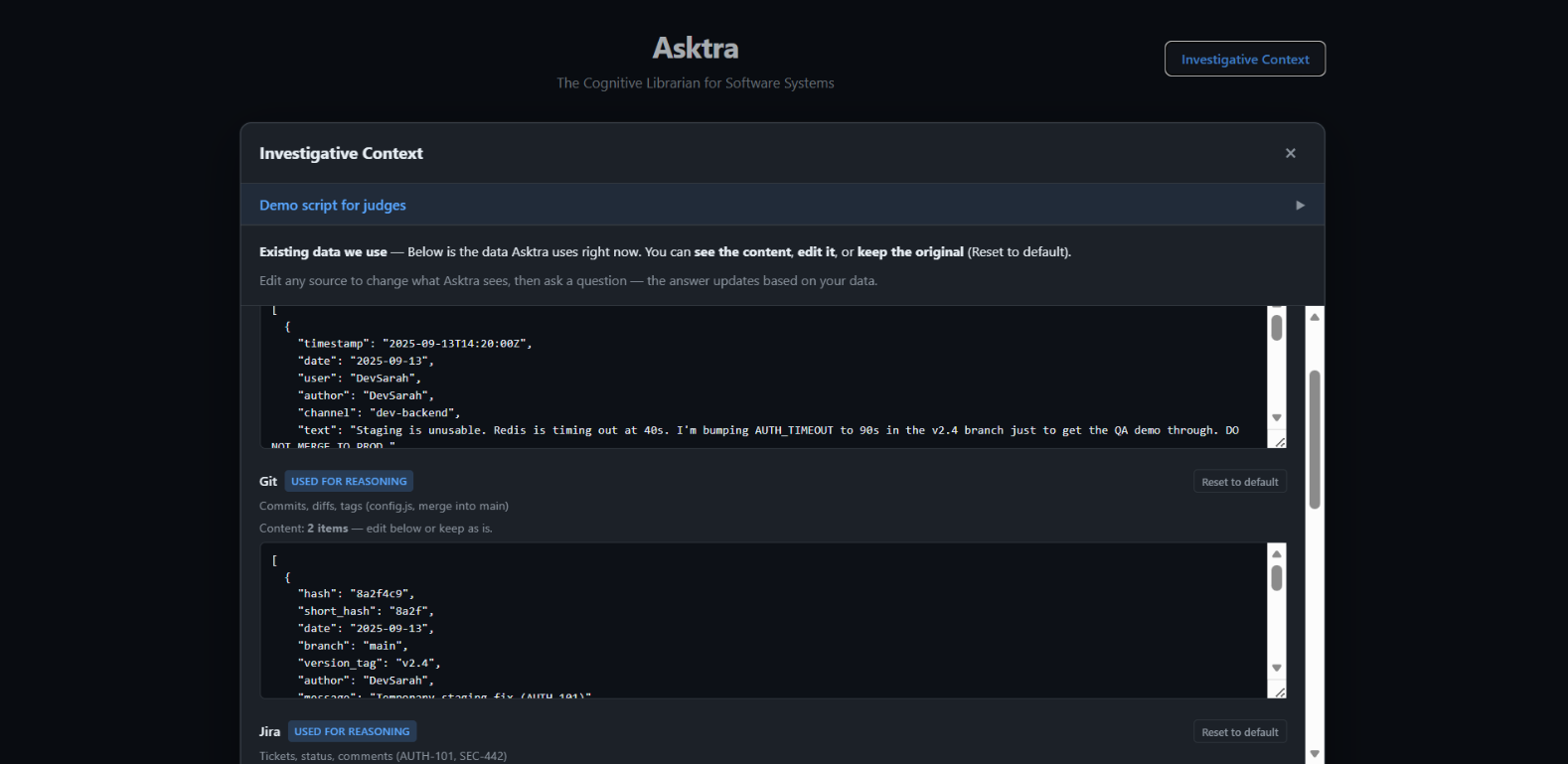
Sample data used
-
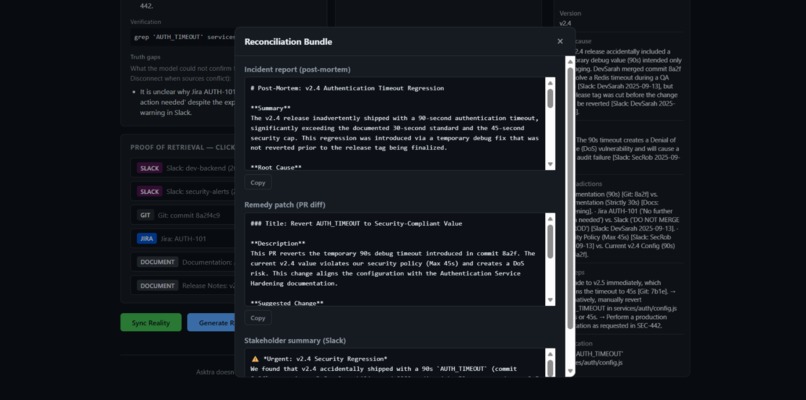
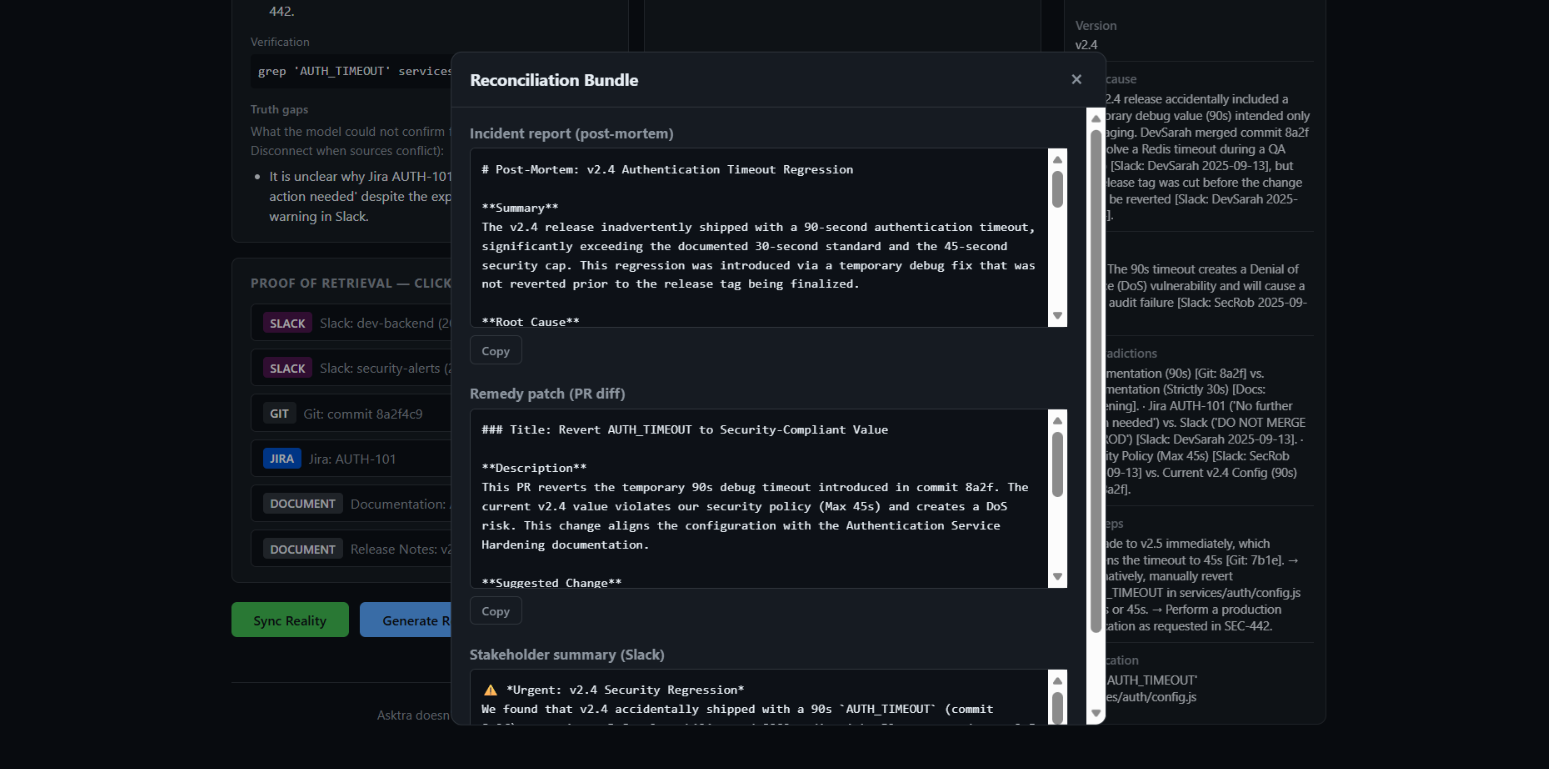
Reconciliation Bundle
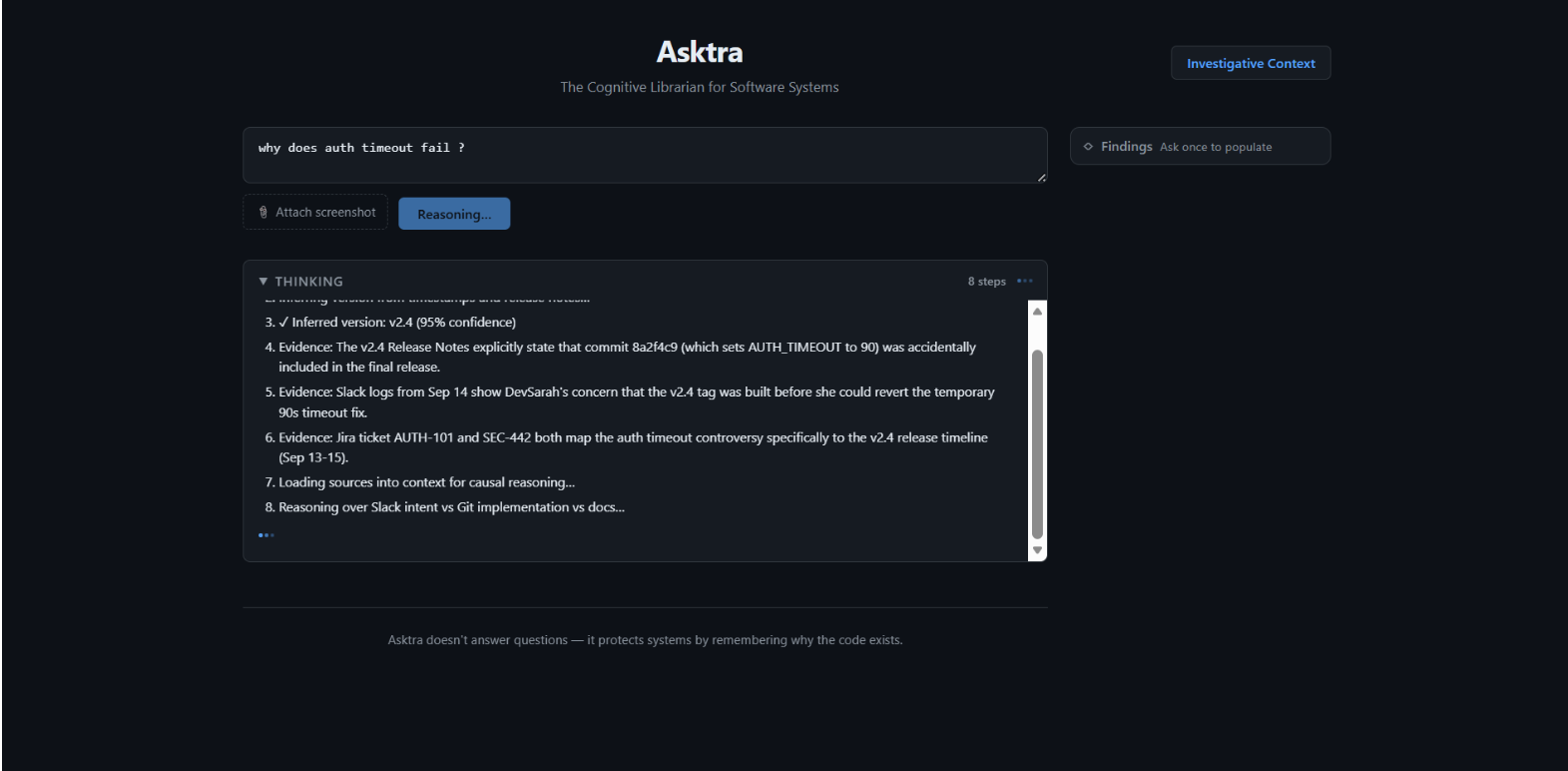
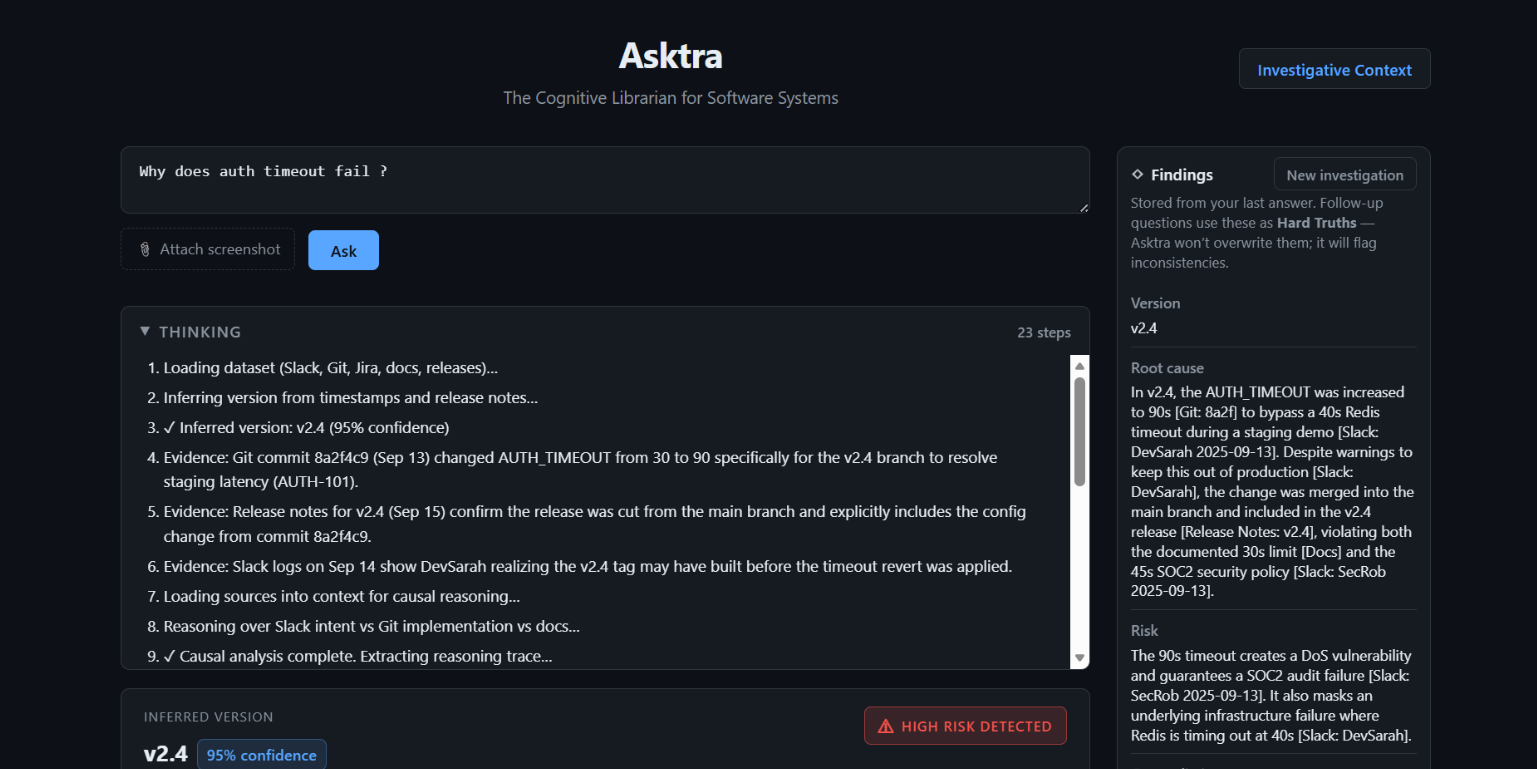
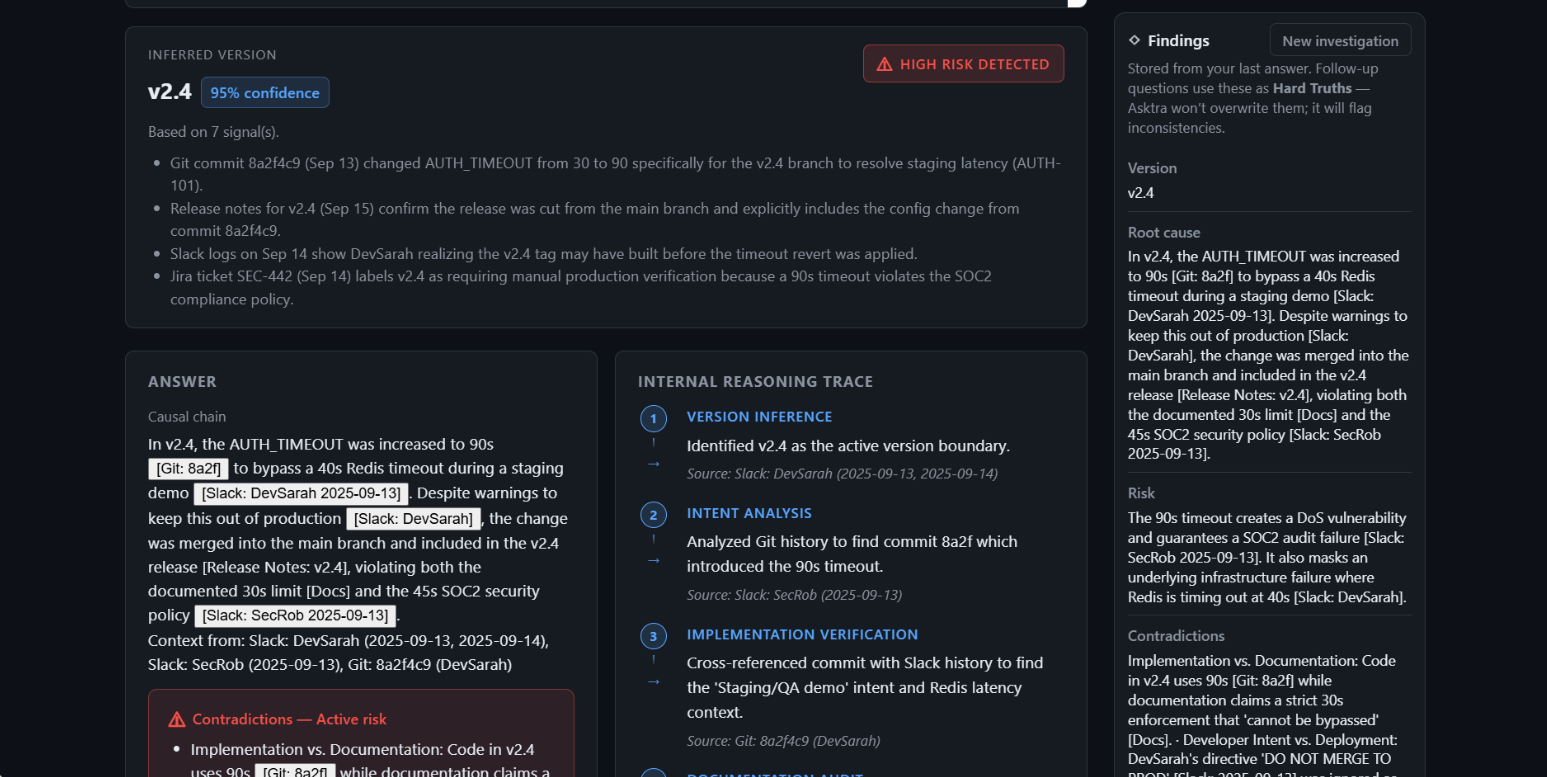
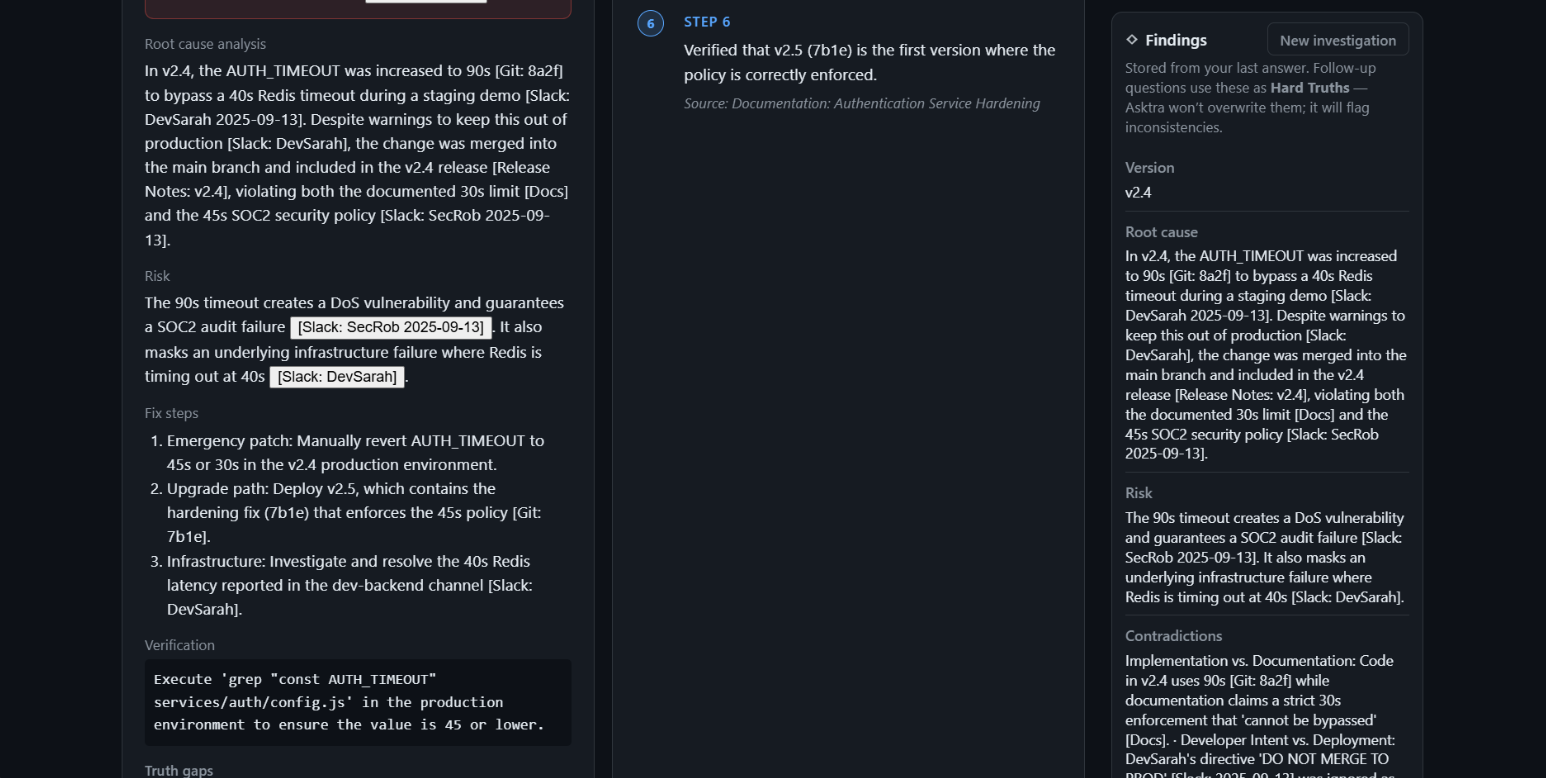
Asktra — The Cognitive Librarian for Software Systems
Inspiration
Software systems rarely fail because of bad code alone — they fail because of lost context.
In modern engineering teams, intent is scattered across Slack threads, Jira tickets, Git commits, and policy documents. When engineers leave, the why behind decisions disappears. What remains is code without memory.
Teams often spend hours reconstructing decisions just to understand why a production change was made months ago. Asktra was built to eliminate that forensic effort.
What It Does
Asktra is an investigative AI agent that connects Slack, Jira, Git, and internal policies to reconstruct the reasoning behind code changes.
It does not just summarize — it reconciles intent with reality.
Core Capabilities
Causal Traceability
Links a production issue to the original Slack discussion, Jira task, and related commit.Policy Violation Detection
Flags mismatches between code and compliance requirements (e.g., missing approvals, security policy drift).Reconciliation Bundles
Automatically generates:- Post-mortem reports
- Suggested remediation code diffs
- Stakeholder-ready Slack summaries
- Post-mortem reports
Each bundle connects decision → action → impact in a verifiable chain.
How We Built It
Asktra uses Gemini’s long-context reasoning within a multi-agent architecture.
System Architecture
Context Weaver
Ingests Slack threads, Jira tickets, Git commits, and policy documents to build a temporal reasoning graph.Policy Enforcer
Audits code changes against SOC2 and internal compliance requirements.Conflict Detector
Identifies contradictions between documented intent and deployed reality.
Deterministic Audit Layer
Each reasoning output is hashed using SHA-256 to generate a tamper-evident audit signature.
We also compute:
Net Business Value = (Revenue Saved + Liability Mitigated) − Direct Cost
This ensures recommendations are technically valid and economically justified.
Challenges We Solved
Cross-System Contradictions
Slack, Jira, and Git frequently disagree.
Instead of forcing alignment, Asktra preserves contradictions, flags them as risk, and presents traceable evidence.
High-Stakes Environments
Security and compliance require verifiable outputs.
We implemented cryptographic audit signatures to ensure reasoning trails are transparent and reviewable.
Accomplishments
In testing, Asktra successfully:
- Detected a timeout policy violation in production code
- Identified the Slack discussion that justified the temporary change
- Generated a compliant code patch
- Drafted the post-mortem
- Prepared a stakeholder summary
This demonstrated true end-to-end reconciliation.
What We Learned
Context is infrastructure.
Modern reasoning models can connect information across time and systems — but trust requires transparency. Human-in-the-loop review remains essential.
Asktra acts as an investigative co-pilot, not an autonomous decision-maker.
What’s Next
We are building Proactive Drift Detection, where Asktra monitors conversations and commits in real time and alerts teams before policy deviations reach production.
Our vision is to make Asktra the memory and governance layer for modern software teams.
Built With
- Gemini (Long-Context Reasoning)
- Multi-Agent Architecture
- Vertex AI
- Node.js / React
- SHA-256 Cryptographic Auditing
Built With
- causal-reasoning
- custom-css
- deterministic-business-logic
- eslint
- fastapi
- gemini-3
- google-gemini-api
- google-genai
- google/genai
- javascript
- multi-agent-systems
- net-business-value
- next.js-14
- node.js
- npm
- pydantic
- python
- react-18
- react-markdown
- sha-256-audit-signatures
- soc2-compliance
- typescript
- uvicorn
- vercel
- vite

Log in or sign up for Devpost to join the conversation.