-
-
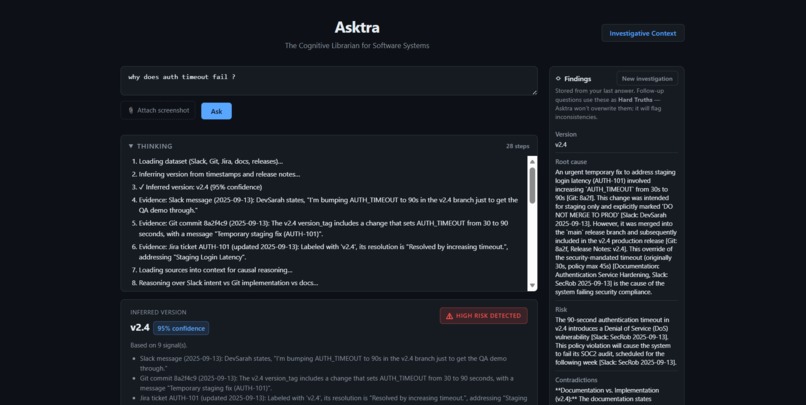
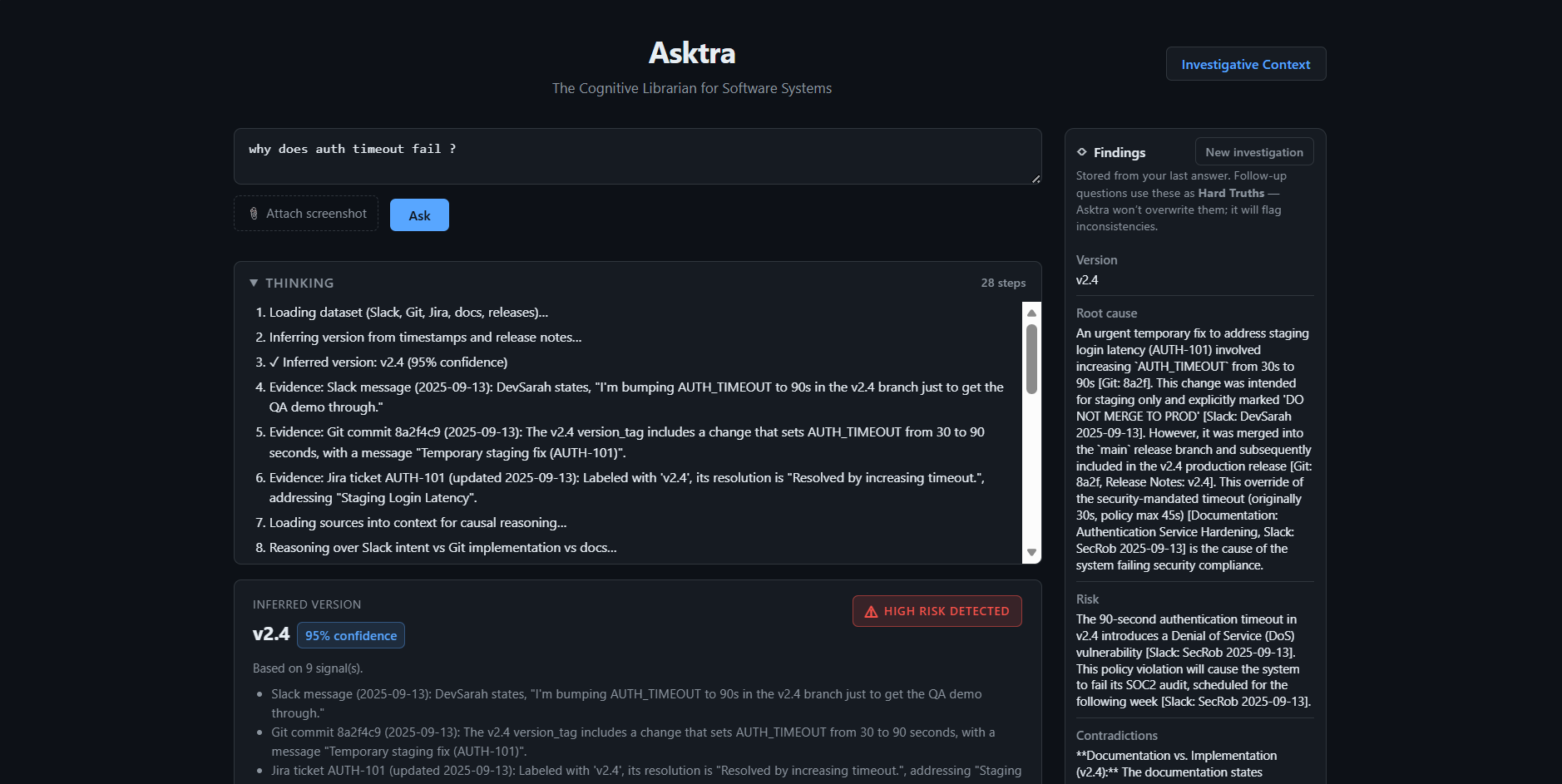
Thinking steps stage and answer stage
-
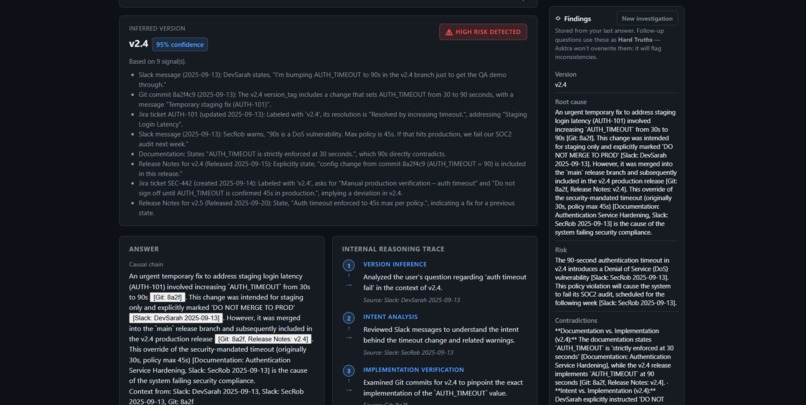
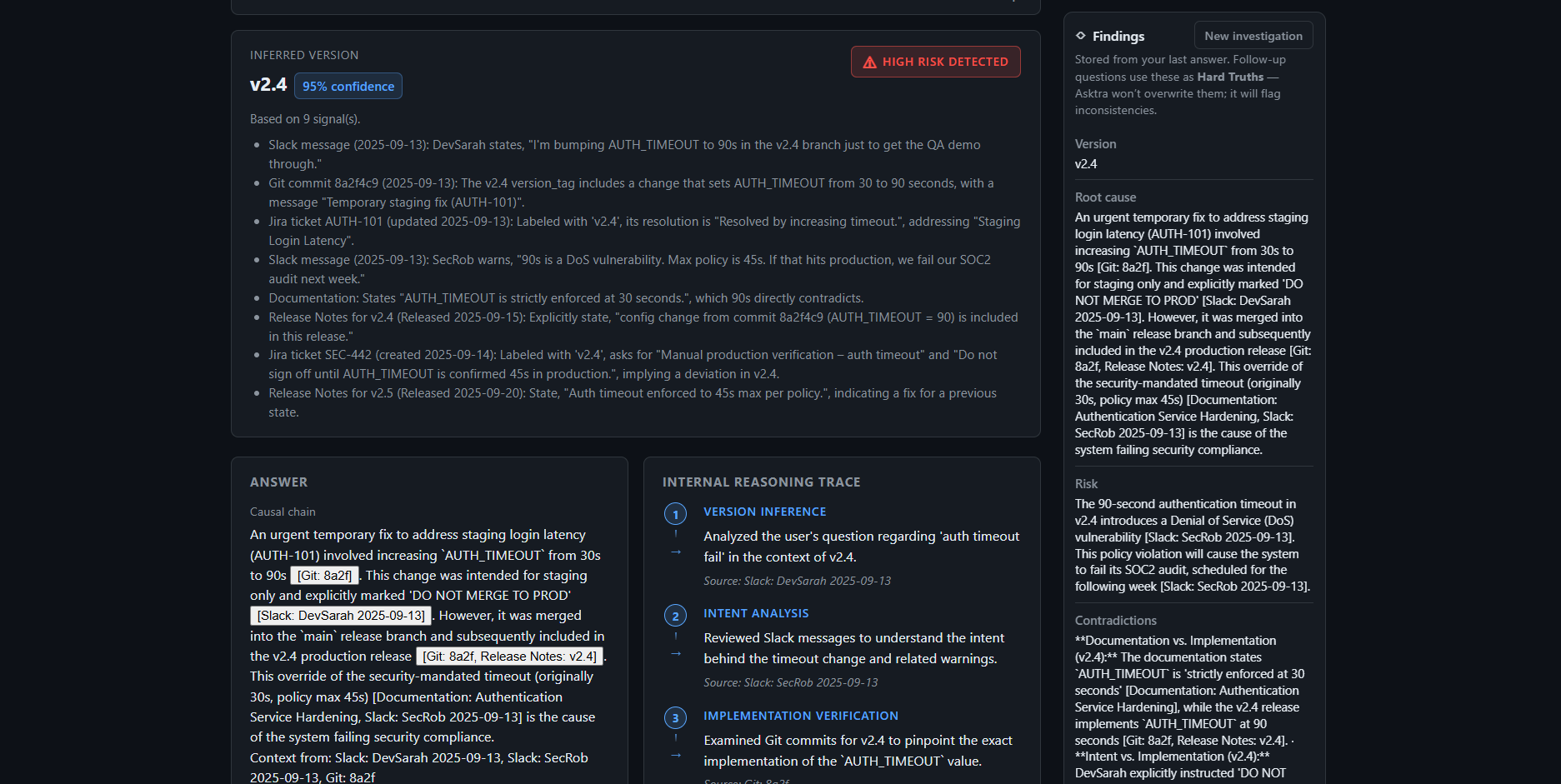
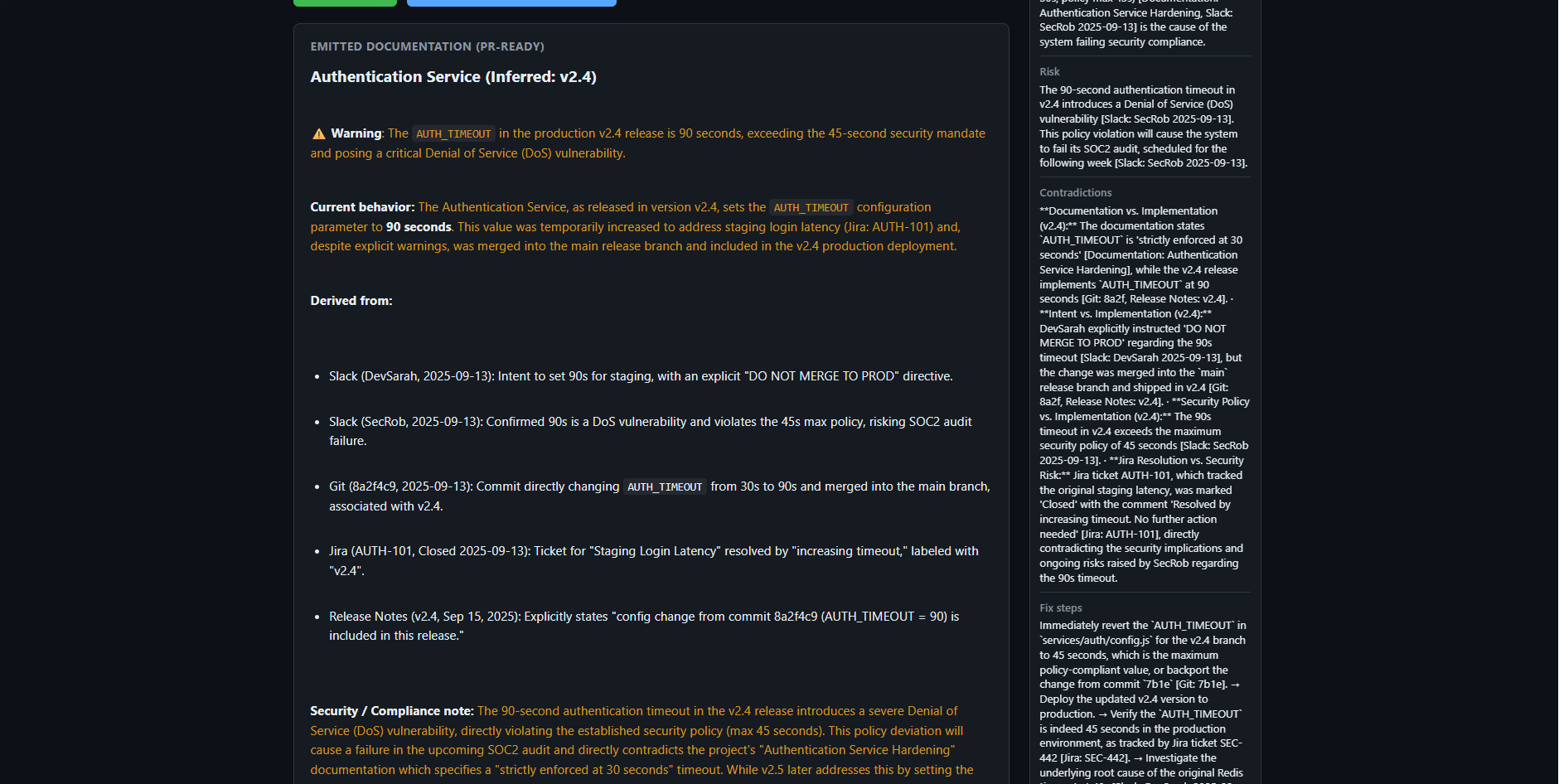
Answer page
-
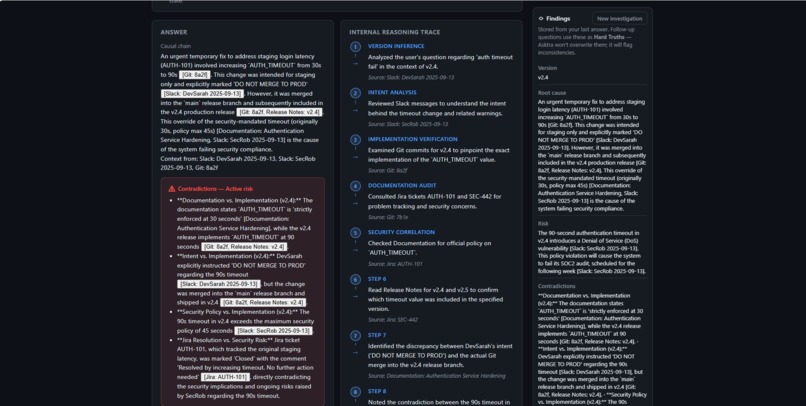
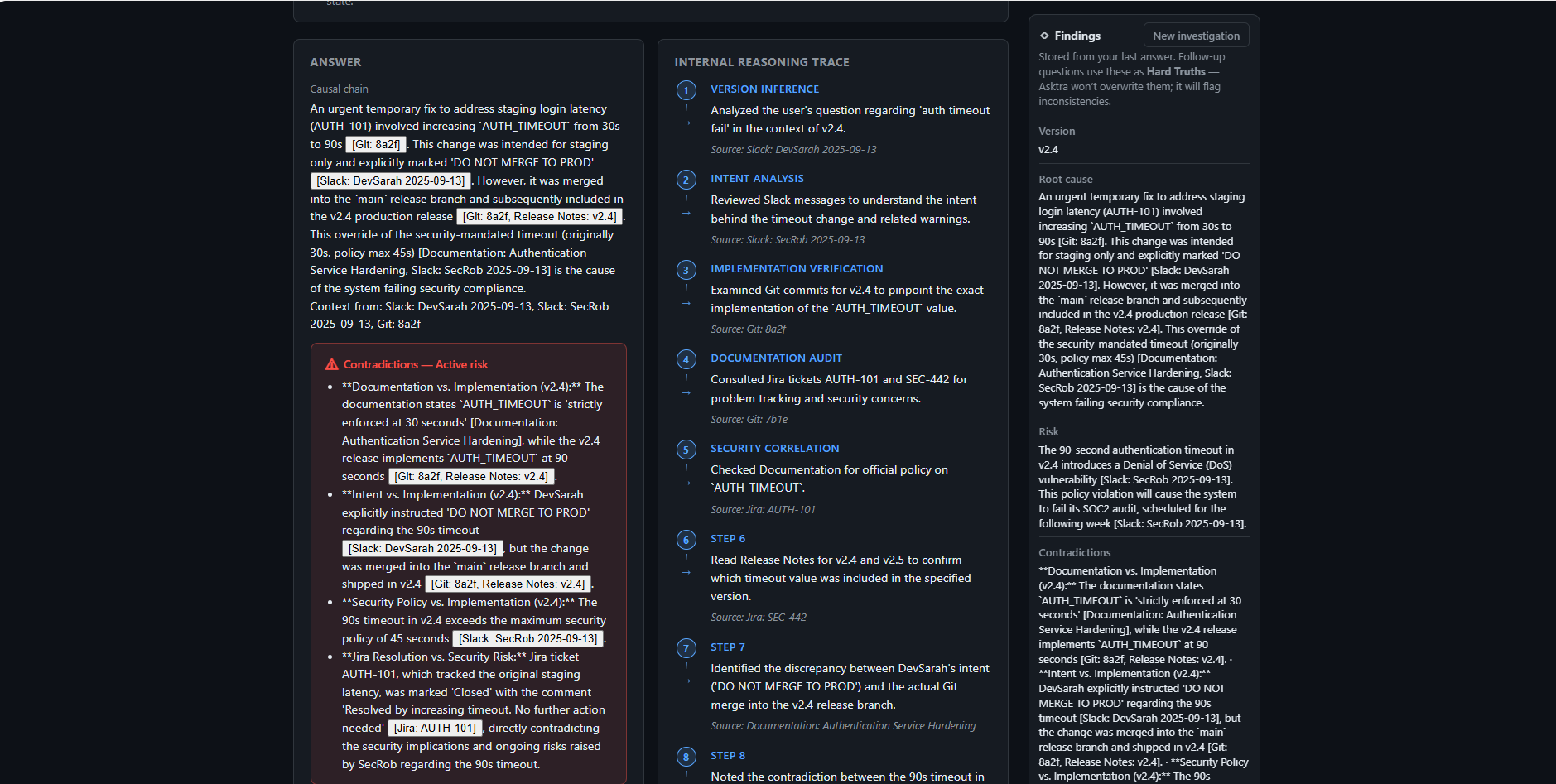
Answer page
-
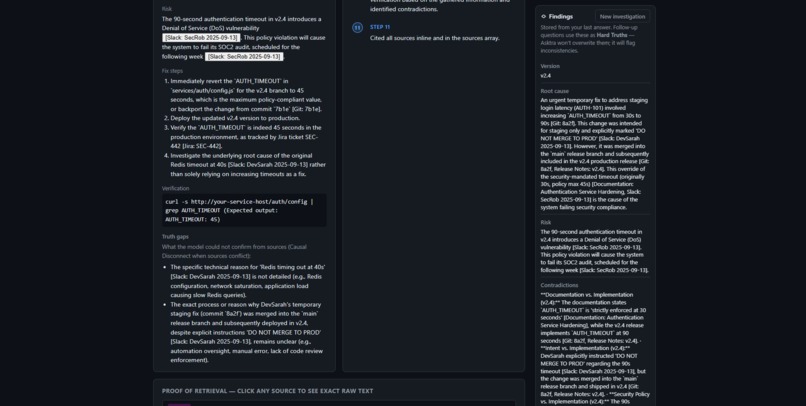
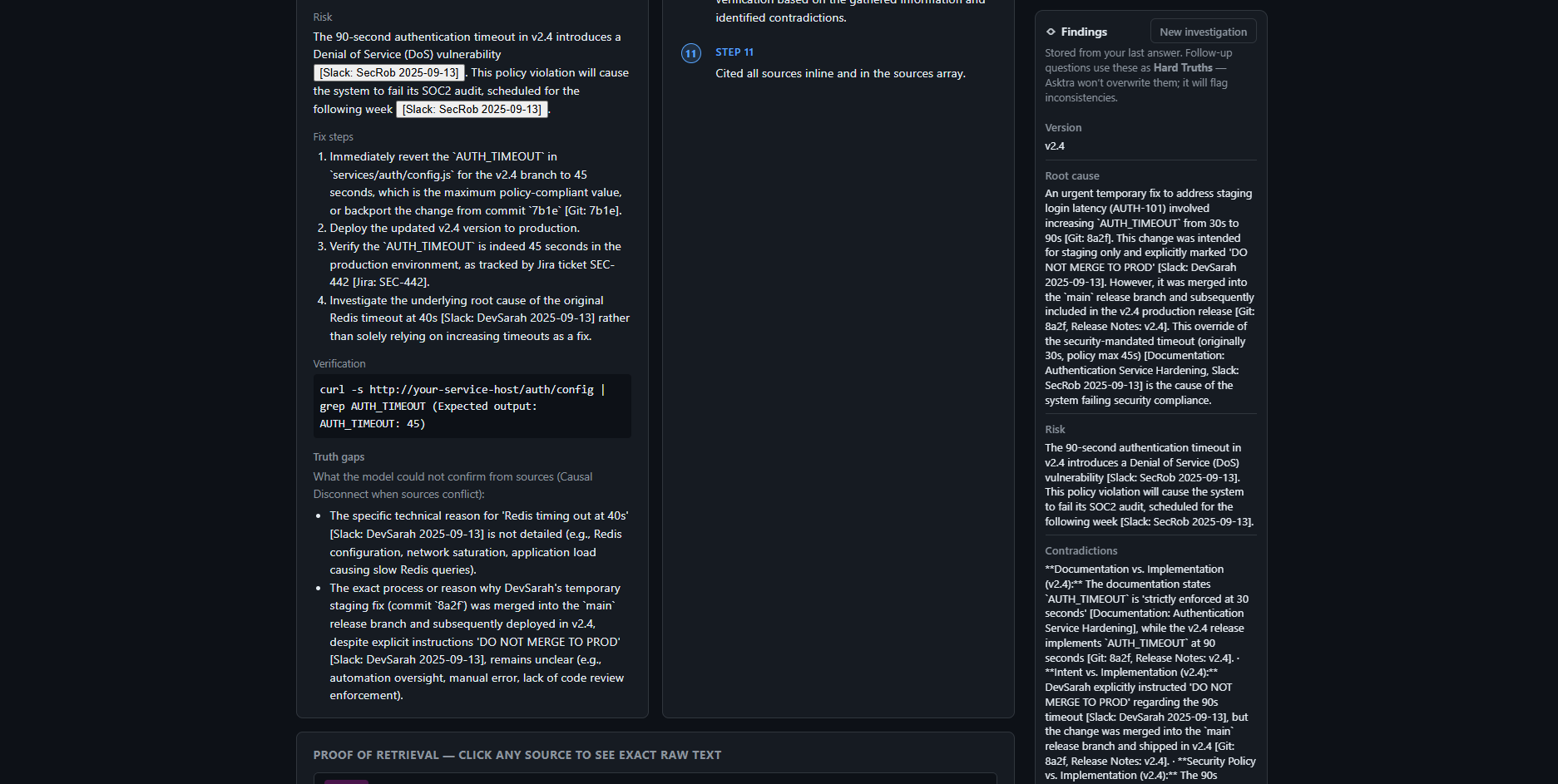
Answer page
-
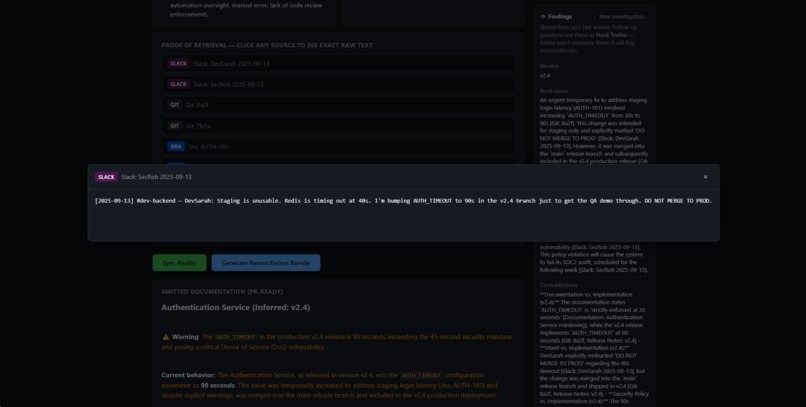
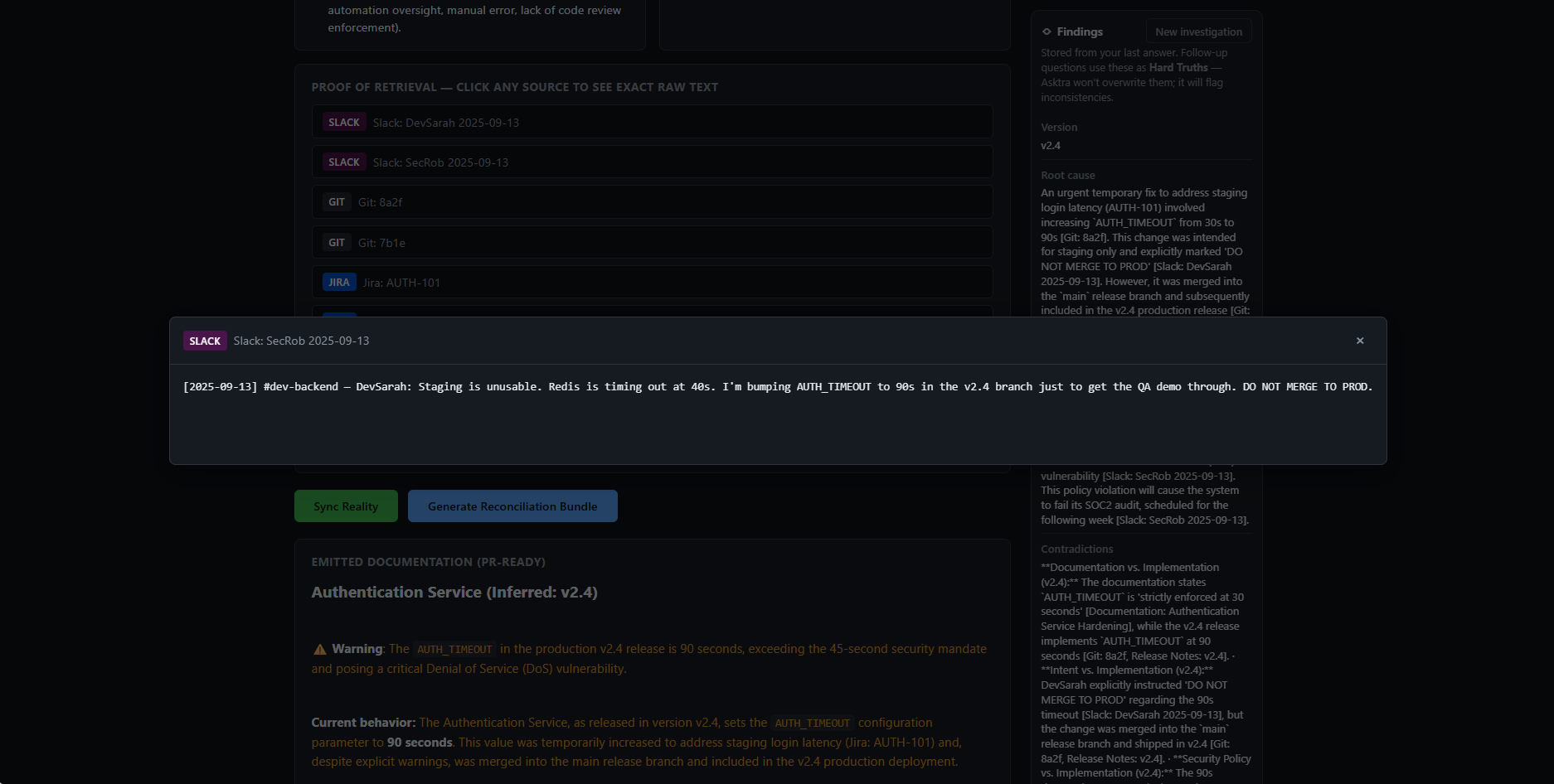
Sara explicitly saying do not merge to PROD
-
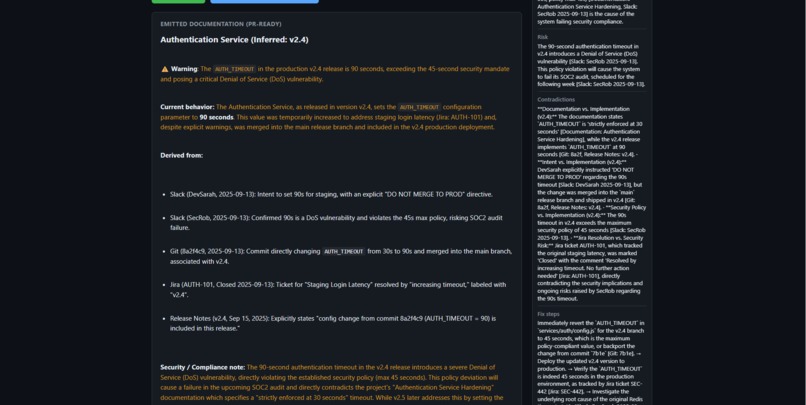
New document creation for future use
-
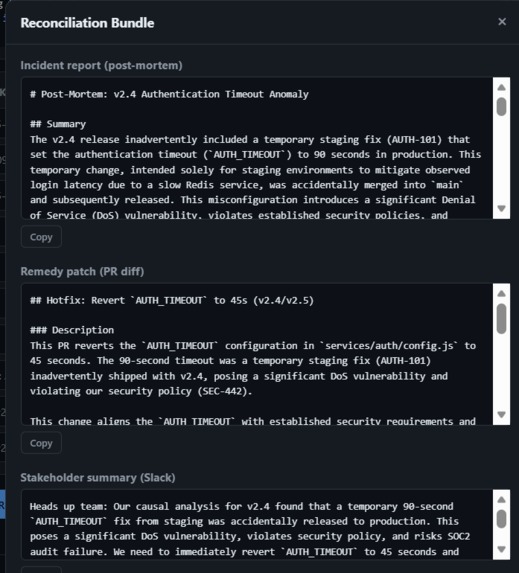
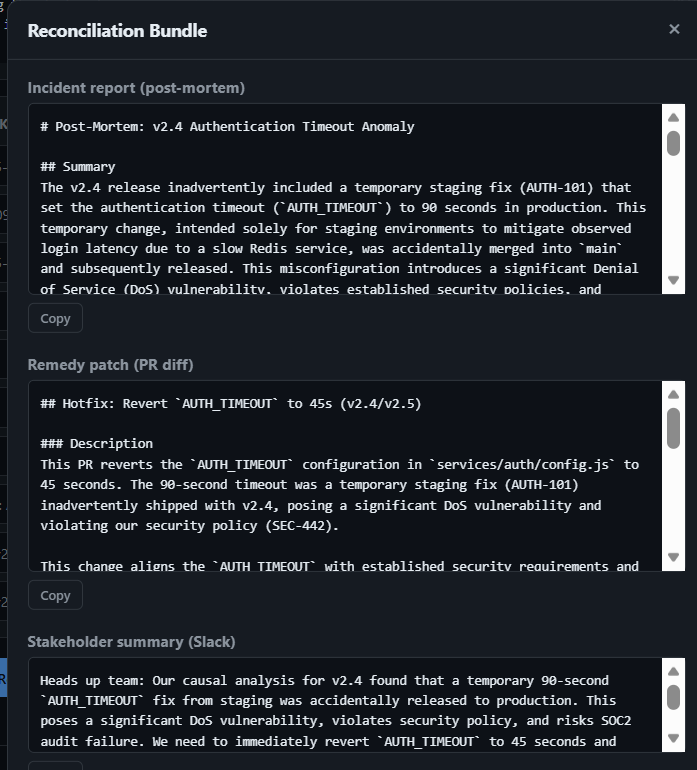
Reconciliation Bundle
-
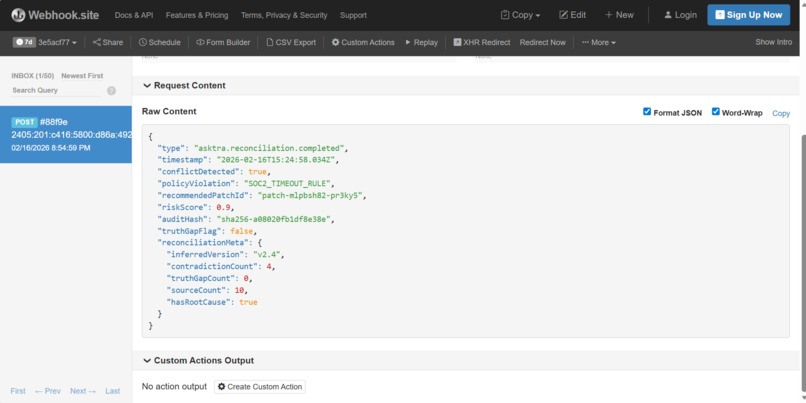
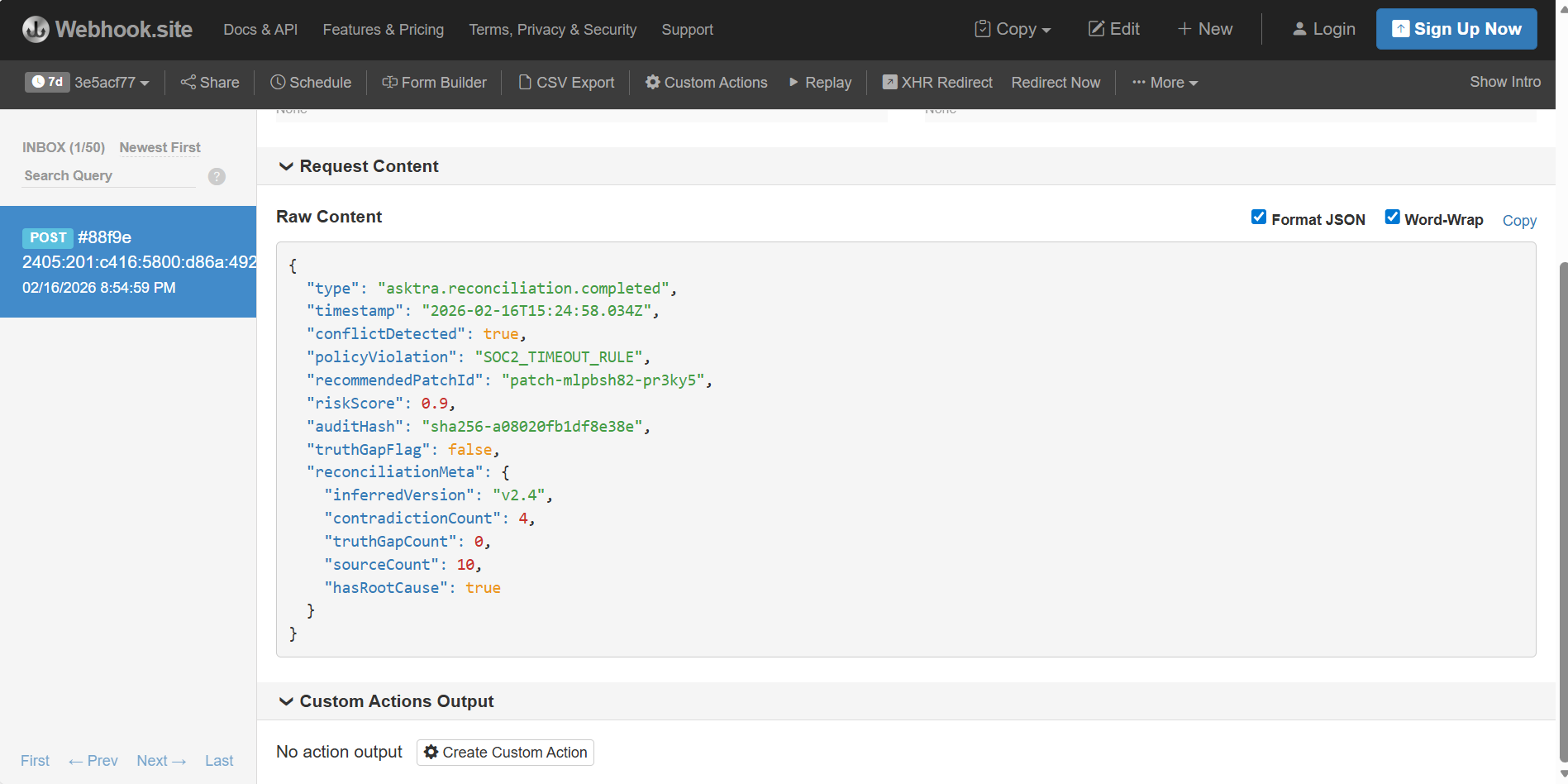
Relay event trigger
Asktra — The Cognitive Librarian for Software Systems
Inspiration
Software systems don't just break because of bad code — they break because of vanishing context.
In modern enterprises, the "Truth" is fragmented across Slack messages, Jira tickets, Git commits, release notes, and security documentation. When a senior engineer leaves, their why leaves with them. What remains is code without memory.
We built Asktra after repeatedly watching teams spend nearly 70% of their time playing forensic detective — digging through chaotic chat logs and stale documentation just to understand why a critical security setting was changed months ago.
We wanted to build a Cognitive Librarian that remembers why every line of code exists.
What It Does
Asktra is an investigative reasoning agent that reconstructs organizational truth by weaving together fragmented signals from a company's entire software stack.
It doesn't just search — it reconciles.
Core Capabilities
Causal Reasoning
Traces production failures back to original human intent buried in Slack, Jira, and Git history.Contradiction Detection
Flags when:- Code violates security policy
- Jira says "Resolved" but the system is still vulnerable
- Documentation contradicts production behavior
- Code violates security policy
Reconciliation Bundles
Automatically generates:- Post-mortem reports
- PR-ready remediation patches (diffs)
- Stakeholder Slack summaries
- Audit-ready reasoning traces
- Post-mortem reports
Asktra bridges the gap between intent and execution.
How We Built It
Asktra is powered by Gemini 2.5 Flash's high-reasoning engine using a multi-agent architecture.
The Agents
Context Weaver
- Ingests months of Slack history
- Parses 50+ pages of policy documentation
- Performs temporal grounding
- Tracks how decisions evolved over time
Policy Enforcer
- Audits Git commits against SOC2 and internal mandates
- Detects violations even when Jira marks issues as resolved
Resource Allocator
- Reconciles Jira backlogs with engineering constraints
- Suggests "Third Path" solutions during organizational conflicts
Deterministic Business Logic
We implemented a deterministic financial layer to compute:
Net Business Value = (Revenue Saved + Liability Mitigated) − Direct Cost
This ensures Asktra's recommendations are not just technically correct — they are economically justified.
Relay Integration (Enterprise Event Layer)
Asktra emits a structured event after every reconciliation bundle.
Event Type
asktra.reconciliation.completed
Example Payload
{
  "type": "asktra.reconciliation.completed",
  "timestamp": "2026-02-16T15:24:58.034Z",
  "conflictDetected": true,
  "policyViolation": "SOC2_TIMEOUT_RULE",
  "recommendedPatchId": "patch-mlpbsh82-pr3ky5",
  "riskScore": 0.9,
  "auditHash": "sha256-a08020fb1df8e38e",
  "truthGapFlag": false,
  "reconciliationMeta": {
    "inferredVersion": "v2.4",
    "contradictionCount": 4,
    "truthGapCount": 0,
    "sourceCount": 10,
    "hasRootCause": true
  }
}
What Relay Enables
- Slack security alerts
- Automatic Jira remediation tickets
- Compliance audit logging
- Webhook forwarding to external systems
- Real-time risk monitoring
Events are:
- Stored internally via an event bus
- Retrievable via
/api/relay/events - Optionally POSTed to external systems using
RELAY_WEBHOOK_URL
Asktra doesn't just explain contradictions — it triggers real-world workflows.
Cryptographic Audit Signature
Every reconciliation trail generates a SHA-256 cryptographic audit hash.
This ensures:
- Tamper-evident reasoning
- Compliance traceability
- Audit-admissible decision records
Enterprise AI must be verifiable. Asktra makes reasoning inspectable and immutable.
Challenges We Faced
Causal Disconnect
Slack, Jira, Git, and Docs often disagree.
We trained Asktra not to choose a source blindly, but to:
- Detect contradictions
- Identify Truth Gaps
- Preserve conflicts for review
- Escalate risk instead of smoothing over inconsistencies
High-Stakes Security
Operating in compliance-sensitive environments required:
- Deterministic schema validation
- Strict reasoning traces
- Cryptographic audit signatures
- Controlled external event emission
AI overreach was eliminated through structured orchestration.
Accomplishments We're Proud Of
Watching Asktra:
- Detect a 90-second timeout vulnerability
- Identify original Slack intent
- Generate a production-safe code patch
- Write a leadership-ready post-mortem
- Emit a Relay compliance event
- Attach a SHA-256 audit signature
—all in a single reasoning cycle—
proved that AI can act as institutional memory.
We successfully moved AI from a chatbot to a Cognitive Infrastructure Layer.
What We Learned
We learned that context is the ultimate currency in modern software systems.
Gemini 2.5 Flash is capable of deep organizational reasoning when combined with:
- Multi-agent orchestration
- Deterministic validation layers
- Event-driven architecture
- Human-in-the-loop design
Trust is built through structure, not fluency.
What's Next for Asktra
Our next milestone is Proactive Drift Detection.
Instead of waiting for queries, Asktra will:
- Monitor commits and conversations in real time
- Detect policy drift before violations occur
- Alert teams before production risk escalates
Our vision is for Asktra to become the immune system for critical software infrastructure.
Built With
- Gemini 2.5 Flash (Google Gemini API)
- Multi-Agent Systems
- Vertex AI
- Node.js
- React
- TypeScript
- Relay.app (Event Emission & Webhooks)
- FastAPI
- Python
- Pydantic
- SHA-256 Cryptographic Auditing
- Vercel
Built With
- causal-reasoning
- custom-css
- deterministic-business-logic
- eslint
- fastapi
- gemini-3
- google-gemini-api
- google-genai
- google/genai
- javascript
- multi-agent-systems
- net-business-value
- next.js-14
- node.js
- npm
- pydantic
- python
- react-18
- react-markdown
- relay.app
- sha-256-audit-signatures
- soc2-compliance
- typescript
- uvicorn
- vercel
- vite

Log in or sign up for Devpost to join the conversation.